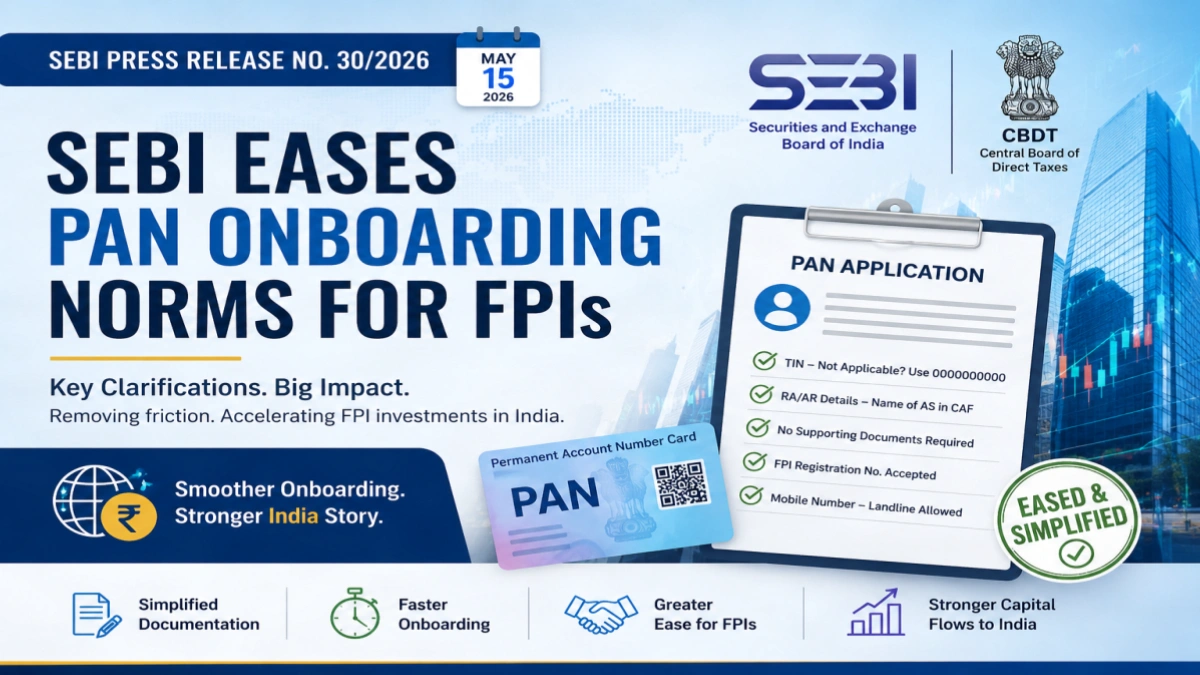
SEBI and CBDT Work Together to Fix FPI Onboarding Problems — What Changed and Why It Matters
India wants more foreign capital in its securities markets — but in early 2026, it was the paperwork that got in the way. On May 15, 2026, the Securities and Exchange Board of India (SEBI) issued Press Release No. 30/2026 announcing a set of important clarifications by the Central Board of Direct Taxes (CBDT) that directly address the PAN allotment roadblocks being faced by Foreign Portfolio Investors (FPIs) trying to register and invest in India.
The problem started in March 2026, when CBDT notified the new Income-tax Rules, 2026 along with completely revised PAN application forms. These updated forms added several new mandatory fields — including Taxpayer Identification Numbers (TINs) and details of Representative Assessees/Authorised Representatives — that were either not applicable to FPIs from many countries, or were practically impossible for them to provide. The result was a growing backlog of FPI onboarding cases stuck at the PAN application stage.
SEBI stepped in, engaged directly with CBDT, and secured a series of practical relaxations. This article explains the full background, what the problem was, what was changed, and what it means for FPIs and India's capital markets.
📋 At a Glance — SEBI Press Release No. 30/2026
Key Numbers in Context
Background: What Is the Common Application Form (CAF) and Why Is PAN So Important for FPIs?
Before understanding the problem, it helps to understand how foreign portfolio investors register and start investing in India. Unlike domestic investors who can open a trading account fairly quickly, FPIs go through a multi-step, multi-authority onboarding process that involves several Indian regulators and institutions simultaneously.
To reduce this complexity, SEBI introduced the Common Application Form (CAF) — a single integrated form through which an FPI can simultaneously accomplish four critical requirements:
SEBI Registration
FPI registration as a market participant under SEBI (Foreign Portfolio Investors) Regulations, 2019
Bank Account
Opening of a bank account in India for receiving and remitting investment proceeds
Demat Account
Opening of a dematerialized account with NSDL or CDSL to hold Indian securities electronically
PAN Application
Application for Permanent Account Number (PAN) from the Income Tax Department, mandatory for all market transactions in India
The CAF was a significant achievement in regulatory coordination — one form, one submission, four outcomes. But its integrated nature also means that a problem with any one component — like PAN — can block the entire onboarding process. An FPI cannot trade in Indian markets until all four elements are in place.
💡 Why PAN Is Not Optional for FPIs
PAN is the master identifier used by India's tax system and is mandatory for all financial transactions above specified thresholds. For FPIs, PAN is required for: executing trades on Indian stock exchanges, filing tax returns on Indian income (dividends, capital gains), TDS (tax deducted at source) credit claims, and regulatory reporting. Without PAN, an FPI is effectively locked out of the Indian market.
What Went Wrong: The March 2026 PAN Form Changes That Created a Bottleneck
On March 20, 2026, CBDT notified the new Income-tax Rules, 2026 along with completely overhauled PAN application forms. These changes were well-intentioned — designed to improve tax compliance, strengthen KYC (Know Your Customer) norms, and plug gaps in the existing PAN registration system for foreign entities.
However, the new forms introduced requirements that, while reasonable for domestic applicants or foreign companies from certain jurisdictions, created serious practical difficulties for FPIs from many countries. Three major changes caused problems:
⚠ The Three Problem Areas in New March 2026 PAN Forms
- 1. Taxpayer Identification Number (TIN) became mandatory: Many countries — particularly in the Middle East, certain offshore financial centres, and smaller jurisdictions — either do not issue TINs equivalent to India's PAN, or their TIN systems are structured very differently. FPIs from these countries had no TIN to provide, and the form did not allow the field to be left blank or marked as "not applicable."
- 2. Representative Assessee / Authorised Representative (RA/AR) details required: The new forms required detailed information about the RA/AR including name, address, contact details, and identity documents (PAN, Aadhaar, or passport number). For FPIs — which are typically institutional entities — the concept of a Representative Assessee is complex. Getting and verifying all the required details for the authorised signatory created significant delays, and the requirement for supporting documents added further bureaucratic burden.
- 3. Mobile number made mandatory: Previously optional, the mobile number field was made compulsory. FPIs — being foreign entities — often do not have Indian mobile numbers, and providing a foreign number raised further procedural questions about format and verification.
The industry response was quick and concerned. FPI custodians, depositories, and market intermediaries flagged these issues to SEBI, noting that the changes were creating a growing backlog of FPI onboarding cases that could not proceed past the PAN application stage. Given that India has been actively courting foreign investment and positioning itself as a preferred destination for global capital, this was an unacceptable friction point.
📝 SEBI's Response — Direct Engagement with CBDT
Rather than wait for the situation to escalate, SEBI took proactive action. In SEBI's own words: "In view of several difficulties expressed by concerned stakeholders in furnishing such information by FPIs, SEBI actively engaged with CBDT to facilitate continued ease of allotment of PAN to FPIs." This cross-regulatory coordination — between SEBI (capital markets) and CBDT (taxation) — demonstrates the collaborative approach India's regulators are taking to resolve investor pain points promptly.
The Six CBDT Clarifications — Full Detail
Following SEBI's engagement, CBDT issued a set of practical clarifications that directly address each of the identified pain points. Here is every clarification explained simply:
Authorised Signatory Name Sufficient for RA/AR Field
The name of the Authorised Signatory (AS) as already captured in the Common Application Form (CAF) will be accepted as sufficient for the Representative Assessee / Authorised Representative (RA/AR) field in the PAN application. No separate identification of a different RA/AR is required.
No Supporting Documents for the Authorised Signatory
No supporting documents related to the Authorised Signatory, Representative Assessee, or Authorised Representative will be required to be submitted along with the PAN application. The CAF itself serves as the document basis. The liability of the AS named in the RA/AR field is solely limited to the purpose of applying for PAN.
Contact Details — Use AS Details If Available, Else FPI Details
FPIs may provide the Authorised Signatory's address, mobile number, landline number, and email ID — if available. If these details are unavailable for the AS, the corresponding contact details of the FPI itself may be submitted in their place. This ends the mandatory requirement to provide AS-specific contact details.
Identity Documents — FPI Registration Number Accepted as Alternative
If the PAN, Aadhaar, or Passport Number of the Authorised Signatory are available, they may be furnished. However, if these identity details are not available, the FPI's own SEBI registration number can be provided as an alternative identifier. This removes a significant blocker for FPIs whose authorised signatories are based in jurisdictions where obtaining these specific Indian or internationally recognised IDs is not possible.
TIN Not Applicable — Enter "0000000000"
For jurisdictions where a Taxpayer Identification Number (TIN) is not issued or is not applicable, FPIs may now enter "0000000000" (ten zeros) in the TIN field of the PAN application form. This simple but important clarification unblocks the application for FPIs from countries that do not operate TIN systems equivalent to India's.
Landline Number Accepted Where Mobile Unavailable
Since FPIs are foreign institutional entities, they may not have Indian mobile numbers. CBDT has clarified that FPIs may provide a landline number in cases where a mobile number is unavailable. This removes the practical impossibility created by making mobile numbers mandatory for foreign entities.
Before vs. After — Exact Changes at a Glance
How Did We Get Here — A Quick Timeline
March 20, 2026 — CBDT Notifies New Income-tax Rules, 2026
CBDT publishes the new Income-tax Rules, 2026 and revises PAN application forms. New mandatory fields introduced including TIN, RA/AR details, and mobile number. These changes apply uniformly to all PAN applicants including FPIs.
March–April 2026 — FPI Onboarding Bottleneck Emerges
FPI custodians, depositories, and market participants begin flagging difficulties. FPIs from jurisdictions without TINs, or where AS identity documents are unavailable, cannot complete the PAN application. The CAF process stalls at the PAN stage for an increasing number of foreign investors.
April–May 2026 — SEBI Engages with CBDT
SEBI, having received stakeholder representations, proactively engages with CBDT to explain the specific difficulties faced by FPIs and propose practical solutions. Cross-departmental discussions take place between the capital markets and taxation regulators.
May 15, 2026 — CBDT Issues Clarifications; SEBI Announces via PR No. 30/2026
CBDT issues six specific clarifications addressing each identified bottleneck. SEBI simultaneously publishes Press Release No. 30/2026 informing the market of the changes and the relief now available to FPIs in their PAN application process.
Why This Matters — The Bigger Picture for India's Capital Markets
This may look like a narrow, technical fix to some PAN form fields. But it has significant implications for India's position as a destination for global capital.
FPIs Are a Critical Pillar of Indian Capital Markets
Foreign Portfolio Investors consistently rank among the largest participants in Indian equity and debt markets. FPI flows significantly influence index levels, currency movements, and overall market sentiment. When FPI onboarding is delayed by paperwork issues, it directly affects investment flows, market depth, and India's reputation in the global investor community.
The CAF Is the Single Gateway — Any Block Is Total
Because the Common Application Form integrates registration, banking, demat, and PAN into a single workflow, a problem with the PAN component does not just delay PAN — it delays everything. An FPI cannot be registered with SEBI, cannot open its bank account, and cannot set up its demat account until the PAN is resolved. The March 2026 form changes had therefore created a total block on new FPI onboarding, not just a PAN delay.
🌟 What This Resolution Achieves
- Unblocks FPI onboarding cases stuck since March 2026 due to TIN and RA/AR issues
- Prevents future bottlenecks for FPIs from jurisdictions without TIN systems
- Reduces documentation burden — no supporting documents for AS/RA/AR field
- Maintains the single-form (CAF) workflow integrity — no need for separate workaround filings
- Signals strong inter-regulatory coordination between SEBI and CBDT
- Reinforces India's "ease of doing business" narrative for foreign investors
- Aligns PAN application requirements with international FPI structures and norms
SEBI's Ongoing Effort on FPI Ease of Onboarding
This press release is not a one-off intervention. SEBI has been systematically working to reduce onboarding friction for FPIs across multiple fronts. SEBI's own statement in the press release notes: "The above measures resonate with the continuous efforts towards providing ease of onboarding to FPIs."
Over the past few years, SEBI has progressively simplified FPI registration categories (from three to two categories — Category I and Category II), simplified the KYC (Know Your Customer) documentation, extended the validity of existing registrations to reduce renewal burden, allowed greater flexibility in FPI structure and beneficial ownership disclosures, and now this latest intervention with CBDT on PAN issues. Each of these steps individually makes a marginal difference, but cumulatively they create a significantly more accessible Indian market for global investors.
🌎 India's Competitive Context — Why Every Friction Point Counts
India competes with other emerging markets — including China, Indonesia, Brazil, and South Africa — for FPI allocation. When an FPI manager decides how much of their portfolio to allocate to India vs. a competitor market, operational efficiency is a real factor. A simpler, faster, less document-heavy onboarding process is a genuine competitive advantage. Conversely, avoidable friction — like a PAN form that requires TINs that don't exist in the investor's home country — can push allocation decisions in a competitor's favour. This is why SEBI's prompt action on the March 2026 issues was the right call.
Practical Guidance — What Should FPIs and Their Custodians Do Now?
If you are an FPI, a custodian bank handling FPI onboarding, a depository participant, or a designated depository institution (DDI), here is what the CBDT clarification means for you practically:
📋 Step-by-Step Practical Guidance
- If you have a pending PAN application stuck due to TIN field: Enter "0000000000" in the TIN field and resubmit or update the application.
- If the RA/AR field was a problem: Use the name of the Authorised Signatory already captured in your CAF — no separate RA/AR identification needed, no supporting documents required.
- If AS contact details are unavailable: Provide the FPI entity's own address, phone number, and email instead of the AS's personal details.
- If AS identity documents (PAN/Aadhaar/Passport) are unavailable: Use the FPI's SEBI registration number in the identity field.
- If mobile number is unavailable: Provide a landline number for the contact number field.
- For new FPI applicants going forward: Follow the clarified requirements from the outset — your CAF already captures the Authorised Signatory name which is now sufficient for the RA/AR field.
- Custodians and DDIs: Communicate these changes to all pending and prospective FPI clients immediately. Update your internal onboarding checklists and form-filling guides to reflect the CBDT clarifications.
Frequently Asked Questions (FAQs)
Conclusion: A Small Fix With a Big Signal
The SEBI Press Release No. 30/2026 may appear narrow in scope — a few tweaks to how FPIs fill out their PAN application forms. But the signal it sends is broader and more important: India's regulators are watching for friction points in the investment process, are willing to act quickly when they are identified, and are capable of coordinating effectively across departmental boundaries (SEBI and CBDT in this case) to resolve them.
For FPIs and their custodians, the immediate benefit is practical — blocked onboarding cases can now proceed, and future applications will be simpler. For India's capital markets, the benefit is reputational — yet another data point that India is a serious, investor-friendly jurisdiction that responds to market feedback with real action.
SEBI's own characterisation is apt: "The above measures resonate with the continuous efforts towards providing ease of onboarding to FPIs." Continuous is the operative word — this is not a one-time fix but part of an ongoing commitment that India must maintain if it wants to remain competitive in attracting the global capital its growth ambitions require.
🔗 Official Source
This article is based on SEBI Press Release No. 30/2026 dated May 15, 2026 – Removal of difficulties for on-boarding for FPIs – PAN allotment related issues – and corroborating coverage by leading financial news outlets.