Indian Contract Act, 1872 • Sections 124–147 • Maharashtra Article 34A
Bank Guarantee Format (India) — Free Generator
Generate an ironclad Bank Guarantee draft for tender deposits, contractual performance, or advance mobilisation payments. Includes automatic Indian number-to-words conversion, Maharashtra July 2026 Article 34A stamp duty calculator, and verified Supreme Court invocation safeguards.
Financial, Performance & Advance Payment BG OptionsUpdated: 14 October 2026 (Post-July 2026 Amendment)Word (.docx) & Print-Ready PDF
Statutory Legal Framework (Direct Answer)
What is a Bank Guarantee under Indian Law?
Under Section 126 of the Indian Contract Act, 1872, a Bank Guarantee (BG) is an independent tripartite legal instrument whereby an issuing bank (the surety) irrevocably undertakes to pay a specified monetary sum to the beneficiary (the creditor) upon default or written demand on behalf of the customer (the principal debtor). For unconditional (on-demand) guarantees, the bank’s payment commitment is completely independent of the underlying commercial dispute, and Indian courts will strictly refrain from granting injunctions against invocation except in proven cases of established fraud or irretrievable injustice.
Governing Law: Sections 124–147 Indian Contract Act, 1872; Section 128 co-extensive liability.
Maharashtra Duty: Article 34A (effective 22 July 2026): 0.1% up to ₹5L (min ₹500); 0.3% above ₹5L (max ₹20L).
Autonomous Contract: Bank cannot enquire into contract disputes under unconditional on-demand BGs.
Contract Act • Sections 124–147
Customise Bank Guarantee (BG) Draft
Guarantee Type & Nature
Guarantee Amount & Stamp Duty
Duty: ₹ 500Maharashtra Stamp Duty (Article 34A w.e.f. 22 July 2026): Flat ₹500 under Article 34A proviso (in favour of Government Corporation / Local Authority for public works / procurement).
Applicant & Beneficiary
Issuing Bank & Contract Reference
Bank Authorised Signatory
Need a custom clause? Describe it in plain words
Gemini 2.5Draft bespoke Indian-law compliant clauses & audit legal enforceability
Bank Guarantee Lifecycle & Invocation Framework
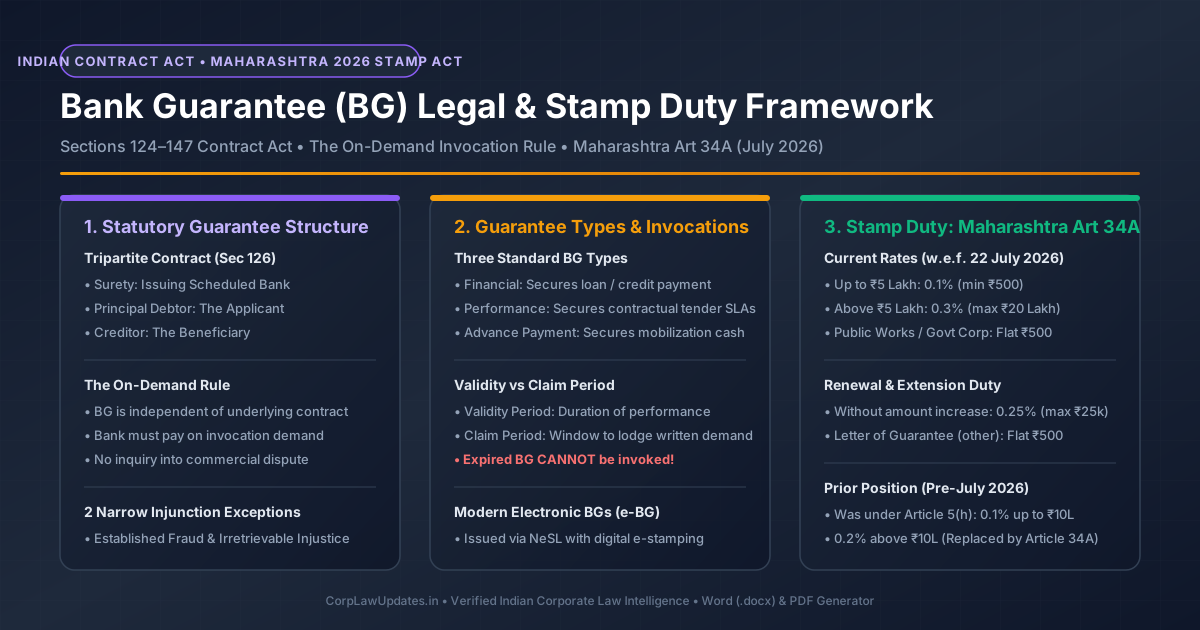
Legal Basis & Tripartite Structure under the Indian Contract Act, 1872
A Bank Guarantee is statutorily classified as a contract of guarantee under Sections 124 to 147 of the Indian Contract Act, 1872. Understanding the tripartite relationship is vital for both issuing banks and corporate beneficiaries:
1
The Principal Debtor (Applicant)
The primary contractor, vendor, or borrower whose underlying performance or payment obligation is being secured. The applicant applies to the issuing bank, provides collateral or margin money, and executes a binding counter-indemnity.
2
The Creditor (Beneficiary)
The project authority, buyer, government department, or lender in whose favour the guarantee is issued. The beneficiary holds the unilateral right to invoke the guarantee upon default without needing the applicant's concurrence.
3
The Surety (Issuing Bank)
Under Section 126, the bank acts as surety. Under Section 128, the surety’s liability is co-extensive with that of the principal debtor, but in unconditional guarantees, the bank’s undertaking is strictly primary and independent.
Types of Bank Guarantees & Their Commercial Applications
Performance Guarantee (PBG)
Secures the prompt and satisfactory completion of contractual commitments. Ubiquitous in EPC contracts, government tenders, and supply agreements. If the vendor fails to meet technical milestones or delays delivery, the buyer encashes the PBG as liquidated damages.
Financial Guarantee
Secures a direct financial repayment obligation. Used for securing loan repayment, deferred customs duty payments, judicial security deposits, or electricity board billing guarantees. The bank acts as a financial backstop.
Advance Payment Guarantee (APG)
Secures the mobilization or upfront advance funds disbursed by the project owner to the contractor. If the contractor fails to utilize the advance for project works or abandons the contract, the owner recovers the unadjusted balance immediately.
The "On-Demand" Autonomy Rule & Supreme Court Injunction Exceptions
In commercial transactions, the vast majority of bank guarantees are drafted as unconditional (on-demand) guarantees. Under settled Indian jurisprudence, an unconditional guarantee represents an autonomous and independent contract between the issuing bank and the beneficiary.
When the beneficiary issues a demand letter confirming default, the bank is legally obligated to honour the demand without reference to the applicant and without examining disputes regarding contractual performance, delay claims, or counter-claims.
The Two Exclusive Supreme Court Exceptions (Stay of Encashment)
Through a long line of landmark judgments — including U.P. State Sugar Corporation v. Sumac International Ltd. (1997), BSES Ltd. v. Fenner India Ltd. (2006), and Standard Chartered Bank v. Heavy Engineering Corporation Ltd. (2020) — the Supreme Court of India has established that courts will NOT grant an injunction restraining invocation of an unconditional bank guarantee, except under two strictly defined circumstances:
- Egregious Fraud: Fraud of an egregious nature that permeates the very foundation of the bank guarantee or the underlying contract, such that the beneficiary seeks to take fraudulent advantage of the bank, and the fraud is known to the bank. Ordinary breach of contract or disputable deductions do not constitute fraud.
- Irretrievable Injustice / Special Equities: Circumstances where encashment would result in irretrievable damage or ruinous injustice of such exceptional magnitude that it would be impossible for the applicant to be reimbursed subsequently through arbitration or a civil suit.
Critical Distinction: Validity Period vs. Claim Period
Why Expired Guarantees Cannot Be Invoked
Failure to appreciate the difference between the Validity Period and the Claim Period is the single most common cause of litigation and lost recoveries in Indian commercial contracts:
Validity Period (Performance Horizon)
The operative duration during which the contractor is required to perform the underlying works or supply the goods. Any contractual default giving rise to a claim must occur within this period.
Claim Period (Grace / Lodgement Window)
An additional window (typically 30, 60, or 90 days after validity expiry) during which the beneficiary is permitted to physically deliver its written demand letter at the issuing bank's counter. Once the claim expiry date passes, the bank’s legal liability is completely discharged under Section 28 (Exception 3) of the Contract Act.
Continuing Guarantees & Statutory Discharge of Surety
The Indian Contract Act provides comprehensive rules governing the duration and termination of surety obligations:
Continuing Guarantee (Section 129 & 130)
Under Section 129, a guarantee which extends to a series of transactions is a continuing guarantee. Under Section 130, it may be revoked by the surety as to future transactions by notice to the creditor. Standard commercial BGs contractually exclude Section 130 revocation to ensure uncompromised security.
Discharge by Variance in Terms (Section 133–139)
Under Section 133, any material variance made without the surety's consent in the terms of the underlying contract discharges the surety as to transactions subsequent to the variance. Similarly, release of principal debtor (Sec 134) or compromise (Sec 135) discharges the surety unless contractually waived.
Stamp Duty on Bank Guarantees — Maharashtra July 2026 Amendment (Article 34A)
Stamp duty is an exclusive State subject under Entry 44 of the Concurrent List (Seventh Schedule of the Constitution of India). In Maharashtra, the Maharashtra Stamp (Fourth Amendment) Act, 2026 (notified on 22 July 2026) created a dedicated statutory regime by inserting Article 34A into Schedule I, superseding the earlier Article 5(h) treatment:
| Guarantee Category / Amount | Current Duty (Article 34A, Post-22 July 2026) | Prior Duty (Article 5(h), Pre-July 2026) |
|---|---|---|
| Up to ₹5,00,000 | 0.1% of secured amount (Minimum ₹500) | 0.1% up to ₹10 Lakh (Minimum ₹100) |
| Exceeding ₹5,00,000 | 0.3% of secured amount (Maximum ₹20 Lakh) | 0.2% above ₹10 Lakh |
| In favour of Government / Local Body for Public Works / Procurement | ₹500 flat concession | Standard ad-valorem rate |
| Renewal / Extension without Amount Enhancement | 0.25% of secured amount (Maximum ₹25,000) | Re-stamped as fresh instrument |
| Letter of Guarantee (other than above) | ₹500 flat | ₹100 flat |
State Variation Notice: Rates for other states (such as Delhi, Karnataka, Tamil Nadu, and Uttar Pradesh) differ substantially. In Delhi, bank guarantees are generally stamped under Article 37 (Letter of Guarantee); in Karnataka, Article 30 applies. Always verify rates against the specific Stamp Act of the state where the guarantee is executed or received.
Electronic Bank Guarantees (e-BGs) via NeSL Platform
In recent years, the Ministry of Finance and major public sector banks (including SBI, PNB, and Bank of Baroda) have transitioned towards Electronic Bank Guarantees (e-BGs) administered via the NeSL (National E-Governance Services Ltd.) platform:
Instant Digital Stamping
Automated e-stamping integrated with State Stamp Treasuries eliminates physical stamp paper procurement and fraud.
Digital Signature (DSC)
Executing bank officers sign electronically via Class-3 DSC; verified directly against the NeSL registry.
Zero Courier Delays
Beneficiaries receive instantaneous, cryptographically verified e-BG records, accelerating tender execution.
Checklist for a Water-Tight Bank Guarantee Draft
- Issuing Branch & Operative Counter: Exact branch address where demands must be physically lodged.
- Full Party Details: Official corporate names, registered offices, and CIN / PAN of applicant and beneficiary.
- Guarantee Amount in Words & Figures: Unambiguous monetary ceiling in Indian Rupees.
- Contract / Tender Reference: Precise LoA / tender number, agreement date, and subject matter.
- Explicit On-Demand Covenant: Bank agrees to pay upon beneficiary’s first written demand without contest.
- Distinct Validity & Claim Expiry Dates: Explicit calendar cutoff dates for performance and claims.
- Exclusion of Section 130: Waiver of applicant's right to revoke the guarantee.
- Execution by Authorised Signatories: Bank officer power-of-attorney numbers (P.A. codes) and seal.
Practical 5-Step Bank Guarantee Invocation Procedure
1
Step 1: Draft Formal Demand Letter on Beneficiary Letterhead
Draft a formal invocation letter citing the BG Number, issue date, guaranteed sum, and a statement that the applicant has committed default under the underlying contract. Ensure the demand complies verbatim with the invocation clause.
2
Step 2: Lodge Demand Within Validity and Claim Window
Deliver the demand letter in person via authorised representative or via registered speed post at the designated bank branch before the close of banking hours on or before the claim expiry date. Obtain an official stamp and acknowledgement receipt.
3
Step 3: Bank Scrutiny of Demand Notice
The bank’s trade finance team verifies that the demand is received within the claim period, is signed by an authorised officer of the beneficiary, and correctly cites the BG particulars.
4
Step 4: Immediate Remittance to Beneficiary
For unconditional guarantees, the bank remits the claimed amount via RTGS or demand draft. The bank does not request permission from the applicant or await adjudication of underlying contractual disputes.
5
Step 5: Bank Recovers from Applicant under Counter-Indemnity
Following pay-out, the bank exercises its right of set-off by debiting the applicant’s margin account, cash credit limit, or liquidating pledged fixed deposit receipts (FDRs) under the counter-indemnity agreement.
Related Trade Finance & Corporate Instruments
Frequently Asked Questions on Bank Guarantees
Clear, authoritative guidance on Indian Contract Act provisions, stamp duty amendments, and court precedents:
What is the difference between a performance guarantee and a financial guarantee?▼
A financial guarantee secures a direct monetary payment obligation (e.g. loan repayment, deferred customs duties, or advance recovery). A performance guarantee secures the timely and satisfactory completion of contractual deliverables (e.g. EPC works, turnkey projects, or tender obligations). Both are tripartite contracts of guarantee governed by Sections 126–147 of the Indian Contract Act, 1872.
Can a bank refuse to pay when a guarantee is invoked?▼
For an unconditional (on-demand) guarantee, no. The bank’s commitment to the beneficiary is autonomous and independent of underlying contractual disputes. The bank must honour a formally compliant demand. The Supreme Court of India recognises only two narrow exceptions where courts may grant an injunction against encashment: established egregious fraud known to the bank, and irretrievable injustice/special equities.
What is the stamp duty on a bank guarantee in Maharashtra?▼
Under Article 34A of the Maharashtra Stamp Act (inserted by the Maharashtra Stamp (Fourth Amendment) Act, 2026, notified 22 July 2026): (1) 0.1% of the amount secured (minimum ₹500) for guarantees up to ₹5 Lakh; (2) 0.3% of the amount secured (maximum ₹20 Lakh) for guarantees exceeding ₹5 Lakh; (3) ₹500 flat for guarantees executed in favour of a Government Corporation, Local Authority, or Statutory Body for public works or public procurement; (4) 0.25% (maximum ₹25,000) for renewals or extensions without enhancement.
What happens if the guarantee expires before invocation?▼
An expired guarantee cannot be legally invoked after the stated validity period and claim period have lapsed. Once the claim expiry date passes, the issuing bank’s liability is automatically extinguished, and the beneficiary forfeits the right to encash the guarantee. Failure to lodge a formal claim within the claim window is the single most common cause of failed BG invocations.
Is an e-bank guarantee valid?▼
Yes. Electronic bank guarantees (e-BGs) issued via National E-Governance Services Ltd. (NeSL) are fully recognised and legally enforceable under Indian law. They integrate digital stamping, electronic signatures (DSC), and direct depository messaging, eliminating the transmission delays, stamp paper custody challenges, and physical verification risks of paper guarantees.
Who are the three parties to a bank guarantee?▼
A bank guarantee involves three statutory parties under Section 126 of the Indian Contract Act, 1872: (1) The Principal Debtor (Applicant) on whose behalf the guarantee is issued; (2) The Creditor (Beneficiary) in whose favour the guarantee is executed; and (3) The Surety (Issuing Bank) who undertakes to pay the guaranteed amount upon default or formal demand.
Does the bank investigate the underlying dispute before paying?▼
No. In an unconditional or on-demand bank guarantee, the issuing bank is legally barred from adjudicating underlying contract claims, delay penalties, or quality disputes between the applicant and beneficiary. The bank must pay immediately upon presentation of a written demand complying with the guarantee terms, and subsequently recover the sum from the applicant under the counter-indemnity.
Disclaimer: This free Bank Guarantee draft generator and legal compliance guide are provided for informational and educational purposes only. Bank guarantee texts, margin requirements, counter-indemnities, and sanction terms are subject to the internal credit policies of the issuing bank and specific tender conditions. Parties should obtain professional legal counsel from an advocate or banking law specialist before executing commercial guarantees.