Companies Act, 2013 • Sections 149, 152, 161 & Schedule IV
Director Appointment Letter Format (India) — Free Generator
Generate a formal Letter of Appointment for Directors and Independent Directors under the Companies Act, 2013. Customise tenures, remuneration, committee mandates, and access a comprehensive 30-day MCA compliance checklist with Form DIR-2, DIR-12, and MBP-1 requirements.
Schedule IV Code for Independent Directors IncludedVerified: 14 October 2026Word (.docx) & Print-Ready PDF
Statutory Compliance Summary (Direct Answer)
What is a Director Appointment Letter under Indian Law?
A Director Appointment Letter is an official corporate charter issued on the company's letterhead formalizing the engagement, roles, fiduciary responsibilities, and remuneration terms of a newly inducted director. Under Schedule IV of the Companies Act, 2013, issuing a formal appointment letter is a statutory prerequisite for Independent Directors. For private and public limited companies appointing Additional Directors or Executive Directors, it defines the contractual relationship, sitting fees, and indemnities, establishing clear documentation before filing Form DIR-12 with the Registrar of Companies (ROC).
Pre-requisite: DIN (Sec 153) + Form DIR-2 written consent (Sec 152(5)) mandatory before appointment.
ROC Deadline: File Form DIR-12 within 30 days of appointment date (Sec 170(2)).
No Stamp Paper: Issued on company letterhead — no non-judicial stamp paper required.
Companies Act, 2013 Engine
Customise Director Appointment Letter
Issuing Company Details
Director Appointee Details
Appointment Terms & Fiduciary Governance
Need a custom clause? Describe it in plain words
Gemini 2.5Draft bespoke Indian-law compliant clauses & audit legal enforceability
Director Appointment & MCA Filing Lifecycle
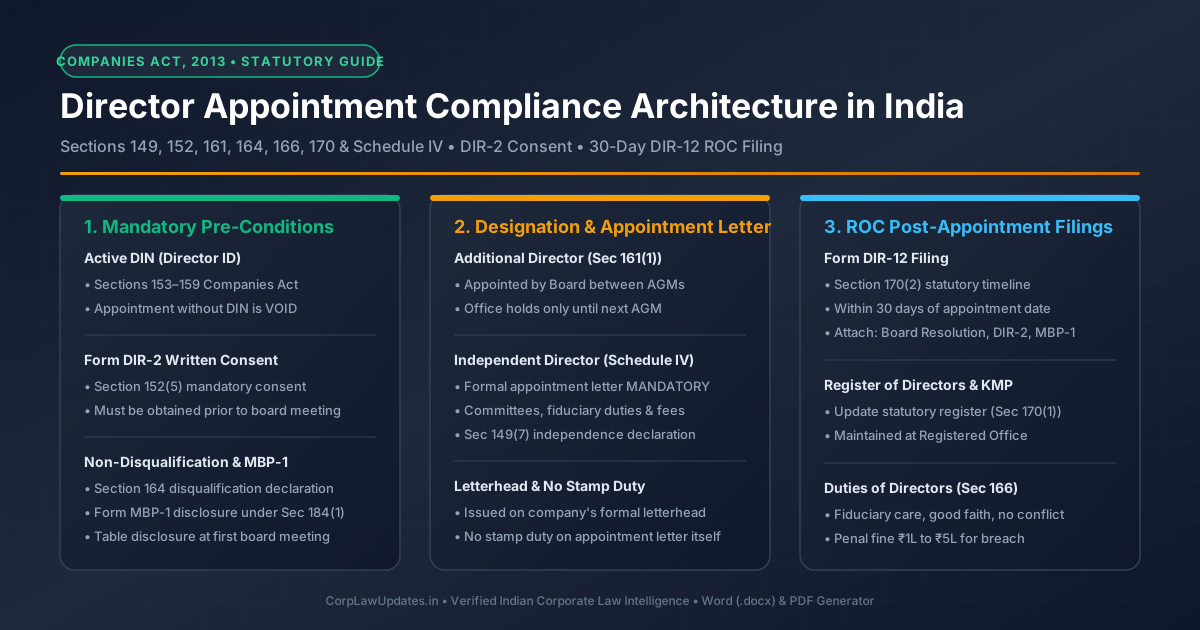
Mandatory Pre-Conditions for Appointing a Director
Under the Companies Act, 2013, the Board of Directors cannot pass a resolution or issue an appointment letter without satisfying these non-negotiable statutory requirements:
1. Valid Director Identification Number (DIN)
Under Sections 153 to 159, every individual proposed to be appointed as a director must hold an active Director Identification Number (DIN) allotted by the Ministry of Corporate Affairs (MCA). An appointment made without a valid DIN is legally void ab initio.
2. Form DIR-2 Written Consent (Section 152(5))
Under Section 152(5) and Rule 8 of the Companies (Appointment and Qualification of Directors) Rules, 2014, the appointee must execute and furnish a written consent to act as director in Form DIR-2 prior to the date of appointment.
3. Non-Disqualification Declaration (Section 164)
The director must declare in writing in Form DIR-8 that they are not disqualified under Section 164(1) or Section 164(2) (e.g. not undischarged insolvent, no court conviction, and not a director of a defaulting company failing to file annual returns for 3 consecutive years).
4. Disclosure of Interest in Form MBP-1 (Section 184(1))
Under Section 184(1), the incoming director must disclose their concern or interest in other companies, bodies corporate, firms, or associations in Form MBP-1 at the first Board meeting in which they participate as a director.
Post-Appointment ROC Filings & Statutory Compliance Checklist
1
File Form DIR-12 with ROC within 30 Days (Section 170(2))
The company must file an electronic return in Form DIR-12 on the MCA V3 portal within 30 calendar days of the appointment. Attachments include: (a) Certified true copy of the Board Resolution, (b) Form DIR-2 consent, (c) Formal Letter of Appointment, and (d) Section 164 declaration. Late filing attracts compounding additional fees.
2
Update Register of Directors and Key Managerial Personnel (Section 170(1))
Enter the particulars of the newly appointed director (DIN, PAN, residential address, nationality, date of birth, date of board resolution, and shares held in the company) in the statutory Register of Directors and KMP maintained at the registered office.
3
Form MGT-14 Verification Note (Section 117(3))
Note: In private limited companies, the appointment of an ordinary director or additional director under Section 161 is generally NOT a matter covered under Section 117(3), and therefore Form MGT-14 is not required. However, if the appointment involves a Managing Director, Whole-time Director, or key managerial personnel in a public company, Form MGT-14 must be filed within 30 days.
Additional Director (Section 161(1)) vs Regular Director vs Independent Director
| Category | Appointing Authority | Tenure in Office | Governing Provision |
|---|---|---|---|
| Additional Director | Board of Directors | Holds office up to the next AGM or due date of AGM | Section 161(1) |
| Regular Director | Shareholders in General Meeting | As per Articles / rotational or non-rotational term | Section 152(2) |
| Independent Director | Shareholders (on Board recommendation) | Up to 5 consecutive years; max 2 consecutive terms | Section 149(10) & Schedule IV |
Fiduciary Duties (Section 166) & Stamp Duty Clarification
Fiduciary Duties Codified under Section 166
Section 166 of the Companies Act, 2013 imposes strict statutory duties upon all directors:
- Act in accordance with the company's Articles of Association.
- Act in good faith to promote the objects of the company for its members and community.
- Exercise due and reasonable care, skill, and independent judgment.
- Avoid any conflict of interest; make no undue personal gain or advantage.
- Never assign the office of director — any assignment made is void.
Breach of Section 166 attracts a mandatory statutory fine of ₹1 Lakh to ₹5 Lakh.
Stamp Paper: Why None is Required for the Letter
Unlike commercial deeds (such as Form SH-4 Share Transfer Deeds or Partnership Deeds), a Director Appointment Letter is NOT an instrument chargeable with stamp duty under State Stamp Acts.
The appointment letter is an official executive communication issued on the formal letterhead of the company signed by an authorized director or company secretary.
Statutory filing fees and ROC stamp fees apply exclusively to the online filing of Form DIR-12 on the MCA portal, not to the underlying physical letterhead appointment letter.
Related Corporate Secretarial Documents & Resolutions
Frequently Asked Questions about Director Appointments
Clear, authoritative answers based on the Companies Act, 2013 and MCA guidelines:
Is DIR-2 consent mandatory before appointing a director?▼
Yes. Section 152(5) requires the appointee’s written consent in Form DIR-2; the company must file it with the ROC within 30 days along with DIR-12.
What is the deadline for filing DIR-12?▼
Within 30 days of the appointment (Section 170(2)). Late filing attracts additional fees.
Can a person without a DIN be appointed as director?▼
No. A valid DIN (Sections 153–159) is a pre-condition.
How long does an additional director stay in office?▼
Only until the next annual general meeting (Section 161(1)); shareholders must regularise the appointment there.
Is an appointment letter mandatory for an independent director?▼
Yes. Schedule IV requires the appointment to be formalised through a letter of appointment covering term, committees, duties and remuneration, plus a Section 149(7) independence declaration.
Does a director appointment letter need stamp paper?▼
No. It is issued on the company’s letterhead. (Stamp duty applies to the underlying filings only via ROC fees, not the letter.)
What disclosures must a new director make?▼
Disclosure of interest/concern in other entities in Form MBP-1 under Section 184(1), and declaration of non-disqualification under Section 164.
Disclaimer: This free Director Appointment Letter generator and compliance guide are provided for educational and secretarial informational purposes only. Appointing directors involves statutory filings under the Companies Act, 2013 with strict penal consequences for non-compliance. Always verify with a practising Company Secretary (CS) or corporate lawyer for transaction-specific advice.