Indian Contract Act, 1872 • Validated 14 October 2026
Non-Disclosure Agreement (NDA) Format for India — Free Generator
Generate a legally enforceable Non-Disclosure Agreement (NDA) for India in Microsoft Word (.docx) and PDF. Customise mutual or one-way confidentiality covenants, specific business purpose clauses, trade-secret protections, and state-level stamp paper guidance.
No Standalone “NDA Act” — Contract Act GovernedUpdated: October 2026Word (.docx) & Print-Ready PDF
Quick Statutory Summary (Direct Answer)
What is a Non-Disclosure Agreement (NDA) in India?
A Non-Disclosure Agreement (NDA), also termed a Confidentiality Agreement or Proprietary Information Agreement, is a private contract governed under the Indian Contract Act, 1872. India has no standalone NDA statute — confidentiality covenants derive legal force from general contract law, equitable breach-of-confidence principles, and the Information Technology Act, 2000. An NDA legally restricts the recipient from disclosing, using, or exploiting trade secrets, technical source code, financials, and business plans without authorization.
Section 27 Caution: Reasonable confidentiality is valid; post-employment non-compete is VOID.
Stamp Paper: State subject — typically ₹100 to ₹500 non-judicial or e-Stamp.
Registration: NOT required with Sub-Registrar; proper stamping ensures admissibility.
Interactive Legal Generator
Customise Non-Disclosure Agreement (NDA) Draft
Agreement Type & Context
Party 1 (Disclosing / Receiving)
Party 2 (Receiving / Disclosing)
Purpose of Disclosure
Tip: A specific purpose prevents legal claims that the NDA was an unlawful overbroad restraint.
Term, Jurisdiction & Dispute Resolution
Need a custom clause? Describe it in plain words
Gemini 2.5Draft bespoke Indian-law compliant clauses & audit legal enforceability
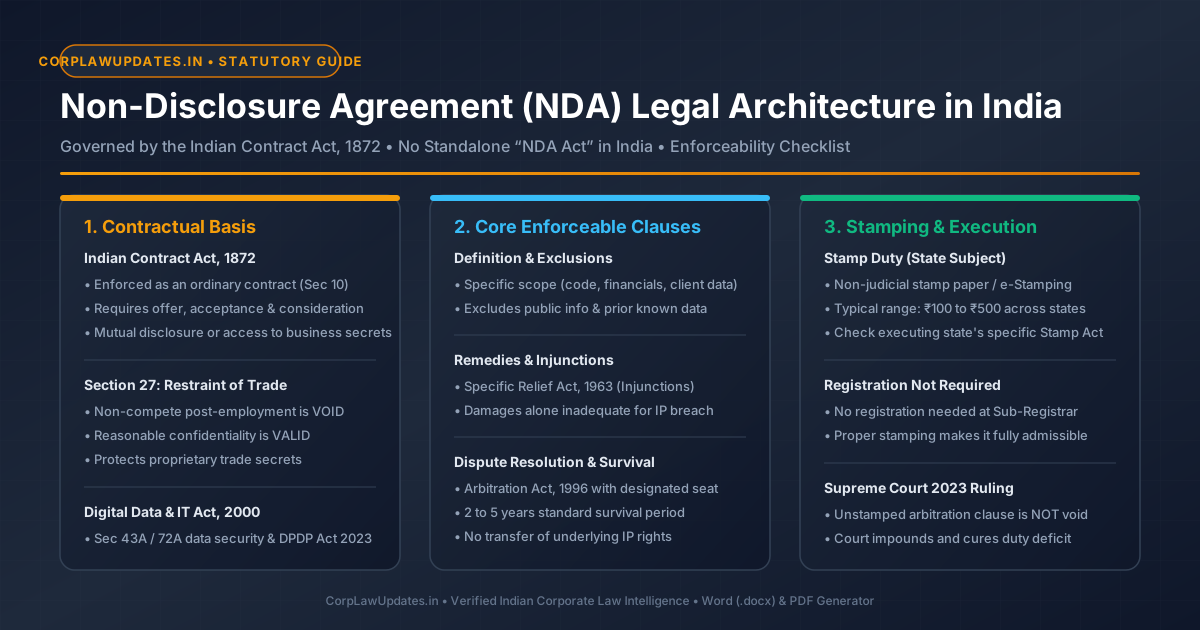
Non-Disclosure Agreement Legal Architecture at a Glance
Types of Non-Disclosure Agreements in India
Depending on commercial circumstances and the direction of information flow, Indian transactions employ two primary types:
Unilateral / One-Way
One-Way Non-Disclosure Agreement
Used when only one party discloses confidential assets to the other. Common scenarios include an employer disclosing proprietary code to an employee, a startup pitching to an angel investor, or a business sharing customer databases with an outsourced contractor.
Bilateral / Mutual
Mutual Non-Disclosure Agreement
Used when both parties share confidential information with each other. Standard in joint-venture negotiations, merger and acquisition (M&A) discussions, technology integration partnerships, and co-development ventures where mutual data exchange is necessary.
Essential Clauses in an Indian NDA & Drafting Analysis
To survive judicial scrutiny in Indian courts, an NDA must be balanced, time-bound, and clear. Our generator incorporates these verified statutory clauses:
1. Definition of Confidential Information
Must specifically enumerate protected categories (customer lists, proprietary source code, financial models, pricing algorithms) rather than claiming “all information exchanged”. Overly broad definitions risk ambiguity during enforcement.
2. Exclusions from Confidentiality
Standard legal carve-outs where confidentiality does not apply: information already in the public domain without breach, information already known to the recipient, independently developed data, or disclosures compelled by court orders or Indian regulatory authorities.
3. Standard of Care & Non-Use
Explicitly restricts the recipient from using confidential data for any purpose other than the agreed “Authorized Purpose”. Imposes an obligation to use at least reasonable care and restricts disclosures to need-to-know personnel.
4. Term & Survival (2 to 5 Years vs Trade Secrets)
Confidentiality obligations typically survive for 2 to 5 years following termination of discussions. For core proprietary trade secrets (e.g. source formulas or algorithms), survival can be perpetual.
5. Remedies & Injunctions under Specific Relief Act, 1963
In trade secret breaches, monetary damages are almost always inadequate because a leaked secret cannot be un-leaked. The NDA must explicitly entitle the disclosing party to seek interim injunctions and specific performance under the Specific Relief Act, 1963.
6. Dispute Resolution under Arbitration and Conciliation Act, 1996
Parties can opt for confidential sole-arbitrator arbitration with a designated seat, preventing sensitive commercial disputes from becoming matter of public record in civil court records.
Section 27 of Contract Act & Employee Non-Compete Distinctions
Under Section 27 of the Indian Contract Act, 1872, every agreement by which anyone is restrained from exercising a lawful profession, trade, or business of any kind is void to that extent.
Indian courts (including landmark Supreme Court rulings such as Percept D'Mark (India) (P) Ltd. v. Zaheer Khan) have established that while a post-employment non-compete clause is completely void, a reasonable confidentiality clause is NOT a restraint of trade. A confidentiality obligation does not prevent an employee or partner from earning a livelihood; it merely prevents them from stealing and exploiting proprietary trade secrets.
Digital Data & IT Act, 2000: Where confidential information includes sensitive digital personal data or software source code, Section 43A and Section 72A of the Information Technology Act, 2000 impose strict statutory compensation for negligence in maintaining security practices. Parties must also adhere to the Digital Personal Data Protection Act, 2023 (DPDP).
Stamp Duty, Registration & The Supreme Court 2023 Ruling
Stamp Paper Requirements (State Subject)
Stamp duty on agreements is a state subject under Entry 63 of List II (State List) of the Constitution of India. There is no single all-India stamp duty rate for an NDA. Typically, an NDA attracts nominal non-judicial stamp duty under Article 5 (“Agreement”) of the respective State Stamp Act, commonly ranging from ₹100 to ₹500. E-stamping via Stock Holding Corporation of India (SHCIL) or state cyber treasuries is legally equivalent to physical stamp paper. Check the specific Stamp Act of the state where execution takes place.
Registration with Sub-Registrar is NOT Required
An NDA does not create or transfer any interest in immovable property and therefore does not require compulsory registration under Section 17 of the Registration Act, 1908. Proper stamping with payment of the requisite state duty is sufficient for legal admissibility.
Unstamped NDA: Supreme Court 7-Judge Bench Ruling (December 2023)
Under Section 35 of the Indian Stamp Act, 1899, an unstamped or insufficiently stamped agreement is inadmissible in evidence until impounded and the deficit duty plus penalty is paid. However, in a historic verdict (In re: Interplay Between Arbitration Agreements under the Arbitration and Conciliation Act, 1996 and the Indian Stamp Act, 1899, delivered in December 2023), a 7-judge Constitution Bench of the Supreme Court held that an arbitration clause in an unstamped agreement is NOT void ab initio. The court will impound the agreement and direct payment of duty rather than refusing arbitration, ensuring contractual dispute mechanisms remain protected.
Practical Step-by-Step NDA Execution Checklist
- Select Agreement Type: Determine whether the relationship warrants a One-Way NDA (startup to investor, employer to worker) or a Mutual NDA (merger discussions, joint development).
- Customise Form Inputs: Specify the exact commercial purpose, defining clear boundaries so the confidentiality covenants cannot be challenged as vague or overbroad.
- Procure Correct Stamp Paper: Obtain non-judicial stamp paper or e-Stamping certificate of appropriate value (commonly ₹100–₹500 depending on the state of execution).
- Execute on Every Page: Authorized signatories of both entities must sign on the signature block and initial the bottom of every single page of the document.
- Witness Attestation: While not strictly mandatory under the Contract Act, having two independent adult witnesses attest the signatures reinforces evidential proof.
- Retain Counterparts: In mutual NDAs, execute two original counterparts so each party retains a fully stamped and signed original in corporate records.
Related Document Formats & Commercial Charters
Employment Agreement
Full-time employment agreement with IP assignment and statutory wage compliance.
Memorandum of Understanding
Preliminary commercial MoU format with binding confidentiality covenants.
Service Level Agreement
B2B vendor & SaaS SLA covering uptime targets, response times, and penalties.
Frequently Asked Questions about Non-Disclosure Agreements (NDAs)
Authoritative answers based on the Indian Contract Act, 1872 and judicial precedents:
Is an NDA legally valid in India?▼
Yes. It is enforceable as a contract under the Indian Contract Act, 1872, provided it has offer, acceptance, consideration, lawful object, and the parties are competent to contract. There is no separate "NDA Act".
What stamp paper value is required for an NDA?▼
It varies by state; typically ₹100–₹500. The duty is fixed, not value-based. Check the Stamp Act of the state where it is executed; e-stamping is equally valid.
Does an NDA need to be registered or notarised?▼
Neither is required for validity. Registration with the Sub-Registrar is not needed; notarisation is optional and only helps prove signature authenticity.
One-way vs mutual NDA — which do I need?▼
One-way when only one side shares secrets (e.g. employer→employee, startup→investor). Mutual when both sides will disclose (e.g. merger talks, JVs).
How long should an NDA last?▼
Commonly 2–5 years of confidentiality obligations, often surviving termination. Perpetual obligations are possible for true trade secrets but harder to justify for general business information.
Can an employee NDA stop someone from joining a competitor?▼
A confidentiality clause can stop them from disclosing your secrets to the competitor. A clause stopping them from joining the competitor is a restraint of trade and risks being void under Section 27 of the Contract Act.
Is a digitally signed / e-stamped NDA valid?▼
Yes. E-signatures are valid under the IT Act, 2000, and e-stamping is legally equivalent to physical stamp paper.
Disclaimer: This free Non-Disclosure Agreement template is provided for general informational and educational compliance purposes only and does not constitute formal legal advice. While drafted in accordance with the Indian Contract Act, 1872 and judicial precedents, complex IP transactions, mergers, and high-value commercial ventures should be reviewed by a qualified advocate or corporate legal counsel prior to execution.