UPSI
Last updated: 16 May 2026
Executive Takeaways🔗
- •SEBI’s 2025 PIT amendment expanded UPSI from 5 to 16 illustrative categories.
- •New UPSI categories now include items like fraud, default, arrest, forensic audit, loan restructuring, CIRP, fundraising, and major litigation outcomes.
- •UPSI is still based on being non-public and price-sensitive, so the list is not exhaustive.
- •For UPSI coming from outside the company, trading window closure is not automatically required just because the information is external.
- •External UPSI still needs careful compliance review, SDD recording, and documentation by the compliance officer.
- •Companies should update their insider trading policy, SDD process, designated persons list, and trading window rules.
- •The 2025 changes make insider-trading compliance more practical, but also more judgment-based.
Understanding UPSI🔗
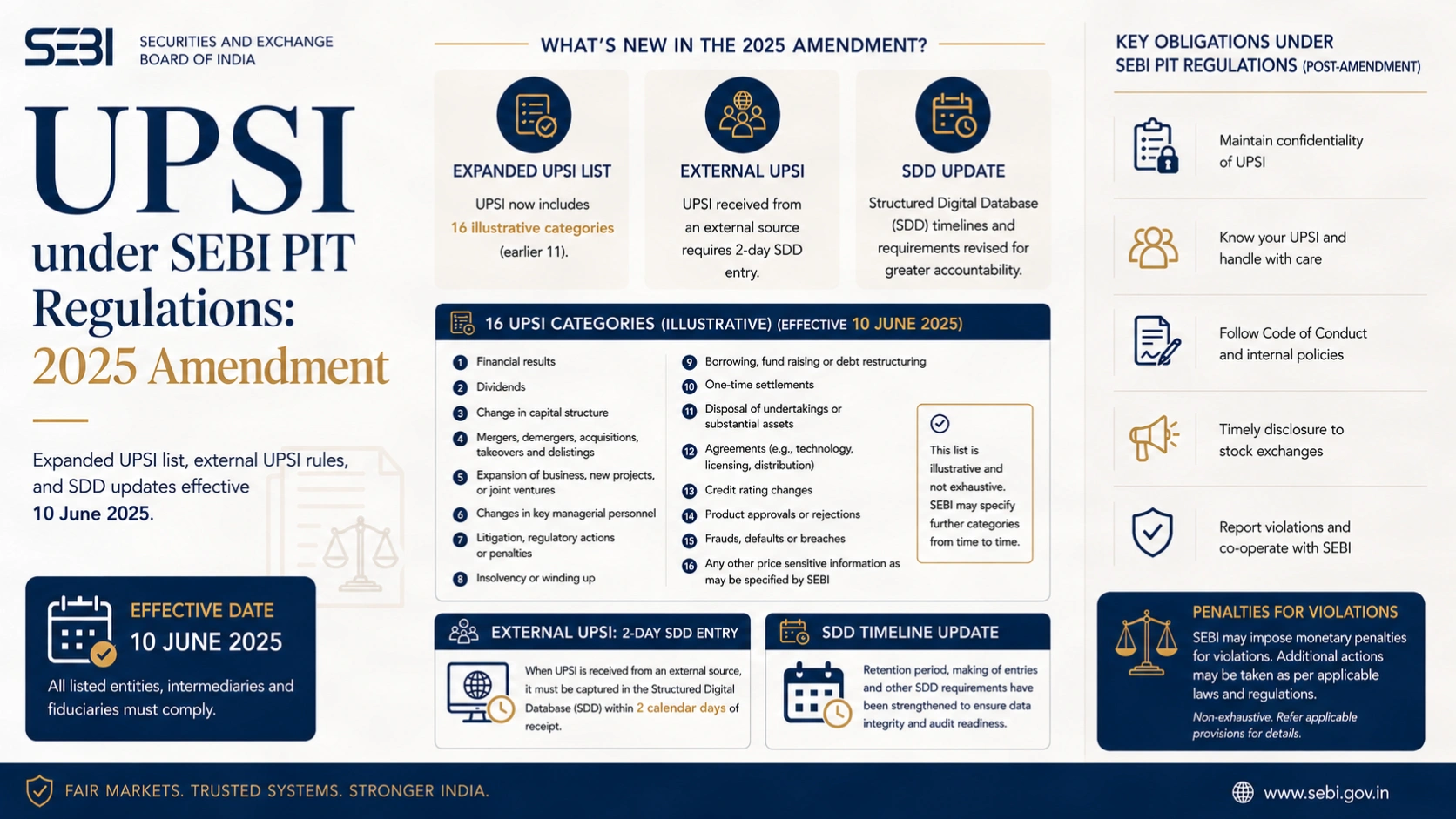
Every listed company director, promoter, compliance officer and employee who has access to company information needs to understand one concept above everything else in securities law: UPSI (Unpublished Price Sensitive Information). Trading in a company’s shares while in possession of UPSI is the core insider trading risk under the PIT Regulations, and SEBI enforces it seriously. In the most significant reform since 2015, SEBI amended the UPSI framework through a notification dated 11 March 2025, effective 10 June 2025, expanding the illustrative UPSI list from 5 to 16 categories and introducing important compliance changes for listed companies.
🚨 Amendment at a Glance
Notification Date
11 Mar 2025
Effective Date
10 Jun 2025
UPSI Events
5 → 16
Notification No. SEBI/LAD-NRO/GN/2025/235 | SEBI Board Approved: 18 December 2024 (208th Board Meeting)
📖 Section 1 — What is UPSI? The Foundation
UPSI — Unpublished Price Sensitive Information is defined under Regulation 2(1)(n) of the SEBI (Prohibition of Insider Trading) Regulations, 2015 as:
📜 Official Definition — Regulation 2(1)(n)
"Any information, relating to a company or its securities, directly or indirectly, that is not generally available which upon becoming generally available, is likely to materially affect the price of the securities and shall, ordinarily including but not restricted to, information relating to..."
— followed by the illustrative list of events (now expanded to 16)
Breaking this definition down into its three essential elements:
🔒
Element 1 — NOT GENERALLY AVAILABLE
The information has not been made public — not on stock exchange, not in any public announcement
📈
Element 2 — PRICE SENSITIVE
Once it becomes public, it is LIKELY to materially affect the price of the company's securities
🏢
Element 3 — RELATES TO COMPANY
Directly or indirectly relates to the company or its securities
💡 Plain English Explanation
Imagine a company director knows its quarterly results are going to be terrible — far below expectations — but this has not been announced yet. If the director sells his shares NOW before the announcement, he benefits because other investors don't know what he knows. That is insider trading. The non-public bad results are the UPSI. Trading on it is the crime.
📜 Section 2 — History and Journey of UPSI Law in India
1992
First Insider Trading Regulations — SEBI Act passed
SEBI (Insider Trading) Regulations, 1992 first introduced
2015
Comprehensive Overhaul — PIT Regulations 2015
N.K. Sodhi Committee recommended comprehensive revision. SEBI (Prohibition of Insider Trading) Regulations, 2015 notified. UPSI defined with 5 illustrative categories under Regulation 2(1)(n).
August 2018
Committee on Fair Market Conduct (FMC Committee) Report
Recommended removing "material events in accordance with listing agreement" from UPSI definition. Noted that not all LODR disclosures are price-sensitive.
18 May 2023
SEBI Consultation Paper 1 — Proposed aligning UPSI with LODR Regulation 30
Proposed including ALL material events under Regulation 30 as UPSI. Industry pushed back — too broad.
9 November 2024
SEBI Consultation Paper 2 — Refined proposal
Narrowed to include only price-sensitive events from Schedule III. Excluded ESG ratings, routine operational disclosures.
18 December 2024
SEBI Board Approves Amendment — 208th Board Meeting
SEBI Board approved expanded UPSI definition. Also approved flexibility for external UPSI.
11 March 2025
Amendment Notified — Notification No. SEBI/LAD-NRO/GN/2025/235
Published in Official Gazette on 12 March 2025. To come into force 90 days later.
10 June 2025 — EFFECTIVE DATE ✅
Illustrative UPSI list expanded from 5 to 16 categories — now in force
All listed companies must comply with expanded UPSI definition, new SDD timelines and revised trading window rules from this date.
📋 Section 3 — The Complete UPSI List: Old vs New
Before the June 2025 amendment, Regulation 2(1)(n) listed only 5 illustrative events as UPSI. The amendment adds sub-clauses vi to xvi, taking the illustrative list to 16 categories. Here is the complete current list.
Existing Events (Modified — Sub-clauses i to v)
New Events Added — Sub-clauses (vi) to (xvi) [Effective 10 June 2025]
⚠️ Important Note on the List
Why this matters
SEBI did not convert every Regulation 30 disclosure into UPSI. The final amendment selected categories that are ordinarily price-sensitive and left out several routine or lower-impact disclosures. This means compliance teams must still apply judgment rather than mechanically treating every disclosure as UPSI.
The UPSI list is illustrative — not exhaustive. The definition uses "shall ordinarily include but not restricted to." This means ANY information satisfying the three core elements (non-public + price-sensitive + relates to company) can be UPSI — even if not in the list. The list merely tells you which events are presumed to be UPSI. For Para A events, no materiality test applies. For Para B events, materiality must be assessed per LODR guidelines.
🔄 Section 4 — Two Other Key Changes in the 2025 Amendment
Change 1 Trading Window Closure Relief for Externally Originating UPSI
One of the most practically significant changes is the relaxation of trading window closure requirements for UPSI originating from outside the listed company. This change is made through a proviso added to Clause 4(1) of Schedule B to the PIT Regulations.
❌ OLD RULE
Trading window MUST be closed whenever designated persons are in possession of ANY UPSI — regardless of whether it came from inside or outside the company.
✅ NEW RULE (from 10 Jun 2025)
For UPSI that originates from outside the listed entity, trading window closure is not mandatorily required merely for that reason. The Compliance Officer should still assess the facts, internal controls, and whether any restriction is appropriate in the circumstances.
💡 What is "External UPSI"? Example
A rating agency informs the company that it is downgrading its credit rating before the formal announcement. This information comes from an external party — the rating agency — but relates to the company. Under the amended framework, the Compliance Officer may record it in the SDD within 2 calendar days, and trading window closure is not automatically required merely because the UPSI originated externally. A documented factual assessment is still advisable.
Change 2 — SDD Entry: 2-Day Window for External UPSI
The Structured Digital Database (SDD) is the record-keeping system every listed entity must maintain under Regulation 3(5) of the PIT Regulations — recording all persons who share/receive UPSI, with timestamps. A new proviso to Regulation 3(5) gives companies flexibility for externally-originating UPSI:
Compliance takeaway
The 2025 amendment creates operational flexibility, but not a free pass. Compliance teams should document (i) whether the UPSI originated internally or externally, (ii) when it was first received, (iii) when it was entered into the SDD, and (iv) why trading window closure was or was not considered necessary on the facts.
👥 Section 5 — Who is an "Insider" and Who are "Designated Persons"?
UPSI is only relevant if you are an "insider" — because only insiders are prohibited from trading on UPSI.
Who is an Insider? — Regulation 2(1)(g)
An insider is any person who is a connected person or any person in possession of or having access to UPSI. This includes:
- Directors and officers of the company
- Employees of the company
- Auditors, accountants, lawyers, bankers of the company
- Any person who receives UPSI from any of the above
- Promoters and their immediate relatives
Who are "Designated Persons"?
Designated Persons (DPs) are the specific group of employees and connected persons on whom trading window restrictions apply. Every listed company must maintain a list of Designated Persons — typically including:
Typically Always Designated:
- Board of Directors
- MD / CEO / CFO / CS (KMPs)
- All Senior Management
- Accounts/Finance team
- Legal and Compliance team
May Also Include:
- Immediate relatives of above persons
- Promoters and promoter group
- Auditors, bankers, legal advisors
- Business development/M&A team
- Any employee with access to UPSI
🚫 Section 6 — What is Prohibited? The Insider Trading Offences
The PIT Regulations prohibit three specific activities when you are in possession of UPSI:
⚠️ The "Possession vs Knowledge" Trap
A critical aspect of insider trading law is that it is based on possession of UPSI — not necessarily conscious knowledge that you possess it. If you are a designated person and UPSI exists about your company, you may not trade — even if you personally did not receive a specific briefing. The defense that "I didn't know about it" is very difficult to establish. This is why trading windows exist — they create a safe period when all UPSI has been published and the slate is clean.
🪟 Section 7 — The Trading Window: What It Is and How It Works
The Trading Window is a concept under Schedule B to the PIT Regulations. It is a period during which designated persons are allowed to trade in the company's securities. When the window is "closed," trading is prohibited.
When Must the Trading Window Be Closed?
- When the company is preparing quarterly/annual financial results — typically closed 48 hours before board meeting
- When UPSI originating from within the company exists and has not been published
- During M&A transactions, fundraising, restructuring — any internal UPSI event
- From 10 June 2025 — where UPSI originates from outside the company, trading window closure is not mandatorily required merely for that reason; the Compliance Officer should still assess the facts and the company’s internal controls.
Typical Trading Window Calendar for Listed Companies
Section 8 Recognised Safe Situations and Common Defences in Insider Trading Cases
The PIT framework recognises certain permitted situations, structured safe routes such as trading plans, and practical defence arguments depending on facts, records, and timing. The three situations below are the most exam-relevant and compliance-relevant.
⚠️ Section 9 — Penalties for Insider Trading in India
🚨 SEBI Enforcement is Serious
SEBI has consistently and aggressively enforced insider trading regulations. In the landmark case of SEBI v. Cabot International Capital Corporation, the Bombay High Court clarified that penalties under the SEBI Act are civil in nature — meaning mens rea (guilty mind) does not need to be proven. Mere possession of UPSI and trading during that period is sufficient for penalty — intent is irrelevant.
💼 Section 10 — Compliance Officer's Action Checklist Post June 2025
✅ What Every Compliance Officer Must Do Now
- Update the Code of Conduct — Revise your company's Code of Fair Disclosure and Code of Conduct to reflect the expanded 16-event UPSI definition
- Retrain Designated Persons — Conduct training/awareness sessions explaining the new categories of UPSI including fraud/default/arrest, forensic audit, rating changes
- Update the Designated Persons list — Review and update who is on the DP list given expanded UPSI triggers
- Revise SDD procedures — Update SDD entry protocols: immediate entry for internal UPSI, 2-calendar-day window for external UPSI
- Identify internal vs external UPSI — Build an internal classification mechanism to distinguish internal from external UPSI — this determines trading window closure obligation
- Update Trading Window Policy Clearly document that externally originating UPSI does not automatically trigger trading window closure merely for that reason, and that the Compliance Officer must record the basis of the assessment made.
- Align with LODR Regulation 30 materiality standards — For Para B events, ensure materiality is assessed per LODR Schedule III and Industry Standards dated 25 February 2025
- Board communication — Ensure the board is informed about expanded insider trading exposure — especially on fraud/default/arrest category
- Audit the existing SDD — Review historical SDD entries to identify any gaps in the context of now-expanded UPSI definition
Practical caution
The amendment does not eliminate judgment calls. A strong compliance file should record the basis on which a particular event was classified as UPSI, whether it was linked to Schedule III of LODR, and what internal controls were triggered in response.
📜 Section 11 — Key Legal Provisions Reference
📝 Bottom Line — UPSI in 2026: What You Must Know
✅UPSI list expanded from 5 to 16 illustrative categories Effective 10 June 2025, major new categories include rating changes, fraud/arrest/default, forensic audits, CIRP or winding-up proceedings, fundraising and loan restructuring.
✅External UPSI brings compliance relief, not automatic exemption If UPSI originates from outside the company, trading window closure is not mandatorily required merely for that reason, though SDD entry within 2 calendar days and a documented factual assessment remain important.
✅Materiality aligned with LODR: For identifying whether a Para B event is UPSI, the materiality criteria under Schedule III of LODR Regulation 30 and Industry Standards dated 25 February 2025 apply.
✅ Compliance Officer accountability: With a broader UPSI definition, the compliance officer's role has never been more critical. Update codes, retrain DPs, revise SDD procedures — immediately.
✅Intent is not the main test In insider trading matters, SEBI focuses heavily on possession of UPSI and the surrounding facts rather than proving guilty intent in the criminal-law sense. A defence based merely on lack of awareness is usually difficult unless backed by credible evidence.
Sources: SEBI (Prohibition of Insider Trading) Regulations, 2015 as amended | SEBI (Prohibition of Insider Trading) (Amendment) Regulations, 2025 — Notification No. SEBI/LAD-NRO/GN/2025/235 dated 11 March 2025, effective 10 June 2025 | SEBI Board Meeting Minutes — 208th Board Meeting dated 18 December 2024 | SEBI Consultation Papers dated 18 May 2023 and 9 November 2024 | Industry Standards on Regulation 30 of SEBI LODR dated 25 February 2025 | SEBI (LODR) Regulations, 2015 — Regulation 30 and Schedule III | SEBI Act, 1992 — Sections 15G and 24 | sebi.gov.in.
⚠️ Disclaimer: This article is for educational and informational purposes only. It does not constitute legal advice. Readers should consult qualified legal professionals for specific compliance guidance.
Frequently Asked Questions (FAQs)🔗
Q1. 1. What is UPSI?▼
Q2. 2. What does UPSI stand for?▼
Q3. 3. What is the legal definition of UPSI in India?▼
Q4. 4. How many UPSI categories are there after the 2025 amendment?▼
Q5. 5. Is the UPSI list exhaustive?▼
Q6. 6. When did the 2025 UPSI amendment become effective?▼
Q7. 7. What are the new UPSI categories added in 2025?▼
Q8. 8. Is every Regulation 30 disclosure automatically UPSI?▼
Q9. 9. Does materiality matter for UPSI?▼
Q10. 10. What is external UPSI?▼
Q11. 11. Does external UPSI require mandatory trading window closure?▼
Q12. 12. How quickly must external UPSI be entered into the Structured Digital Database?▼
Q13. 13. Does internal UPSI still require immediate SDD entry?▼
Q14. 14. What is the Structured Digital Database?▼
Q15. 15. Who is an insider under PIT Regulations?▼
Q16. 16. Who are designated persons?▼
Q17. 17. Can a person trade if they did not know the information was UPSI?▼
Q18. 18. What is insider trading?▼
Q19. 19. What activities are prohibited under PIT?▼
Q20. 20. What is the trading window?▼
Q21. 21. When is the trading window usually closed?▼
Q22. 22. Does the 2025 amendment change the trading window rule?▼
Q23. 23. What is a trading plan under PIT?▼
Q24. 24. Are trading plans always allowed?▼
Q25. 25. What is the penalty for insider trading in India?▼
Q26. 26. Can SEBI punish a person even without proof of intent?▼
Q27. 27. Why is the 2025 amendment important?▼
Q28. 28. Should companies revise their insider trading policy after the amendment?▼
Q29. 29. Does every external event mean the trading window can remain open?▼
Q30. 30. What is the safest compliance approach for companies?▼
Contextual Analysis & Regulatory Updates🔗
Read our latest analysis and critical updates on corporate circulars related to SEBI:
SEBI Master Circular for Debenture Trustees 2026: Complete Guide to All 17 Chapters, Deadlines and Compliance Actions
Published: 28 September 2026
SEBI Board Meeting, September 24, 2026: New Portfolio Managers Regulations, Settlement Framework Overhaul, and 11 More Key Decisions
Published: 25 September 2026
SEBI Extends Samuhik Prativedan Manch to Clearing Members: 14 Compliance Reports From 30 September 2026
Published: 17 September 2026