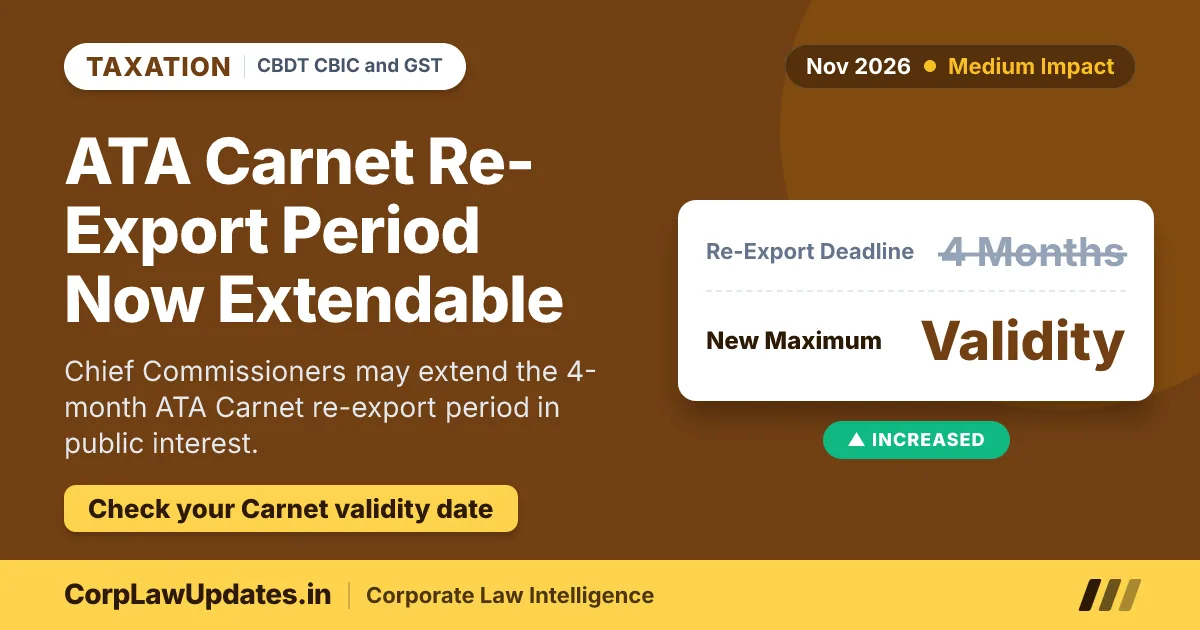
Goods brought into India temporarily under an ATA Carnet no longer face a hard four-month re-export deadline. Notification No. 36/2026-Customs, G.S.R. 989(E), dated Friday, 13 November 2026, issued by the Central Board of Indirect Taxes and Customs, amends Notification No. 4/2018-Customs dated 18 January 2018 so that the Principal Chief Commissioner of Customs or the Chief Commissioner of Customs may extend the four-month re-export period — where satisfied that it is necessary in the public interest — by such further period as they deem fit, up to the validity of the ATA Carnet itself. The notification was published in the Gazette of India on 13 November 2026 and carries no separate commencement clause.
Quick Answer: CBIC Notification No. 36/2026-Customs (G.S.R. 989(E), 13 November 2026) amends Notification No. 4/2018-Customs so the Principal Chief Commissioner or Chief Commissioner of Customs may extend the four-month ATA Carnet re-export period, where satisfied it is necessary in the public interest, by any further period up to the validity of the ATA Carnet.
What the notification actually does
The notification is short — a single operative paragraph — and it does exactly one thing. Issued in exercise of the powers under sub-section (1) of section 25 of the Customs Act, 1962, on the Government being satisfied that it is necessary in the public interest so to do, it amends Notification No. 4/2018-Customs dated 18 January 2018 (published as G.S.R. 42(E) on the same date), the notification that governs the temporary import of goods under ATA Carnets.
In condition (vi) of that notification — the condition that requires goods imported under an ATA Carnet to be re-exported within four months — the amendment inserts a new proviso after the second proviso:
"Provided also that where the Principal Chief Commissioner of Customs or the Chief Commissioner of Customs, as the case may be, is satisfied that it is necessary in the public interest so to do, may extend the aforesaid period of four months by such further period as it may deem fit, not exceeding the period of validity of the A.T.A. Carnet."
The notification is F. No. CBIC-15018/3/2026-ICD-CBIC, signed by Indrajit Panda, Under Secretary. Its Gazette ID is CG-DL-E-13112026-277893. It states no separate commencement date, so it takes effect with its publication in the Gazette on 13 November 2026.
Key changes
- The four-month re-export period can now be extended. The Principal Chief Commissioner or Chief Commissioner of Customs may extend the period by such further period as they deem fit.
- The extension is capped at the Carnet's own validity. No extension can run beyond the period of validity of the ATA Carnet — the Carnet's expiry date is the hard ceiling.
- The extension is discretionary and conditional. The officer must be satisfied that the extension is necessary in the public interest. The notification says the officer "may" extend — it does not create a right to an extension.
- The decision sits at the top of the field formation. Only the Principal Chief Commissioner or the Chief Commissioner of Customs can grant the extension — not an officer below that rank.
- Nothing else in Notification No. 4/2018-Customs changes. The amendment touches only condition (vi). The rest of the ATA Carnet framework — including the duty treatment of the goods while they are in India — is untouched.
In plain language: if you bring goods into India temporarily under an ATA Carnet — for an exhibition, a trade fair, a film shoot, a sporting event or professional work — you used to have four months to take them back out, with no extension mechanism in the notification. Now the senior-most customs officer in the zone can extend that period, if satisfied it is in the public interest, but never beyond the date your Carnet itself expires. Four months is still the default; the extension is the exception, and you have to ask for it.
Old vs new: what has actually changed
The comparison below is drawn from the text of Notification No. 36/2026-Customs itself, which quotes the condition it amends.
What an ATA Carnet is, and why four months mattered
An ATA Carnet is an international customs document that lets goods enter a country temporarily without paying import duty, on the condition that they are re-exported within a set period. It is used for goods that are not meant to stay — exhibition displays, trade-fair equipment, professional tools, film and broadcast gear, sporting equipment, commercial samples. Notification No. 4/2018-Customs is the Indian notification that gives effect to this arrangement, and its condition (vi) fixed the re-export period at four months.
Four months is enough for a single exhibition or a short project. It is not enough when the reason the goods are here runs longer — an exhibition extended by popular demand, a film shoot delayed by weather, a multi-city trade programme, or equipment held up by a regulatory approval. Until now, the notification offered no way to extend the period. The practical choices were to re-export and re-import the goods (with fresh paperwork, cost and delay), or to pay duty and regularise the goods as imports. The new proviso gives the senior customs officer a third option: extend the stay, in the public interest, up to the life of the Carnet.
Who is affected
- Exhibitors and trade-fair organisers — Indian and foreign exhibitors who bring displays, machinery or products into India for exhibitions and fairs, and whose programmes run beyond four months.
- Film, television and event crews — professional equipment imported temporarily for shoots, concerts and sporting events that overrun their schedule.
- Professionals and service providers — engineers, technicians and specialists who bring tools and instruments for a project in India.
- Customs brokers and freight forwarders — the intermediaries who manage Carnet movements and will now need to know the extension route and its limits.
- Export promotion and trade bodies — organisations that sponsor exhibitions and trade delegations, for whom the four-month ceiling was a recurring constraint.
What to do next
- Check the Carnet's validity first. The extension can never run beyond the period of validity of the ATA Carnet. The expiry date printed on the Carnet is the absolute ceiling — if the Carnet itself expires soon, an extension under this notification cannot help, and the Carnet-issuing authority is the place to go.
- Apply before the four months run out. The notification does not prescribe a form or a timeline for the application. Apply to the jurisdictional Principal Chief Commissioner or Chief Commissioner of Customs well before the four-month period expires, so the decision can be made while the goods are still lawfully here.
- Make the public-interest case in writing. The officer must be satisfied that the extension is necessary in the public interest. Set out why the goods need to stay — the exhibition or project, the reason for the delay, the dates — and why re-export and re-import is not a sensible alternative.
- Do not treat the extension as automatic. The notification says the officer "may" extend. It is a discretionary power, exercised case by case. Plan as if the four-month deadline still applies, and treat an extension as a contingency, not a guarantee.
- Keep the rest of the conditions in view. The amendment changes only the time limit in condition (vi). Every other condition of Notification No. 4/2018-Customs continues to apply — the goods must still be re-exported, and the exemption remains a temporary-import exemption, not a route to permanent import.
What the notification does not change
- The four-month period is still the default. The amendment adds an extension power; it does not lengthen the period itself. Goods must still be re-exported within four months unless an extension is granted.
- The Carnet's validity is not extended. The notification extends the re-export period, not the Carnet. The Carnet's own validity is fixed by the issuing authority in the country of issue.
- No duty becomes payable by reason of the extension alone. The notification does not impose duty or change the exemption; it changes only the time within which the goods must leave.
- The two existing provisos in condition (vi) are untouched. The new proviso is inserted after the second proviso; the notification does not amend or repeal what was already there.
Frequently asked questions
How long can goods now stay in India under an ATA Carnet?
The default period is still four months from import. The Principal Chief Commissioner or Chief Commissioner of Customs may now extend it, where satisfied it is necessary in the public interest, by such further period as they deem fit — but never beyond the period of validity of the ATA Carnet itself.
Who can grant the extension?
Only the Principal Chief Commissioner of Customs or the Chief Commissioner of Customs, as the case may be — the senior-most officer of the customs zone. The notification does not give the power to any officer below that rank.
Is the extension automatic?
No. The officer "may" extend the period, and only where satisfied that it is necessary in the public interest. It is a discretionary power, exercised case by case. Importers should apply in writing and set out the public-interest reasons.
Does the notification extend the ATA Carnet itself?
No. It extends the re-export period under condition (vi) of Notification No. 4/2018-Customs, capped at the Carnet's validity. The Carnet's own expiry date is unchanged and acts as the ceiling for any extension.
When did the change take effect?
Notification No. 36/2026-Customs (G.S.R. 989(E)) was published in the Gazette of India on 13 November 2026. It states no separate commencement date, so it takes effect with its Gazette publication.
Does this change the duty treatment of goods imported under an ATA Carnet?
No. The amendment touches only the re-export period in condition (vi) of Notification No. 4/2018-Customs. The duty exemption for temporary imports under the Carnet is otherwise unchanged.
Sources
- Primary source: Notification No. 36/2026-Customs, G.S.R. 989(E), dated 13 November 2026, Ministry of Finance (Department of Revenue) (Central Board of Indirect Taxes and Customs), F. No. CBIC-15018/3/2026-ICD-CBIC — amending Notification No. 4/2018-Customs dated 18 January 2018 under section 25(1) of the Customs Act, 1962 (Gazette of India, Extraordinary, Part II, Section 3, Sub-section (i); Gazette ID CG-DL-E-13112026-277893). Official e-Gazette PDF: https://egazette.gov.in/WriteReadData/2026/277893.pdf
- Related reading on CorpLawUpdates: India–New Zealand FTA: First Tranche of Customs Duty Concessions; all tax updates at corplawupdates.in/category/taxation.


