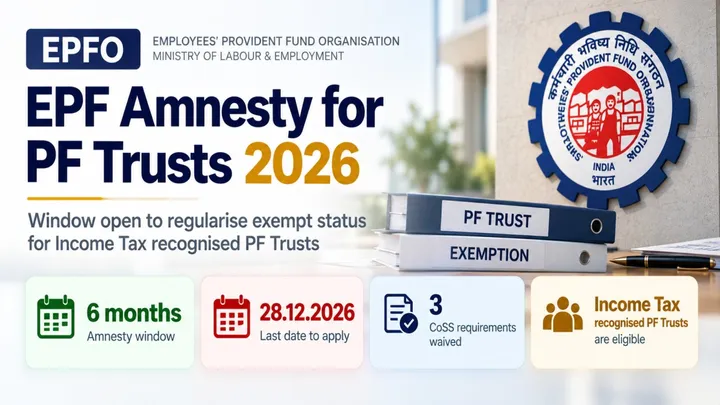
A Provident Fund (PF) Trust that is recognised under the Income Tax Act, 1961 but has no formal exemption order has until 28 December 2026 to seek retrospective regularisation of its exempt status under the Amnesty provisions of the Employees' Provident Fund (EPF) Scheme 2026. The Amnesty also waives certain Code on Social Security (CoSS), 2020 requirements, such as minimum employee headcount, corpus size and the 3-year compliance rule. The Employees' Provident Fund Organisation (EPFO) is urging eligible establishments across India to expedite their submissions before the window closes.
The reminder is contained in a Ministry of Labour & Employment press release published by PIB on 13 October 2026. Eligibility, benefits and the steps to take now are set out below.
Under the Amnesty provisions of the EPF Scheme 2026 (notified 29.06.2026), a PF Trust that is recognised under the Income Tax Act, 1961 but has no formal exemption order under section 17 of the EPF&MP Act, 1952 or section 143 of the Code on Social Security (CoSS), 2020 can seek retrospective regularisation of its exempt status. The six-month window expires on 28.12.2026. The Amnesty also waives CoSS requirements such as minimum employee headcount, corpus size and the 3-year compliance rule. The manner of application is set out in the circular issued on 11.07.2026.
Quick Reference
What Does the Amnesty Scheme Change for PF Trusts?
The Amnesty lets PF Trusts that do not hold a formal exemption order regularise their exempt status retrospectively. It also waives certain Code on Social Security (CoSS), 2020 requirements, such as minimum employee headcount, corpus size and the 3-year compliance rule.
The release names these three requirements as examples ("such as") and does not state that the list is exhaustive. It gives no numerical thresholds; those should be taken from the CoSS, 2020 provisions and the circular issued on 11.07.2026. The "Position without Amnesty" column is inferred from the release describing these requirements as waived.
Some PF Trusts run their own provident fund and have Income Tax recognition, but never got the separate legal permission (an "exemption order") that lets an establishment stay outside the EPFO-run fund. The Amnesty gives those Trusts a one-time chance to get that status recognised as if it had been in place all along, without being blocked by size or track-record conditions.
Why Does This Matter?
Income Tax recognition and exemption under the provident fund law are two separate things. A Trust can have the first and lack the second, which is the gap the Amnesty is designed to close.
The release describes the Amnesty as a one-time opportunity and a transitional measure.
Who Is Eligible to Apply?
Eligibility turns on two conditions that must both be true: the PF Trust is recognised under the Income Tax Act, 1961 (43 of 1961), and it lacks a formal exemption order under section 17 of the Employees' Provident Funds and Miscellaneous Provisions (EPF&MP) Act, 1952 or section 143 of the Code on Social Security (CoSS), 2020.
Indirectly affected parties include the Chartered Accountants and statutory auditors of such establishments. EPFO has specifically engaged them to identify and assist qualifying Trusts.
When Does the Amnesty Window Close?
The Amnesty window closes on 28 December 2026. It opened on notification of the EPF Scheme 2026 on 29.06.2026 and runs for six months from that date.
EPF Scheme 2026 notified, with Amnesty provisions as a transitional measure.
Circular issued setting out operational guidelines, including manner of application and procedural requirements.
PIB release: EPFO steps up its nationwide drive with less than three months left.
Amnesty window expires.
What Benefits Does the Amnesty Offer?
According to the release, the key benefits include:
- Retrospective regularisation of the Trust's exempt status.
- Waiver of CoSS, 2020 requirements, such as minimum employee headcount, corpus size, and the 3-year compliance rule.
- Operational flexibility after regularisation: the establishment may comply either as an exempt or as an unexempt establishment.
- Continuity of income tax benefits: the release advises eligible PF Trusts to use this one-time opportunity so they can continue the income tax benefits available to trusts recognised by the Income Tax Department.
Practical interpretation: The flexibility benefit means regularisation does not lock a Trust into staying exempt. Management can choose the compliance route that suits it once the status is regularised. How that choice is exercised is a procedural matter the release does not describe.
How Is EPFO Spreading Awareness?
EPFO has described its outreach as multi-channel and nationwide:
- Strategic meetings and seminars with apex industry and market bodies, including the Confederation of Indian Industry (CII), the Institute of Chartered Accountants of India (ICAI) and the Bombay Stock Exchange (BSE).
- Direct engagement with Chartered Accountants and statutory auditors to identify and assist qualifying PF Trusts.
- Seminars and workshops by EPFO Zonal and Regional Offices with local establishments, employers and trust members.
- Multi-media campaigns, social media outreach and explanatory infographics.
The release also describes the institutional work behind the drive:
- Hybrid training programmes run by the Exemption Division (Head Office) for EPFO field officials.
- Dual-track institutional and employer training delivered through online modules and in person at the Pandit Deendayal Upadhyaya National Academy of Social Security (PDUNASS), for officers and employers.
- Coordination with the Ministry of Finance (Department of Revenue / Income Tax Department) to institutionalise data sharing of exempted establishment records, aimed at identifying and cross-verifying unnotified or non-compliant PF Trusts so that tax-recognised trusts without formal EPFO exemption orders regularise promptly. Regional offices continue active follow-ups.
CorpLawUpdates Analysis
For compliance teams, the immediate issue is a simple screening exercise: does the Trust have a formal exemption order or not? Income Tax recognition alone is not an exemption order, and that is the gap the Amnesty is aimed at.
In our view, the waiver of CoSS requirements such as headcount, corpus size and the 3-year rule is likely to matter most in practice, because a Trust that does not meet those conditions could otherwise find qualification difficult. This is editorial interpretation; the release does not discuss it. Practitioners should read the circular issued on 11.07.2026 alongside this release, since the circular carries the procedure.
Where a Trust is uncertain about its position, the sensible approach is to establish the facts well ahead of 28 December. The release urges eligible establishments to expedite their submissions.
Compliance Checklist
The release does not specify the application form, portal, fee, supporting documents or consequences of missing the deadline. These details should be checked in the circular issued on 11.07.2026.
Frequently Asked Questions
The Amnesty is a transitional provision in the EPF Scheme 2026, notified on 29.06.2026. It gives PF Trusts recognised under the Income Tax Act, 1961 but lacking a formal exemption order a one-time opportunity to regularise their exempt status retrospectively.
The Amnesty window for PF Trusts closes on 28 December 2026. It runs for six months from the date of notification of the EPF Scheme 2026 (29.06.2026).
PF Trusts that are recognised under the Income Tax Act, 1961 (43 of 1961) but do not hold a formal exemption order under section 17 of the EPF&MP Act, 1952 or section 143 of the Code on Social Security, 2020.
The Amnesty under the EPF Scheme 2026 waives statutory requirements under the Code on Social Security, 2020, such as the minimum employee headcount, the corpus size requirement and the 3-year compliance rule. The release gives these as examples and does not state that the list is exhaustive.
The release does not say so. It states that, after regularisation, the establishment has complete operational flexibility to comply either as an exempt or as an unexempt establishment. It does not describe how or when that choice is made.
The circular issued on 11.07.2026 details the operational guidelines for the Amnesty under the EPF Scheme 2026, including the manner of application and procedural requirements.
The release does not mention any extension. It states that the window expires on 28.12.2026 and that EPFO is urging eligible establishments across India to expedite their submissions.
The release does not state the consequences of missing the 28.12.2026 deadline. The position after the window closes should be checked in the EPF Scheme 2026 and the circular issued on 11.07.2026, and a Trust in doubt should seek professional advice well before the deadline.
Issuing authority: Ministry of Labour & Employment, via PIB Delhi
Posted: 13 October 2026, 2:37 PM | Release ID: 2322732
Signed off by: Rini Choudhury
Related instruments: EPF Scheme 2026 (notified 29.06.2026); circular issued on 11.07.2026 setting out operational guidelines (issuing authority not named in the release)
Primary source: PIB press release, 13 October 2026
This article is for informational and educational purposes only and does not constitute legal or regulatory advice. Readers should verify the applicable primary regulatory source before taking action.