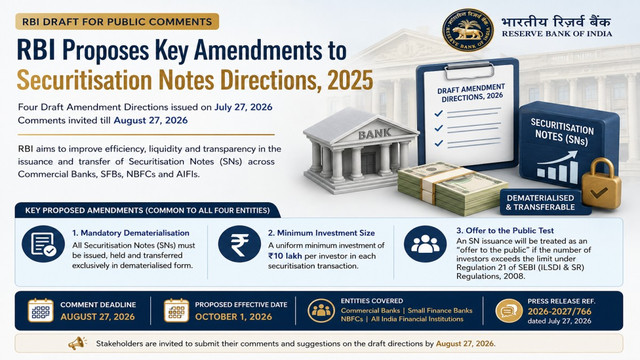
🟡 DRAFT FOR PUBLIC COMMENTS — Reserve Bank of India, Department of Regulation, issued four parallel draft Amendment Directions on July 27, 2026 (Press Release 2026-2027/766) covering Commercial Banks, Small Finance Banks, NBFCs, and All India Financial Institutions. Stakeholder comments are invited until August 27, 2026. The changes, as drafted, are proposed to take effect from October 1, 2026.
Background: RBI's Draft Securitisation Notes Amendment Directions, 2026
RBI maintains separate Securitisation Transactions Directions for each category of regulated entity that participates in loan securitisation — Commercial Banks, Small Finance Banks, NBFCs, and All India Financial Institutions (AIFIs). These entity-specific Directions were most recently reissued in 2025, and they govern how a bank or NBFC (the "originator") can sell a pool of loans to a Special Purpose Entity (SPE), which in turn funds the purchase by issuing Securitisation Notes (SNs) to investors.
On July 27, 2026, RBI's Department of Regulation released four draft Amendment Directions — one for each entity category — proposing identical changes to two paragraphs of each set of 2025 Directions. According to the accompanying press release, the objective is to improve efficiency, liquidity and transparency in the issuance and subsequent transfer of SNs. In practical terms, the draft does two things: it forces the entire lifecycle of a securitisation note into dematerialised form, and it fixes a uniform minimum investment size per investor. It also redefines when an SN issuance counts as an "offer to the public," anchoring that test to the investor-count limit under Regulation 21 of the SEBI (Issue and Listing of Securitised Debt Instruments and Security Receipts) Regulations, 2008.
Because the same two changes are being proposed across all four entity categories simultaneously, this article treats the four drafts as a single regulatory action for ease of reference, while flagging the category-specific statutory basis and paragraph numbering separately in the section below.
What Each Draft Direction Amends
All four drafts carry the same interim reference "RBI/2026-27/__ | DOR.STR.REC.XX/21-04-177/2026-27" and the same placeholder date "XX, 2026" — standard RBI practice for a draft circulated for comment before a final circular number is assigned. Each draft amends its own 2025 Directions, but the paragraph numbers being substituted, and the statutory powers invoked, differ slightly by entity category.
Commercial Banks
💡 Amends the RBI (Commercial Banks – Securitisation Transactions) Directions, 2025. Powers invoked: Sections 21 and 35A of the Banking Regulation Act, 1949. Para 27 is substituted with the dematerialisation and ticket-size rule; Para 28 is substituted with the "offer to the public" definition.
Small Finance Banks
💡 Amends the RBI (Small Finance Banks – Securitisation Transactions) Directions, 2025. Powers invoked: Sections 21 and 35A of the Banking Regulation Act, 1949. Para 26 is substituted with the dematerialisation and ticket-size rule; Para 27 is substituted with the "offer to the public" definition.
Non-Banking Financial Companies
💡 Amends the RBI (Non-Banking Financial Companies – Securitisation Transactions) Directions, 2025. Powers invoked: Sections 45JA, 45K, 45L, 45M and 45MA of the RBI Act, 1934; Sections 30A, 32 and 33 of the National Housing Bank Act, 1987; and Sections 3, 31A and 6 of the Factoring Regulation Act, 2011 — the broadest statutory base of the four, reflecting NBFC coverage of housing finance and factoring entities. Para 26 is substituted with the dematerialisation and ticket-size rule; Para 27 is substituted with the "offer to the public" definition.
All India Financial Institutions
💡 Amends the RBI (All India Financial Institutions – Securitisation Transactions) Directions, 2025. Powers invoked: Section 45L of the RBI Act, 1934. Para 26 is substituted with the dematerialisation and ticket-size rule; Para 27 is substituted with the "offer to the public" definition.
Change 1: Mandatory Dematerialisation and ₹1 Crore Minimum Ticket Size
The substituted paragraph (Para 26 for SFBs, NBFCs and AIFIs; Para 27 for Commercial Banks) rewrites the rules governing how SNs are issued, held and transferred.
❌ Physical-form SNs are no longer permitted. Issuance, holding, and every subsequent transfer of a securitisation note must be in dematerialised form only.
⚠️ ₹1 crore minimum ticket size applies both at the time of original issuance and at every subsequent transfer of the note — not a one-time entry threshold.
✅ Contractual safeguard required: the agreement between the originator and the SPE must include a clause obligating the SPE to ensure ongoing compliance with the ticket-size condition, including at each transfer.
📝 Definition — "Ticket size": for the purpose of these Directions, ticket size means the size of investment by a single investor (not the aggregate issuance size of the SN tranche).
Change 2: Redefined "Offer to the Public"
The second substituted paragraph (Para 27 for SFBs, NBFCs and AIFIs; Para 28 for Commercial Banks) replaces the standalone RBI test for what counts as a public offer of SNs.
📝 An offer of SNs is now deemed to have been made "to the public" if it is made to a number of persons that meets or exceeds the investor-count limit prescribed under Regulation 21 of the SEBI (Issue and Listing of Securitised Debt Instruments and Security Receipts) Regulations, 2008, as amended from time to time. This ties the RBI framework's public/private offer distinction directly to the existing SEBI threshold, so any future SEBI revision to Regulation 21 will automatically flow through to the RBI test without requiring a separate RBI amendment.
Effective Date and Comment Process
Each of the four drafts states that the amendment will come into force with effect from October 1, 2026. Since these are drafts released for public comment — not final circulars — this date reflects RBI's proposed effective date and is contingent on the Directions being finalised as drafted, or with whatever modifications follow the comment process. Comments may be submitted through the "Connect2Regulate" section on the RBI website, or forwarded to the Chief General Manager, Credit Risk Group, Department of Regulation, Central Office, Reserve Bank of India, 12th/13th Floor, Shahid Bhagat Singh Marg, Fort, Mumbai – 400001, or by email, on or before August 27, 2026.
Summary of RBI Securitisation Notes Amendment (2026 Draft)
Compliance Checklist
☑ Identify which of the four drafts applies to your entity (CB / SFB / NBFC / AIFI) and note the correct amended paragraph numbers for that category.
☑ Review current and planned securitisation note issuances to confirm they can be fully dematerialised ahead of the proposed October 1, 2026 effective date.
☑ Check structuring of SN tranches against the ₹1 crore per-investor minimum ticket size, both at issuance and for any planned secondary transfers.
☑ Update or prepare originator-SPE transaction documentation to embed the mandatory ongoing ticket-size compliance clause.
☑ Cross-check any SN offer against the investor-count threshold in Regulation 21 of the SEBI (Issue and Listing of Securitised Debt Instruments and Security Receipts) Regulations, 2008 to determine public vs. private offer classification.
☑ If the proposed changes raise implementation concerns, prepare comments for submission via Connect2Regulate, or by email/post to the Chief General Manager, Credit Risk Group, Department of Regulation, before August 27, 2026.
☑ Track RBI's website for the final circular numbers and finalised text, since the current drafts carry only placeholder references ("RBI/2026-27/__").
CorpLawUpdates Analysis
The most consequential element of this draft is the blanket dematerialisation mandate. RBI has steadily pushed instruments across the credit and money markets — commercial paper, certificates of deposit, non-convertible debentures — toward compulsory demat form over the last two decades, largely to improve traceability, reduce settlement risk, and curb the use of physical instruments to obscure beneficial ownership. Extending that logic to securitisation notes closes one of the few remaining pockets where physical-form issuance was still viable, and it does so uniformly across banks, SFBs, NBFCs and AIFIs rather than entity-by-entity over time.
The bigger operational challenge is likely to be the ₹1 crore ticket-size floor applying at every subsequent transfer, not just at original issuance. Originators and SPEs will need transfer-tracking mechanisms — not just issuance-stage checks — to ensure no secondary sale fragments an SN holding below the threshold, and the mandated originator-SPE contractual clause effectively pushes ongoing monitoring liability onto the SPE. For market participants used to treating ticket-size compliance as a one-time issuance check, this is a meaningful process change.
The ₹1 crore floor also has a market-structure consequence worth watching: it effectively locks retail and smaller institutional investors out of the SN market, concentrating participation among large institutional and high-net-worth investors. Combined with the tightened public-offer test tied to SEBI Regulation 21, RBI appears to be steering securitisation notes firmly toward a private-placement, institutional-investor model.
Because all four entity-specific Directions are being amended in lockstep, with identical substantive changes, this also signals RBI's intent to keep its securitisation framework harmonised across regulated entity types rather than allowing category-specific divergence. Practitioners advising originators or SPEs that straddle multiple entity types — for instance, an NBFC-originated pool with a bank-sponsored SPE — should watch for whether the final circulars preserve this uniformity or introduce entity-specific carve-outs after the comment period. The August 27, 2026 deadline leaves a relatively short window for industry bodies to flag implementation concerns before the proposed October 1, 2026 effective date.
Source documents:
Press Release: "RBI issues Draft (Securitisation Transactions) Amendment Directions," Press Release No. 2026-2027/766, dated July 27, 2026, signed by Brij Raj, Chief General Manager, Department of Communication, RBI.
Draft Reserve Bank of India (Commercial Banks – Securitisation Transactions) Amendment Directions, 2026 — Ref. RBI/2026-27/__ | DOR.STR.REC.XX/21-04-177/2026-27, signed by Vaibhav Chaturvedi, Chief General Manager.
Draft Reserve Bank of India (Small Finance Banks – Securitisation Transactions) Amendment Directions, 2026 — same reference and signatory.
Draft Reserve Bank of India (Non-Banking Financial Companies – Securitisation Transactions) Amendment Directions, 2026 — same reference and signatory.
Draft Reserve Bank of India (All India Financial Institutions – Securitisation Transactions) Amendment Directions, 2026 — same reference and signatory.
This article is for informational and educational purposes only and does not constitute legal or regulatory advice. Verify with primary regulatory sources before acting.


