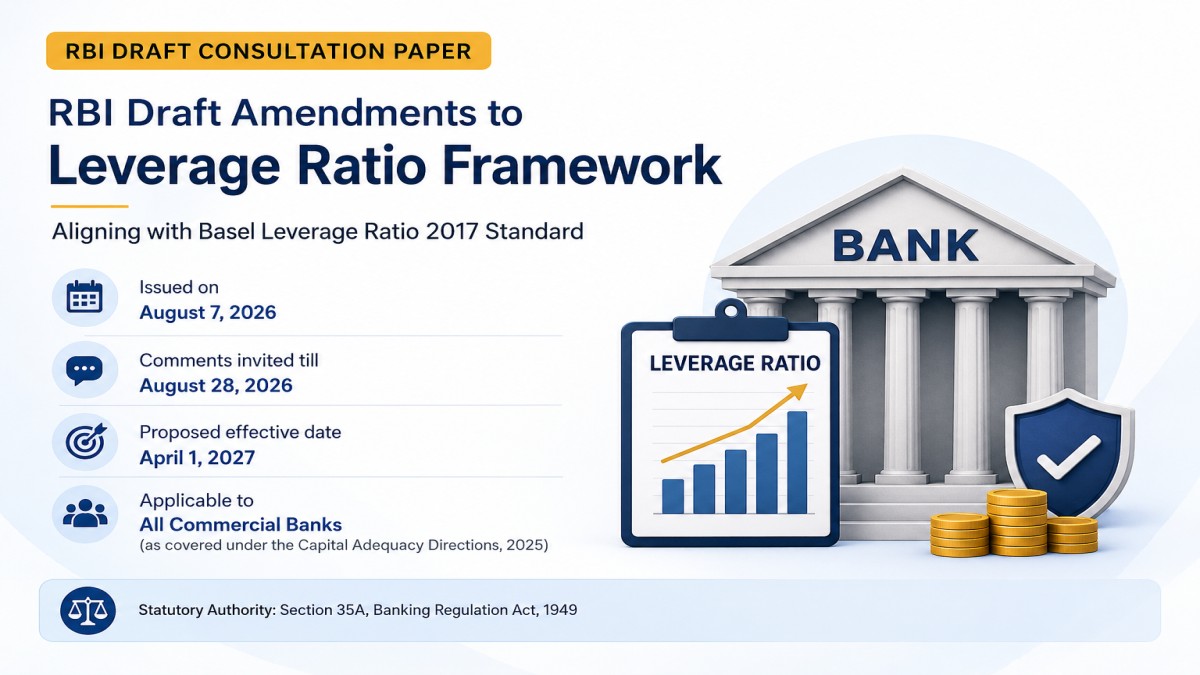
Issued by: Reserve Bank of India, Department of Regulation — August 7, 2026
Comments invited till: August 28, 2026
If finalised, proposed effective date: April 1, 2027
Background
The Reserve Bank of India has put out for public comment a draft amendment that rewrites the leverage ratio chapter of its bank capital adequacy rulebook. The leverage ratio is a simple, non-risk-sensitive backstop — capital divided by total exposure — designed to cap how much banks can borrow against their capital base, regardless of how "safe" their assets look on paper.
India's current leverage ratio provisions sit in Chapter VII of the RBI (Commercial Banks – Prudential Norms on Capital Adequacy) Directions, 2025. The Basel Committee on Banking Supervision has since finalised what the industry calls the "Leverage Ratio 2017 Standard" — a more granular set of rules for how derivatives, securities financing transactions (SFTs), and off-balance sheet items feed into the exposure measure. This draft is RBI's move to bring Indian banks onto that updated global template.
Practically, this is not a light edit — the draft substitutes paragraphs 262 through 270 in full, deletes paragraph 271, and replaces the Pillar 3 disclosure requirements in Annex III with two new templates. Every commercial bank's capital and treasury/risk teams will need to re-map their exposure calculation methodology against the new text.
Paragraph 262 — Definition, Minimum Requirement & Scope
The leverage ratio continues to be defined as the capital measure divided by the exposure measure, expressed as a percentage.
- Domestic Systemically Important Banks (D-SIBs): 4%
- All other banks: 3.5%
- G-SIB branches operating in India: 3.5% plus the applicable G-SIB leverage ratio buffer (including any additional buffer set by the home regulator)
Capital distribution constraints for G-SIB branches
A G-SIB branch that fails to meet either its CET1 risk-based requirement or its Tier 1 leverage ratio requirement will face restrictions on capital distribution. Where a branch misses both requirements, the stricter of the two applicable conservation standards applies.
"Meeting both requirements" means: a CET1 risk-based ratio covering the 5.5% minimum plus the 2.5% capital conservation buffer plus the applicable G-SIB higher-loss-absorbency requirement plus any countercyclical buffer, and a Tier 1 leverage ratio covering the 3.5% minimum plus the G-SIB leverage ratio buffer.
The draft sets out the minimum capital conservation ratios — expressed as a percentage of earnings that must be retained — for a G-SIB branch in the first higher-loss-absorbency bucket (1% risk-based G-SIB buffer):Both capital and exposure measures are calculated quarter-end by default. Banks may move to more frequent (daily/monthly) averaging only with RBI approval, applied consistently. The minimum ratio must be met at all times, not just at reporting dates.
Paragraph 263 — Scope of Consolidation
The leverage ratio framework will follow the same scope of regulatory consolidation used for the risk-based capital framework, cross-referenced to paragraph 8 of the 2025 Directions — so banks don't need to run a separate consolidation exercise just for leverage reporting.
Paragraph 265 — General Measurement Principles
The exposure measure generally follows gross accounting values. Banks may not net assets against liabilities, and cannot use collateral, guarantees, or other credit risk mitigants to shrink the exposure measure, except where a specific carve-out applies (e.g., eligible netting for SFTs and derivatives).
Items already deducted from Tier 1 capital — such as certain investments in unconsolidated financial entities, and prudent valuation adjustments — must also be deducted from the exposure measure. Liability-side fair-value gains or losses, however, are never deducted.
Securitised exposures can be excluded from the exposure measure only if the transaction meets the operational risk-transfer conditions in paragraph 96 — but even then, any retained securitisation exposure must still be included. Where the risk-transfer conditions aren't met (including for synthetic securitisations), the entire securitised exposure stays in.
- SFTs where counterparty exposure rises as counterparty credit quality falls
- SFTs where the counterparty's credit quality is positively correlated with the value of securities received — i.e., credit quality weakens as collateral value falls
- Switching from principal to agency structuring purely to get favourable leverage treatment
- Collateral swaps engineered to dodge inclusion in the exposure measure
- Off-balance-sheet structuring used to move assets out of the exposure measure
RBI has also reserved the right to temporarily exempt central bank reserve balances from the exposure measure during exceptional macroeconomic conditions — but if it does, it will raise the minimum ratio requirement to offset the effect, and banks must disclose the ratio both with and without the exemption.
The total exposure measure remains the sum of four buckets: on-balance sheet exposures, derivative exposures, SFT exposures, and off-balance sheet items — each covered in its own paragraph below.
Paragraph 266 — On-Balance Sheet Exposures
Non-derivative, non-SFT balance sheet assets are included at accounting value, net of specific provisions, with general provisions/loan-loss reserves also deducted where they've already reduced Tier 1 capital.
Unsettled trades
Banks using trade-date accounting must reverse out any offsetting between unsettled sale receivables and unsettled purchase payables — unless the assets are fair-valued trading-book instruments settling on a delivery-versus-payment basis, in which case limited netting is allowed. Settlement-date accounting banks follow a separate treatment under paragraph 269.
Cash pooling arrangements
Where a bank sweeps customer account balances into a single account daily (and isn't liable to customers individually), the exposure measure is based on the single pooled balance, not each underlying account. Less-frequent sweeps can still qualify for single-balance treatment if five specific conditions are met — a legally enforceable right to sweep, no maturity mismatches, combined-balance interest/fee charging, among others. If the conditions aren't met, each participating account must be reflected separately.
Fiduciary assets
Where a bank recognises fiduciary assets on its balance sheet under its accounting framework, those assets can be excluded from the exposure measure — but only if they meet the applicable accounting standard's criteria for derecognition and, where relevant, deconsolidation. This adjustment also feeds into Template LR1's asset-reconciliation disclosure.
Paragraph 267 — Derivative Exposures
Exposure = alpha × (Replacement Cost + Potential Future Exposure), where alpha is fixed at 1.4. Replacement cost is the greater of zero or (market value − eligible cash variation margin received + cash variation margin provided). PFE add-ons use a multiplier fixed at one for leverage-ratio purposes, distinct from the risk-based capital treatment.
Collateral received against a derivative can never reduce the exposure measure — the leverage framework treats received collateral as not reducing the underlying settlement risk. Collateral posted, on the other hand, must be grossed back into the exposure measure if it reduced balance-sheet assets under the bank's accounting framework.
Cash variation margin can reduce the replacement-cost component (not the PFE component) only if strict conditions are met: non-segregation of received cash, at least daily mark-to-market and margin exchange, currency matching the governing agreement, full mark-to-market coverage, and a single legally enforceable master netting agreement between the parties.
Clearing member exposures
A bank clearing trades for clients generally must capture its trade exposure to the CCP like any other derivative — unless it isn't contractually obligated to reimburse the client for CCP-default losses, in which case that exposure can be excluded. Banks providing clearing services as a "higher-level client" in multi-level structures get a similar exclusion if strict legal-enforceability and porting conditions are satisfied.
Written credit derivatives
Because written credit protection creates notional credit exposure to the underlying reference entity — not just fair-value counterparty risk — the effective notional amount of a written credit derivative must generally be added to the exposure measure, treated similarly to a cash loan or bond. This amount can be reduced by negative fair-value changes already reflected in Tier 1 capital, and further offset by a matching purchased credit derivative on the same reference name if it meets strict same-or-better-terms, maturity, and correlation conditions.
Paragraph 268 — Securities Financing Transaction (SFT) Exposures
For a bank acting as principal, the SFT exposure measure combines (i) gross SFT assets (with limited netting of cash payables/receivables against the same counterparty, permitted only where both legs share the same explicit final settlement date, the right of set-off is legally enforceable including on default/insolvency, and the parties intend or are mechanically bound to net-settle), plus (ii) a counterparty credit risk add-on based on current exposure, calculated without a PFE component.
Where sale accounting has been applied to an SFT, the bank must reverse those entries and treat the transaction as financing for leverage-ratio purposes — leverage risk stays with the security's lender regardless of accounting treatment.
A bank acting purely as agent — and not providing any indemnity or guarantee — generally doesn't need to recognise the SFT in its exposure measure at all. Where it does provide an indemnity limited to the shortfall between lent security/cash and collateral received, only that guaranteed difference is captured; broader economic exposure (e.g., managing unsegregated collateral) pulls in the full transaction amount.
Paragraph 269 — Off-Balance Sheet (OBS) Items
OBS items — commitments (cancellable or not), direct credit substitutes, acceptances, and standby/trade letters of credit — are converted into credit exposure equivalents using credit conversion factors (CCFs) prescribed under the RBI (Commercial Banks – Capital Charge for Credit Risk – Standardised Approach) Directions, 2026, applied to the notional amount. Specific/general provisions that have already reduced Tier 1 capital may be deducted, but the resulting OBS exposure can never go below zero. Securitisation-related OBS exposures follow the treatment in paragraph 89 separately.
Paragraph 270 — Disclosure & Reporting
- Quarterly public disclosure of the Basel III leverage ratio, both standalone and consolidated
- Quarterly reporting to RBI's Department of Supervision with full capital and exposure-measure calculation detail
- Pillar 3 disclosures via two new templates — LR1 and LR2 — under Annex III
Paragraph 271 — Deleted
The draft deletes paragraph 271 in its entirety without replacement text.
Annex III — New Disclosure Templates
Template LR1 reconciles a bank's total consolidated balance-sheet assets to its leverage ratio exposure measure, adjusting for items such as unconsolidated investments, securitised exposures meeting risk-transfer conditions, fiduciary assets, trade-date adjustments, cash pooling, derivatives, SFTs, and OBS conversion.
Template LR2 gives a granular row-by-row breakdown of on-balance sheet, derivative, SFT, and OBS exposures, Tier 1 capital, the resulting leverage ratio, applicable minimum requirement and buffers, plus mean-value disclosures for SFTs to smooth out quarter-end window-dressing effects.
What's Changing — At a Glance
Compliance Checklist
☑ Map current leverage-ratio calculation methodology against new paragraphs 262–270 to identify gaps
☑ Confirm your bank's D-SIB / G-SIB-branch status and applicable minimum ratio (4% vs 3.5% vs 3.5% + buffer)
☑ Rebuild derivative exposure calculations using the fixed 1.4 alpha multiplier and updated PFE add-on rules
☑ Review SFT netting eligibility against the strict matching-settlement-date/legal-enforceability/net-settlement criteria in paragraph 268(2)
☑ Reassess cash-pooling arrangements against the five conditions for single-balance treatment
☑ Prepare draft LR1 and LR2 disclosure templates ahead of the April 1, 2027 proposed effective date
☑ Submit comments/feedback to RBI on or before August 28, 2026 via 'Connect 2 Regulate' or email
CorpLawUpdates Analysis
The most consequential change here isn't the headline 4%/3.5% minimums — those largely track what banks already work with — it's the granularity RBI is importing around derivatives, SFTs, and written credit protection. The fixed 1.4 alpha multiplier, combined with strict conditions for netting and cash variation margin recognition, means banks that have been taking a liberal view of what can be netted out of their exposure measure will likely see that measure grow, not shrink.
The G-SIB branch capital conservation table is a narrower but sharper provision — it directly links dividend and distribution capacity to a bank's position on a CET1-versus-leverage matrix. For the handful of foreign G-SIB branches operating in India, this converts what was previously a fairly abstract "maintain the buffer" obligation into a concrete earnings-retention schedule.
The compliance lift is real. Treasury and regulatory reporting teams will need to rebuild exposure calculation logic — particularly for SFT netting eligibility and the cash-pooling single-balance test — well before the April 2027 effective date, and prepare for two entirely new Pillar 3 templates (LR1, LR2) that demand line-item reconciliation most banks don't currently maintain in that format.
Watch this space: this amendment only touches the leverage ratio chapter. Given RBI's stated intent to align fully with the Basel III framework, further amendments to risk-weighted asset calculation, liquidity coverage, or NSFR chapters of the 2025 Directions may follow a similar consultation-and-alignment pattern in the coming quarters.
This article is for informational and educational purposes only and does not constitute legal or regulatory advice. Verify with primary regulatory sources before acting.