RBI · Foreign Exchange · 15 October 2026
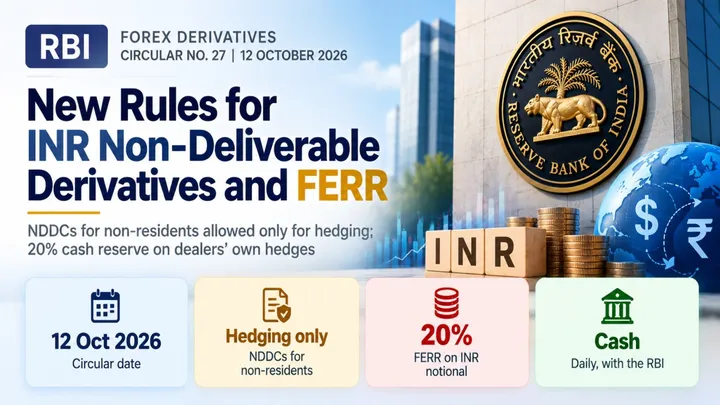
What happened: On 15 October 2026, the RBI released a 22-question FAQ clarifying its new Foreign Exchange Risk Reserve (FERR) — the 20% cash reserve on large rupee derivative hedges introduced by A.P. (DIR Series) Circular No. 26 (10 October 2026) and widened by Circular No. 27 (12 October 2026). The FAQs settle the market's biggest doubt: which transactions actually attract the reserve, and which don't.
First, what the FAQ does and doesn't do
The FAQs introduce no new obligations. The rules stay exactly as the 10 and 12 October circulars set them — this document only clarifies scope, computation, maintenance and reporting. If your reading of the circulars was already correct, nothing changes for you. If parts were ambiguous (and for several banks they were — forward quotes were reportedly being held back while desks waited for clarity), the FAQs answer those questions.
Which contracts attract FERR — the five-condition test
For a contract between an Authorised Dealer and a user (Circular No. 26), FERR applies only when all five conditions hold together:
What's explicitly out
The FAQs are as useful for their exclusions as their inclusions:
- Market-making and proprietary positions: not covered. The reserve applies only where the AD hedges the currency risk of its own assets and liabilities by purchasing foreign currency against the rupee (Circular No. 27).
- User sells foreign currency against the rupee: not covered — only purchases.
- Capital account hedges: not covered — only current account transactions.
- Non-INR contracts: not covered.
- The tricky one — current account payments arising from capital account transactions: interest on external commercial borrowings, coupons on resident debt instruments held by non-residents, and dividends paid to non-resident investors are current account transactions under Section 2(j) of FEMA, 1999 — but they are excluded from FERR under Circular No. 26 because they arise from an underlying capital account transaction. However, if an AD hedges its own currency risk on such exposures, FERR does apply under Circular No. 27.
- Contracts with RBI itself: no FERR on INR derivative contracts ADs undertake with the Reserve Bank of India.
Odd detail, worth knowing: on rbi.org.in the FAQ page is headed "Foreign Exchange Reserve Ratio (FERR)" — but the document itself defines the acronym as Foreign Exchange Risk Reserve. Same acronym, different expansion, depending on where you look on the RBI's own site.
Threshold mechanics: the $2 million line and how to measure it
- FERR applies only where the notional exceeds the USD two million equivalent — contracts at or below that level are exempt.
- Structuring to dodge the threshold is prohibited: ADs must guard against transactions structured to avoid the requirement.
- Options: the threshold is tested on the notional of the option contract. Where two or more options form a single structure, it counts as one contract — and the single option with the highest notional is used both for the threshold test and for computing FERR.
- If a partial cancellation leaves the notional still above the threshold, FERR continues pro-rata on the remaining notional from the next day. If the reduction takes the notional below USD two million equivalent, the requirement ceases from the day following the reduction.
How the reserve is computed and maintained
- Computation: FERR is 20% of the INR equivalent of the notional of each applicable contract. RBI's own example: a USD 10 million contract at ₹95/USD gives a notional of ₹95 crore, so the reserve is ₹19 crore.
- Where: in the AD's current account with the RBI, maintained daily, from the working day immediately following the date the contract is undertaken, on a gross basis per transaction. Granular details of qualifying transactions and the reserve must be maintained and audited.
- Until when: until the day after termination of the derivative contract.
- Interaction with CRR: the daily minimum balance in the RBI current account must not be less than the aggregate of (i) Section 42(1) RBI Act obligations, (ii) FERR under the October 10 and 12 directions, and (iii) any other cash-reserve obligation with the RBI.
- No interest is payable on FERR balances, and the balances cannot be counted as High Quality Liquid Assets for liquidity coverage purposes.
- Pre-existing contracts: not covered — only contracts undertaken after the respective directions (10 and 12 October 2026). But rollovers count as fresh contracts: a rolled-over pre-existing contract attracts FERR if it meets the conditions.
Reporting: daily, through CIMS
ADs must report daily through RBI's Centralised Information Management System (CIMS) — covering both user contracts and the ADs' own-hedging contracts. The report for day T is due by 5 PM on the following working day (T+1), and includes contracts undertaken on T plus all outstanding contracts with their current notional as on the reporting date, against which FERR is maintained. The reporting format is available in CIMS.
Who should care, and what to do next
- Authorised Dealer banks: test every post-10-October INR derivative contract against the five-condition test; set up daily CIMS reporting with the 5 PM T+1 cut-off; review anti-structuring controls; note the daily minimum-balance aggregation with CRR obligations.
- Importers and corporate treasurers: hedges above USD 2 million equivalent in notional attract the reserve — expect pricing to reflect the dealer's cost. Structures that split a hedge to stay under the threshold are a violation, not a workaround.
- CS aspirants and compliance teams: the FAQs are a clean exam-ready summary of the entire FERR regime — the five-condition test, the capital-account carve-out, and the rollover rule are the parts most likely to be tested.
Sources: RBI Press Release 2026-2027/1334, "RBI issues Frequently Asked Questions on Foreign Exchange Risk Reserve" (15 October 2026) · FAQs on Foreign Exchange Risk Reserve (rbi.org.in FAQ page; FAQ PDF), clarifying A.P. (DIR Series) Circular No. 26 (10 October 2026) and Circular No. 27 (12 October 2026). Review draft — not legal advice; verify with your AD bank before acting.