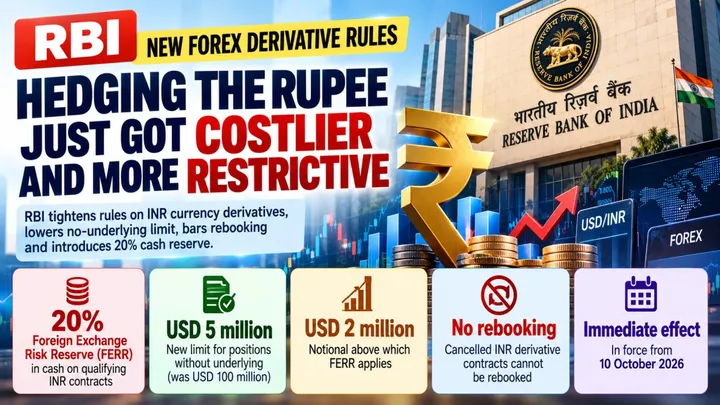
Hedging rupee exposure now needs more documentation, and Authorised Dealers must lock up cash against certain hedges. On 10 October 2026 the RBI cut the threshold for taking INR foreign exchange derivative positions without establishing an underlying exposure from USD 100 million to USD 5 million equivalent, barred rebooking of INR derivative contracts cancelled after the circular, and required Authorised Dealers to maintain a Foreign Exchange Risk Reserve (FERR) in cash, equal to 20% of notional, on contracts above USD 2 million that hedge current account purchases of foreign currency.
Quick Answer
By A.P. (DIR Series) Circular No. 25 (RBI/2026-27/291) and Circular No. 26 (RBI/2026-27/292) dated 10 October 2026, the RBI told Authorised Dealers that, with immediate effect: (1) they shall not permit users to rebook any INR foreign exchange derivative contract, deliverable or non-deliverable, cancelled with any Authorised Dealer after the issuance of the Directions, although rollover on maturity continues; (2) the threshold for positions without establishing underlying exposure falls from USD 100 million to USD 5 million equivalent, both for hedging contracted exposure across all Authorised Dealers and for exchange-traded INR positions across all Recognised Stock Exchanges together; (3) they must obtain and retain an undertaking from users that the same underlying exposure has not been hedged with another Authorised Dealer; and (4) they must maintain a Foreign Exchange Risk Reserve (FERR) in cash with the Reserve Bank, equal to 20% of the INR equivalent of the notional, for INR contracts above USD 2 million equivalent undertaken to hedge current account transactions where the user is purchasing foreign currency against INR.
What Changed in the RBI Forex Derivative Rules?
The circulars refer to the Master Direction – Risk Management and Inter-Bank Dealings dated 5 July 2016, as amended from time to time, and reset the thresholds that operate under the proviso to para 2.4(i) and para 3.4(i) of Section I of Part A. They do not themselves say that they amend the Master Direction. The press release (2026-2027/1305) says the measures follow evolving conditions and are intended to ensure orderly functioning of the foreign exchange market, strengthen market discipline and ensure appropriate risk management. Where the circulars do not state the earlier position, the table says so.
Who Is Affected?
What Is the New USD 5 Million Limit?
- OTC hedging of contracted exposure: under the proviso to para 2.4(i) of Section I of Part A of the Master Direction, the USD 100 million facility (across all Authorised Dealers) falls to USD 5 million equivalent of notional value outstanding at any point of time.
- Exchange-traded currency derivatives: under para 3.4(i), the single USD 100 million limit across all currency pairs involving INR and across all Recognised Stock Exchanges falls to USD 5 million equivalent.
- Beyond the limit: a user needs to establish the existence of an underlying exposure.
Can Users Still Rebook or Roll Over Forex Derivatives?
What Documentation Must Authorised Dealers Collect?
- An undertaking from the user, at the time of offering an INR derivative to hedge a contracted exposure, that the same underlying exposure has not been hedged with any other Authorised Dealer.
- If the exposure is hedged in parts with several dealers, the undertaking must clearly state the amounts already booked with the others.
- The undertaking can be part of the deal confirmation. It is in addition to documents called for under para 2.4(iv) of Section I of Part A.
- The Authorised Dealer is responsible for compliance, including the existence of underlying exposure, and must retain the documents for not less than two years.
What Is the Foreign Exchange Risk Reserve (FERR)?
Under para 3 of Circular No. 26, any attempt by users to circumvent the requirements in para 2(ii), meaning the USD 2 million notional threshold and the scope of hedging current account transactions where the user purchases foreign currency against INR, through multiple transactions with one or more Authorised Dealers is considered a violation of the Directions.
When Do the New Forex Derivative Rules Apply?
10 October 2026: Both circulars issued and in force with immediate effect.
From 10 October 2026: Rebooking ban applies to contracts cancelled after the circular is issued; USD 5 million thresholds and the undertaking requirement apply.
Daily: FERR deposited and reported through CIMS.
There is no transition period. The circulars are issued under Sections 10(4) and 11(1) of FEMA, 1999 and Section 45W of the RBI Act, 1934, and are without prejudice to permissions or approvals required under any other law.
Compliance Checklist
The circulars state no separate penalty. Circular No. 26 treats attempts by users to circumvent the para 2(ii) conditions through multiple transactions as violations of the Directions.
Open Questions to Watch
- Existing positions. The circulars apply with immediate effect but do not say how contracts booked before 10 October 2026, or positions already above USD 5 million, are treated. For FERR, the text refers to each derivative contract without a cut-off.
- FERR scope. The Reserve is tied to users purchasing foreign currency to hedge current account transactions. The text is silent on other hedging cases.
- Cost of FERR. Whether the cash reserve earns any return is not stated.
- "Users". Exact categories follow the Master Direction and are not redefined here.
- Rebooking cut-off. The rule covers a contract "cancelled with any of the Authorised Dealers, after the issuance of these Directions". This article reads "after the issuance" as qualifying the cancellation, so contracts cancelled before 10 October 2026 are not covered. The wording could also be read as barring rebooking after that date of a contract cancelled earlier, so confirm the position with your Authorised Dealer or the RBI.
Frequently Asked Questions
What is the RBI Foreign Exchange Risk Reserve (FERR)?
FERR is a cash reserve equal to 20% of the INR notional of a qualifying foreign exchange derivative contract, which Authorised Dealers must deposit and maintain with the RBI daily until the contract terminates.
Which contracts attract FERR?
INR foreign exchange derivative contracts with users, of notional value exceeding USD 2 million equivalent, undertaken to hedge current account transactions where the user purchases foreign currency against INR.
What is the new limit for forex derivative positions without underlying exposure?
USD 5 million equivalent of notional value outstanding at any time. It was USD 100 million for both OTC hedging across Authorised Dealers and exchange-traded INR positions across Recognised Stock Exchanges.
Can I rebook a cancelled forex derivative contract?
No. Authorised Dealers shall not permit users to rebook any INR foreign exchange derivative contract, deliverable or non-deliverable, that has been cancelled with any Authorised Dealer after the issuance of the Directions on 10 October 2026. Rollover of contracts on maturity continues to be permitted, subject to the Master Direction.
Are rollovers still allowed?
Yes. Authorised Dealers may continue to permit rollover of contracts on maturity, subject to the Master Direction.
When did these rules take effect?
Both circulars came into force with immediate effect on 10 October 2026.
What undertaking must users give?
A statement that the same underlying exposure has not been hedged with any other Authorised Dealer, with details of amounts booked elsewhere if the exposure is hedged in parts.
How do Authorised Dealers report FERR?
They report details of the FERR maintained on a daily basis through the RBI's Centralised Information Management System (CIMS).
CorpLawUpdates Analysis
The package arrives three days after the 7 October monetary policy, where the Governor said the RBI is committed to orderly exchange rate adjustments and curbing excessive volatility. The circulars themselves cite only evolving market conditions and orderly functioning of the market, so any link to the rupee is our reading, not an RBI statement. For corporate treasuries, the immediate issue is documentation: positions to hedge a contracted exposure above USD 5 million equivalent now need the underlying exposure established, and the no-duplicate-hedge undertaking applies to INR derivative contracts offered to hedge a contracted exposure, with no size threshold stated in the circular. Users hedging current account purchases of foreign currency above USD 2 million may see higher quotes because dealers must lock up cash. Banks need daily FERR processes and CIMS reporting in place at once. These are editorial views, not RBI statements.
Documents: (1) A.P. (DIR Series) Circular No. 25, Risk Management and Inter-Bank Dealings; (2) A.P. (DIR Series) Circular No. 26, Risk Management and Inter-Bank Dealings – Foreign Exchange Risk Reserve; (3) Press Release: RBI Announces Regulatory Measures for the Foreign Exchange Market.
Issuing authority: Reserve Bank of India, Financial Markets Regulation Department.
Reference: RBI/2026-27/291 (Circular 25) and RBI/2026-27/292 (Circular 26), both dated 10 October 2026; Press Release 2026-2027/1305.
Signatories: Dimple Bhandia, Chief General Manager (circulars); Brij Raj, Chief General Manager (press release).
Powers: Sections 10(4) and 11(1), FEMA, 1999; Section 45W, RBI Act, 1934.
Refers to: Master Direction – Risk Management and Inter-Bank Dealings dated 5 July 2016, as amended from time to time (thresholds under the proviso to para 2.4(i) and para 3.4(i) of Section I of Part A).
Primary source: A.P. (DIR Series) Circulars No. 25 (RBI/2026-27/291) and No. 26 (RBI/2026-27/292) and Press Release 2026-2027/1305, dated 10 October 2026 (www.rbi.org.in)
This article is for informational and educational purposes only and does not constitute legal or regulatory advice. Readers should verify the applicable primary regulatory source before taking action.