✅ Final Circular — Immediate Effect
RBI A.P. (DIR Series) Circular No. 18 | Issued by Reserve Bank of India | Dated: June 24, 2026 | Effective: Immediate | Addressed to: All Authorised Persons
📋 Quick Reference
Why RBI Withdrew 732 FEMA Circulars in June 2026
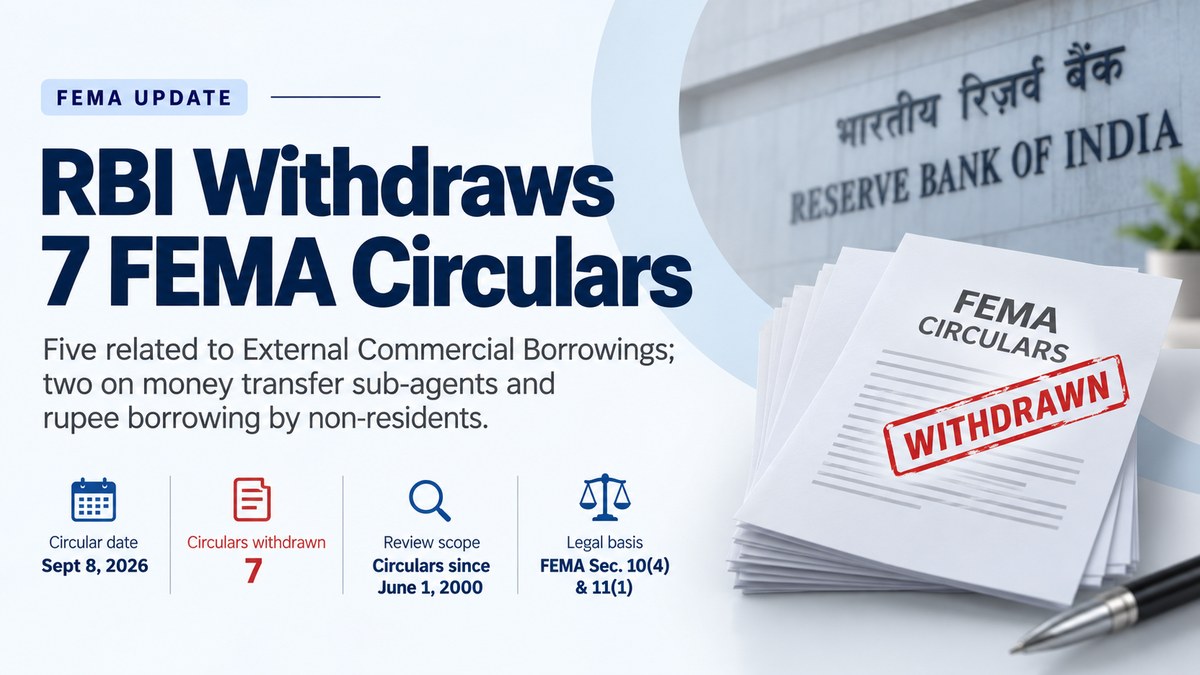
On June 24, 2026, the Reserve Bank of India issued A.P. (DIR Series) Circular No. 18 under FEMA, 1999 — formally withdrawing 732 circulars that have accumulated under the A.P. (DIR Series) since the FEMA framework came into effect in June 2000. This is one of the largest single regulatory housekeeping exercises undertaken by the RBI in the foreign exchange space, and it is part of the central bank's ongoing initiative to rationalise and simplify the regulatory architecture under the Foreign Exchange Management Act, 1999.
The FEMA regulatory framework operates through a tiered structure: the Act itself, Notifications issued by the Ministry of Finance, Regulations notified by RBI, and a very large body of Directions/Circulars addressed to Authorised Persons (AD Category-I banks, AD Category-II entities, and Authorised Money Changers). Over the 25 years since FEMA replaced FERA in June 2000, this last layer — the A.P. (DIR Series) circulars — grew into a sprawling archive of over a thousand standalone communications covering everything from ECB all-in-cost ceilings reviewed quarterly, to one-time Exim Bank Line of Credit notifications, to now-redundant AML compliance instructions that have since been consolidated into Master Directions.
The problem was that many of these circulars remained formally "alive" in the regulatory record even after their content was absorbed into, amended by, or entirely superseded by later Master Directions and consolidated frameworks. This created confusion for Authorised Persons trying to identify the current applicable instruction — practitioners had to trace a chain of circulars, identify which were still operative, and reconcile conflicts. The June 24 circular cuts through this by formally withdrawing 732 such defunct circulars in one sweep, leaving the Master Direction framework as the primary surviving regulatory layer.
What the Circular Does — Operative Provisions
⚠️ Core Action: 732 A.P. (DIR Series) circulars listed in the Annex to this circular stand withdrawn with immediate effect from June 24, 2026. Authorised Persons must not rely on, cite, or apply any of these circulars going forward.
📌 Grounds for Withdrawal (Para 1): The circular specifies four reasons a circular may be listed in the Annex:
- Subsequent regulatory amendments — later rules or notifications changed the position
- Redundancy — the circular served a one-time purpose (e.g., Exim Bank LoC notifications)
- Overlap — another instruction covers the same ground
- Supersession by newer directives — a Master Direction or later circular replaced it
The circular is brief and operative in nature — there are only three substantive paragraphs. Paragraph 1 states the withdrawal action and provides the Annex reference. Paragraph 2 instructs Authorised Persons to notify their constituents (customers, corporate clients, branches) of the withdrawal. Paragraph 3 states the statutory basis — Section 10(4) (power to issue directions to Authorised Persons) and Section 11(1) (power to call for information) of FEMA, 1999 — and importantly preserves the without-prejudice clause: the withdrawal does not affect any permissions or approvals required under any other law.
✅ What Continues: All current FEMA obligations, limits, and permissions remain governed by the surviving Master Directions (e.g., Master Direction on Export of Goods and Services, Master Direction on Liberalised Remittance Scheme, Master Direction on ECB and Trade Credits, Master Direction on FDI). Only the standalone circulars listed in the Annex are extinguished.
The Annex — 732 Withdrawn Circulars: Category Breakdown
The Annex (provided as an Excel file) lists all 732 circulars by serial number, subject, A.P. (DIR Series) Circular number, and date. The circulars span June 2000 to December 2023. The following breakdown categorises them by regulatory subject matter:
🏦 Exim Bank Lines of Credit
100+ circulars notifying individual Exim Bank Government of India-supported Lines of Credit to foreign governments and banks across Africa, Asia, Latin America, and Eastern Europe — all one-time notifications with no continuing regulatory obligation.
💱 External Commercial Borrowings (ECB)
100+ ECB-related circulars covering policy liberalisation, all-in-cost ceiling reviews, end-use clarifications, sector-specific windows (civil aviation, MFIs, SEZs, housing), and pre-2019 New ECB Framework architecture — all superseded by the Master Direction on ECB and Trade Credits.
🛡️ AML / KYC / CFT Standards
~50 circulars on KYC norms, Anti-Money Laundering standards, and Combating Financing of Terrorism obligations for Authorised Money Changers and MTSS operators — now consolidated under Master Directions and PMLA-linked guidelines.
🇺🇸 Deferred Payment Protocols — Erstwhile USSR
79 circulars relating to Deferred Payment Protocols dated April 30, 1981 and December 23, 1985 between the Government of India and the erstwhile USSR — a Cold War-era bilateral trade mechanism now entirely defunct following the dissolution of the Soviet Union.
📈 Foreign Direct Investment (FDI)
60+ FDI-related circulars covering sector-specific conditions (pharma, telecom, print media, insurance, defence, construction, retail), pricing guidelines, FIPB approval procedures, e-Biz platform filings, and downstream investment guidelines — now governed by the consolidated FDI Policy and FEMA (Non-Debt Instruments) Rules, 2019.
💵 Exchange Earners' Foreign Currency (EEFC) Account
20+ circulars on the EEFC Account scheme — liberalisations, scheme amendments, trade-related loans/advances clarifications, and reporting discontinuations — now subsumed within current FEMA (Foreign Currency Accounts) Regulations and Master Directions.
🌍 Liberalised Remittance Scheme (LRS)
15+ LRS circulars from the USD 25,000 origination (2004) through successive enhancements to USD 50,000, USD 100,000, USD 125,000, USD 200,000, and current USD 250,000 limit — now consolidated in the Master Direction on LRS.
🏠 NRI / PIO / FCNR / NRE Related
20+ circulars on NRI/PIO facilities, FCNR(B) accounts, NRE account operations, housing loans to NRIs, repatriation of assets, NRNR/NRSR account closures, and Power of Attorney operations — now governed by the Master Direction on Non-Resident Deposits.
🏗️ Branch / Liaison / Project Offices
15+ circulars on establishment, reporting, and delegation of powers relating to Branch Offices, Liaison Offices, and Project Offices of foreign entities in India — now governed by the Master Direction on Establishment of BO/LO/PO.
🔁 Trade Credits for Imports
15+ circulars on Trade Credits — all-in-cost ceiling reviews, Rupee-denominated trade credit introduction, and end-use clarifications — now absorbed into the Master Direction on ECB and Trade Credits.
📊 Other / Miscellaneous
Remaining circulars cover FCCB buyback/prepayment guidelines, India Millennium Deposits, Overseas Direct Investment liberalisation, GDR/ADR issues, Rupee Denominated Bonds (Masala Bonds), FDI in LLPs, Diamond Dollar Accounts, R-Return reporting changes, Foreign Investment via SEBI-registered FVCIs, and various one-time operational notifications.
Notable Individual Circulars Being Withdrawn
Among the 732 withdrawals, a few merit particular note from a historical regulatory perspective:
India Millennium Deposits (IMDs) — A.P. (DIR) Circular No. 18, 2000
The IMD scheme was a one-time special NRI deposit scheme launched in 2000 to mobilise foreign exchange. The scheme matured long ago; the circular has had no operative life for over two decades.
Delhi High Court Order — World Cup 2003 Remittances (A.P. DIR Circular No. 74/2003 and No. 52/2004)
Circulars relating to the Delhi High Court's directions on foreign exchange remittances connected to the 2003 ICC Cricket World Cup — clearly one-time event-specific directions with no residual applicability.
Deferred Payment Protocols — India–USSR (1981 and 1985)
These protocols governed bilateral trade settlements between India and the Soviet Union under rupee-rouble arrangements. Following the USSR's dissolution in 1991, these became legally academic. The RBI issued updating circulars on these protocols into the 2010s, all of which are now being cleaned up in this sweep — 79 circulars across the full time series.
LRS Origination — USD 25,000 Limit Circulars (2004)
The first Liberalised Remittance Scheme circulars from 2004, when the LRS was launched with a USD 25,000 annual limit for resident individuals, are being formally withdrawn. The current limit is USD 250,000 per financial year under the Master Direction on LRS.
LRS USD 125,000 Enhancement Circulars (2014)
Two circulars from June 2014 (A.P. DIR Series Circular Nos. 138 and 5 of 2014–15) that raised the LRS limit from USD 75,000 to USD 125,000 are also among the withdrawn entries. This step is often overlooked in the standard LRS timeline (the USD 200,000 limit was actually reached in September 2007, briefly; the 125,000 limit came later in 2014 after the limit had been scaled back). Both circulars are now withdrawn.
Before vs. After — Regulatory Framework Position
Compliance Checklist for Authorised Persons and Practitioners
Notify constituents immediately — Para 2 of the circular expressly requires Authorised Persons to bring the contents to the notice of their constituents. Corporate clients, exporters, importers, and foreign exchange users relying on any of the listed circulars must be informed by their AD banks or AMCs.
Audit all internal compliance manuals and checklists — Any FEMA compliance manual, internal SOP, or due diligence checklist that cites any of the 732 withdrawn circulars must be updated. Replace circular references with the corresponding Master Direction provision.
Review ECB documentation and compliance certificates — Companies with outstanding ECBs should verify that any compliance certificates, Form-83 filings, or lender documents referencing pre-2019 ECB policy circulars are updated to cite the Master Direction on ECB and Trade Credits (updated January 2019 and subsequently).
Update legal opinions and transaction advice notes — CS professionals and lawyers advising on FEMA transactions (ODI, FDI, ECB structuring, LRS, Branch/LO establishment) should confirm that no withdrawn circular is cited as primary authority in any outstanding legal opinion or regulatory filing.
Cross-check AML/KYC policies — AD Category-II entities and Authorised Money Changers should verify that their Board-approved AML/KYC/CFT policies do not cite any of the ~50 legacy AML/KYC/CFT circulars being withdrawn. Policies must reference the operative Master Direction on KYC.
Verify LRS customer documentation — Any customer Form A2 declarations or LRS annual limit tracking that references old LRS limit amounts (USD 25,000, USD 50,000, USD 100,000, USD 125,000) should be reviewed; the current limit is USD 250,000 per financial year governed by the Master Direction.
Download and retain the Annex — The full list of 732 withdrawn circulars is available in the Excel Annex to this circular. Download and archive this list as your definitive reference for what has been withdrawn. The list is available on the RBI website alongside the circular.
What This Means for FEMA Compliance — Practitioner Analysis
No ECB limit has changed. No FDI sectoral cap is different. The LRS ceiling remains USD 250,000 and AML obligations are exactly what they were on June 23, 2026. What this circular does is formally close the books on 732 circulars that were de facto dead but still sitting in the regulatory archive with no official burial. The practical payoff is a reduced compliance risk: a practitioner who cites a now-withdrawn circular in a legal opinion or regulatory filing can no longer argue that the citation was reasonable — the RBI has now drawn a bright line. This matters particularly as India's foreign exchange ecosystem grows more layered, with GIFT City and IFSC-specific regulations adding new instruments on top of an already complex FEMA framework.
From June 2000 onward, the RBI issued a new A.P. (DIR Series) circular each time a foreign exchange question needed an answer — quarterly ECB cost reviews got one circular per quarter; each Exim Bank Line of Credit triggered its own notification. By 2015–16, when the Master Direction framework was introduced to consolidate all of this, the standalone circular layer had already exceeded a thousand entries. The problem was that the old circulars were never formally taken off the books even as the Master Directions absorbed their content. The result: a practitioner researching the current ECB all-in-cost ceiling in 2024 would encounter a sequence of conflicting standalone circulars sitting above the Master Direction, with no clear signal from the RBI that they were defunct. This circular clears that ambiguity for 732 of those entries.
For compliance officers at AD Category-I banks, the most immediate action item is constituent notification. Para 2 of the circular uses the word "may" — making this discretionary rather than a mandatory direction — but the practical case for proactive notification is strong. Any corporate client that has, for example, been relying on a pre-2019 ECB circular for compliance certificate purposes needs to know that the circular has been formally withdrawn. AD banks would be well-advised to issue a brief client communication directing constituents to the corresponding Master Direction for ongoing queries.
For Professionals and Practitioners handling FEMA compliance mandates — FLA returns, ODI filings, FDI downstream reporting, Branch/LO annual activity certificates — this is a good moment to conduct a comprehensive cross-reference audit to ensure all filed documents and internal compliance frameworks cite current, surviving authority.
Looking ahead, this exercise is likely part of a broader regulatory rationalisation drive aligned with the Finance Ministry's announced goal of simplifying the foreign exchange regulatory framework as part of the FEMA Amendment agenda. Further rounds of similar housekeeping — covering other series of FEMA notifications — cannot be ruled out. Practitioners should also watch for a possible consolidation or simplification of the FDI policy framework, which continues to operate through a combination of FEMA (Non-Debt Instruments) Rules 2019, the annual Consolidated FDI Policy circular from DPIIT, and surviving RBI Master Directions.
📄 Source
Document: Review of Circulars issued under Foreign Exchange Management Act, 1999 (FEMA)
Reference: RBI/2026-27/175 | A.P. (DIR Series) Circular No. 18 | Dated: June 24, 2026
Issuing Authority: Reserve Bank of India (Foreign Exchange Department)
Signatory: Dr. Aditya Gaiha, Chief General Manager-In-Charge
Annex: List of 732 withdrawn circulars (Excel file accompanying the PDF circular)
This article is for informational and educational purposes only and does not constitute legal or regulatory advice. Verify with primary regulatory sources before acting.