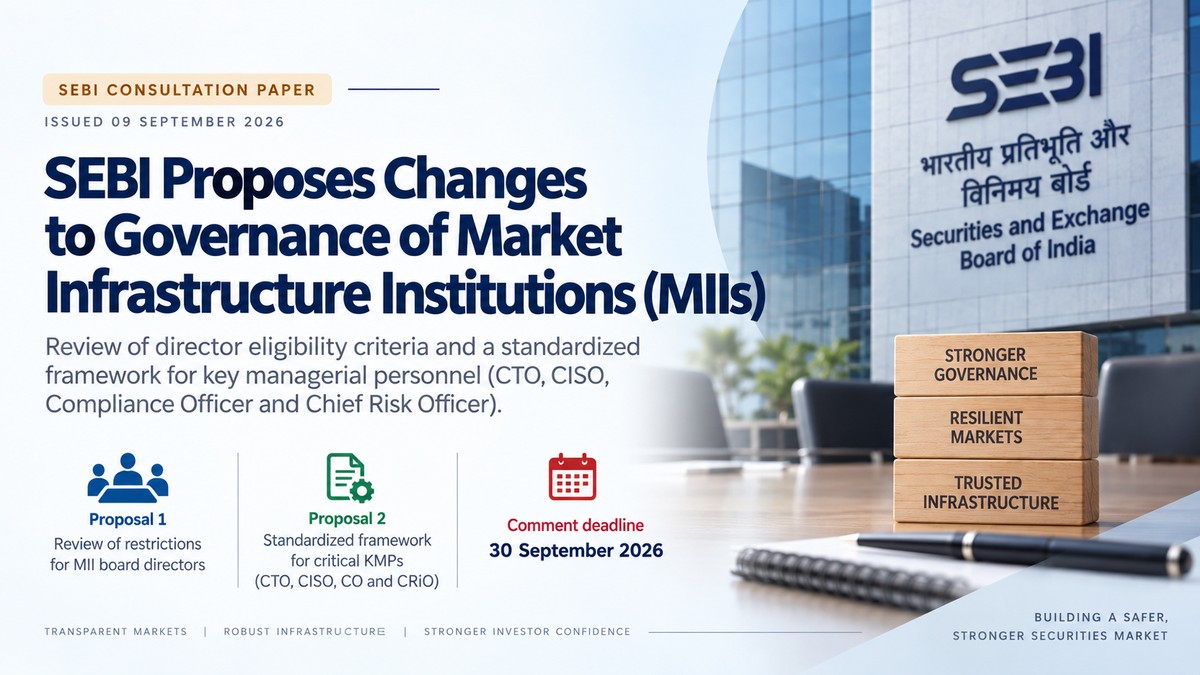
SEBI Proposes Changes to Governance of Market Infrastructure Institutions (MIIs)
SEBI has proposed two significant governance measures for Market Infrastructure Institutions: a review of eligibility criteria for directors on MII governing boards and a standardized framework for the qualification, experience, skill-set and certification requirements of critical Key Managerial Personnel such as the CTO, CISO, Compliance Officer and Chief Risk Officer.
Quick Answer: What Has SEBI Proposed?
SEBI's consultation paper proposes amendments to the Securities Contracts (Regulation) (Stock Exchanges and Clearing Corporations) Regulations, 2018 and the Securities and Exchange Board of India (Depositories and Participants) Regulations, 2018. The proposals are intended to address practical difficulties in finding suitable directors for MIIs and to bring greater standardization to the appointment of certain critical KMPs.
SEBI MII Governance Proposal: At a Glance
Review of Criteria for Appointment of Directors on MII Governing Boards
Why Is SEBI Reviewing the Existing Rule?
Following the demutualization of stock exchanges, representation of Trading Members (TMs) and Clearing Members (CMs) on governing boards was progressively restricted. Their collective representation was initially capped at one-third and was later reduced to one-fourth. The Bimal Jalan Committee subsequently recommended that no trading or clearing member, irrespective of the exchange on which it operates, should be permitted on the board of any stock exchange.
The recommendation was approved by the SEBI Board on 2 April 2012 and was later codified into the SECC Regulations, 2012. Similar restrictions were subsequently introduced for depositories in relation to Depository Participants (DPs).
What Practical Difficulty Has SEBI Identified?
SEBI states that MIIs have faced practical difficulty in finding suitable candidates, particularly for Public Interest Directors (PIDs), because the existing provisions can operate very broadly.
The consultation paper notes that a director of a company may become ineligible merely because, somewhere within a larger conglomerate or holding structure, a separate subsidiary has a business relationship as a TM, CM or DP. SEBI points out that some conglomerates operate through separate businesses with “Chinese walls” and limited or no interference between entities.
A broad corporate-association restriction can exclude experienced professionals from MII boards even when the individual's own role may have only a remote connection with a TM, CM or DP. SEBI proposes to review the framework to encourage the flow of expertise and talent into MIIs.
What Is the Existing Restriction?
Under Regulation 23(6) and related provisions of the SECC Regulations, 2018, a trading member, clearing member, or their associates and agents, irrespective of the recognized stock exchange or clearing corporation of which they are members, cannot be on the governing board of a recognized stock exchange or recognized clearing corporation.
A person who is a director in an entity that itself is a TM or CM, or has associates that are TMs or CMs, is deemed to be a TM or CM for this purpose, subject to specified carve-outs.
The D&P Regulations, 2018 contain a corresponding framework for depositories and their DPs.
The existing framework also requires recognised stock exchanges and recognised clearing corporations to monitor compliance on a continuous basis so that directors appointed to their governing boards do not subsequently become associated with a trading member or clearing member. Depositories have a corresponding continuous-monitoring obligation in relation to Depository Participants.
What New Carve-Out Is SEBI Proposing?
SEBI proposes to extend the existing carve-out, currently available in specified circumstances for directors of public financial institutions and banks, to directors of companies that have associates functioning as TMs, CMs or DPs where the company has well-diversified shareholding.
The proposed amendments would apply the concept in the SECC Regulations for TMs/CMs and make a corresponding amendment under the D&P Regulations for DPs.
How Would “Well-Diversified Shareholding” Be Defined?
The proposal further states that where shareholder(s) individually or together with persons acting in concert hold shares equal to or above the 10% stake or voting-rights threshold and those shareholder(s) are in the public sector, the company would be deemed to have well-diversified shareholding.
Does the Proposal Change the Rule for Depositories Too?
Yes. SEBI proposes to make similar amendments under Regulation 24(10) of the D&P Regulations, 2018, but in the context of association with Depository Participants.
Practical Example: How the Proposed Carve-Out Could Work
Hypothetical example: Assume Company A has a diversified ownership structure satisfying the proposed 10% test, while a separate entity within its broader group operates as a trading member. Under the proposed framework, the existence of that separate TM relationship would not automatically result in the same director being deemed a trading member for purposes of the MII-board restriction, provided the conditions of the proposed carve-out are satisfied.
This is an illustrative example only and is not a factual scenario stated by SEBI.
Standardized Qualification Framework for Critical MII KMPs
SEBI's second proposal focuses on the people responsible for some of the most critical control functions within MIIs: the Chief Technology Officer (CTO), Chief Information Security Officer (CISO), Compliance Officer (CO) and Chief Risk Officer (CRiO).
How Are These KMPs Appointed Today?
SEBI approves appointment, renewal and termination. Applications are forwarded by the MII's Governing Board.
The Governing Board approves appointment, reappointment, termination and resignation based on NRC recommendations.
The Nomination and Remuneration Committee approves appointment and removal of other KMPs.
Why Does SEBI Want a Standardized SOP?
SEBI describes MIIs as public infrastructure utilities for the capital markets that also function as first-line regulators. According to the consultation paper, CTO, CISO, CO and CRiO functions are central to technological resilience, cyber-security, compliance and risk management.
The consultation paper states that there is currently no standardized framework prescribing the qualification, experience, skill-set and certification requirements for these roles. SEBI considers a structured framework important because continuity and competence in these functions directly support the integrity and orderly functioning of the securities market.
Who Will Provide Inputs for the Proposed KMP SOP?
The proposed SOP would be approved by the Governing Board of the MII, taking into account inputs from the relevant statutory committees.
How Quickly Should Vacancies in These KMP Roles Be Filled?
Is This Already Law?
No. The document is a consultation paper inviting public comments. The proposed amendments and SOP framework should therefore not be treated as final binding requirements merely because they appear in the consultation paper.
The final regulatory position will depend on SEBI's subsequent decision and any amendments or directions that may ultimately be issued.
What Should Practitioners Watch?
What Can MIIs and Practitioners Do Now?
Because this is a consultation paper, there is no final compliance checklist to implement as law. However, affected stakeholders can prepare without assuming that the proposal will necessarily be adopted in its current form.
What Questions Has SEBI Asked Stakeholders?
For Part A, SEBI has asked:
2. Are there any other comments on Part A?
For Part B, SEBI has asked:
2. Do you agree with the proposed three-month vacancy timeline?
3. Should MIIs appoint deputies for CTO, CISO, CO and CRiO positions to ensure continuity?
4. Are there any other comments on Part B?
Frequently Asked Questions
What is SEBI proposing for MII governing-board directors?
SEBI proposes to extend an existing carve-out to directors of companies having associates that are TMs, CMs or DPs where the company has well-diversified shareholding, subject to the proposed conditions.
What is the proposed 10% threshold?
Under the proposal, no shareholder other than public-sector shareholders, individually or together with persons acting in concert, should directly or indirectly own 10% or more stake, control the company, or hold shares carrying 10% or more voting rights, subject to the wording of the proposed rule.
Does the proposal apply to depositories?
Yes. SEBI proposes corresponding amendments under Regulation 24(10) of the D&P Regulations, 2018 in relation to associations with Depository Participants.
Which KMP positions are covered by the proposed SOP?
The proposed framework covers the Chief Technology Officer, Chief Information Security Officer, Compliance Officer and Chief Risk Officer.
What would the proposed SOP cover?
The SOP would prescribe relevant qualification, experience, skill-set, certification and related requirements for the four specified KMP roles.
Who would approve the KMP SOP?
The Governing Board of the MII would approve the SOP after taking into account inputs from the relevant statutory committees.
What is the proposed timeline for filling a KMP vacancy?
The consultation paper proposes that the position be filled within 3 months from the date the position becomes vacant, with advance planning where a vacancy is anticipated.
Is the three-month vacancy requirement already mandatory?
No. It is a proposal contained in a consultation paper and should not be treated as a final binding requirement unless and until SEBI adopts it through the applicable regulatory process.
What is the deadline for submitting public comments?
Public comments and suggestions are invited latest by 30 September 2026.
CorpLawUpdates Analysis
The consultation paper is aimed at making MII governance more practical without abandoning the underlying conflict-of-interest safeguards. The most important shift proposed in Part A is an additional carve-out from the existing board-eligibility restriction for directors of companies having associates that are Trading Members, Clearing Members or Depository Participants, where the company satisfies the proposed well-diversified shareholding test. The proposal does not replace the underlying restriction; it would broaden the circumstances in which the carve-out is available.
For governance professionals, the proposed 10% threshold is likely to become a key screening metric if the proposal is finalized. However, ownership percentage alone would not be the only relevant consideration because the proposal also refers to control and voting rights, including holdings by persons acting in concert.
Part B is equally significant from a governance and continuity perspective. Instead of relying only on individual appointment decisions, SEBI proposes a standardized internal framework for four critical functions whose performance affects technology resilience, cyber-security, compliance and risk management. The consultation paper also highlights continuity by proposing advance vacancy planning and a three-month filling period.
Primary Source
Document: Consultation Paper on “Strengthening Governance of MIIs”
Issuing authority: Securities and Exchange Board of India (SEBI)
Issued on: 09 September 2026
Public comment deadline: 30 September 2026
The consultation paper covers the proposed review of MII governing-board director criteria, the proposed definition of well-diversified shareholding, the proposed SOP for CTO, CISO, Compliance Officer and CRiO appointments, the proposed three-month vacancy timeline, and the questions invited for public comments.


