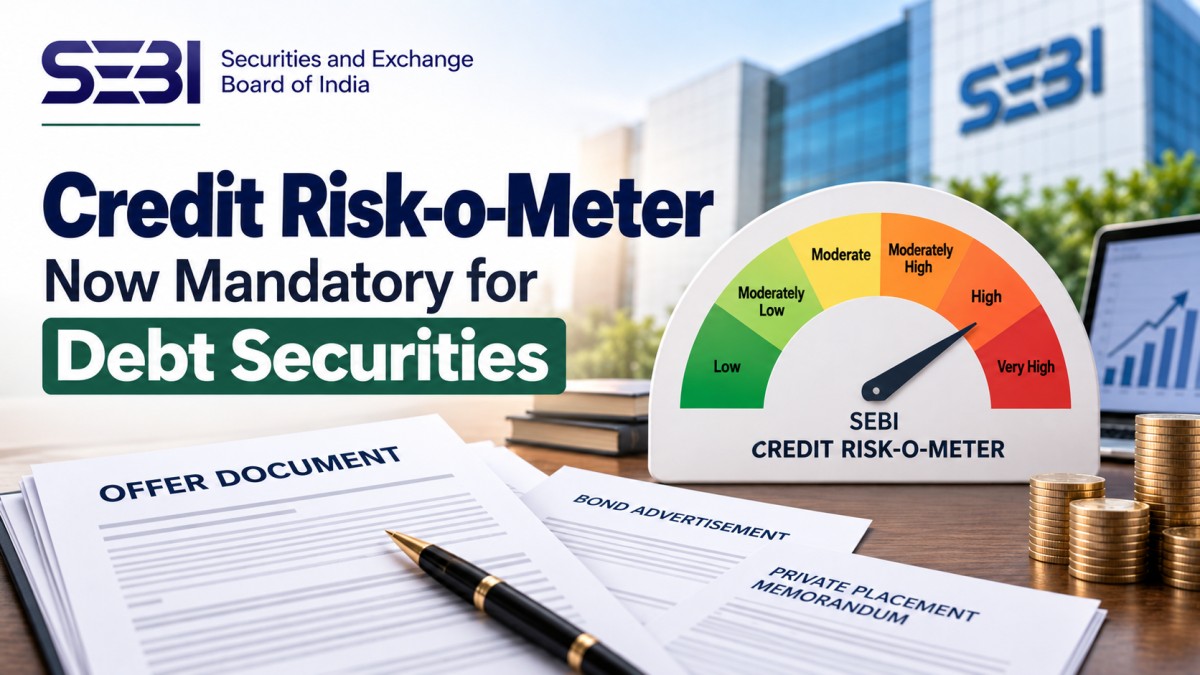
Offer documents, abridged prospectuses, private placement memorandums, advertisements and the web and mobile platforms of online bond platform providers (OBPPs) will have to carry a colour-coded Credit Risk-o-Meter for listed and proposed-to-be-listed debt securities. SEBI's circular of 7 October 2026 makes the meter mandatory after 45 days from issuance and maps SEBI's credit rating symbols, AAA to D, onto six colour-coded levels of credit risk. It covers non-convertible securities, commercial papers, securitised debt instruments, security receipts and structured debt or market linked debentures, whether issued by public issue or private placement.
Quick Answer
SEBI circular HO/17/11/22(1)2026-DDHS-POD1 dated 7 October 2026 makes the Credit Risk-o-Meter a mandatory component of offer documents, abridged prospectuses, private placement memorandums, all advertisements of issuers and Online Bond Platform Providers (OBPPs), and the web and mobile platforms of OBPPs. Annexure-A applies it to all listed and proposed-to-be-listed non-convertible securities (NCS), commercial papers, securitised debt instruments, security receipts and structured debt or market linked debentures, whether issued by public issue or private placement. The meter maps SEBI's credit rating symbols, AAA to D, to six risk levels and colours. The circular comes into force after 45 days from the date of issuance; counting from 7 October 2026 gives 21 November 2026 (calculated, not stated in the circular).
What Is the SEBI Credit Risk-o-Meter?
The Credit Risk-o-Meter is a pictorial, colour-coded meter that displays the credit risk of a debt security so that investors can assess it before investing. Under Annexure-A para 2.4, it maps SEBI's existing credit rating symbols, AAA to D, onto six levels of risk, so it does not introduce a new rating scale. Issuers and OBPPs must clearly indicate that the meter represents only the credit risk associated with the debt security (para 2.3), and OBPPs must derive the information solely from ratings assigned by SEBI-registered credit rating agencies (CRAs) (para 2.13.1).
What Changed for Debt Issuers and Bond Platforms?
Which Securities and Documents Are Covered?
Annexure-A applies to all listed and proposed to be listed issuances of Non-Convertible Securities (NCS), Commercial Papers (CPs), Securitised Debt Instruments (SDIs), Security Receipts (SRs) and Structured Debt or Market Linked Debentures (MLDs), whether by public issue or private placement. The meter must appear in:
- the offer document
- the abridged prospectus
- the private placement memorandum
- all advertisements of the issuer or OBPP
- web and mobile platforms of OBPPs
How Do Credit Ratings Map to the Six Risk Levels and Colours?
Annexure-A para 2.4 maps CRA rating symbols to six levels, each with a fixed colour and HTML colour code. The colour scheme applies to all digital and polychrome printed promotion material for the debt security.
What Must Be Written Below the Meter?
- Credit rating agency: the name of the CRA.
- Actual rating: the rating of the security in text format.
- Unsecured instruments: the word "unsecured" in bold red text.
These three items are listed in Annexure-A para 2.6. Separately, para 2.3 requires issuers and OBPPs to clearly indicate that the meter represents only the credit risk associated with the debt security. The circular does not say where that indication must be placed.
Special cases
Which Disclaimers Are Mandatory?
Issuers and OBPPs must place a prescribed disclaimer below the meter in the offer document, abridged prospectus and PPM, and display it suitably on web and mobile platforms. Use the exact wording in Annexure-A para 2.11 rather than a paraphrase.
- General disclaimer (para 2.11.1): the meter rests on evaluation of the issuer's credit risk, is not investment advice or a recommendation, and debt investments also carry market and liquidity risks.
- Unsecured perpetual bonds (para 2.11.2): the meter does not capture the unique structural risks of these instruments, which may carry the risk of total loss of invested capital. Investors are told to read the Information Memorandum or PPM carefully.
The circular does not say whether the para 2.11.2 disclaimer replaces or supplements the para 2.11.1 disclaimer for unsecured perpetual bonds. Check the stock exchange's formats before finalising the wording for such issues.
What Extra Duties Do Online Bond Platform Providers Have?
When Does the Credit Risk-o-Meter Requirement Take Effect?
7 October 2026: Circular issued.
After 45 days (around 21 November 2026): Provisions come into force.
Directions to exchanges and depositories (para 6): Stock exchanges and depositories are directed to put in place the necessary systems and processes, make necessary amendments to bye-laws, rules and regulations wherever applicable, bring the circular to the notice of existing and prospective issuers of debt securities and disseminate it on their websites. The circular does not set a separate deadline for these steps.
The circular says its provisions come into force after 45 days from the date of issuance. Counting 45 days from 7 October 2026 gives 21 November 2026, a Saturday (calculated). Because the wording is "after" 45 days, the first day of applicability could be read as 21 or 22 November 2026. Confirm with the exchange notices.
Who Is Affected?
Compliance Checklist
The timing column is a practical suggestion: the circular says only that its provisions come into force after 45 days, and it sets no separate deadline for the steps assigned to exchanges and depositories. The circular does not state a penalty for non-compliance. It is issued under Section 11(1) of the SEBI Act, 1992 read with Regulation 55(1) of the SEBI (Issue and Listing of Non-Convertible Securities) Regulations, 2021.
Open Questions to Watch
- Scope of advertisements. Para 1.4 says "all advertisements", while para 2.12.3 speaks of advertisements that explicitly reference the rating. The exchange or SEBI notices may clarify the boundary.
- Unrated or withdrawn ratings. The circular does not say how securities without a rating, or with a withdrawn rating, will be shown.
- Day count. Exact first day of applicability after the 45 days.
- Existing issuances. Annexure-A applies to all listed and proposed-to-be-listed issuances, but the circular has no transitional provision for securities already listed, continuing advertisements or OBPP listings of existing bonds. Wait for exchange or SEBI notices before assuming a position.
- Municipal debt securities. The NCS Master Circular covers municipal debt securities, but the applicability paragraph of Annexure-A names only NCS, commercial papers, securitised debt instruments, security receipts and structured debt or market linked debentures.
- QR code on monochrome advertisements. Para 2.12.4 appears in the OBPP section but refers to the website of the "OBPP/Issuer". The circular does not state expressly whether issuers' own monochrome advertisements must also carry the QR code.
Frequently Asked Questions
What is the SEBI Credit Risk-o-Meter?
It is a mandatory colour-coded pictorial meter showing the credit risk of a debt security, based on the rating from a SEBI-registered credit rating agency and mapped to six risk levels.
When does the Credit Risk-o-Meter circular come into force?
The Credit Risk-o-Meter circular comes into force after 45 days from its issuance on 7 October 2026. Counting 45 days from 7 October gives 21 November 2026 (calculated; the circular does not state a date), so confirm the first day of applicability with the exchange notices.
Which debt securities need the Credit Risk-o-Meter?
Listed and proposed to be listed NCS, commercial papers, securitised debt instruments, security receipts and structured debt or market linked debentures, whether issued by public issue or private placement.
Where must the Credit Risk-o-Meter be displayed?
In the offer document, abridged prospectus, private placement memorandum, all advertisements of issuers and OBPPs, and the web and mobile platforms of OBPPs.
What happens when a bond has ratings from two agencies?
The meter reflects the lowest rating. The issuer or OBPP may also disclose all ratings alongside the meter.
How fast must an OBPP update the meter after a rating change?
Within 24 hours of receiving intimation of the rating change from NSDL or CDSL, through an automated system.
Which colour represents the lowest credit risk?
Irish Green (#08A04B) represents lowest credit risk, which covers AAA long-term and A1+ short-term ratings.
Is there a special rule for AT1 and other unsecured perpetual bonds?
Yes. Para 2.11.2 of Annexure-A prescribes a specific disclaimer for unsecured perpetual bonds (such as AT1 bonds). It states that the Credit Risk-o-Meter does not reflect the unique structural risks of these instruments, which may carry the risk of total loss of invested capital, and advises investors to read the Information Memorandum or Private Placement Memorandum carefully before investing.
CorpLawUpdates Analysis
The meter is a presentation rule, so the heavy lifting falls on operations rather than legal drafting. For issuers, the immediate issue is redesigning offer documents and advertisement templates with fixed colour codes before the 45-day mark. For OBPPs, the harder part is engineering: a live NSDL/CDSL rating feed, automated 24-hour updates, a lock on manual overrides and audit logs. Showing only the lowest rating on the meter also means a single weak rating from one agency will drive the visual. These are editorial views, not SEBI statements.
Document: Circular on Introduction of Credit Risk-o-Meter as an additional disclosure mechanism for debt securities, with Annexure-A.
Issuing authority: Securities and Exchange Board of India, Department of Debt and Hybrid Securities.
Reference: HO/17/11/22(1)2026-DDHS-POD1, dated 7 October 2026.
Signatory: Rohit Dubey, General Manager.
Addressed to: issuers of debt securities, OBPPs, recognised stock exchanges and depositories.
Amends: SEBI Master Circular for issue and listing of Non-Convertible Securities, Securitised Debt Instruments, Security Receipts, Municipal Debt Securities and Commercial Paper dated 15 October 2025 (new Chapter II-C, "Disclosure of Credit Risk-o-Meter for debt securities", and new clause 14 in Annexure-XXIB of Chapter XXI).
Primary source: SEBI circular HO/17/11/22(1)2026-DDHS-POD1 dated 7 October 2026, available at www.sebi.gov.in under "Legal → Circulars" (para 8 of the circular).
This article is for informational and educational purposes only and does not constitute legal or regulatory advice. Readers should verify the applicable primary regulatory source before taking action.