📌 Key Facts at a Glance
-MRD-POD1/I/14266/2026
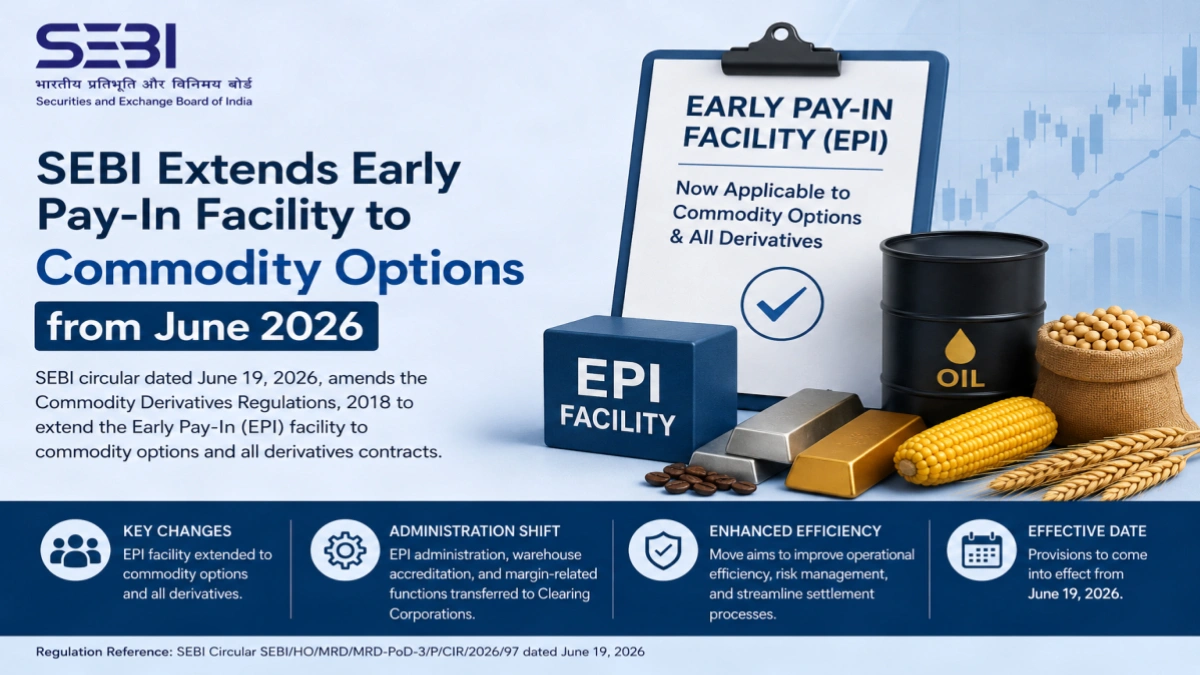
SEBI has issued Circular No. HO/47/16/13(4)2026-MRD-POD1/I/14266/2026 dated June 19, 2026, addressed to the Managing Directors and Chief Executive Officers of all Recognised Stock Exchanges and Clearing Corporations having a Commodity Derivatives Segment. The circular comes into force with immediate effect and makes two significant changes to the Early Pay-In (EPI) framework in the commodity derivatives segment: it extends the benefit of EPI from futures contracts to all derivatives contracts (including options), and it shifts the institutional responsibility for the EPI facility from Stock Exchanges to Clearing Corporations.
The circular revises Paragraph 11.3.1 of Chapter 11 of the SEBI Master Circular for Commodity Derivatives Segment (SEBI/HO/MRD/MRD-PoD-1/P/CIR/2023/136 dated August 04, 2023). It is issued in exercise of powers under Section 11(1) of the SEBI Act, 1992, read with Regulation 51 of the Securities Contracts (Regulation) (Stock Exchanges and Clearing Corporations) Regulations, 2018.
📜 Background — What Is Early Pay-In and Why Was It Being Extended?
What Is Early Pay-In (EPI)?
In commodity derivatives, Early Pay-In (EPI) is a facility that allows a market participant who holds a short position (i.e., has sold a derivatives contract) to voluntarily deliver the underlying commodity — by depositing certified goods into the Stock Exchange/Clearing Corporation accredited warehouse — before the standard settlement date. In return for making this early delivery, the participant's margin obligations for that short position are reduced: the exchange or clearing corporation may, based on its risk perception, exempt the participant from all types of margins on that position — except mark-to-market (MTM) margins, which continue to apply.
EPI is a practical tool for commodity producers, traders, and hedgers who already have physical stocks and want to lock in a price through a derivatives contract without the additional capital burden of posting margins throughout the contract's life. By depositing the actual commodity early, they demonstrate their ability to perform and are accordingly relieved of the margin requirement that would otherwise reflect delivery risk.
Under Para 11.3.1 of the August 2023 Master Circular, EPI was available only against relevant futures contracts sold. Market participants who sold commodity derivatives through options contracts could not avail of the EPI benefit — even if they held physical stocks of the underlying commodity in exchange-accredited warehouses.
The old Para 11.3.1 placed the EPI facility with Stock Exchanges. In practice, settlement in commodity derivatives involves Clearing Corporations as the central counterparty. The responsibility for EPI — including warehouse accreditation, goods deposit, and margin exemption determination — more naturally belongs with the Clearing Corporation, which manages risk and settlement centrally.
How This Circular Came to Be — The Regulatory Journey
📅 REGULATORY TIMELINE — FROM REPRESENTATION TO CIRCULAR
🏗️ Regulatory Foundation
📝 The Core Change — Old Para 11.3.1 vs. New Para 11.3.1
The circular's operative provision is the replacement of Para 11.3.1 of the August 2023 Master Circular. Here is exactly what changed:
🔍 Two Changes — Explained in Detail
🔒 What Remains Unchanged
- The fundamental mechanism of EPI — depositing certified goods against a short position to secure margin relief — remains the same.
- EPI continues to apply only to short positions (i.e., sold contracts). Buyers/long position holders are not covered.
- Mark-to-market (MTM) margins continue to be collected even after EPI is made. This position is explicitly preserved in the new text.
- The margin exemption is discretionary ("may exempt") based on the Clearing Corporation's risk perception — not automatic. Clearing Corporations retain the right to assess risk and determine the extent of margin relief on a case-by-case basis.
- The goods must be "certified goods" — only commodities meeting the quality and certification standards prescribed by the exchange/clearing corporation for delivery are eligible for EPI.
- The scope is confined to the Commodity Derivatives Segment. This circular does not affect the equity derivatives or currency derivatives segments.
📋 Before vs. After — EPI Framework in Commodity Derivatives
📊 Impact Analysis — Who Benefits and What Changes
🌾 Commodity Producers & Hedgers
The biggest beneficiaries. Farmers, agri-processors, traders, and commodity firms that hedge by writing options contracts can now avail EPI if they hold certified goods — eliminating the margin burden without liquidating their physical stock. Capital efficiency improves significantly.
⚙️ Clearing Corporations (NCCL, ICCL, MCX-CCL)
Must now establish or extend EPI infrastructure to cover options contracts — including warehouse accreditation systems, delivery workflow for options settlement, and updated margin computation logic. System changes required before implementation of EPI for options can begin in practice.
📈 Options Market Liquidity
Reducing the margin cost for options sellers who can make EPI may attract more physical commodity holders to write options — improving depth and liquidity in commodity options markets, particularly agricultural derivatives where physical delivery is common.
🏦 Stock Exchanges (MCX, NCDEX etc.)
The transfer of EPI responsibility to Clearing Corporations means exchanges must update their member-facing communications, circulars, and operational frameworks to reflect that EPI is now administered by the Clearing Corporation. No substantive loss of function — Exchanges remain the trading venue.
🏢 Trading Members / Brokers
Must update client advisories, margin systems, and back-office processes to reflect that: (a) EPI is now available for options, and (b) warehouse deposit and margin relief is administered by the Clearing Corporation. Client education on the new options-EPI facility will be important.
📋 Regulatory Consistency
This change aligns EPI treatment across futures and options contracts in commodities, removing an asymmetry that had no underlying policy justification. The delivery mechanism and margin logic are the same for both types of contracts when physical settlement is involved.
✅ Compliance Action Points
- ✅ Clearing Corporations (NCCL, ICCL, MCX-CCL etc.): Review and update operational frameworks for the EPI facility to: (a) extend coverage to options contracts, and (b) confirm that all warehouse accreditation, deposit procedures, margin exemption determinations, and MTM collection are now administered by the Clearing Corporation. Issue updated member circulars reflecting these changes.
- ✅ Stock Exchanges (MCX, NCDEX etc.): Update website disclosures, member communications, and bye-laws as directed under paragraph 4 of the circular, which requires Stock Exchanges and Clearing Corporations to bring the provisions to the notice of their members and disseminate them on their websites.
- ✅ Trading Members / Brokers: Update margin computation systems to reflect that EPI is now available for commodity options positions. Inform clients — particularly those holding physical commodity stock who write options — of this new facility. Coordinate with Clearing Corporations on the operational procedures for EPI on options contracts.
- ✅ Commodity market participants (hedgers, producers, traders): If you hold certified goods in Clearing Corporation accredited warehouses and have sold commodity options contracts, you may now be eligible for EPI on those options positions. Contact your trading member or the relevant Clearing Corporation to understand the procedures, eligibility criteria, and documentation required to avail this facility.
- ✅ Compliance and legal teams: Update internal policy documents and client-facing materials to reference the revised Para 11.3.1 of the Commodity Derivatives Master Circular. Note that this circular is available on the SEBI website under "Legal → Circulars" and "Info for → Commodity Derivatives."
This circular revises Para 11.3.1 of Chapter 11 of the SEBI Master Circular for Commodity Derivatives Segment (SEBI/HO/MRD/MRD-PoD-1/P/CIR/2023/136 dated August 04, 2023). The rest of Chapter 11 and all other provisions of the Master Circular remain unchanged. Compliance teams should read this circular alongside the Master Circular and treat the revised Para 11.3.1 as the operative text going forward.
This article is for informational purposes only and does not constitute legal or financial advice. Verify all details against the official SEBI circular before relying on this content for compliance purposes.