Transfer of Property Act, 1882 & Indian Easements Act, 1882
Rent / Lease Agreement Format (India) — Free Generator
Generate an enforceable, court-ready 11-month Leave & License or registered Lease Deed in Word (.docx) and PDF. Includes Maharashtra 0.25% stamp duty calculator, Model Tenancy Act caveats, digital stamping guidance, and AI custom clause drafter.
Free Word & PDF Downloads Maharashtra Digital Stamping Ready Built-in AI Custom Clause Drafter
1. Agreement Type & Execution Place
2. Owner / Licensor (First Party)
3. Tenant / Licensee (Second Party)
4. Scheduled Property Details
5. Commercial Terms & Rent Schedule
Maharashtra Stamp Duty & Registration Fee Calculator
Under the Maharashtra Stamp Act, stamp duty is levied at 0.25% on total rent + 10% notional interest per year on refundable deposit for tenures up to 5 years:
Total Rent₹3,85,000
10% Notional Int.₹9,167
Taxable Base₹3,94,167
Stamp Duty (0.25%)₹986
Registration Fee: ₹1000 (Urban) / ₹500 (Rural)w.e.f. 1 July 2025: Digital Stamping Mandatory
Need a custom clause? Describe it in plain words
Gemini 2.5Draft bespoke Indian-law compliant clauses & audit legal enforceability
Rent & Lease Agreement Legal Architecture in India
Statutory comparison: Transfer of Property Act vs Easements Act & Maharashtra Duty Formula
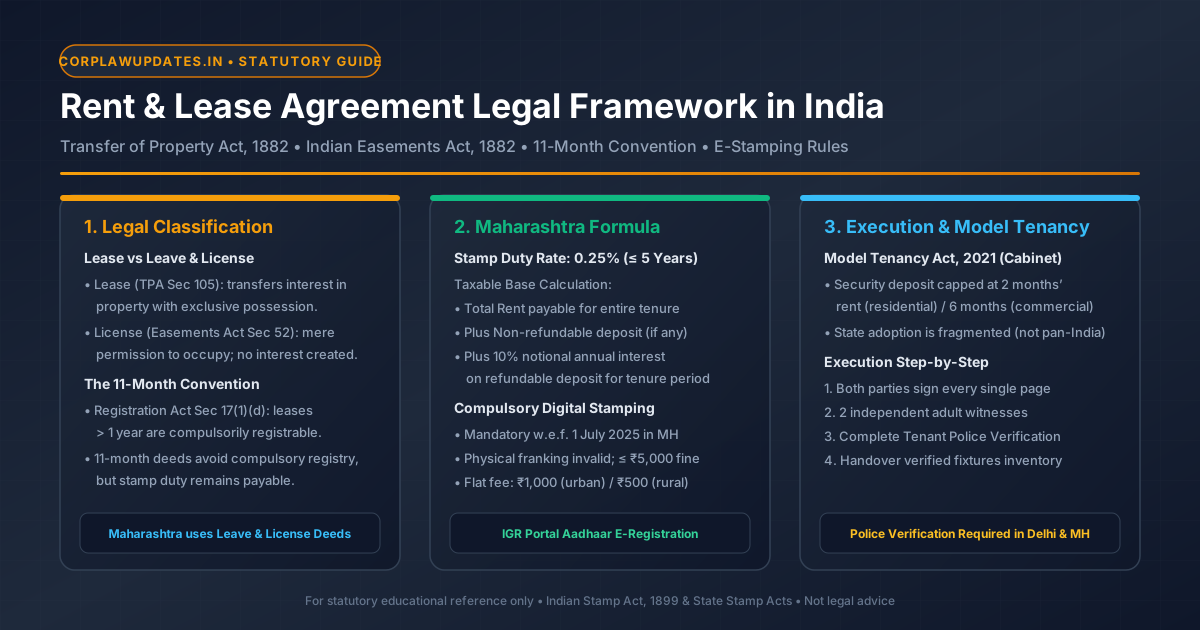
1. Legal Framework: Transfer of Property Act vs Indian Easements Act
Under Indian jurisprudence, residential and commercial tenancy arrangements derive their validity from two distinct statutory regimes:
Lease Deed (TPA, 1882)
Defined under Section 105 of the Transfer of Property Act, 1882 as a transfer of a right to enjoy immovable property for a certain time in consideration of price paid or promised. A lease creates an interest in the property and transfers exclusive possession to the lessee.
Section 106 Notice: 15 days for monthly tenancies, 6 months for agricultural / manufacturing leases.
Leave & License (Easements Act, 1882)
Defined under Section 52 of the Indian Easements Act, 1882 as a grant of permission to do something upon immovable property which would, in the absence of such right, be unlawful. A license confers a mere personal privilege without creating any legal estate or tenancy.
Maharashtra Convention: In Maharashtra, contracts are strictly Leave & License to prevent archaic tenant protections under the Rent Control Act.
2. The 11-Month Convention: Section 17(1)(d) Registration Act, 1908
The overwhelming prevalence of 11-month rental contracts across India is a deliberate legal construct rooted in Section 17(1)(d) of the Registration Act, 1908. Under this provision, leases of immovable property from year to year, or for any term exceeding one year, or reserving a yearly rent, are compulsorily registrable.
Why 11 Months and Not 12?
By restricting the tenure to eleven (11) months, parties avoid mandatory registration before the Sub-Registrar of Assurances. This saves substantial registration surcharges and cumbersome physical appearances while keeping the document admissible under the Indian Evidence Act.
Note on Stamp Duty: Even if an 11-month deed is unregistered, stamp duty is legally mandatory. An unstamped or deficiently stamped agreement cannot be impounded as primary evidence in court.
3. Maharashtra Stamp Duty Formula & Digital Mandate (July 2025)
Maharashtra maintains one of the most clearly codified stamp duty schedules in India for Leave and License agreements under Article 36A / 5(g-a) of the Maharashtra Stamp Act:
| Agreement Tenure | Applicable Stamp Duty Rate | Registration Fee |
|---|---|---|
| Up to 5 Years (≤ 60 months) | 0.25% of (Total Rent + Non-refundable deposit + 10% notional annual interest on refundable deposit) | ₹1,000 (Urban) / ₹500 (Rural) |
| 5 Years to 10 Years | 0.50% of the calculated taxable base | ₹1,000 (Urban) / ₹500 (Rural) |
| Above 10 Years | 1.00% of the calculated taxable base | ₹1,000 (Urban) / ₹500 (Rural) |
Worked Example (Mumbai 24-Month Lease):
Consider a monthly rent of ₹25,000 for 24 months with a refundable security deposit of ₹2,00,000:
- Total Rent = ₹25,000 × 24 months = ₹6,00,000
- Notional 10% Interest on Deposit = ₹2,00,000 × 10% × 2 years = ₹40,000
- Taxable Base = ₹6,00,000 + ₹40,000 = ₹6,40,000
- Stamp Duty (0.25%) = ₹6,40,000 × 0.25% = ₹1,600
Mandatory Digital Stamping (W.e.f. 1 July 2025):
In Maharashtra, digital e-stamping and e-registration through the state IGR (Department of Registration and Stamps) portal is compulsory. Physical stamp paper and franking are no longer legally recognized for rent deeds, and contravention carries penalties up to ₹5,000.
4. Stamp Duty in Other States (State-Specific Legislation)
Stamp duty is a state subject under Entry 63 of the State List (List II) of the Seventh Schedule to the Constitution of India. Rates vary widely across jurisdictions:
- Delhi (NCT): Leases up to 11 months typically require 2% on average annual rent or ₹100/₹500 non-judicial e-stamp depending on classification.
- Karnataka (Bengaluru): Stamp duty for residential leases up to 11 months is 0.5% to 1% of annual rent plus deposit or minimum stamp slabs.
- Uttar Pradesh & Haryana: Slabs depend on tenure and consideration, typically levied via e-stamping counters.
Always verify current local notification rates under your respective State Stamp Act prior to execution.
5. Model Tenancy Act, 2021: Scope and Essential Caveats
The Union Cabinet approved the Model Tenancy Act (MTA), 2021 on 2 June 2021 to balance the rights of landlords and tenants and replace archaic post-colonial rent control laws.
Key Tenets of the Model Tenancy Act:
- Mandatory Written Agreement: No tenancy is lawful without a registered formal contract submitted to the local Rent Authority within 2 months.
- Security Deposit Cap: Capped strictly at a maximum of 2 months’ rent for residential tenancies and 6 months’ rent for non-residential commercial premises.
- Fast-Track Dispute Adjudication: Three-tier hierarchy comprising Rent Authority, Rent Court, and Rent Tribunal, barring civil court jurisdiction.
- Subletting Ban: Prohibits subletting without prior supplementary agreement.
Crucial Legal Caveat: The MTA is a model law. It has no direct legal force unless individual state legislatures enact corresponding state tenancy statutes. States such as Andhra Pradesh, Tamil Nadu, and UP have aligned legislation, while other states continue under legacy laws.
6. Tenant Police Verification: Step-by-Step Procedure
Tenant police verification is mandatory in metropolitan jurisdictions (Delhi, Mumbai, Bengaluru, Gurugram, Pune) to ensure security and prevent unlawful occupancy:
- Collect Documents: Tenant’s government ID (Aadhaar/Passport/Voter ID), permanent address proof, employment letter/ID card, and 2 passport photos.
- Submission: File the prescribed Tenant Verification Form either through the state police citizen portal (e.g., Mumbai Police / Delhi Police portal) or physically at the local police station having jurisdiction over the property.
- Acknowledgment: Obtain the police seal and stamped acknowledgment slip. Keep a copy annexed to the original lease agreement.
7. Complete 7-Step Execution Checklist
- Choose Agreement Type: Select 11-month Leave & License (for Maharashtra) or standard Rent Agreement based on property location.
- Complete Document Form: Fill party details, property description, rent, deposit, and add any custom clauses via the AI builder.
- Procure Stamp Paper: Pay requisite state stamp duty via online e-stamp portal or IGR digital stamping (mandatory in Maharashtra).
- Signature on Every Page: Both Owner (Licensor) and Tenant (Licensee) must sign or initial at the bottom of every page, and affix full signature on the final execution block.
- Attestation by 2 Witnesses: Two adult, independent witnesses must sign with their full names and residential addresses.
- Registration: Complete biometric e-registration (if in Maharashtra) or register at the Sub-Registrar office if the tenure exceeds 11 months.
- Police Verification & Safekeeping: File tenant police verification and ensure both parties retain a complete executed original or certified copy.
Frequently Asked Questions (Rent & Lease Agreements)
Is an 11-month rent agreement legally valid without registration?
Yes. Under Section 17(1)(d) of the Registration Act, 1908, compulsory registration applies only to leases exceeding one year (or year-to-year). An 11-month agreement is legally valid without registration, provided proper stamp duty is paid under your state Stamp Act. However, registering the agreement is strongly recommended for stronger evidentiary enforceability in court.
What is the stamp duty on a rent agreement in Maharashtra?
Under the Maharashtra Stamp Act, stamp duty on Leave and License agreements for up to 5 years is 0.25% of the total consideration (total rent payable + non-refundable deposit + 10% notional annual interest on refundable deposit). For 5–10 years it is 0.50%, and above 10 years it is 1.00%. The registration fee is ₹1,000 in urban municipal corporation areas and ₹500 in rural areas. Digital stamping is mandatory w.e.f. 1 July 2025.
What is the difference between a lease and a leave and license agreement?
A lease (Transfer of Property Act, 1882, Section 105) transfers an interest in immovable property and confers exclusive possession to the tenant. A license (Indian Easements Act, 1882, Section 52) grants only a personal permission to occupy without transferring any legal interest or estate. In Maharashtra, residential and commercial rentals are framed as leave and license agreements to avoid rigid tenancy rights under state rent control statutes.
Is police verification of tenants mandatory?
Yes, in major urban centres including Delhi (under Delhi Police notifications) and Maharashtra (under local police commissionerate directives), landlords are legally required to submit a Tenant Police Verification form along with identity and address proofs. Failure to comply can invite prosecution under Section 188 of the Indian Penal Code (or Bharatiya Nyaya Sanhita).
What is the maximum security deposit a landlord can take?
The Union Model Tenancy Act, 2021 caps security deposits at a maximum of 2 months’ rent for residential properties and 6 months’ rent for commercial properties. However, because the Model Tenancy Act is a model framework adopted only by select states, prevailing market practices in cities like Bengaluru, Mumbai, and Hyderabad range from 2 to 10 months’ rent, governed by contract and state-specific laws.
Can the landlord increase rent during the agreement?
No, a landlord cannot unilaterally hike rent during the currency of an active term unless the agreement explicitly contains an escalation clause. Standard practice permits rent revision only at renewal (typically 5% to 10% per annum) with the execution of a fresh agreement or addendum.
Can a landlord evict a tenant before the term ends?
A landlord can only terminate an agreement before term expiry on specific grounds stipulated in the contract (such as non-payment of rent, unlawful subletting, or illegal activities) and must serve the agreed written notice period. Forcible eviction, locking the premise, or disconnecting electricity and water utilities is strictly illegal under Indian law; eviction must follow due process.