IBBI Discussion Paper: Proposed Amendments to CIRP, Liquidation and Personal Guarantor Regulations
🟡 Consultation Paper — Not Yet in Force
Issued by the Insolvency and Bankruptcy Board of India (IBBI). This is a Discussion Paper inviting public comments on proposed amendments to the CIRP, Liquidation, and Personal Guarantor Regulations. Comments must be submitted by 22nd July, 2026.
Background
IBBI has received representations from stakeholders flagging procedural gaps across the insolvency framework — spanning the appointment of registered valuers in CIRP, the fallout from the removal of interim moratorium protection for personal guarantors, the resolution professional's role during pending Section 12A withdrawal applications, and the administrative load on liquidators when updating the stakeholders' list. This Discussion Paper responds to those representations with four sets of proposed amendments across the CIRP Regulations, the two Personal Guarantor Regulations, and the Liquidation Process Regulations.
Several of the proposals trace directly to the Insolvency and Bankruptcy Code (Amendment) Act, 2026, particularly the withdrawal of automatic interim moratorium protection for personal guarantors and the constitution of a committee of creditors in the liquidation process — both of which require consequential regulatory changes to keep procedure aligned with the amended Code.
The Board proposes to finalise regulations under clauses (aa) and (t) of Section 196(1) read with Section 240 of the Code after considering public comments, which are open until 22nd July, 2026.
CoC Approval for Valuer Appointment, Report Deadlines and Confidentiality (Topic 1)
❌ The Problem
Registered valuers (RVs) under Regulation 27(1) are currently appointed by the resolution professional (RP) alone, with no committee involvement — despite valuation being central to plan evaluation. There is no deadline for RVs to submit their report, and no confidentiality procedure. Compounding this, Regulation 36(2)(ka) requires fair value to be disclosed in the Information Memorandum (IM) itself, undermining confidentiality at later stages.
✅ Proposed Solution
- Valuer appointment under Regulation 27(1) will require prior committee approval.
- The RP must share the IM with each RV; the RV must submit the fair value and liquidation value report — after accounting for the IM and physical verification of assets — in a sealed cover or secure electronic mode, on or before the last date for receipt of resolution plans.
- The sealed cover / secure record will be opened before the committee only on the plan-receipt date, after members give a confidentiality undertaking and comply with Section 29(2).
- The fair value disclosure requirement in the IM (Regulation 36(2)(ka) and its proviso) is proposed to be removed entirely.
- Regulation 35(2) is proposed to be omitted.
📝 Draft Regulation Text (Summary)
Regulation 27(1) inserts "with the prior approval of the committee." New sub-regulations 27(1A)–(1C) prescribe the sealed-cover submission and confidentiality mechanism. Regulation 35(2) stands omitted. Regulation 36(2)(ka), along with its proviso, stands omitted.
Topic 2: Intimation of Cessation of Interim Moratorium for Personal Guarantors
❌ The Problem
Before the Amendment Act, 2026, Sections 96 and 124 gave an automatic interim moratorium from the date of filing under Sections 94/95 and 122/123, applicable to all individuals including personal guarantors. The Select Committee found this was being misused by personal guarantors to obstruct recovery, causing value erosion. The Amendment Act accordingly inserted sub-section (4) into both Sections 96 and 124, disapplying interim moratorium to personal guarantors, effective 26th May, 2026. But for applications already pending admission on that date, the other party has no formal mechanism to learn that protection has lapsed.
✅ Proposed Solution
A new procedural obligation is proposed: the applicant must intimate the other party, in writing, within 30 days of commencement of the amending regulations, that interim moratorium no longer applies by virtue of the new Section 96(4) / 124(4). An explanation is also proposed clarifying that creditors may continue or initiate recovery proceedings against the personal guarantor for all pending applications as on 26th May, 2026.
⚠️ Deadline to Note
Intimation must be made within 30 days of commencement of the amending regulations — not 30 days from 26th May, 2026. The clock starts once these regulations are finalised and notified.
Topic 3: RP's Continuation in Office Pending Disposal of Section 12A Withdrawal
❌ The Problem
Stakeholders sought clarity on whether the RP must keep discharging CIRP duties while a committee-approved Section 12A withdrawal application is pending before the Adjudicating Authority (AA). Although this is implicit from reading Section 12A with Regulation 30A, no explicit provision confirms it.
✅ Proposed Solution
A clarification is proposed to be inserted after Regulation 30A(2), stating expressly that the RP shall continue to discharge CIRP responsibilities until the Section 12A withdrawal application is decided by the AA.
Topic 4: Modification of Entries in the List of Stakeholders
❌ The Problem
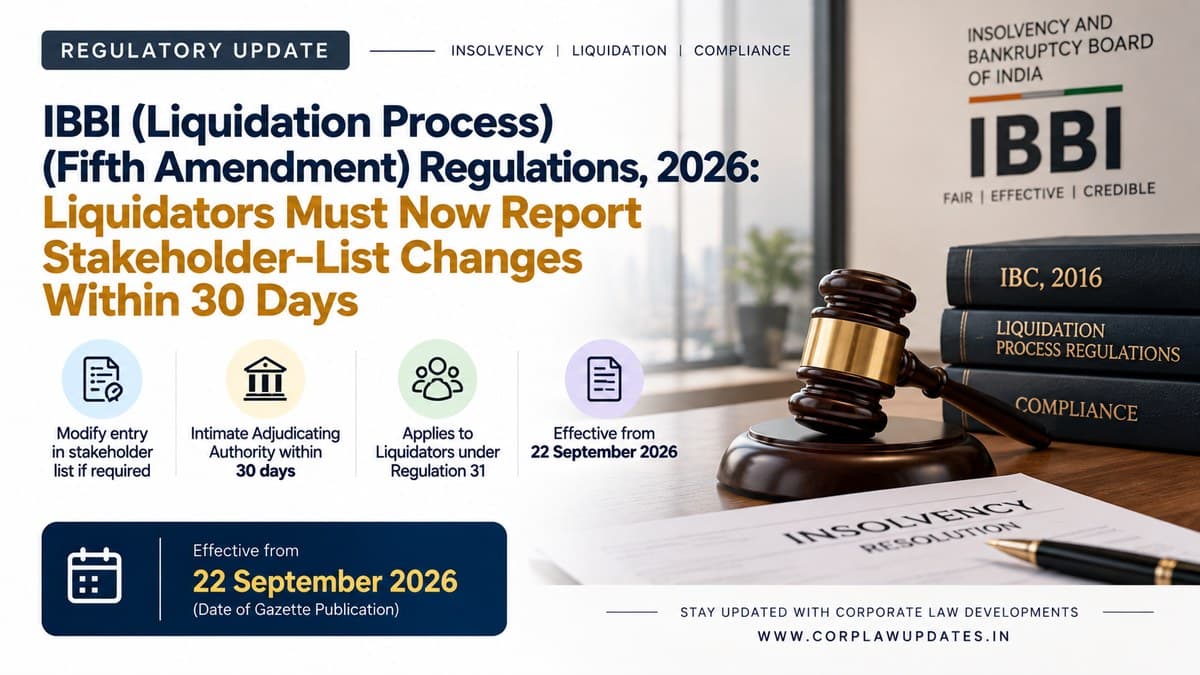
Regulation 31(3) and (4) of the Liquidation Regulations currently require the liquidator to approach the AA for any modification to the list of stakeholders, and to modify entries only as directed by the AA. This made sense when the only creditor body was the purely advisory Stakeholders' Consultation Committee under Regulation 31A. It no longer serves a purpose now that a committee of creditors exists in liquidation under the Amendment Act.
✅ Proposed Solution
Regulation 31(3) and (4) are proposed to be omitted entirely, since the committee of creditors now provides the oversight that previously required AA involvement for routine stakeholder list updates.
Key Changes: Earlier Framework vs Proposed Framework
Compliance Checklist
☑ RPs: Review current valuer engagement practices — factor in the upcoming CoC approval requirement before appointing RVs on live matters.
☑ RPs: Build a sealed-cover/secure-electronic workflow for valuation reports ahead of the plan-receipt date.
☑ IPs handling PG matters: Identify all Section 94/95/122/123 applications pending admission as on 26th May, 2026, that will need the 30-day intimation once the regulations are notified.
☑ Creditors of personal guarantors: Track the intimation deadline to resume or initiate recovery action once cessation is confirmed.
☑ RPs with pending Sec. 12A applications: Continue discharging CIRP duties in full until the AA decides the withdrawal application.
☑ Liquidators: Note that once finalised, stakeholder list updates will route through the committee of creditors instead of the AA.
☑ All stakeholders: Submit comments via the IBBI website by 22nd July, 2026 if any provision needs clarification or revision.
How to Submit Comments on the IBBI Discussion Paper
IBBI has prescribed a structured process for submitting comments, available on its website until 22nd July, 2026:
- Visit the IBBI website at www.ibbi.gov.in and select 'Public Comments.'
- Select the consultation titled 'Strengthening the Regulatory Framework — Amendments to CIRP Regulations, Liquidation Regulations and PG to CD Regulations.'
- Provide your name and email ID.
- Select your stakeholder category: Corporate Debtor, Personal Guarantor to a Corporate Debtor, Proprietorship firm, Partnership firm, Creditor to a Corporate Debtor, Insolvency Professional, Insolvency Professional Agency, Insolvency Professional Entity, Academic, Investor, or Others.
- Choose whether your comment is a General Comment or a Specific Comment.
- For General Comments, select the applicable category — e.g. inconsistency within a regulation, between regulations, between regulations and the Rules or the Code, or between the regulations and any other law; a difficulty in implementation; or a provision that should (or should not) have been included.
- For Specific Comments, select the relevant Topic Number (1–4) and Proposal Number, and write your comment against it.
- Comments on multiple Topics can be added by repeating the process before clicking 'Submit.'
CorpLawUpdates Analysis
The most consequential proposal here is arguably the sealed-cover valuation mechanism. Requiring CoC approval for valuer appointment, and locking the fair value report until the plan-receipt date, directly addresses the confidentiality gap IBBI itself has flagged — the absence of any standardised procedure to keep valuation reports confidential between submission and disclosure. Removing fair value from the IM closes a real leak in the confidentiality chain that regulation 36(2)(ka) had inadvertently created.
The personal guarantor intimation requirement is a practical fix to a legislative gap rather than a policy shift — the substantive change (removal of automatic interim moratorium) already happened via the Amendment Act on 26th May, 2026. What IBBI is doing here is plugging the notice gap so that creditors sitting on pending applications aren't left unaware their recovery options have reopened. Practitioners handling PG matters should proactively audit their pending dockets now rather than waiting for the regulations to be notified.
The Regulation 30A clarification and the Regulation 31 stakeholder-list change are both low-friction, high-utility fixes — they codify what most practitioners already assumed or reduce paperwork that no longer serves a purpose given the committee of creditors now exists in liquidation. In our reading, these two are the least likely of the four topics to draw substantive objections during the comment period, though stakeholders should still review the draft text closely.
Watch for how IBBI defines "commencement of the amending regulations" in the final text — since the 30-day PG intimation clock runs from that date, not from 26th May, 2026, the actual compliance deadline will only become clear once these proposals are finalised and notified.
Source: Discussion Paper — "Strengthening the Regulatory Framework: Amendments to CIRP Regulations, Liquidation Regulations and PG to CD Regulations," Insolvency and Bankruptcy Board of India. Public comments open till 22nd July, 2026, submitted via www.ibbi.gov.in.
This article is for informational and educational purposes only and does not constitute legal or regulatory advice. Verify with primary regulatory sources before acting.