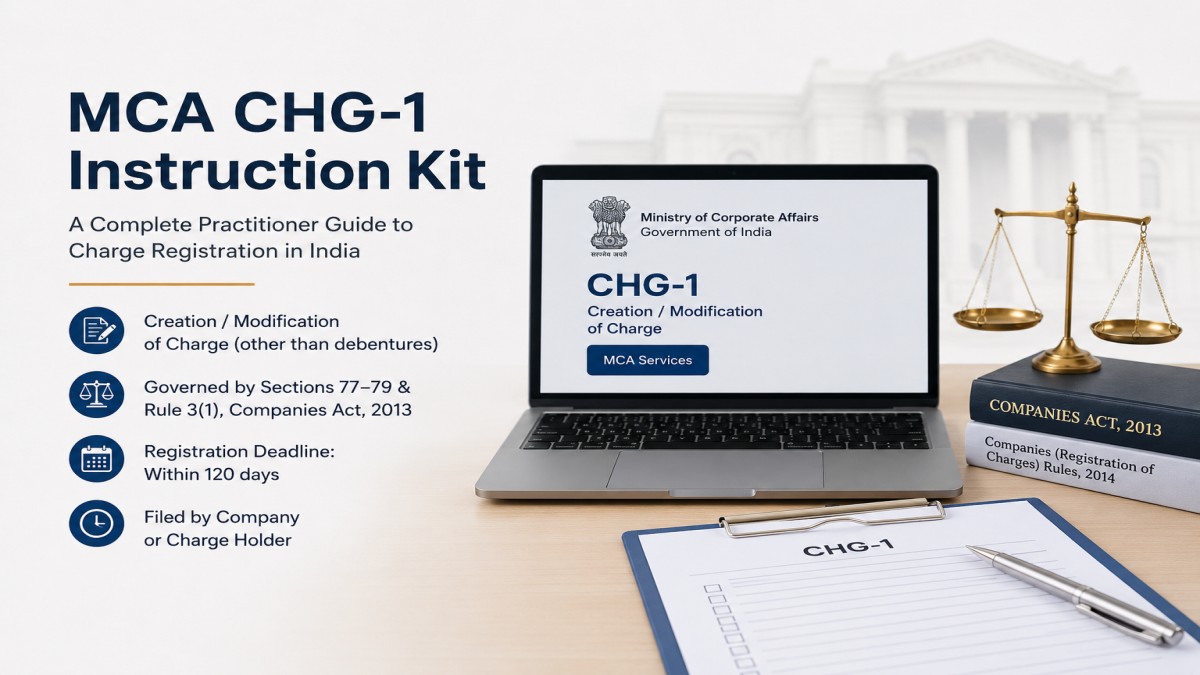
Document Type: Instruction Kit / User Guide for webform CHG-1
Governing Provisions: Sections 77–79 (Section 378 for foreign companies), Companies Act, 2013; Rule 3(1), Companies (Registration of Charges) Rules, 2014 — currently in force
Every time a company pledges an asset as security for a loan, that pledge is invisible to the outside world until it's registered with the Registrar of Companies. That registration — filed through the MCA CHG-1 webform — is what turns a private lending arrangement into a fact the market can rely on: a bank checking a company's asset position, or a creditor deciding whether to extend credit, both depend on the charge register being accurate and current. Miss the filing window, and the charge can become unenforceable against the company's liquidator or other creditors, regardless of what the loan documents say.
CHG-1 covers the creation or modification of any charge other than one relating to debentures, and it also absorbs a specific SARFAESI-era scenario: modification of a charge in favour of an Asset Reconstruction Company (ARC) or an assignee, where a distressed loan has been sold on to a specialised recovery entity. The Instruction Kit that MCA has published walks filers through the entire lifecycle — from first login to final acknowledgement — and this guide distils that kit into a practitioner-usable reference, covering every field, deadline, and fee rule it contains.
This is aimed equally at a CS trainee filing their first CHG-1 and a compliance head managing a consortium-financed charge across multiple lenders — the mechanics are the same, but the stakes rise quickly once multiple charge holders, ranks, and percentage extents enter the picture.
Under Section 2(16) of the Companies Act, 2013, a "charge" is any interest or lien created on a company's property or assets as security — a mortgage is the most familiar example. Think of it as a formal IOU with collateral attached: if the company can't repay, the charge holder has a legal claim on that specific asset ahead of unsecured creditors. Registering it with the RoC is what makes that claim visible and enforceable.
What Law Governs the CHG-1 Webform, and Who Needs to File It?
CHG-1 is filed pursuant to Sections 77, 78 and 79 of the Companies Act, 2013 — and, for foreign companies, Section 378 read together with those same three sections — along with Rule 3(1) of the Companies (Registration of Charges) Rules, 2014. Its job is to let a company notify its Registrar of Companies of a charge it has created or modified. Importantly, the obligation doesn't stop at charges the company itself creates: if a company acquires property that already carries a charge, it must also furnish particulars of that pre-existing charge. And a single asset can carry more than one charge simultaneously, provided the existing charge holder consents — which is exactly the scenario the webform's "consortium finance" and "joint charge" fields are built to handle.
Rule 3 of the Companies (Registration of Charges) Rules, 2014 does not apply to a charge created or modified by a banking company in favour of the Reserve Bank of India, where the loan or advance was made under Section 17(4)(d) of the RBI Act, 1934. This carve-out was inserted by the Companies (Registration of Charges) Amendment Rules, 2022 (effective 27 April 2022), and it means such charges are not required to be filed on CHG-1 at all.
Check Points Before You Start Filling the Form
- Read the instructions and guidelines carefully before starting the online application.
- Attach only the mandatory supporting documents, and only in the specified format.
- For resubmissions, the CHG-1 application must still be available in the user's application history, and the 15-day window from the "Resubmission Required" date must not have lapsed.
- The filing company must have a valid, approved CIN or FCRN.
- The DSC attached must be registered on the MCA portal against the DIN, PAN, or membership number entered in the form.
- The applicant must be registered as a Business User on the MCA portal before filing.
- The signing authority's DSC must be valid, non-expired, and non-revoked.
- Authorised signatories must hold an approved DIN, or a valid PAN or membership number, as applicable.
- If any field lacks space for the full information, additional details can be provided as an optional attachment.
- Check the "Notifications and alerts" function under "My Workspace" on the FO user dashboard for any flags on the application.
How Do You Access and Submit the CHG-1 Webform?
MCA offers two entry routes into the CHG-1 webform, and both converge on the same submission-to-acknowledgement sequence once the application itself is open.
Once inside the form, company information is entered — auto-populated for company users, searchable by name for professional users, and dropdown-selectable for other business users associated with multiple CINs. From there, both routes follow the same lifecycle:
If the DSC-affixed PDF isn't uploaded within 15 days of SRN generation, or fees aren't paid in time, the SRN is cancelled outright and the filing must start over.
Resubmission — What Changes if MCA Sends the Form Back
If a filed CHG-1 is marked "Resubmission Required," it can be reopened either through the application history on the user dashboard, or directly via the link in MCA's notification email. Either route leads back into the same form — filer corrects the flagged issues, saves as a draft if needed, and resubmits. The SRN is then updated, the DSC re-affixed, and the revised PDF re-uploaded.
Resubmission must be completed — including uploading the DSC-affixed PDF — within 15 days of the date the Back Office user marked the SRN for resubmission. If the DSC-affixed document isn't uploaded within 24 hours of the SRN update, MCA sends daily SMS and email reminders for up to 15 days or until submission, whichever comes first.
What Information Does CHG-1 Require, Field by Field?
The webform is built around a small number of decision points — is this a creation or a modification, is the applicant the company or the charge holder, are there multiple charge holders — that determine which fields become mandatory. Below is a working breakdown grouped by what each cluster of fields is actually trying to establish.
Company and Charge Identification
Dates and Filing Deadlines
- If a charge holder is the applicant, filing is not allowed before 30 days have elapsed from the charge date.
- Registration is not allowed beyond 120 days of the creation/modification date, regardless of applicant.
- The date entered must be on or after the date in Field 16 (prior modification date) and on or before the system date.
Field 16 (date of creation/last modification prior to the present one) is displayed only for modification filings, and is pre-filled from the charge master associated with the Charge ID in Field 3(b) where available.
Property Description and Multiple Charge Holders
Field 7(a) requires selecting at least one checkbox describing what the charge is on. Field 8(c) — number of charge holders — is where consortium and joint-charge scenarios diverge from single-lender filings:
If "No" is selected for both "Whether consortium finance is involved" and "Whether joint charge involved" — the number of charge holders is pre-filled and locked at 1.
If "Yes" is selected for both — the number of charge holders must be entered as greater than 1.
Once more than one charge holder is entered, the "List of Charge Holders" section appears, along with Download Excel and Import buttons — filers can populate the required number of rows in the downloaded template (.XLS format) and import it back, rather than entering each holder manually.
"Pari passu" means charge holders rank equally — no one gets paid first if the asset is sold, they share proportionally. Consortium finance is when multiple lenders jointly fund one loan (each holding a defined share); a joint charge is when multiple, independent charge holders share security over the same asset. The webform's rank, percentage, and amount fields exist specifically to record how that shared claim is split.
Amount Secured by the Charge
Acquiring Property That's Already Charged
Field 12 exists for the scenario where a company acquires property that already carries a charge in someone else's favour. Filling in any one of sub-fields 12(a)–(f) makes the rest mandatory as a set — MCA doesn't allow a partial disclosure here.
When Property Isn't Registered in the Company's Name
Field 15(b)(i) — CIN or LLPIN of the entity in whose name the property/interest is actually registered — must be valid and different from the CIN in Field 1. Field 15(b)(iii), the name of that entity or individual, becomes mandatory whenever Field 15(a) confirms the property isn't registered in the filing company's name; if a CIN/LLPIN was entered in 15(b)(i), this name field auto-fills from that master record.
Attachments
All attachments must be PDF or JPG, up to 2MB per file (10MB total across the submission).
- Instrument(s) of creation or modification of charge — mandatory in every filing.
- Instrument(s) evidencing creation/modification for acquired property — mandatory only when Field 12 (acquisition) is filled in.
- Optional attachments — up to five, for any supplementary information that didn't fit within a field.
Declaration and Digital Signatures
The declaration section requires the Board resolution number and date authorising the signatory. Where a CIN is entered, that date must be on or after the company's date of incorporation; where an FCRN is entered, it must be on or after the date the foreign company established its place of business in India. Either way, the date cannot be later than the system date.
PAN of the charge holder is mandatory unless the second declaration checkbox — confirming the holder is a multilateral or international financial institution exempted from Indian income tax under the UN Privileges and Immunities Act — is selected. Where the charge has been modified in favour of an ARC or assignee (Field 6(a) = "Yes"), both the ARC/assignee's name and PAN become mandatory, digitally signed fields.
Certification by a chartered accountant, cost accountant, or company secretary in whole-time practice is optional if the filing company is an OPC or Small Company, and mandatory for every other company. The professional must confirm their Associate/Fellow status and quote their membership number (CA/CMA) or Certificate of Practice number (CS), matching the category selected.
What Do the Webform Buttons Actually Do?
How Much Does It Cost to File CHG-1?
Normal fees for Indian companies with share capital scale with the company's nominal share capital:
Additional Fees for Delayed Filing
Under the additional-fee logic, the clock starts on the date of creation/modification of the charge, with a 30-day limit for the standard additional fee and a 60-day limit for ad valorem fees to apply, per the Companies (Registration of offices and Fees) Rules, 2014:
"Small Company" is as defined under Section 2(85) of the Companies Act, 2013. Fees remain subject to change under the Act or any rule, regulation, or notification issued under it.
STP vs Non-STP Processing — Why the Signatory Mix Matters
STP stands for Straight-Through Processing — the filing goes on record automatically, with no MCA officer reviewing it and no chance to fix mistakes afterward. Non-STP means a human check happens, and MCA may come back for clarification before the filing is finalized.
Annexures and Useful Links
Annexure A — PIN Code Master: Referenced via the "All India Pin Code Directory" file on data.gov.in's PIN code catalog.
Annexure B — List of Charge Holders: Supplied as an embedded Excel template ("List of Charge Holders.XLS") for entering multiple charge holder particulars.
- Form access: mca.gov.in → Company Forms Download (E-Filing)
- E-filing FAQs: mca.gov.in → Ministry FAQs
- Payment and fee services: mca.gov.in → Payment Services
Before You File: A Practitioner's Checklist
☑ Calculate the 120-day registration deadline from the charge date immediately — filing is barred after that.
☑ If filing as the charge holder, confirm at least 30 days have passed since the charge date.
☑ Gather the mandatory instrument of creation/modification as a PDF/JPG under 2MB before opening the form.
☑ Verify the DSC to be used is registered on the MCA portal against the correct DIN/PAN/membership number.
☑ Decide upfront whether the filing will go through STP (both signatures, no resubmission) or non-STP (charge holder only).
☑ Arrange certification by a practicing CA, CMA, or CS in whole-time practice, unless the company is an OPC or Small Company.
☑ Calculate the applicable fee from the nominal share capital slab, and budget for ad valorem charges if filing may be delayed.
☑ Set a reminder to affix the DSC and upload the signed PDF within 15 days of SRN generation, and pay fees within 7 days of upload.
☑ For consortium/joint charges, pre-validate rank, percentage extent, and amount-per-holder figures offline before importing into the form.
Frequently Asked Questions
Practitioner's Analysis
The detail most likely to trip up an otherwise careful filer is the interplay between the 30-day and 120-day windows. Most practitioners keep the 120-day outer deadline front of mind because it's tied to escalating fees, but the 30-day restriction on charge-holder-initiated filings is easy to miss — it only bites when the charge holder, rather than the company, is the one filing, which is exactly the scenario that arises when a company is slow or unwilling to register a charge itself and the lender steps in.
The bigger operational risk sits with STP processing. Because a jointly-signed form is taken on record with no resubmission option, every numeric field — rank, percentage extent, amount secured per holder — needs to be right the first time, particularly in consortium or joint-charge filings where these figures must reconcile against Field 10(a)'s total. A single arithmetic mismatch in the percentage-extent column, for instance, isn't something that gets flagged for correction after the fact in STP mode; it goes on record as filed.
For consortium-financed charges specifically, the safer workflow is to build out the charge-holder schedule — ranks, percentages, amounts — in the downloadable Excel template first, reconcile the totals offline against the master amount in Field 10(a), and only then import it into the webform. This sidesteps the temptation to hand-enter multiple rows directly into the form, where errors are harder to catch before submission.
More broadly, the automated guardrails in this kit — SRN cancellation on missed deadlines, tiered reminder emails for resubmission, and the STP/non-STP split based purely on who signs — reflect MCA's steady move toward system-enforced compliance on charge filings rather than officer discretion. Firms that handle a high volume of charge registrations would do well to build these deadlines directly into their internal tracking systems rather than relying on MCA's reminder emails as the primary safeguard.
This article is for informational and educational purposes only and does not constitute legal or regulatory advice. Verify with primary regulatory sources, including the official CHG-1 Instruction Kit on the MCA portal, before acting.