Form MGT-7 and MGT-7A: The Complete Annual Return Guide — Due Dates, Filing Process on MCA V3, Fees, Penalties and Everything That Changed
Section 92, Companies Act, 2013 · Rule 11, Companies (Management and Administration) Rules, 2014 · Updated for the FY 2025-26 filing cycle
Every company registered in India must file an annual return with the Registrar of Companies under Section 92 of the Companies Act, 2013 — in Form MGT-7A if it is a One Person Company or a small company, and in Form MGT-7 in every other case. The return must be filed within 60 days of the Annual General Meeting, or within 60 days of the date on which the AGM ought to have been held. Both forms are now filed exclusively as webforms on the MCA V3 portal, are processed in STP mode with no resubmission facility, and attract an additional fee of ₹100 per day with no upper cap if filed late — quite apart from the separate adjudication penalty under Section 92(5).
There is a particular kind of quiet dread that settles over a compliance desk in late November. The accounts are signed, the AGM is done, AOC-4 has gone through — and then someone opens the MGT-7 webform and discovers that the registered office photograph is missing, the shareholder Excel has 203 rows against a master showing 198, and the director whose DSC is needed left the country on Friday.
Form MGT-7 is not a difficult form. It is a long form with a large number of internal validations, and on the V3 portal those validations bite at submission rather than politely at the end. This guide walks through the entire thing: who files which version, exactly when it is due, what each section actually wants, how the filing sequence works on V3, what it costs, what happens if you are late, and what has changed over the last eighteen months — which, as it turns out, is quite a lot.
At a Glance
What Form MGT-7 Actually Is
The annual return is the company's self-portrait as at the close of the financial year. Not the accounts — those go in AOC-4. The annual return is the structural picture: who owns it, who runs it, how the capital is arranged, what meetings were held, what was paid to whom, and whether anyone was penalised along the way.
Section 92(1) of the Companies Act, 2013, read with Rule 11(1) of the Companies (Management and Administration) Rules, 2014, requires every company to prepare an annual return containing the particulars as they stood on the close of the financial year in respect of:
- its registered office, principal business activities and particulars of holding, subsidiary and associate companies;
- its shares, debentures and other securities, and the shareholding pattern;
- its promoters, members and debenture-holders, along with changes since the close of the previous financial year;
- meetings of members or a class of members, the Board and its committees, together with attendance details;
- remuneration of directors and key managerial personnel;
- penalty or punishment imposed on the company, its directors or officers, and details of compounding of offences and appeals;
- matters relating to certification of compliances and disclosures as may be prescribed; and
- such other matters as required in the form.
AOC-4 tells the Registrar what the company earned and owned. MGT-7 tells the Registrar what the company is — its ownership, its board, its governance rhythm. That is why the annual return has to be filed even by a company that did no business at all during the year. A dormant balance sheet is still a balance sheet; a company with no activity still has members, directors and a registered office.
MGT-7 or MGT-7A? Choosing the Right Form
This is the first decision, and getting it wrong is expensive because the webform validates the CIN against the company class in the MCA master. If the master shows your company as a small company and you open MGT-7, the form will reject the CIN — and vice versa.
The small company threshold moved — and it moved a long way
Until 30 November 2025, a small company was a private company with paid-up capital not exceeding ₹4 crore and turnover not exceeding ₹40 crore. The Ministry of Corporate Affairs then notified the Companies (Specification of Definition Details) Amendment Rules, 2025 through G.S.R. 880(E) dated 1 December 2025, substituting Rule 2(1)(t) and raising the limits substantially.
Both conditions must be satisfied simultaneously. The exclusions in the proviso to Section 2(85) are untouched: a public company, a holding or subsidiary company, a Section 8 company, and any company or body corporate governed by a special Act can never be a small company, however modest its numbers. These are also the ceiling limits permitted by Section 2(85) itself — the Government cannot raise them further without amending the Act.
A large number of private companies that filed MGT-7 last year will file MGT-7A this year. But the switch is not something you assert — it follows the MCA master. The classification updates once AOC-4 for the relevant year is filed and processed. Until the master is updated, the V3 form will continue to treat the company under its existing class. Check the company master on the MCA portal before you start drafting, not after.
Due Dates: The 60-Day Clock and Where It Starts
Section 92(4) fixes the deadline at 60 days from the date on which the AGM is held. Where no AGM is held in a year, the 60 days run from the date on which the AGM ought to have been held, and the company must file a statement of the reasons for not holding it. That second limb matters more than most people expect: skipping the AGM does not postpone the annual return by even one day.
Two validation rules in the webform are worth committing to memory, because they are where dates most often fail:
- The difference between the financial year 'From date' and 'To date' cannot exceed 15 months and 1 day. Long first financial years are accommodated, but only to that limit.
- The difference between the financial year end date and the due date of AGM entered in the form cannot exceed 9 months. Enter a due date of AGM beyond that and the form stops you.
There is a third rule that catches people every single season. The date of AGM, the due date of AGM and the extended due date of AGM entered in MGT-7 or MGT-7A must match exactly what was entered in AOC-4, AOC-4 XBRL, AOC-4 NBFC (Ind AS), or MGT-15, if any of those has already been approved for the same financial year end date. A one-day mismatch between AOC-4 and MGT-7 will block the annual return.
Filing Fees and What Delay Costs
Normal fee — Companies (Registration Offices and Fees) Rules, 2014
Fee payable is subject to change in pursuance of the Act or any rule, regulation or notification issued thereunder.
Calculate Your Exact Filing Fees & Delay Penalties
Use our dedicated MCA fee calculators to compute statutory base fees according to authorized capital slabs, calculate exact ₹100/day delay fees up to your expected filing date, and evaluate indicative adjudication penalty exposure under Section 92(5) with applicable Section 446B relief for small enterprises.
Additional fee for delay
For delay beyond the period provided under Section 92(4), the additional fee is ₹100 per day. There is no ceiling. The instruction kits record the event date for computing delay as the AGM date or the calculated due date of AGM, whichever is earlier, with a time limit of 60 days — the calculated due date being the later of the due date of AGM or the extended due date of AGM as per the webform, and taking into account any oversight days updated for the form.
For belated annual returns relating to defaults up to 30 June 2018, the older slab structure applies — 2 times normal fee up to 30 days of delay, rising through 4, 6 and 10 times, to 12 times of normal filing fees for delay beyond 180 days.
These are two independent exposures and practitioners conflate them constantly. The ₹100 per day is an additional filing fee paid on the form itself at the time of late filing. Separately, Section 92(5) provides that on failure to file within the prescribed period, the company and every officer in default are liable to a penalty of ₹10,000, and in case of continuing failure a further penalty of ₹100 for each day of continuation, subject to a maximum of ₹2,00,000 for the company and ₹50,000 for each officer in default. That penalty is imposed through an adjudication order by the Registrar under Section 454 — it does not appear on the payment screen.
If the non-compliant company is a Small Company, One Person Company (OPC), DPIIT-recognized Start-up, or Producer Company, Section 446B provides significant relief: the statutory adjudication penalty payable under Section 92(5) is halved (50%), and the overall statutory cap is restricted to ₹1,00,000 for the company and ₹25,000 for each officer in default (instead of ₹2,00,000 and ₹50,000 respectively). Note that Section 446B relief applies strictly to Section 92(5) adjudication penalties — it does not reduce the mandatory ₹100/day MCA portal additional filing fee.
Three further consequences deserve a place on the risk register:
- Section 92(6) — a company secretary in practice who certifies the annual return otherwise than in conformity with the requirements of Section 92 and the rules is liable to a penalty of ₹2,00,000. Certification is not a formality.
- Section 164(2) — failure to file financial statements or annual returns for a continuous period of three financial years disqualifies every director of that company for five years, with DIN deactivation across every company they sit on.
- Section 248 — sustained non-filing is a standard trigger for the Registrar to initiate strike-off proceedings.
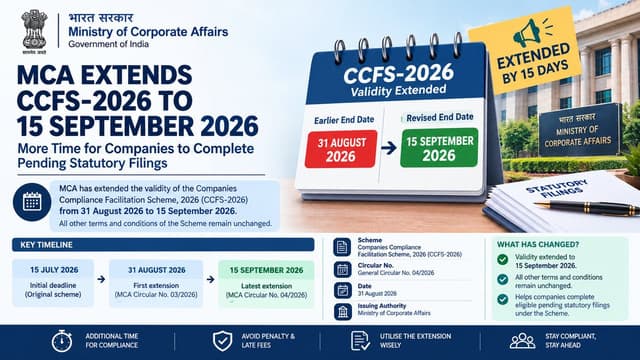
The Companies Compliance Facilitation Scheme, 2026 was introduced by General Circular No. 01/2026 dated 24 February 2026, and ran from 15 April 2026. It allowed companies to clear pending MGT-7, MGT-7A, AOC-4 (all variants), ADT-1, FC-3 and FC-4 filings — along with specified legacy 1956 Act forms — on payment of normal fees plus only 10% of the applicable additional fees. The window was extended twice, by General Circular No. 03/2026 dated 8 July 2026 and General Circular No. 04/2026 dated 31 August 2026, and finally closed on 15 September 2026. Filings made after that date attract the full additional fee. Companies that missed the window should not assume a further scheme — plan on full cost.
Section by Section: What the Form Actually Asks
What follows is a working walkthrough of Form MGT-7, with the MGT-7A position noted where it diverges. Everything is reported as it stood on the close of the financial year, not as at the filing date — with two deliberate exceptions, noted below, where the form now asks for both.
I. Registration and other details
The CIN is pre-filled for company users, searchable by name for professional users, and served from a dropdown for other business users. The form validates that the CIN is Active, or Under CIRP, or Under Liquidation — and that it belongs to the right class: a small company or OPC CIN for MGT-7A, and a CIN other than a small company or OPC for MGT-7.
Then come the fields that surprise people opening the form for the first time since the V3 migration:
- Name of the company as on filing date (pre-filled, non-editable) and name as on the financial year end date (pre-filled, editable). Two separate fields — a company that changed its name during the year reports both.
- Registered office address as on filing date (non-editable) and as on the financial year end date (editable). Same logic.
- Latitude and longitude of the registered office, pre-filled from the database where available and non-editable; where not pre-filled, the user enters them manually.
- Photograph of the registered office showing the external building and the company name prominently visible — attachment in PDF or JPG, up to 2 MB.
What the form asks for is the external building with the company's name board visible. There is no requirement in the form for an interior shot, and none for a director to appear in the frame. Companies operating from co-working spaces or shared premises should ensure the name board is actually up before someone is sent out with a phone camera in the last week of November.
The section also carries class, category and sub-category of the company as on the financial year end date (pre-filled from CIN, editable); for MGT-7, whether shares are listed on a recognised stock exchange, with the stock exchange table offering NSE, BSE, MCX and Others — row one mandatory, the rest optional — and the codes auto-filled as A1024, A1, A1025 and A1026 respectively; and the name of the Registrar and Transfer Agent where the company is a public company having share capital with listed shares.
Finally, the AGM block: whether the AGM was held, the date of AGM, the due date of AGM, whether an extension was granted, the SRN of the GNL-1 filed for extension, the extended due date, and — if no extension was granted — the reasons.
II. Principal business activities
Number of business activities, main activity group code and business activity code, with the percentage of turnover against each. Two validations: the percentages must total exactly 100, and the number of business activities must be greater than zero whenever turnover is greater than zero. In MGT-7 the section regenerates up to a maximum of 15 activities, with anything beyond that going into an optional attachment.
NIC codes from the previous year's MGT-7 or MGT-7A are pre-filled — but only where the previous return was itself filed in the V3 version. First-time V3 filers will find these blank and must select from the drop-down. The full Annexure-A activity code table, running from group A (agriculture, forestry, fishing) through to group S (other services activities), sits at the end of both instruction kits.
III. Holding, subsidiary and associate companies
MGT-7 captures holding, subsidiary and associate companies including joint ventures. MGT-7A captures associate companies including joint ventures, and the section is not applicable to an OPC at all. Details go in through an Excel template only — downloaded from the form, filled, and uploaded, subject to a 2 MB cap. The CIN or FCRN entered must be unique across rows and must not repeat the filer's own CIN, and the total percentage across holding company rows cannot exceed 100.
IV. Share capital, debentures and other securities
This section displays only where the company has share capital. Number of classes is pre-filled from the class-wise master as on the financial year end date and is editable; where a pre-filled class is no longer relevant, a checkbox allows the entire class table to be deleted, with auto-calculation adjusting on deletion.
For each class, the form asks for authorised, issued, subscribed and paid-up capital, the number of equity and preference shares, and the nominal value per share. The arithmetic rules are strict and worth listing:
- Nominal value per share must be the same for a single class across all columns of the table for every type of capital.
- Subscribed and paid-up capital must be greater than zero if the number of shares is greater than zero — and must be zero if zero shares are entered.
- Subscribed and paid-up capital must be equal to or less than the number of shares multiplied by the nominal value.
- Paid-up capital reported in the form must not exceed the authorised share capital as on the financial year end date.
- Value entered must be greater than zero in either equity or preference shares — a share-capital company cannot report zero in both.
MGT-7 additionally captures the ISIN of the equity shares, which becomes enabled and mandatory where there has been an issue of equity shares during the year for a company whose class is 'Public' and whose financial year end date is 31 March 2021 or later; and details of stock split or consolidation during the year, with before-and-after number of shares and face value per share for each class.
Both forms capture details of shares and debenture transfers since the closure date of the last financial year — or, for a first return, at any time since incorporation. A "NIL" checkbox is available; if it is not selected, the number of transfers must be greater than zero, and the details go in through the prescribed Excel template capped at 2 MB. In MGT-7A this section is not applicable to an OPC.
V. Turnover and net worth
Turnover and net worth of the company as defined in the Companies Act, 2013. Turnover may be zero — unless a percentage of turnover was specified against business activities in section II, in which case turnover must be greater than zero. The two sections talk to each other.
VI. Shareholding pattern
Promoter shareholding and non-promoter (public) shareholding, entered separately for equity and preference shareholders. Percentages are auto-calculated as the number of shares in a row divided by the sum of shares in the same column for the same class across both the promoter and non-promoter tables — so they cannot be overridden.
Two things are newer here. A breakup of the total number of shareholders (promoters plus others) is pre-filled and non-editable, and must equal the total entered above. And the form now captures a gender-wise number of shareholders — a field added during the V3 rebuild that has no analogue in the old V2 form.
Details of foreign institutional investors holding shares are captured where the FII share count in the promoter or non-promoter table is greater than zero, subject to a maximum of 25 rows, with anything beyond 25 going into an optional attachment.
VII. Number of promoters, members and debenture holders
Figures at the beginning and at the end of the year. The opening figures are pre-filled from the closing figures of the previous year's webform and are editable. The validations are unforgiving in a useful way:
- Zero is not permitted simultaneously in both the 'Promoter' and 'Members (other than promoters)' rows.
- The number of debenture holders must be greater than zero if debentures outstanding at the end of the year are greater than zero.
- The sum of promoters and members at year-end must be equal to or greater than the shareholder count reported in section VI(B).
VIII / IX. Board composition, directors, KMP and meetings
In MGT-7, the composition of the Board is the sum of executive and non-executive directors at the beginning and at the end of the year, with minimum-strength validations built in: 2 for a private company, 3 for a public company (each other than a producer or Section 8 company), and 5 for a producer company. The executive and non-executive percentage columns together cannot exceed 100.
Directors and KMP as on the financial year end date regenerate up to 20 rows, as do particulars of changes in directors and KMP during the year, with overflow going to an optional attachment. DIN or PAN must be unique across regenerated blocks unless the designation is different. Critically, every person entered must be associated with the company under the selected designation as on the financial year end date, and any date of cessation entered must match the signatory records held by MCA — not the company's own understanding of when someone resigned.
Meetings are captured in three buckets in MGT-7 — members/class/requisitioned/NCLT/court-convened meetings, Board meetings, and committee meetings — and in two buckets in MGT-7A, which has no committee meetings section. All three are entered through Excel templates only, each capped at 2 MB. The date of every meeting must fall on or before the financial year end date and on or after the date of incorporation, and the number of members attending cannot exceed the number entitled to attend.
Attendance of directors regenerates from the total number of directors at year-end, and director names are filled sequentially from the directors entered earlier, excluding anyone designated as Manager, CEO, CFO or company secretary. In MGT-7A, the attendance of directors block is marked not applicable for an OPC — which is logical, since an OPC may have a single director. (Note on MCA Kit quirk: In the official MGT-7A Instruction Kit, Field VIII-C refers back to a director count that is a residual copy-paste artifact from the full MGT-7 kit structure; the live V3 webform handles this cleanly by populating director rows directly from the active directors as at the financial year-end).
IX–X. Remuneration of directors and KMP
MGT-7 splits this three ways — managing director, whole-time directors and manager; CEO, CFO and company secretary; and other directors. MGT-7A splits it two ways, omitting the CEO/CFO/CS bucket. A "NIL" option disables the subsequent fields. Each table regenerates up to 15 rows, with overflow going to an optional attachment. Zero is an accepted value in the remuneration fields — a director drawing nothing is reported as nothing, not omitted.
XI–XII. Penalties, punishment and compounding
Details of penalties or punishment imposed on the company, its directors or officers, and details of compounding of offences. A "NIL" option disables the fields; where it is not selected, the number entered must be greater than zero and the table regenerates up to a maximum of 15 rows.
XII / XIII. Details of shareholders and debenture holders
Displayed only where the company has share capital — and in MGT-7A, only in the case of a private company. The list is uploaded as an attachment in the prescribed template titled "Details of Shareholder and Debenture holder". In MGT-7 the attachment may be a macro-enabled predefined sheet, a normal Excel sheet, or a CSV without validations, with up to 15 files of 20 MB each — a 300 MB total that exists specifically for companies with very large member registers.
Practitioners auditing the official MCA Instruction Kit for Form MGT-7 will notice an internal drafting contradiction: Footnote 6 of the kit states that the shareholder/debenture-transfer Excel attachment is "applicable and mandatory for listed companies only". However, the primary field-level instruction table in the very same kit (Field XIII) specifies that the attachment is mandatory whenever the company "is having share capital". In practice on the MCA V3 webform, the system tests whether the company has share capital — unlisted private and public companies with share capital are prompted for the member list. Filers should follow the portal-enforced validation rule.
Once the list of shareholders is attached, the details are not visible either in the PDF generated by the webform or in the attached Excel. You cannot proofread the shareholder list by opening the submitted PDF. Verify the file thoroughly before attaching, because after submission there is no practical way to review what went in — and no resubmission facility.
The MGT-8 Change: Certification Is Now Inside the Form
This is the single largest structural change to the annual return in recent years, and it still causes confusion.
Under Section 92(2), the annual return of a listed company, or a company having paid-up share capital of ₹10 crore or more, or turnover of ₹50 crore or more, must be certified by a company secretary in practice, and the certificate is to be in Form MGT-8. Historically MGT-8 was prepared on the professional's letterhead and attached to MGT-7 as a separate document.
Pursuant to the Companies (Management and Administration) Amendment Rules, 2025, that certification has been integrated into Form MGT-7 as a static field on the V3 portal. The instruction kit for MGT-7 confirms it plainly: the MGT-8 attachment has been removed and the required fields have been added within the form, including the DSC of the company secretary. The section is titled "Compliance of sub-section (2) of Section 92, in case of listed companies", and the form displays it where any of three triggers is met — shares listed on a recognised stock exchange, or the sum of paid-up equity and preference shares equal to or greater than ₹10 crore, or turnover equal to or greater than ₹50 crore.
Because the embedded block is a structured static field, there is no room in it for qualifying remarks. MCA's FAQ for the Lot 3 forms confirms that qualifying remarks about compliance can presently be added through the 'Optional Attachment' field in Form MGT-7, with specific reference to the embedded MGT-8 portion.
The ICSI, by advisory dated 24 December 2025, went further. Noting both this limitation and the fact that Form MGT-7A carries no MGT-8 field at all — a live problem now that the widened small company definition brings much larger companies into MGT-7A — the Institute advised members to continue issuing MGT-8 certifications on the letterhead of a peer-reviewed practice unit, generate a UDIN as per Institute guidelines, and attach the certificate as an optional attachment. Practitioners should treat that advisory as the working standard until MCA revises the form layout.
Who signs what
How to File: The V3 Process, Step by Step
Both forms are webforms, filled in the browser rather than downloaded as a PDF. There are two routes to the form and they differ only in how you reach it.
- Access the MCA homepage and log in with valid credentials.
- Select MCA Services, then Company e-Filing.
- Select Annual Filings.
- Access "Form No. MGT-7 (Annual Return (other than OPCs and Small Companies))" or "Form No. MGT-7A (Abridged Annual Return for OPCs and Small Companies)".
- Enter company information. For a company user, CIN and company name are auto-populated from the login. A professional user gets a search option by company name; other business users get a dropdown of associated CINs.
- Fill the application. The Save as draft option is enabled only once the CIN has been entered.
- Submit the webform. The system auto-saves and verifies; if errors are detected you are returned to the form with all error messages displayed.
- An SRN is generated on submission, to be used for all future correspondence with MCA.
- Affix the DSC.
- Upload the DSC-affixed PDF on the MCA portal.
- Pay the fees.
- An acknowledgement email is generated.
Route 2 is identical except that you reach the form through the search bar on the MCA homepage, and may log in either before or after performing that search.
Generating the SRN is not filing. If you do not successfully upload the DSC-affixed PDF within 15 days of SRN generation, and complete payment within 7 days of successful upload of the DSC-affixed document or the due date of filing plus 2 days, whichever is earlier, the SRN will be cancelled. A cancelled SRN means starting over — and if the due date has passed in the meantime, starting over at a higher additional fee. Submitting on 28 November and paying "next week" is how companies end up paying delay fees on a form they filed on time.
Attachments and size limits
A useful general rule from both instruction kits: wherever the space within a field is insufficient to provide all the information, the additional detail can be given as an optional attachment. That is the release valve for the 15-row and 20-row caps on remuneration, penalties, FII details and director changes.
Excel functionality — and the step everyone forgets
Excel functionality has been added at several fields, letting the user download a template, populate it offline and upload it back. After downloading the templates from the form, you must enable Excel by following the instructions contained in the template itself — macro-enabled workbooks will not populate correctly otherwise. This single step accounts for a surprising share of "the template isn't working" support calls each season.
The Validations That Actually Stop Filings
Because MGT-7 and MGT-7A are processed in STP mode — taken on record electronically without further processing, with no provision for resubmission — an error caught at submission is an inconvenience, but an error that passes through is permanent. Both instruction kits carry the same warning: ensure all particulars in the webform are correct.
- CIN status must not be strike off, amalgamated, converted to LLP, converted to LLP and dissolved, dormant under Section 455, dissolved, liquidated, not available for e-filing, under process of strike off, or dissolved under Section 59(8) or Section 54 of the Insolvency and Bankruptcy Code, 2016.
- The applicant must be registered on the MCA portal before the webform is filed.
- Signatories must have an approved DIN, a valid PAN, or a valid membership number, and the membership and certificate of practice numbers of a signing PCS must be valid.
- The DSC must be registered on the MCA portal against the DIN, PAN or membership number entered, and must be valid, non-expired and non-revoked.
- No MGT-7 may already be filed for the same financial year end date where MGT-7A is being filed, and vice versa — including forms merely pending payment or pending approval, not just approved ones.
- Multiple filings for the same financial year are not permitted, except where "Revised" is selected in 'Type of Annual filing', or (in MGT-7A) where the original form is marked defective.
- A revised filing is allowed only where a previous paid filing exists for the same FY and is marked defective, and where "No" was selected against 'Whether AGM held' in the original form.
- The SRN of the GNL-1 entered against the AGM extension field must be an approved SRN filed under the purpose 'Extension of AGM', associated with the same CIN.
- Check the Notifications and alerts function under 'My Workspace' on the FO user dashboard before and after filing.
Two structural notes that often come as news. First, no new class-wise master will be created for companies that do not have a class-wise master in V3 upon filing MGT-7 — the company master is updated for issued, subscribed and paid-up capital, and class-wise capital is updated only where the class already exists in the company's share class master. Second, the company status is not updated from Listed to Unlisted or Unlisted to Listed through the filing of MGT-7. If either needs fixing, it needs fixing separately.
And a welcome expansion: companies under CIRP or under liquidation can now file MGT-7 and MGT-7A, with the form accepting a CIN in those statuses and restricting signing to the IRP, RP or Liquidator.
What Has Changed: A Short Timeline
Two Obligations That Travel With MGT-7
Placing the annual return on the website. Section 92(3) requires every company to place a copy of the annual return on its website, if any, and the web address is to be disclosed in the Board's report under Section 134(3)(a). Since Form MGT-9 was discontinued, this website placement is the public-disclosure mechanism. A company with a website and no annual return on it has an open non-compliance that costs nothing to fix.
Sequencing with AOC-4. Nothing in Section 92 formally requires AOC-4 to be filed first, but in practice it usually is — financial statements are due within 30 days of the AGM while the annual return is due within 60 — and the AGM date entered in MGT-7 must match the approved AOC-4. Filing AOC-4 first also matters where a company is relying on the revised small company definition, because the classification in the MCA master updates on the basis of that filing.
Five Mistakes That Recur Every Season
1. Treating the SRN as the filing. Submission generates an SRN; the filing is complete only on successful DSC upload and payment. Watch the 15-day and 7-day clocks.
2. Reporting cessation dates from the company's records rather than MCA's. The form validates the date of cessation against the signatory records. If DIR-12 was filed late, the MCA record governs.
3. Leaving the shareholder Excel unreconciled. The sum of promoters and members at year-end must be at least the shareholder count in section VI(B), and once attached the list cannot be reviewed in the generated PDF. Reconcile before you upload.
4. Assuming the small company reclassification is automatic on the calendar. It follows the MCA master, which follows AOC-4. Verify the class before choosing the form.
5. Forgetting that a dormant-in-fact company still files. Unless the company holds formal dormant status under Section 455, no activity during the year is no answer. The annual return is about structure, not trade.
Frequently Asked Questions
What is the due date for filing Form MGT-7 for FY 2025-26?
Sixty days from the date of the Annual General Meeting. Where the AGM for FY 2025-26 is held on 30 September 2026, the annual return in MGT-7 or MGT-7A is due by 29 November 2026. If the AGM is held earlier, the deadline moves earlier with it.
Which companies file MGT-7A instead of MGT-7?
One Person Companies and small companies. From 1 December 2025, a small company is a private company (excluding holding companies, subsidiaries, Section 8 companies and companies governed by a special Act) with paid-up share capital not exceeding ₹10 crore and turnover in the immediately preceding financial year not exceeding ₹100 crore. Both conditions must be met together.
What is the penalty for late filing of the annual return?
Two separate exposures. An additional filing fee of ₹100 per day with no upper limit, payable on the form. And, under Section 92(5), a penalty of ₹10,000 on the company and on every officer in default, plus ₹100 for each day of continuing failure, subject to a maximum of ₹2,00,000 for the company and ₹50,000 for each officer in default — imposed through a separate adjudication order.
Is Form MGT-8 still required?
The obligation under Section 92(2) remains for listed companies and companies with paid-up capital of ₹10 crore or more or turnover of ₹50 crore or more. The mechanics have changed: on the V3 portal the certification is embedded within Form MGT-7 as a static field rather than filed as a separate attachment. The ICSI has nevertheless advised members to continue issuing the MGT-8 certificate on peer-reviewed practice unit letterhead with a UDIN and attach it as an optional attachment.
Can Form MGT-7 be resubmitted if there is an error?
No. Both MGT-7 and MGT-7A are processed in STP mode and taken on record electronically without further processing, and the instruction kits state expressly that there is no provision for resubmission. A revised filing is possible only in narrow circumstances — where a previous paid filing for the same financial year is marked defective and, in the original form, "No" was selected against 'Whether AGM held'.
Does a company with no business activity still have to file?
Yes. The annual return reports the company's structure as at the close of the financial year — members, directors, capital, registered office — and is required regardless of whether the company traded. The only meaningful relief is formal dormant status under Section 455, which is itself obtained by filing Form MSC-1.
What happens if the AGM was never held?
The 60-day period runs from the date on which the AGM ought to have been held, and the company must file a statement setting out the reasons for not holding it. A separate penalty under Section 99 arises for failing to hold the AGM at all — that is a distinct default from the annual return default.
Is the registered office photograph really mandatory?
The field is present in both webforms and asks for a photograph of the registered office showing the external building with the company name prominently visible, as a PDF or JPG of up to 2 MB. There is no requirement in the form for an interior photograph or for any person to appear in it.
Can a company under insolvency proceedings file the annual return?
Yes. A CIN with the status "Under CIRP" or "Under Liquidation" is accepted, but only the Interim Resolution Professional, Resolution Professional or Liquidator may sign the form by affixing their DSC. Where they sign using a PAN, no association with the company is checked.
Is CCFS-2026 still available for old pending returns?
No. The Companies Compliance Facilitation Scheme, 2026 closed on 15 September 2026, following extensions granted by General Circular No. 03/2026 dated 8 July 2026 and General Circular No. 04/2026 dated 31 August 2026. Pending filings made after that date attract the full additional fee of ₹100 per day. No further extension had been notified as at the date of this article.
Primary sources: Instruction Kit for Form No. MGT-7 (Annual Return (other than OPCs and Small Companies)), Ministry of Corporate Affairs; Instruction Kit for Form No. MGT-7A (Abridged Annual Return for OPCs and Small Companies), Ministry of Corporate Affairs.
Statutory basis: Section 92, Companies Act, 2013 read with Rule 11(1) of the Companies (Management and Administration) Rules, 2014; Companies (Registration Offices and Fees) Rules, 2014.
Other material referred to: Companies (Specification of Definition Details) Amendment Rules, 2025 notified vide G.S.R. 880(E) dated 1 December 2025; Companies (Management and Administration) Amendment Rules, 2025; ICSI advisory dated 24 December 2025 on Form MGT-7 / MGT-7A certification under the MCA V3 portal; MCA General Circular No. 01/2026 dated 24 February 2026 and General Circulars No. 03/2026 dated 8 July 2026 and No. 04/2026 dated 31 August 2026 relating to CCFS-2026.
MCA links: Form MGT-7 — mca.gov.in/content/mca/global/en/mca/e-filing/annual-filings/form-mgt7.html · Form MGT-7A — mca.gov.in/content/mca/global/en/mca/e-filing/annual-filings/form-mgt7a.html
This article is for informational and educational purposes only and does not constitute legal or regulatory advice. Form design, validations and fees on the MCA V3 portal are revised from time to time. Readers should verify the applicable primary source, including the latest instruction kit and any subsequent notification or circular, before acting.