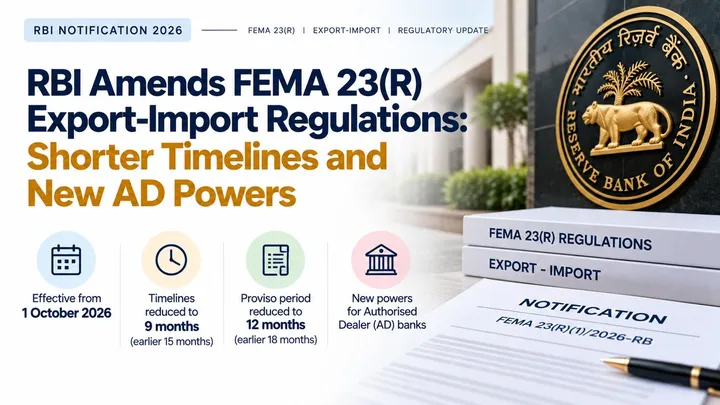
The Reserve Bank of India has removed the separate Export Declaration Form (EDF) filing for a large class of service exporters. Under Notification No. FEMA 23(R)/(2)/2026-RB dated 2 November 2026 — the Foreign Exchange Management (Export and Import of Goods and Services) (Second Amendment) Regulations, 2026 — a resident individual exporting services is deemed to have submitted the EDF the moment they give the required payment-related information to their Authorised Dealer (AD) bank for crediting their account. Other service exporters get the same deemed-submission treatment where the inward remittance for the service is not more than ₹10 lakh. The amendment is in force from 1 October 2026, so it covers service exports made since the new FEMA export-import framework itself began.
Quick answer: Under RBI Notification No. FEMA 23(R)/(2)/2026-RB dated 2 November 2026, in force from 1 October 2026, a resident individual exporting services is deemed to have submitted the Export Declaration Form once they provide the required payment information to their AD bank, and any other service exporter is deemed to have submitted it where the inward remittance for the service does not exceed ₹10 lakh.
In plain business language, this is the difference the amendment makes: a freelancer in India billing an overseas client no longer has to file a separate declaration form with the bank to prove the export. Handing the bank the payment details it needs to credit the money is itself the declaration. For a small firm or agency, the same shortcut applies on smaller receipts — but only up to ₹10 lakh per remittance. Above that line, the old filing duty still applies.
What the Second Amendment actually changes
The amendment touches only three regulations of the principal FEMA (Export and Import of Goods and Services) Regulations, 2026 (Notification No. FEMA 23(R)/2026-RB dated 13 January 2026, in force from 1 October 2026). Everything else in that framework — including export realisation periods — is left untouched by this instrument. The three changes are:
1. A new definition: "resident individual"
Regulation 2(1) gains a new clause (da): "'resident individual' means a person resident in India who is a natural person." That single definition is the hinge of the whole amendment. It draws the line between a human being resident in India — a freelancer, consultant, designer, tutor, developer working in their own name — and every other kind of exporter, such as a company, firm or LLP, which falls under the "person other than a resident individual" limb instead.
2. EDF deemed submitted for service exports — Regulation 3(2)
Regulation 3(2) gains two new provisos, and the three existing provisos are renumbered (c), (d) and (e). The new provisos say:
- Resident individuals (new proviso (a)): the exporter of services is deemed to have submitted the EDF when the exporter, being a resident individual, provides the information required in relation to the receipt of payment for the services to the Authorised Dealer for crediting the exporter's account. There is no monetary cap on this limb — it applies whatever the value of the service export.
- Everyone else, up to ₹10 lakh (new proviso (b)): the exporter of services is deemed to have submitted the EDF when the exporter, being a person other than a resident individual, provides the same payment information to the Authorised Dealer for crediting the exporter's account, if the value of the inward remittance for the service is not more than ₹10 lakh (or its equivalent in foreign currency).
The test in the second limb is per remittance, per service — the value of the inward remittance for that service. It is not an annual turnover test, and it is not an aggregate across clients. A company receiving ₹8 lakh for one service engagement is within the limb for that receipt; the same company receiving ₹12 lakh for another engagement is outside it for that receipt and must file the EDF as before.
3. A matching narrowing on the import side — Regulation 18(1)(d)
The amendment substitutes the clause governing AD-bank entries in the Import Data Processing and Monitoring System (IDPMS). An AD bank must now enter details of import of service in IDPMS, as furnished by the importer who is a person other than a resident individual and where the invoice or contract value is more than ₹10 lakh (or its equivalent in foreign currency), within five working days of receipt of details. In effect, the bank's IDPMS entry duty no longer covers resident-individual importers, nor imports of ₹10 lakh or less. The five-working-day clock itself is unchanged.
Old position vs new position
Who is affected
- Freelancers and independent professionals resident in India — designers, developers, consultants, writers, tutors, creators and similar individual service exporters. This is the group that gains the most: the separate EDF filing disappears entirely, at any value, provided the payment information reaches the AD bank.
- Small service-exporting businesses — companies, LLPs, partnership firms and other entities whose individual inward remittances for a service are ₹10 lakh or less. Each qualifying receipt is covered; larger receipts are not.
- AD banks — they remain the funnel. The deemed-submission mechanism works through the information the exporter gives the bank, and on the import side the bank's IDPMS entry duty is now expressly limited to non-individual importers above ₹10 lakh.
- Importers of services — resident individuals importing services fall outside the bank's IDPMS entry duty under the substituted clause, as do all imports of ₹10 lakh or less.
- Not affected by this amendment: exporters of goods (whose declaration route is different), and non-individual service exporters on receipts above ₹10 lakh, who continue to file the EDF as before.
What to do next
- Confirm which limb you fall in. If you export services as a natural person resident in India, you are a "resident individual" and the deemed-submission rule applies at any value. If you export through a company, firm or LLP, check each receipt against the ₹10 lakh line.
- Give your AD bank complete payment information, every time. "Deemed submitted" is not "nothing to do". The deeming works only when you provide the information required in relation to the receipt of payment for the services to the AD bank for crediting your account. Incomplete or missing payment details mean the deeming does not trigger.
- Keep your own record per receipt. Note the client, invoice, service, remittance value and the date you gave the payment information to the bank. If a receipt is later queried, that trail is your evidence that the EDF was deemed submitted.
- Split your receipts correctly. For a non-individual exporter, apply the ₹10 lakh test to each inward remittance for a service separately. Do not net off receipts, and do not assume a small annual total brings a large single receipt inside the relief.
- For receipts above ₹10 lakh as a non-individual exporter, file the EDF as before. Do not treat the amendment as a blanket exemption — above the line, the filing duty is unchanged.
- Ask your AD bank how it is operationalising the change. The notification states the legal rule; banks may still ask for particular payment details or formats. Confirm with your own bank before assuming a particular remittance is fully covered, especially for October 2026 receipts that predate the 2 November notification.
- Do not confuse this with realisation deadlines. The amendment does not extend the time within which export proceeds must be realised and repatriated. Track those deadlines separately.
Fee trap / common mistake: The biggest misunderstanding this amendment invites is reading "no EDF" as "no paperwork". The regulation deems the EDF submitted because you gave the bank the payment information — if you never give it, or give it incompletely, there is nothing to deem. The second trap is the ₹10 lakh line: it applies per inward remittance for a service, and only to exporters who are not resident individuals. A resident individual has no cap; a company has no blanket exemption.
Why this amendment came now
The principal FEMA (Export and Import of Goods and Services) Regulations, 2026 took effect on 1 October 2026 and, for the first time, brought every exporter of services — not just software exporters — inside a declaration duty. That created an immediate compliance question for individuals earning from overseas clients, who previously filed no such declaration for non-software services. The Second Amendment, notified a month later and backdated in force to 1 October 2026, answers that question in law: for resident individuals, the payment information given to the bank is the declaration. The ₹10 lakh limb extends a version of the same relief to small business receipts, while keeping the full filing duty for larger corporate receipts where the monitoring interest is greatest.
Frequently asked questions
Do freelancers in India still need to file an EDF for service exports after this amendment?
No separate EDF filing is needed for a resident individual exporting services. Under Notification No. FEMA 23(R)/(2)/2026-RB, the EDF is deemed submitted when the individual provides the required payment information to their AD bank for crediting their account. The payment information itself must still be provided.
What is a "resident individual" under the FEMA Second Amendment Regulations 2026?
A "resident individual" is a person resident in India who is a natural person, as defined by new clause (da) in Regulation 2(1). Companies, firms, LLPs and other entities are not resident individuals and fall under the separate ₹10 lakh limb instead.
Does the ₹10 lakh EDF relief apply per invoice, per client or per year?
Per inward remittance for a service. The regulation tests whether the value of the inward remittance for that service is not more than ₹10 lakh (or its foreign-currency equivalent). Each receipt is tested on its own; there is no annual aggregate test in the amendment.
I run a private limited company and received ₹12 lakh from one overseas client — do I still file an EDF?
Yes. As a person other than a resident individual, the deemed-submission relief applies only where the inward remittance for the service is ₹10 lakh or less. A ₹12 lakh receipt is above the line, so the EDF must still be furnished as before.
From when does the EDF deemed-submission rule apply?
The Second Amendment Regulations came into force on 1 October 2026, even though they were notified on 2 November 2026. Service exports from 1 October 2026 onwards are therefore covered by the new provisos.
Does this amendment change the deadline for bringing export money back to India?
No. The amendment amends only Regulations 2, 3 and 18 of the principal Regulations. Export proceeds realisation periods are untouched by this instrument.
What changes for importers of services?
AD banks must now enter import-of-service details in IDPMS only where the importer is a person other than a resident individual and the invoice or contract value exceeds ₹10 lakh, within five working days of receipt of details. Resident-individual importers and imports of ₹10 lakh or less fall outside that entry duty.
Sources
- RBI Notification No. FEMA 23(R)/(2)/2026-RB — Foreign Exchange Management (Export and Import of Goods and Services) (Second Amendment) Regulations, 2026, dated 2 November 2026 (official RBI PDF)
- RBI Notifications listing (official rbi.org.in) — the notification is listed on 3 November 2026.
- Principal Regulations: RBI Notification No. FEMA 23(R)/2026-RB dated 13 January 2026, as amended by Notification No. FEMA 23(R)/(1)/2026-RB dated 22 September 2026 — both as footnoted in the Second Amendment notification itself.
This article explains a regulatory change for general information. It is not legal or tax advice for any specific transaction — confirm the treatment of your own receipts with your Authorised Dealer bank.