RBI Overhauls "Matters to be Placed Before the Board" Framework for Banks — Governance Amendment Directions 2026

CL

Editorial team

CorpLawUpdates.in · Professionals & compliance specialists

Verified for complianceLast verified: 15 July 2026
Legal basis: RBI/2026-27/177 (DOR.HGG.GOV.150) — Commercial Banks | RBI/2026-27/178 (DOR.HGG.GOV.151) — Small Finance Banks | RBI/2026-27/179 (DOR.HGG.GOV.152) — Payments Banks | RBI/2026-27/180 (DOR.HGG.GOV.153) — Local Area Banks | Covering Press Release: 2026-2027/668
10 min read1,687 wordsSource: RBI Issues Amendment Direction...Effective: 1 October 2026Last amended: 14 July 2026High impact

Summary

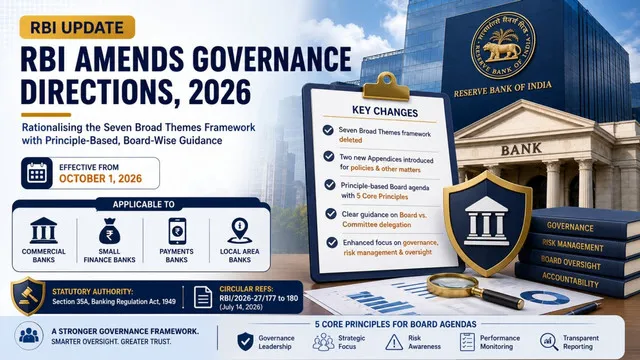
RBI issued Governance Amendment Directions (July 14, 2026) for Commercial, Small Finance, Payments and Local Area Banks, replacing the "seven broad themes" with principle-based guidance and detailed Appendix lists of matters for Board approval/review/delegation, effective October 1, 2026.

Quick AnswerAI

RBI's Governance Amendment Directions dated July 14, 2026 (RBI/2026-27/177–180) replace the earlier "seven broad themes" for Board agendas with principle-based guidance and consolidated Appendix I (policies) and Appendix II (other matters) lists specifying what must go to the Board, what can be delegated, and to which Committee — applicable to Commercial Banks, Small Finance Banks, Payments Banks and Local Area Banks from October 1, 2026. A parallel Annex II discontinues five matters (e.g., ATM failed-transaction reviews, PPI interoperability) that no longer require Board-level placement.

Key Takeaways

  • Issued July 14, 2026; comes into force October 1, 2026 for all four bank categories
  • Follows draft Directions floated April 8, 2026 in the Statement on Developmental and Regulatory Policies
  • Replaces the "seven broad themes" with principle-based Board-agenda guidance
  • Appendix I lists ~19 policy heads (Credit, Investment, Risk Management, IT, Compensation, KYC etc.) needing Board approval, noting which parts are delegable
  • Appendix II A/B lists 20-38+ non-policy matters for approval/review/information, and matters delegable to Committees
  • Chairperson has "primary responsibility" for setting Board meeting agendas
  • Annex II discontinues 5 matters per bank category, including ATM failed-transaction reviews and PPI interoperability reporting
  • Feedback on requiring Board to define "materiality" for policy amendments was accepted and the requirement removed
  • Original September 1, 2026 effective date pushed to October 1, 2026 after industry feedback on transition time
  • Companion RBI exercise consolidated 9,000+ regulatory circulars into 238 Master Directions in 2025; a similar 64-MD consolidation of supervisory instructions was opened for public comment April 8, 2026

rbi-governance-directions-amendment-2026-board-matters

🟢 Final Amendment Directions — Effective October 1, 2026
Issued by: Reserve Bank of India
Date of Issue: 14th July 2026
Applicable to: Commercial Banks, Small Finance Banks, Payments Banks, Local Area Banks
Circular RefsRBI/2026-27/177 (Commercial Banks) · /178 (SFBs) · /179 (Payments Banks) · /180 (LABs)
File Nos.DOR.HGG.GOV.150 to 153/29.67.001/2026-27
DateJuly 14, 2026
Issued ByReserve Bank of India (Department of Regulation)
Addressed ToBoards of Commercial Banks, Small Finance Banks, Payments Banks, Local Area Banks
Statutory AuthoritySection 35A, Banking Regulation Act, 1949
Effective DateOctober 1, 2026
AmendsRBI Governance Directions, 2025 (seven-broad-themes framework), for each bank category — specific paragraphs deleted/reinserted, not a full supersession

Why RBI Rationalised the Seven Broad Themes Framework

Bank Boards in India have long operated under RBI's "seven broad themes" framework — a high-level list guiding what topics Boards should periodically review. Over time, however, dozens of individual Master Directions and circulars separately mandated specific matters — from dividend declarations to cyber-security reviews — be placed before the Board, often without clear guidance on whether such matters could be delegated to a Committee.

RBI flagged this problem in its April 8, 2026 Statement on Developmental and Regulatory Policies, noting that "the matters to be placed before the Boards of banks... are determined by the Boards themselves, guided by the seven broad themes," but that a comprehensive review and rationalisation of these instructions was underway, alongside a much larger 2025 exercise that had already consolidated over 9,000 regulatory circulars into 238 Master Directions.

Draft Amendment Directions were floated the same day for public comment, proposing to drop the seven themes in favour of principle-based guidance. After incorporating stakeholder feedback (detailed in an accompanying Annex), RBI finalised four parallel sets of Amendment Directions on July 14, 2026 — one each for Commercial Banks, Small Finance Banks (SFBs), Payments Banks, and Local Area Banks (LABs) — all structured identically and effective from October 1, 2026.

What Changes in the Governance Directions

Each Amendment Direction follows the same broad pattern: delete the old paragraphs listing the seven broad themes and the "Calendar of Reviews and Board Meeting Procedures" chapter, then insert a reference framework built around two new Appendices covering policies (Appendix I) and other Board matters (Appendix II A/B).

⚠️ One structural exception: Commercial Banks, Small Finance Banks, and Payments Banks also gain a short "Board oversight areas" statement — risk management system, exposures to related entities, and corporate governance conformity — inserted as paragraph 11A, 20A, and 16A respectively. Local Area Banks do not get this provision; the LAB Amendment Direction inserts only paragraphs 21A (Appendix cross-references) and 21B (the five agenda principles), with no separate oversight-statement paragraph.
💡 Appendix I lists policies requiring Board approval (Credit Policy, Investment Policy, Risk Management Policy, Outsourcing Policy, IT Policy, Compensation Policy, KYC Policy, and more), tagged Yes/No for whether review of the policy can be delegated to a Board Committee.
💡 Appendix II-A lists non-policy matters that must go to the Board for approval, review, or information (e.g., dividend declaration, MD & CEO appointment, and — for Commercial Banks and Small Finance Banks only — ICAAP structural design). Appendix II-B lists matters that may, at the Board's discretion, be delegated — mostly to the Audit Committee, Risk Management Committee, or "any Committee to which powers have been delegated by the Board."

Three of the four categories — Commercial Banks, Small Finance Banks, and Payments Banks — retain identical underlying logic, differing only in paragraph cross-references because each is governed by its own set of RBI Master Directions. Local Area Banks follow a lighter structure that omits the separate oversight-statement paragraph altogether (see note above), relying solely on the Appendix cross-references and the five agenda principles.

Category-by-Category Structural Changes

Bank CategoryCircular RefKey Structural Change
Commercial BanksRBI/2026-27/177New Chapter II sub-section "B1 — Matters to be placed before the Board" inserted after paragraph 19; PVB Board responsibilities (paras 52, 57) cross-referenced to the amended provisions
Small Finance BanksRBI/2026-27/178New paragraphs 33A–33B inserted in Chapter V; oversight paragraph reinserted as 20A in Chapter IV
Payments BanksRBI/2026-27/179New paragraphs 27A–27B inserted after paragraph 27; oversight paragraph reinserted as 16A
Local Area BanksRBI/2026-27/180New paragraphs 21A–21B inserted after paragraph 21; Chapter V retitled "Matters to be placed before the Board"

Five Guiding Principles for Board Agendas (21B/27B/33B/19B)

Beyond the Appendices, each Direction sets out identical principles for how Boards should determine their agendas:

  • The Board retains ultimate responsibility for business strategy and financial soundness, key personnel decisions, governance structure, and risk/compliance obligations — though it may delegate specific matters to Board or Management Committees with appropriate reporting lines.
  • The Board must clearly articulate which matters are reserved for its approval versus flagged for information, while ensuring sufficient time is dedicated to strategy and risk governance.
  • The Chairperson holds primary responsibility for setting the meeting agenda.
  • The Board must ensure it receives sufficient management information to discharge its role, specifying the nature and frequency of such information, and may seek external reports if needed.
  • The Board must periodically review both the matters placed before it and those delegated to Committees — including timeliness of agenda circulation and adequacy of information.

Matters Discontinued (Annex II to the Covering Press Release)

Alongside the new Appendices, RBI's covering press release identifies matters that will no longer need to be placed before the Board at all from October 1, 2026, since the underlying regulatory requirement itself ceases to apply.

Discontinued MatterApplicable Categories
Risk management procedures for multicity/payable-at-all-branches cheques (CBS banks)All four categories
Review of ATM failed transactions and penalties paidAll four categories
PPI interoperability review (under Digital Banking Policy)All four categories
Review note on sanction of credit limits to exportersCommercial Banks, SFBs
Review of implementation of instructions on rural branch operationsCommercial Banks, SFBs

How Stakeholder Feedback Shaped the Final Directions

RBI's Annex I to the covering press release summarises the consultation on the April 8, 2026 draft. Several points are worth flagging for compliance teams:

Accepted: The requirement for Boards to define "material amendment" for each policy individually was dropped, easing the delegation of routine policy reviews to Committees.
Accepted: Delegation is now restricted to duly constituted Board/Sub-Committees, explicitly excluding transfer of core oversight functions to Senior Management; the clause attributing "ultimate responsibility for the bank's performance" to the Board was also softened.
Not Accepted: Requests to retain the seven broad themes, continue the Action Taken Report requirement, and shift primary agenda-setting responsibility away from the Chairperson were all rejected — RBI held that Boards retain full discretion over how to structure oversight beyond the prescribed principles.
⚠️ Partially Accepted: The originally proposed effective date of September 1, 2026 was pushed back to October 1, 2026 in response to feedback on the Board-charter review cycle, though banks did not receive the fuller six-month runway some respondents sought.

Key Changes at a Glance

ParameterEarlier FrameworkNew Requirement
Board agenda guidanceSeven broad themes (2025 Directions)Principle-based guidance + consolidated Appendices
Sourcing of Board-matter requirementsScattered across numerous individual Master Directions and circularsConsolidated into Appendix I (policies) and Appendix II A/B (other matters)
Agenda-setting responsibilityNot expressly assignedChairperson has "primary responsibility"
Certain reporting matters (ATM failures, PPI interoperability, etc.)Mandatory Board-level placementDiscontinued entirely per Annex II

Compliance Checklist

☑ Map existing Board and Committee charters against Appendix I and Appendix II A/B for your specific bank category before October 1, 2026

☑ Identify policies newly eligible for delegated review to a Board Committee, and update delegation resolutions accordingly

☑ Update Board meeting agenda templates to remove references to the seven broad themes

☑ Confirm the Chairperson's role in agenda-setting is reflected in Board procedure documents

☑ Remove the five discontinued matters (per Annex II) from standing Board agenda items for your bank category

☑ Reassess Committee terms of reference (Audit, Risk Management, Asset-Liability, Customer Service) against the "Yes, to [Committee]" delegation tags in Appendix I/II

☑ Track paragraph renumbering in the underlying 2025 Governance Directions to keep internal policy cross-references current

☑ For matters arising from RBI supervisory instructions (as opposed to Directions/circulars), continue following supervisory guidance directly — RBI has clarified these are not automatically covered by the Appendix I/II delegation framework

CorpLawUpdates Analysis

The most significant shift here is architectural rather than substantive: RBI has not necessarily added new obligations, but has consolidated dozens of scattered "place before the Board" requirements — previously spread across a wide range of separate Master Directions and circulars — into two structured Appendices per bank category. For governance and secretarial teams, this converts what was effectively a research exercise (tracking every Master Direction for Board-placement clauses) into a reference-table lookup.

The likely compliance challenge lies in reconciling existing Committee terms of reference with the new delegation tags. Many banks' Risk Management, Audit, and Asset-Liability Committee charters were drafted around the old seven-themes structure; the Appendices now specify, paragraph-by-paragraph, exactly which sub-matters can go to which Committee — meaning charters will need granular, not just cosmetic, revision.

Practitioners should also note the RBI's firm stance in Annex I that the Chairperson's "primary responsibility" for agenda-setting does not dilute collective Board input — a distinction likely to matter in future supervisory reviews of Board minutes and agenda-preparation processes. Similarly, the rejection of continuing Action Taken Reports as a mandatory item signals that RBI is deliberately pushing implementation-tracking mechanisms back into Board discretion rather than prescribing them.

Looking ahead, this consolidation exercise sits alongside RBI's broader supervisory-instruction rationalisation — the April 8, 2026 SDRP flagged 64 draft Master Directions consolidating supervisory instructions for public comment, alongside proposed changes to CRAR quarterly-profit inclusion and Investment Fluctuation Reserve norms. Expect further consolidated, Appendix-style Board-matter frameworks as these draft directions mature into final circulars.

Source: RBI Press Release "RBI Issues Amendment Directions on 'Matters to be placed before the Boards of the Banks'" dated July 14, 2026 (Press Release: 2026-2027/668), together with the four Governance Amendment Directions RBI/2026-27/177–180 and the Statement on Developmental and Regulatory Policies dated April 8, 2026 (Press Release: 2026-2027/38). Signatories: Scenta Joy, Chief General Manager (Amendment Directions); Brij Raj, Chief General Manager (Press Releases).

This article is for informational and educational purposes only and does not constitute legal or regulatory advice. Verify with primary regulatory sources before acting.

Related Updates

RBI Proposes One-Time Approval for Mutual Funds, Insurers, Pension Funds Re-Acquiring Bank Shares — Draft Amendment Directions, 2026
RBINewHigh impact

RBI Proposes One-Time Approval for Mutual Funds, Insurers, Pension Funds Re-Acquiring Bank Shares — Draft Amendment Directions, 2026

RBI's draft Amendment Directions, 2026 (Commercial, Small Finance, Payments, Local Area Banks) let mutual funds, insurers and pension funds get one-time approval for subsequent major shareholding acquisitions up to 10% in a bank. Comments due 4 August 2026.

RBI invites public comments on the draft “Reserve Bank of India (Acquisition and Holding of Shares or Voting Rights) Amendment Directions, 2026”

14 July 2026
12 min
RBI Creates 'Type I NBFC' Category and Opens Deregistration Window — NBFC Registration Amendment Directions, 2026
RBIHigh impact

RBI Creates 'Type I NBFC' Category and Opens Deregistration Window — NBFC Registration Amendment Directions, 2026

RBI's April 29, 2026 Amendment Directions create 'Type I/Type II NBFC' categories, effective July 1, 2026. NBFCs below ₹1,000 crore without public funds/customer interface may deregister via PRAVAAH by Dec 31, 2026; CoR surrender form revised June 30, 2026.

Voluntary Surrender of Certificate of Registration by NBFCs (including HFCs) for Cancellation – Application Form and Indicative Checklist

30 June 2026Eff. 1 July 2026
19 min
RBI Issues Master Direction on Credit Derivatives, 2026 — Introduces TRS and Credit Index Products
RBIHigh impact

RBI Issues Master Direction on Credit Derivatives, 2026 — Introduces TRS and Credit Index Products

RBI's Master Direction – Credit Derivatives, 2026 (effective June 25, 2026) introduces CDS and TRS on corporate bonds, plus exchange-traded credit index derivatives, supersedes 2022 norms, and permits FPI participation in CDS up to 5% of corporate bond stock.

RBI issues Master Direction – Reserve Bank of India (Credit Derivatives) Directions, 2026

26 June 2026Eff. 25 June 2026
20 min