🟢 Final Amendment Directions — In Force from July 1, 2026
Issuing Authority: Reserve Bank of India, Department of Regulation, Central Office | Notified: April 29, 2026 | Effective Date: July 01, 2026 | Related Update: Press Release dated June 30, 2026 confirms the voluntary surrender of CoR application form and checklist have been revised on PRAVAAH to operationalise this amendment.
Background: A New Tier Below the Scale-Based Framework
The RBI (NBFC – Registration, Exemptions and Framework for Scale Based Regulation) Directions, 2025, issued on November 28, 2025, govern which entities need a Certificate of Registration (CoR) to carry on non-banking financial business and which categories of NBFC are exempt. Buried within that framework was a descriptive — but not formally defined — category: an "NBFC not availing public funds and not having any customer interface." Such entities, typically holding companies or group-financing vehicles with no retail footprint, were treated more lightly across several NBFC Directions, but the absence of a crisp, standalone definition created ambiguity about who exactly qualified and how the exemption from core registration provisions actually operated in practice.
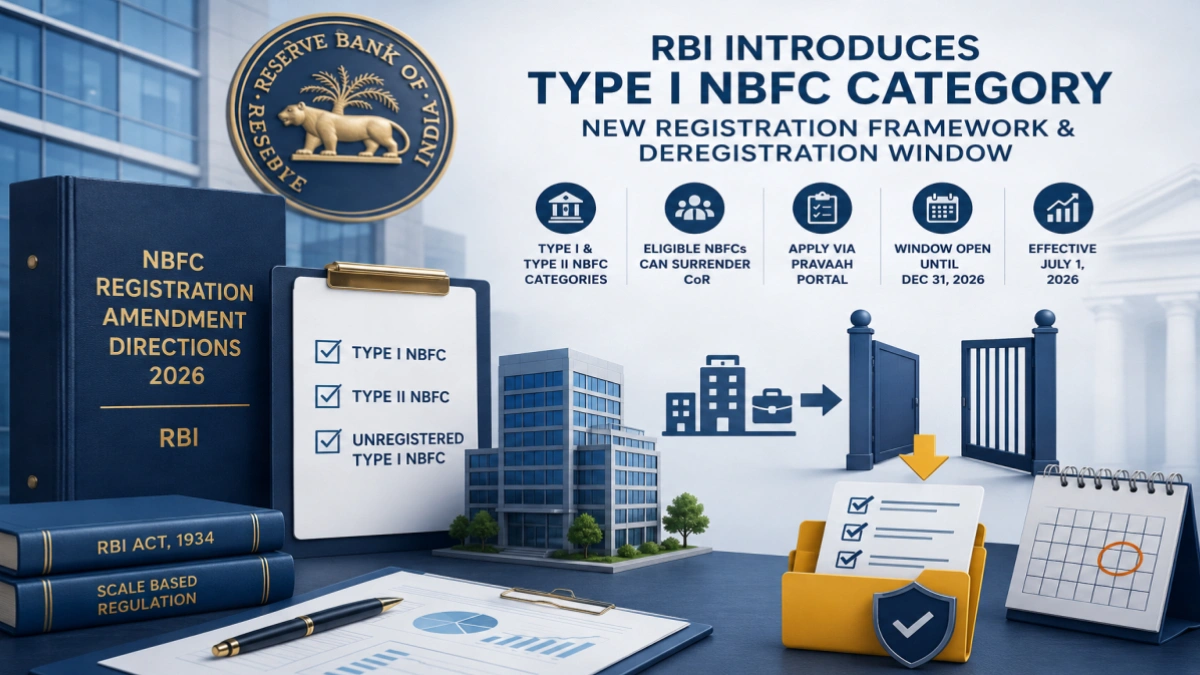
The Amendment Directions of April 29, 2026 close that gap. Acting "based on a review of instructions pertaining to regulatory framework including registration requirement for 'NBFCs not availing public funds and not having customer interface'," RBI has converted the loose descriptive phrase into a formal taxonomy — Type I NBFC, Type II NBFC, and Unregistered Type I NBFC — each with its own definition, conditions and registration consequence, and has built out a dedicated deregistration pathway with a hard year-end deadline.
Because this reclassification touches the very threshold question of whether an entity needs RBI registration at all, RBI has simultaneously refreshed the operational paperwork: the voluntary surrender of CoR application form and indicative document checklist, first made available on the PRAVAAH portal following a September 23, 2025 press release, have now been revised (per the press release dated June 30, 2026) to build in the new Unregistered Type I NBFC ground for surrender.
What Is a Type I NBFC and an Unregistered Type I NBFC? New Definitions in Paragraph 6
📝 Four New/Modified Definitions
6(14A) — "NBFC not availing public funds and not having any customer interface": an NBFC, registered as Type I NBFC or otherwise, that neither accepts nor intends to accept public funds, and neither has nor intends to have a customer interface, both terms taking their meaning from elsewhere in the Directions.
6(18) explanation added: indirect receipt of public funds is clarified to mean funds received not directly but through associates and Group entities that themselves have access to public funds.
6(22) "Type I NBFC": an NBFC meeting the 14A definition and holding a CoR issued by RBI specifically as Type I NBFC.
6(23) "Type II NBFC": any NBFC granted a CoR other than as Type I NBFC — effectively the residual, mainstream category.
6(24) "Unregistered Type I NBFC": an NBFC meeting the 14A definition that is exempted from sections 45IA and 45IC of the RBI Act under new paragraph 65A — i.e., it need not hold a CoR at all.
Terminology Replaced Across the Directions
Two differently worded versions of the earlier descriptive phrase are now replaced with "NBFC holding Certificate of Registration as 'Type I NBFC.'" Paragraphs 10(2)(iv), 15(1) and 40 had used "NBFC not availing public funds and not having any customer interface," while paragraphs 17 and 19 had used the shorter "NBFC without public funds and customer interface" — both are swapped out for the new defined term. The explanation that previously sat under paragraph 10(2)(iv) is deleted outright, since the concept it explained is now captured by the standalone 14A definition.
Unregistered Type I NBFC Deregistration Rules — Paragraph 38A Explained
A new Section A.1, headed "NBFCs not availing public funds and not having any customer interface," is inserted after paragraph 38, running through ten detailed sub-paragraphs.
✅ Exemption and Deregistration
NBFCs in this category with asset size below ₹1,000 crore (per the latest audited balance sheet) are exempted from sections 45IA and 45IC of the RBI Act with effect from July 1, 2026. Existing entities — including those currently holding a Type I NBFC CoR — that meet the exemption criteria may apply to RBI for deregistration within six months, i.e., by December 31, 2026. Entities not currently meeting the criteria remain free to apply later, once they do.
⚠️ Group Aggregation Rule
Where a Group has multiple Unregistered Type I NBFCs, their asset sizes are aggregated for the ₹1,000 crore threshold. If the aggregate reaches or exceeds ₹1,000 crore, every Unregistered Type I NBFC in that Group must register as Type I NBFC and becomes subject to the applicable RBI instructions for that category.
The deregistration application must be filed through PRAVAAH, on the company's letterhead, accompanied by the following:
- The original CoR, submitted physically to RBI.
- Audited financials for the last three financial years.
- A statement on the status of public funds and customer interface over the same three years.
- A Statutory Auditor's Certificate confirming the absence of public funds and customer interface as on date.
- A Board Resolution covering three commitments: no current or future public funds/customer interface; an undertaking to seek Type II NBFC registration if that changes; and an undertaking to seek Type I NBFC registration if asset size reaches ₹1,000 crore.
- A Board undertaking to disclose the Unregistered Type I NBFC status, along with public funds/customer interface status, in the financial statements' Notes to Accounts.
💡 RBI's Satisfaction Test
Deregistration is not automatic on filing. RBI must be satisfied that the NBFC is operating with a "conscious and long-term business model" of functioning without public funds and without customer interface — a qualitative standard that gives RBI discretion to refuse deregistration even where the numeric asset-size threshold is met.
Statutory Auditors of an Unregistered Type I NBFC must file an Exception Report directly with RBI if the conditions on public funds, customer interface, or any other exemption condition are breached. NBFCs in this category that grow to ₹1,000 crore or more in assets must instead apply for Type I NBFC registration through PRAVAAH, with a similar (though not identical) documentation set; RBI issues the Type I NBFC CoR once satisfied the conditions are met. Registered Type I NBFCs must make the same Notes-to-Accounts disclosure annually, and their Statutory Auditors must specifically report exceptions to RBI's Department of Supervision.
❌ Limits of the Dispensation
Existing NBFCs in this category that do not hold a Type I NBFC CoR are not eligible for the relaxed regulatory treatment available to those that do. Any entity intending to access public funds or acquire a customer interface must invariably seek Type II NBFC registration. An Unregistered Type I NBFC wanting to make overseas investment in the financial services sector must first register with RBI, comply as a Type I NBFC, follow paragraphs 15–19 of the NBFC (Undertaking of Financial Services) Directions, 2025 and obtain prior RBI approval — and is barred from overseas investment in the non-financial sector altogether. The exemption itself runs only to sections 45IA and 45IC; the rest of Chapter IIIB of the RBI Act, 1934 continues to apply, and RBI retains its Chapter V enforcement powers against these entities.
📌 Where to Find Interpretive Guidance
RBI has noted that FAQs on exemptions and registration requirements for this category of NBFC are available under Section H of "All you wanted to know about NBFC" on the RBI website — a useful reference point for compliance teams working through edge cases not directly addressed in paragraph 38A itself.
RBI has also reserved the right to issue instructions specifically addressed to Unregistered Type I NBFCs if it observes concerns or risks at any of them, and has clarified that other Directions apply to these entities only where specifically addressed to them. Any violation of the conditions applicable to an Unregistered Type I NBFC is to be viewed seriously and can invite penal action under the RBI Act, 1934.
New Paragraph 65A — The Four Conditions for Exemption
A standalone paragraph 65A sets out, in one place, the four conditions an Unregistered Type I NBFC must continuously satisfy: operating without public funds and without customer interface as a conscious, long-term business model; maintaining asset size below ₹1,000 crore per the latest audited balance sheet; passing an annual Board Resolution at the start of each financial year affirming it will not avail public funds or have customer interface during that year; and disclosing its Unregistered Type I NBFC status, along with the public funds/customer interface position, in its Notes to Accounts.
Consequential Amendments Across 14 NBFC Directions
The old descriptive phrase is replaced by "NBFC holding Certificate of Registration as 'Type I NBFC'" in the Applicability Clauses of thirteen separate Directions issued in 2025 — covering Undertaking of Financial Services, Prudential Norms on Capital Adequacy, Credit Facilities, Credit Risk Management, Concentration Risk Management, Transfer and Distribution of Credit Risk, Securitisation Transactions, Classification/Valuation/Operation of Investment Portfolio, Asset Liability Management, Income Recognition/Asset Classification/Provisioning, Resolution of Stressed Assets, Treatment of Wilful Defaulters and Large Defaulters, and Financial Statements: Presentation and Disclosures. A near-identical replacement is made separately in Table 2 under paragraph 9(iii) of the Prudential Norms on Declaration of Dividends Directions, 2025, taking the total to fourteen Directions touched by this single terminology change.
The Revised Application: Voluntary Surrender of CoR
Operationally, RBI has updated the application form and indicative checklist used to surrender a CoR — first published via the September 23, 2025 press release and now revised, per the June 30, 2026 press release, to build in the new Unregistered Type I NBFC ground. The application itself is addressed under Section 45-IA(6) of the RBI Act, 1934 / Section 29A(6) of the National Housing Bank Act, 1987, and is filed with the General Manager, Department of Regulation, at the RBI nodal office having jurisdiction over the company's Registered Office (or with the Chief General Manager, Resolution Group, Department of Regulation, Central Office, Mumbai, for entities under the Mumbai nodal office's jurisdiction).
Annex I to the form is a sixteen-point fact sheet covering, broadly:
- Company identity (name, CIN, registered office, contact details)
- CoR particulars and application date
- Brief corporate history
- Asset size and Net Owned Fund
- Shareholders holding more than 10%
- Promoter and director details
- Statutory auditor details
- Group NBFCs / financial sector entities
- Outstanding public deposits, where applicable
- Reason for surrender
- Financial Assets/Total Assets and Financial Income/Gross Income ratios
- Past penal action or show-cause notices (MCA, Income Tax Department, RBI, NHB)
Annex II sets out four separate indicative document checklists depending on the ground for surrender: exit from NBFI business; fulfilment of the criteria for an unregistered Core Investment Company; fulfilment of the criteria for an Unregistered Type I NBFC; and ceasing to be a legal entity through merger, amalgamation, dissolution or voluntary strike-off. The Unregistered Type I NBFC checklist largely mirrors the documentation set out in paragraph 38A of the Amendment Directions — three years of audited financials, an extract of the main object clause in the Memorandum of Association, a three-year statement on public funds and customer interface, a Statutory Auditor's Certificate, a Board Resolution, and a Board undertaking on disclosure — but goes one step further: the Board Resolution must also commit the company to seek Type I NBFC registration if it intends to undertake overseas investment in the financial services sector, a condition not separately spelled out in paragraph 38A(2)(v) itself.
⚠️ Submission Is Not Cancellation
Both the June 30, 2026 and the earlier September 23, 2025 press releases stress that merely filing the application and documents does not amount to cancellation of the CoR. The NBFC/HFC must keep complying with all applicable RBI/NHB instructions and keep filing regulatory/supervisory returns until RBI actually cancels the CoR and communicates that decision to the entity.
Earlier Framework vs. New Requirement
Compliance Checklist for NBFCs and Group Compliance Teams
☑ Map every Group NBFC against the new 14A definition to identify which entities qualify as 'NBFC not availing public funds and not having any customer interface.'
☑ Where multiple such entities exist in the Group, compute the aggregate asset size against the ₹1,000 crore threshold before deciding on deregistration versus Type I NBFC registration.
☑ For entities eligible to deregister, prepare the paragraph 38A document set — the original CoR for physical submission to RBI, three years' audited financials, public-funds/customer-interface status statement, Statutory Auditor's Certificate, Board Resolution and disclosure undertaking — and file via PRAVAAH well before the December 31, 2026 deadline.
☑ Schedule the annual Board Resolution required under paragraph 65A(3) at the start of each financial year for any entity relying on the Unregistered Type I NBFC exemption.
☑ Update Notes to Accounts templates for the current and forthcoming financial year to include the Unregistered Type I NBFC / Type I NBFC disclosure required under paragraphs 38A and 65A.
☑ Brief Statutory Auditors on the new Exception Report obligation — to RBI directly for Unregistered Type I NBFCs, and to the Department of Supervision for registered Type I NBFCs.
☑ Review any overseas investment plans of group entities relying on the exemption — financial-sector investment needs prior registration and RBI approval; non-financial-sector investment is barred for Unregistered Type I NBFCs.
☑ Continue filing all applicable regulatory/supervisory returns for any entity with a pending surrender or deregistration application — submission alone does not stop the compliance clock.
CorpLawUpdates Analysis
The most significant move here is not the new terminology by itself but the deadline attached to it. By giving existing eligible NBFCs a fixed six-month window — ending December 31, 2026 — to apply for deregistration, RBI has effectively forced a decision point on every Group that has been quietly running a dormant or non-public-fund NBFC purely as a holding or investment vehicle.
Entities that do nothing do not automatically lose their registration, but they also do not automatically gain the benefit of the lighter-touch regime; paragraph 38A(7) makes clear that an existing entity without a Type I NBFC CoR is simply ineligible for the relaxed treatment available to entities that do hold one.
Conglomerates that have historically used several small, asset-light NBFCs for different group-financing purposes face the sharpest practical test from the Group-aggregation rule: they will now need to compute a combined balance sheet against the ₹1,000 crore threshold, and a Group that crosses that line collectively will find every constituent Unregistered Type I NBFC pulled into mandatory Type I NBFC registration — even if no single entity in isolation comes close to the threshold.
For compliance teams, the practical challenge is less about understanding the new definitions and more about the documentation burden of the deregistration application itself: three years of audited financials, a current-status statement, a Statutory Auditor's Certificate, and a carefully worded Board Resolution covering forward-looking undertakings, all filed through PRAVAAH alongside physical submission of the original CoR. RBI's qualitative "conscious and long-term business model" test also means deregistration is not a rubber-stamp exercise — entities should be prepared to demonstrate genuine, durable intent rather than a one-off compliance posture timed to the deadline.
Looking ahead, the fact that RBI revised the voluntary surrender application form within roughly two months of notifying the Amendment Directions — and just one day before the Directions take effect — signals that the regulator expects meaningful uptake of the deregistration route from day one. Practitioners advising NBFC groups should treat the next two quarters as the operative compliance window, watch for the referenced FAQs under Section H of "All you wanted to know about NBFC" for interpretive guidance, and expect RBI's Department of Supervision to scrutinise Exception Reports closely as the first wave of deregistration applications and Type I NBFC registrations works through the system.
Sources: (1) Reserve Bank of India (Non-Banking Financial Companies – Registration, Exemptions and Framework for Scale Based Regulation) Amendment Directions, 2026, RBI/2026-27/43, DOR.FIN.REC.No.67/03.10.001/2026-27 dated April 29, 2026, signed by J P Sharma, Chief General Manager-in-Charge. (2) Press Release 2026-2027/574 dated June 30, 2026, signed by Brij Raj, Chief General Manager. (3) Press Release 2025-2026/1151 dated September 23, 2025, signed by Puneet Pancholy, Chief General Manager. (4) Application Form and Indicative Checklist for Voluntary Surrender of Certificate of Registration by NBFC/HFC, as revised.
This article is for informational and educational purposes only and does not constitute legal or regulatory advice. Verify with primary regulatory sources before acting.