Key Change

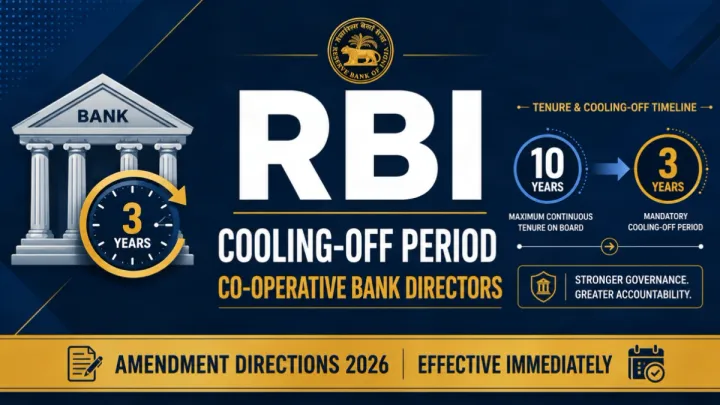
Directors completing 10-year continuous tenure on co-operative bank boards must observe 3-year cooling-off before re-appointment. Sub-3-year resignation breaks are ignored in tenure calculation.

TL;DR — Executive Summary
  • RBI issued Amendment Directions on May 25, 2026 (Press Release No. 2026-2027/326) mandating a minimum 3-year cooling-off period for directors of Urban Co-operative Banks (UCBs), State Co-operative Banks (StCBs), and Central Co-operative Banks (CCBs) after completing a continuous tenure of 10 years on the board of the same bank.
  • Two separate directions issued simultaneously — RBI/DOR/2026-27/94 for UCBs and RBI/DOR/2026-27/95 for RCBs — both inserting identical new Paragraph 7A into the RBI (Co-operative Banks – Governance) Directions, 2025; effective immediately from May 25, 2026.
  • During the 3-year cooling-off period, the outgoing director may only remain associated with the bank as a member or customer — no other capacity or role is permitted at the same bank.
  • The director may join the board of a different bank during the cooling-off period, provided they are otherwise eligible under applicable RBI norms.
  • Tenure calculation loophole closed: any interruption of less than 3 years in directorship is ignored — pre-break tenure is added to post-break tenure. Only a break of 3 years or more resets the 10-year tenure clock.
  • The maximum continuous director tenure of 10 years was introduced by the Banking Laws (Amendment) Act, 2025 effective August 1, 2025 (revised from 8 years under the Banking Regulation (Amendment) Act, 2020, applicable to UCBs from June 29, 2020 and to StCBs/CCBs from April 1, 2021).
  • Non-compliance with these RBI Directions issued under Section 35A of the Banking Regulation Act, 1949 exposes the bank to supervisory action, penalties, and regulatory restrictions by RBI.
  • Draft directions were first issued on January 8, 2026 seeking stakeholder feedback; the final directions incorporate modifications based on feedback received, as detailed in the Annex to Press Release 2026-2027/326.

RBI Mandates 3-Year Cooling-off Period for Co-operative Bank Directors After 10-Year Tenure – UCB & RCB Amendment Directions 2026

19 min read3,031 wordsRBI issues final Amendment Directions on Cooling-off Period for Directors of Co-operative BanksEffective: 25 May 2026High impact17 views

Summary

RBI issues Amendment Directions on May 25, 2026 mandating a 3-year cooling-off period for directors of UCBs, StCBs and CCBs after completing 10 years of continuous tenure. Brief resignations under 3 years are ignored for tenure calculation — loophole officially closed.

RBI Cooling-off Period for Co-operative Bank Directors 2026 – Amendment Directions

The Reserve Bank of India issued governance amendment directions for co-operative banks on May 25, 2026. Through two simultaneous Amendment Directions — one for Urban Co-operative Banks (UCBs) and one for Rural Co-operative Banks (RCBs) — RBI has introduced a mandatory 3-year cooling-off period for directors who complete a continuous tenure of 10 years on the board of the same co-operative bank. Both sets of directions take effect immediately. The change is intended to close a loophole where brief resignations were used to bypass the statutory tenure limit.

Why this matters

  • It closes a tenure-circumvention loophole in co-operative bank governance.
  • It applies a mandatory cooling-off period after 10 years on the same board.
  • It strengthens board rotation, accountability, and supervisory discipline.

💡 Key Facts at a Glance

Press Release No.2026-2027/326
UCB Notification Ref.RBI/DOR/2026-27/94 | DOR.GOV.REC.No.82/18.10.014/2026-27
Date of IssueMay 25, 2026
Effective DateImmediate effect
Applicable ToUCBs, State Co-operative Banks (StCBs), Central Co-operative Banks (CCBs)
Cooling-off Period3 Years (after completing 10-year continuous tenure)
Issued ByUCB: Scenta Joy, Chief General Manager | RCB: Brij Raj, Chief General Manager
Legal AuthoritySection 35A read with Section 10A(2A)(i) and Section 56 of the Banking Regulation Act, 1949
Paragraph InsertedNew Paragraph 7A in both UCB and RCB Governance Directions, 2025

🏛️ Section 1 — Background: Why Was This Reform Needed?

The Problem with India's Co-operative Banking Governance

India's co-operative banking sector — comprising Urban Co-operative Banks (UCBs), State Co-operative Banks (StCBs), and Central Co-operative Banks (CCBs) — has historically struggled with weak board governance. Unlike commercial banks where professional management is the norm, co-operative banks are often dominated by local political figures, community leaders, and businesspersons who treat their board positions as permanent personal assets. According to analysts, prolonged control of a board by a single individual or group can adversely affect institutional independence, transparency, and fair decision-making.

India's UCB count has declined to 1,457 at end-March 2025 from 1,926 in 2004, as RBI consolidation continued via mergers, closures, and licence cancellations. Many of these failures have been linked to concentrated, long-tenured board control — directors with decade-long tenures developing cozy relationships with management that bypassed basic risk controls.

The Legislative Journey — From 2020 to 2026

Year / DateEvent
June 29, 2020The Banking Regulation (Amendment) Act, 2020 made Section 10A(2A)(i) of the Banking Regulation Act, 1949 applicable to UCBs — prescribing a ceiling of 8 years on continuous director tenure
April 1, 2021The same 8-year tenure ceiling extended to State Co-operative Banks (StCBs) and Central Co-operative Banks (CCBs)
August 1, 2025The Banking Laws (Amendment) Act, 2025 increased the maximum continuous tenure from 8 years to 10 years for directors of UCBs, StCBs, and CCBs
November 28, 2025RBI issued UCB Governance Directions, 2025 — the parent directions that these amendments now modify
January 8, 2026RBI issued Draft Amendment Directions for both UCBs and RCBs proposing the cooling-off period — seeking stakeholder feedback
May 25, 2026✅ Final Amendment Directions issued with immediate effect — incorporating feedback from stakeholders with suitable modifications

The Loophole That Triggered This Reform

Despite the statutory tenure ceiling, RBI directly acknowledged that directors were exploiting a gap in the law. The official notification states:

"In a few cases, directors have been found to be resorting to certain methods to circumvent the provisions of the Act, such as resigning briefly from office and being re-elected / co-opted to the Board within a short period of time, thereby continuing to be on the Board of a UCB for an extended period beyond the legally permissible tenure, which defeats the intent and spirit of the statutory provision."

— RBI (Urban Co-operative Banks – Governance) Amendment Directions, 2026

In other words, directors were effectively resetting their tenure clock by making a brief resignation and getting back on the board through re-election or co-option — sometimes within weeks. This allowed them to serve well beyond the legal limit while technically complying with the letter of the law. The new cooling-off period directly plugs this gap.

📋 Section 2 — The Core Amendment: New Paragraph 7A (Verbatim)

The amendment inserts a new Paragraph 7A after Paragraph 7 in both the UCB Governance Directions, 2025 and the RCB Governance Directions, 2025. The text for UCBs (identical in substance for RCBs) reads:

Paragraph 7A — New Insertion (UCBs):

"A director on the Board of a UCB, after completing a continuous tenure of ten years in office, shall be eligible to be re-appointed, whether by election or co-option or in any other manner, as a director on the Board of the same UCB only after undergoing a minimum cooling-off period of three years. During the cooling-off period, the said director shall not be associated with the UCB in any capacity / manner other than as a member / customer. This, however, shall not preclude him / her from being appointed as a director on the Board of another bank, if otherwise eligible.

Explanation:

For calculating the period of continuous tenure, the total time served on the Board of the UCB including the period of directorship preceding an interruption of less than three years but excluding the period of directorship preceding at least a three-year interruption shall be reckoned."

🔄 Section 3 — Before vs After: What Changes?

AspectBefore (Old Position)After (New Position — May 25, 2026)
Maximum Continuous Tenure10 years (since Aug 1, 2025; was 8 years before)10 years — unchanged
Re-appointment After Completing Max TenureNo statutory cooling-off required — directors could resign briefly and re-joinMandatory 3-year cooling-off period before re-appointment to the same bank
Permitted Activities During Cooling-offNo restriction; director could hold any positionCan be a member or customer only — no other capacity or association
Director in Another Bank During Cooling-offNo restrictionAllowed — cooling-off applies only to the same bank where tenure was completed
Tenure Calculation (Brief Resignation Trick)Loophole: brief resignation could arguably reset the tenure clockLoophole closed: interruptions of less than 3 years are ignored — tenure continues to accumulate
Tenure Calculation (Genuine Long Break)No clear statutory guidanceInterruption of 3 years or more resets the tenure clock — prior tenure is not counted
CoverageUCBs, StCBs, CCBs — tenure ceiling already applied; no cooling-off frameworkUCBs (under UCB Directions 2025); StCBs and CCBs (under RCB Directions 2025) — cooling-off now applies to all
Effective Date of New RuleImmediate effect from May 25, 2026

📐 Section 4 — How Is "Continuous Tenure" Calculated? The Explanation

The most critical — and most carefully crafted — part of the amendment is the Explanation clause that defines how continuous tenure is computed. This directly addresses the "brief resignation" loophole.

ScenarioHow Tenure Is CountedPractical Effect
Continuous service without breakAll years counted towards 10-year limitStandard case — 10 years triggers cooling-off
Brief resignation (interruption < 3 years)Pre-interruption tenure is added back — gap is ignored for counting purposesLoophole closed — 5 years + 1 month break + 5 years = 10 years continuous (cooling-off triggered)
Genuine long break (interruption ≥ 3 years)Pre-interruption tenure is excluded — fresh count begins from re-appointment8 years + 3 year genuine break + re-appointment = fresh 10-year clock starts from re-appointment date

📝 Worked Example — The Loophole Is Now Closed

Old position: Director A serves 9 years on the board → resigns for 6 months → gets re-elected. Under old rules, they could argue their tenure clock reset.
New position: Director A serves 9 years → resigns for 6 months (less than 3 years) → re-elected → the 9 years is counted; after just 1 more year of the new term, they hit 10 years total and must undergo the 3-year cooling-off before re-appointment. The 6-month break is legally irrelevant.

🏦 Section 5 — UCBs vs RCBs: How Do the Two Sets of Directions Differ?

Two separate but substantively identical Amendment Directions have been issued — one for UCBs and one for RCBs. The language of the new Paragraph 7A is the same in both; the difference lies only in the type of bank covered.

FeatureUCB Amendment Directions, 2026RCB Amendment Directions, 2026
Banks CoveredPrimary (Urban) Co-operative Banks — UCBsState Co-operative Banks (StCBs) + Central Co-operative Banks (CCBs)
Notification ReferenceRBI/DOR/2026-27/94RBI/DOR/2026-27/95
Parent Directions ModifiedRBI (UCB – Governance) Directions, 2025 (November 28, 2025)RBI (RCB – Governance) Directions, 2025
Tenure Rule Applicability (Original)Applicable to UCBs from June 29, 2020 (8 yrs); revised to 10 yrs from Aug 1, 2025Applicable to StCBs and CCBs from April 1, 2021 (8 yrs); revised to 10 yrs from Aug 1, 2025
Signed ByScenta Joy, Chief General ManagerBrij Raj, Chief General Manager
Cooling-off Paragraph 7AIdentical — 10 years tenure → 3 years cooling-off; same association restrictions; same tenure calculation explanationIdentical — 10 years tenure → 3 years cooling-off; same association restrictions; same tenure calculation explanation

📅 Section 6 — Key Rules at a Glance: What a Director Must Know

RuleDetail
Maximum continuous tenure on same bank board10 years
Cooling-off after completing 10-year tenureMinimum 3 years — cannot be re-appointed before this period ends
What is allowed during cooling-offMember or customer of the same bank — nothing more
What is NOT allowed during cooling-offDirector, advisor, consultant, officer, or any other association with the same bank
Can director join another bank during cooling-off?Yes — explicitly permitted, provided the person is otherwise eligible under applicable rules
Effect of short break (< 3 years) in tenureBreak is ignored — pre-break tenure is added to post-break tenure for computing the 10-year limit
Effect of long break (≥ 3 years) in tenureBreak resets the clock — pre-break tenure is excluded; 10-year limit counts only from date of re-appointment after the break
Effective DateImmediate — from May 25, 2026

👥 Section 7 — Who Is Affected and What Must They Do?

StakeholderImpactImmediate Action Required
Directors of UCBs approaching or at 10-year tenureMust now vacate the board and observe 3-year cooling-off before any re-appointment to the same UCBCalculate cumulative continuous tenure (including any sub-3-year breaks) immediately; plan transition
Directors who recently resigned briefly to reset tenurePre-break tenure will be counted if the break was less than 3 years — may have hit 10-year limit alreadyRecalculate tenure including all stints with sub-3-year interruptions; seek legal advice if necessary
UCB / StCB / CCB BoardsMust review tenure of all directors and identify those subject to the cooling-off requirementConduct immediate board-level review; ensure compliance; plan board composition accordingly
Compliance / Legal Officers of Co-operative BanksMust implement new tenure calculation methodology and ensure no director in cooling-off holds any role other than member/customerUpdate governance records; report to RBI if any director is in breach; ensure Board composition is compliant
Registrar of Cooperative Societies (State Level)Must ensure elections / co-options do not admit directors in their cooling-off periodAlign election procedures with new cooling-off requirements
Bank members / depositorsStronger governance protections — reduced risk of entrenched directors compromising bank managementNo immediate action; benefit from stronger board governance going forward

⚠️ Immediate Effect — Action Required NOW

The latest move is expected to improve board rotation, strengthen governance oversight and enhance accountability across the cooperative banking sector, and is likely to trigger leadership changes in several banks where directors have remained on boards for extended periods. Banks should not wait — the directions are already in force and non-compliance could attract RBI supervisory action.

🌐 Section 8 — Broader Context: The Draft Directions (January 8, 2026) and Stakeholder Feedback

The final directions on May 25, 2026 are not the first iteration of this reform. RBI followed a transparent consultative process:

  • January 8, 2026: RBI issued draft Amendment Directions for both UCBs and RCBs seeking public feedback — the draft had proposed the same 3-year cooling-off framework
  • Feedback Examination: RBI examined the stakeholder feedback received on both draft directions
  • Modifications Incorporated: The feedback resulted in "consequent modifications" which were incorporated into the final directions (a statement on feedback received is published as an Annex to the press release)
  • May 25, 2026: Final directions issued with immediate effect

The fact that the final directions largely mirror the draft indicates that the broad framework — including the 3-year cooling-off period and the tenure calculation explanation — survived stakeholder scrutiny without fundamental change. The "modifications" are likely procedural or clarificatory rather than substantive.

❓ Frequently Asked Questions

Q1. I am a director who has served 9 years, resigned 6 months ago, and was just re-elected. How does the new rule apply to me?

Under the new tenure calculation explanation, your 6-month resignation is treated as an interruption of less than 3 years — it is ignored. Your pre-resignation tenure of 9 years is added to your post-re-election tenure. This means after just 1 more year on the board, you will have completed the 10-year continuous tenure threshold. At that point, you will need to step down and serve a 3-year cooling-off before you can be re-appointed to the same bank's board. (Source: RBI UCB Amendment Directions 2026, Para 7A Explanation)

Q2. During the 3-year cooling-off, can I still attend the bank's AGM or general body meetings as a member?

Yes. The directions allow you to remain associated with the bank as a member or customer only. Attending AGMs as a member, exercising voting rights as a member, or using banking services as a customer are all permitted. What is not permitted is holding any capacity that gives you influence over governance — such as director, advisor, committee member, or officer of the bank. (Source: RBI UCB Amendment Directions 2026, Para 7A)

Q3. Can I become a director of a different co-operative bank while serving my cooling-off period?

Yes, explicitly. The directions state: "This, however, shall not preclude him/her from being appointed as a director on the Board of another bank, if otherwise eligible." The cooling-off restriction applies only to re-appointment to the same bank where the 10-year tenure was completed. You can immediately join another co-operative bank's board (subject to normal eligibility requirements). (Source: RBI UCB Amendment Directions 2026, Para 7A)

Q4. I served 5 years, then had a break of 3 years and 1 month, then rejoined. Does my earlier 5-year term count?

No. The Explanation to Para 7A specifies that tenure "preceding at least a three-year interruption shall be excluded" from the continuous tenure calculation. Since your break was 3 years and 1 month — meeting the "at least three years" threshold — your earlier 5-year term is not counted. Your tenure clock restarts from the date of your re-appointment after the break. You now have a fresh 10-year window from that date. (Source: RBI UCB Amendment Directions 2026, Para 7A Explanation)

Q5. Does this rule apply to all UCBs regardless of size?

Yes. The Amendment Directions apply to all UCBs regulated by RBI — there is no size-based exemption in the directions. The statutory basis (Section 10A(2A)(i) of the Banking Regulation Act, 1949) applies uniformly. All primary co-operative banks, whether Tier 1 (small UCBs with deposits under ₹100 crore) or Tier 4 (large UCBs with deposits above ₹10,000 crore), must comply. (Source: RBI UCB Amendment Directions 2026)

Q6. Does the 3-year cooling-off apply to directors of commercial banks or only co-operative banks?

These specific Amendment Directions apply only to co-operative banks — UCBs, StCBs, and CCBs. Commercial banks (public sector, private sector, foreign banks) are governed by separate RBI Directions and the Banking Regulation Act provisions that apply to them. This particular reform was triggered by the cooperative bank-specific provisions of Section 10A(2A)(i) read with Section 56 of the Banking Regulation Act, 1949, which have a specific applicability for co-operative banks. (Source: RBI Press Release 2026-2027/326; RBI UCB Amendment Directions 2026)

Q7. What happens if a director in cooling-off continues to remain associated with the bank in some capacity?

This would constitute a violation of the RBI Amendment Directions issued under Section 35A of the Banking Regulation Act, 1949. Non-compliance with Section 35A directions exposes the bank (and potentially the individual) to supervisory action by RBI — including penalties, directions, and in serious cases, restrictions on the bank's operations. The bank's board and compliance function would be responsible for ensuring no cooling-off director holds any prohibited association. (Source: Section 35A, Banking Regulation Act, 1949)

Q8. When did the maximum continuous tenure get revised from 8 years to 10 years?

The Banking Laws (Amendment) Act, 2025 raised the maximum continuous tenure of directors of UCBs, State Co-operative Banks, and Central Co-operative Banks from eight years to ten years, with the amended provision coming into effect on August 1, 2025. The earlier 8-year ceiling had been introduced by the Banking Regulation (Amendment) Act, 2020 for UCBs (effective June 29, 2020) and extended to StCBs and CCBs from April 1, 2021.

Q9. Is this rule applicable to State Co-operative Banks (StCBs) as well?

Yes. While the UCB directions apply to Urban Co-operative Banks, the RCB framework covers State Co-operative Banks (StCBs) and Central Co-operative Banks (CCBs). Both the UCB and RCB directions contain identical Paragraph 7A language. For StCBs and CCBs, the original tenure ceiling became applicable from April 1, 2021 (under the Banking Regulation (Amendment) Act, 2020), and the 10-year revised limit applies since August 1, 2025.

📝 Bottom Line

RBI's May 25, 2026 Amendment Directions for UCBs and RCBs close a long-standing governance gap in India's cooperative banking sector. By mandating a 3-year cooling-off period after a 10-year continuous tenure and — critically — by making sub-3-year resignations legally invisible for tenure calculation purposes, RBI has effectively ended the "revolving door" practice where powerful directors could circumvent statutory tenure limits through brief, tactical resignations. The amendment is expected to improve board rotation, strengthen governance oversight and enhance accountability across the cooperative banking sector, and is likely to trigger leadership changes in several banks where directors have remained on boards for extended periods. Co-operative banks must act immediately — the directions are already in force. All directors should have their cumulative tenure (including sub-3-year interruptions) calculated without delay, and boards must plan for any leadership transitions required.

Primary Sources: RBI Press Release No. 2026-2027/326 dated May 25, 2026 (rbi.org.in); RBI (Urban Co-operative Banks – Governance) Amendment Directions, 2026 — RBI/DOR/2026-27/94; RBI (Rural Co-operative Banks – Governance) Amendment Directions, 2026 — RBI/DOR/2026-27/95. Additional Sources: The Tribune / ANI (May 25, 2026); Indian Cooperative (May 25, 2026); Banking Laws (Amendment) Act, 2025; Banking Regulation (Amendment) Act, 2020. This article is for informational purposes only and does not constitute legal advice.

Related Updates

RBI’s New Loan Recovery Draft: Mobile Phone Restriction, Stricter Recovery Agent Rules, and What Changes in 2026
RBIMedium impact

RBI’s New Loan Recovery Draft: Mobile Phone Restriction, Stricter Recovery Agent Rules, and What Changes in 2026

RBI’s revised May 20, 2026 draft tightens loan-recovery rules with stronger borrower protection, mandatory certification for recovery agents, public disclosure of agencies, call recording, and a new device-financing rule that permits only graduated restriction of financed mobile phone functions afte

RBI Issues Revised Draft Amendment Directions on ‘Conduct of Regulated Entities in Recovery of Loans and Engagement of Recovery Agents

21 May 2026Eff. 1 October 202687 views
28 min
RBI Amends CET1 Capital Rules: Quarterly Profit Inclusion in CRAR Now Formula-Based — 2026 Amendment Directions Explained
RBIHigh impact

RBI Amends CET1 Capital Rules: Quarterly Profit Inclusion in CRAR Now Formula-Based — 2026 Amendment Directions Explained

RBI on May 8, 2026 amended CET1 capital rules for CRAR by removing the 25% NPA provisioning deviation condition. A new formula, EPt = NPt − 0.25×D×t, now applies to Commercial Banks, SFBs, and Payments Banks. Quarterly audited or reviewed financials are mandatory.

RBI Press Release – Quarterly Profits in CET1 (May 08, 2026)

10 May 2026Eff. 8 May 202661 views
14 min
RBI Keeps Repo Rate Unchanged at 5.25% – MPC April 2026 Meeting Key Highlights
RBI

RBI Keeps Repo Rate Unchanged at 5.25% – MPC April 2026 Meeting Key Highlights

RBI's Monetary Policy Committee unanimously held the repo rate at 5.25% in its 60th meeting (April 6–8, 2026). Neutral stance retained. West Asia conflict poses major risk. GDP growth projected at 6.9% and CPI inflation at 4.6% for FY2026-27.

RBI Press Release 2026-2027/121 — Minutes of 60th MPC Meeting, April 6-8, 2026

27 April 202648 views
7 min