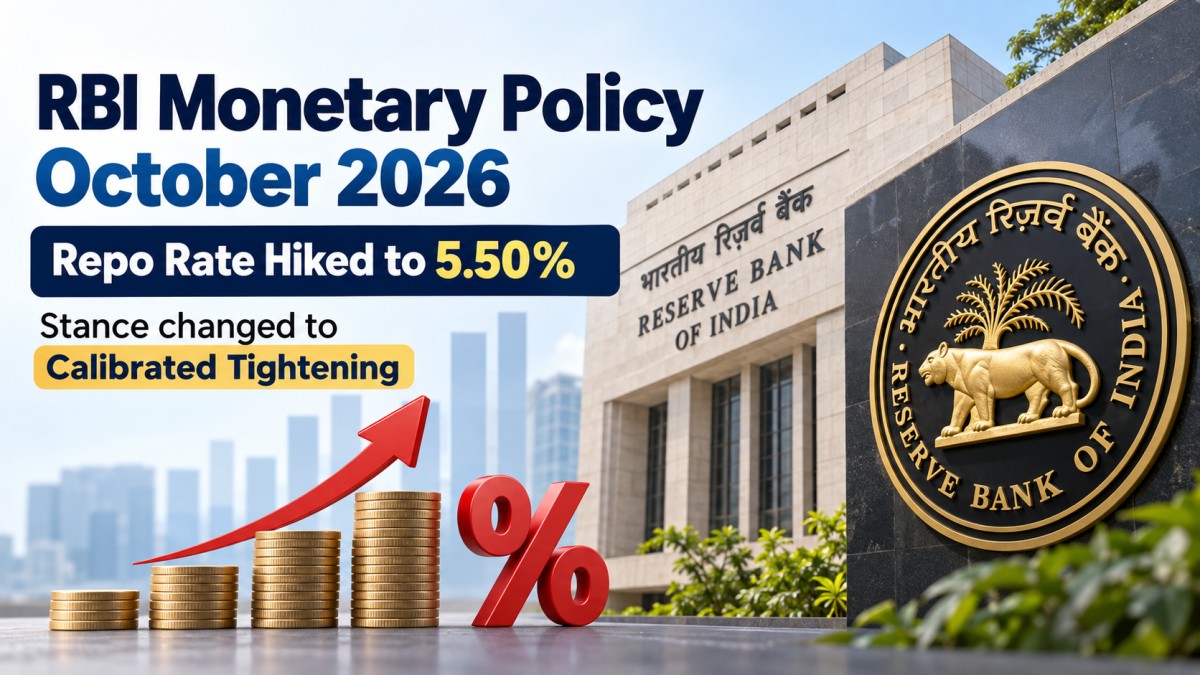
On 7 October 2026, the RBI's Monetary Policy Committee (MPC) raised the policy repo rate by 25 basis points to 5.50 per cent and changed its stance to calibrated tightening, which the MPC says means rate cuts are off the table in the near term. Borrowers with repo-linked floating-rate loans may see higher rates or EMIs at their next reset, depending on their loan terms. The decision was taken at the MPC's 63rd meeting, held from 5 to 7 October 2026.
Quick Answer
The RBI's Monetary Policy Committee (MPC) voted unanimously on 7 October 2026 to increase the policy repo rate under the liquidity adjustment facility (LAF) by 25 bps to 5.50 per cent. The MPC also decided to change the policy stance to calibrated tightening, which it says means rate cuts are off the table in the near term; two members, Dr. Nagesh Kumar and Prof. Ram Singh, preferred to retain the neutral stance. Following the hike, the standing deposit facility (SDF) rate is 5.25 per cent, and the marginal standing facility (MSF) rate and Bank Rate are 5.75 per cent. The RBI projects FY2026-27 real GDP growth at 7.1 per cent and CPI inflation at 5.2 per cent. The next MPC meeting is on 2 to 4 December 2026.
What Changed in the October 2026 Monetary Policy?
Two things changed: the price of money and the signal about its direction. The earlier values below are arithmetic from the 25 bps hike; the press releases state only the new rates.
What Is the New Policy Rate Corridor?
The corridor is the band within which the weighted average call rate (WACR) is meant to move. After the hike, the SDF rate of 5.25 per cent forms the floor, the repo rate of 5.50 per cent sits in the middle, and the MSF rate of 5.75 per cent forms the ceiling. The Bank Rate is also 5.75 per cent. The Governor said the RBI will use an appropriate mix of liquidity tools and strive to align the WACR with the policy repo rate.
Why Did the MPC Raise the Repo Rate?
The MPC's reasoning rests on inflation. The Resolution says inflation and its outlook are "not benign" compared with last year, with headline CPI expected to average almost 5.8 per cent over the next three quarters and core inflation projected at 4.4 per cent this year. It concluded that recalibrating the policy rate was imperative.
- Global shock: A re-escalation of the West Asia conflict in September pushed crude prices up. The Indian basket averaged US$ 116.1 per barrel in September, against US$ 82.0 in July.
- Weather: The southwest monsoon ended 13 per cent below the Long Period Average on 30 September 2026, with strong El Niño conditions.
- Broadening prices: Core inflation rose to 4.2 per cent in August from 3.9 per cent. About 37 per cent of the CPI basket (by weight) now shows inflation above 4 per cent.
- Demand and credit: Evidence of demand-side pressure is limited, but strong growth in monetary and credit aggregates poses a risk.
- Global tightening: The US Fed raised rates by 25 bps in September, and other major central banks have tightened.
The MPC also observed that there is some evidence of elevated inflation expectations, but only limited signs of supply-side pressures getting embedded in pricing behaviour.
What Does "Calibrated Tightening" Mean?
Under the new stance, rate cuts are off the table in the near term, and the next policy action can only be a rate hike or a pause. The MPC said the duration and extent of the hiking cycle depend on actual growth-inflation developments, especially underlying inflation, the broadening of price pressures, second-round effects of the supply shock and demand impulses.
CorpLawUpdates analysis: A split on stance, with unanimity on the rate, suggests the committee agreed on the immediate need to act but not on signalling a hiking cycle. Treasury and finance teams should treat the December meeting as a genuine hike-or-pause decision.
What Are the RBI's Growth and Inflation Projections?
Core inflation is projected at 4.4 per cent for 2026-27. The RBI describes the risks to both growth and inflation as evenly balanced.
The gap between growth and inflation narrows in Q3 FY27, when CPI is projected to peak at 6.0 per cent.
Where the economy stands today
- Growth: Real GDP grew 7.8 per cent in Q1 FY27, driven by private consumption and strong investment. Manufacturing PMI averaged 53.8 and services PMI 54.2 in Q2, both in expansion but slower than Q1.
- Inflation: CPI inflation rose to 4.8 per cent in August 2026 from 4.5 per cent in July, led by food and fuel. Sugar and onion saw sharp spikes.
- Credit: Bank credit grew 18.1 per cent year on year as on 15 September 2026, against 10.4 per cent a year ago.
- Banking health: Scheduled commercial banks' GNPA ratio was 1.67 per cent and CRAR 17.87 per cent in June 2026. NBFC GNPA was 2.50 per cent and CRAR 25.50 per cent.
- External sector: Net FDI was US$ 13.8 billion in April to August 2026. Foreign exchange reserves were US$ 734.6 billion on 2 October 2026, about 11 months of import cover. The merchandise trade deficit was US$ 58.7 billion in July-August.
What Liquidity Measures Did the RBI Mention?
System liquidity stayed in surplus, with an average daily surplus of ₹5.9 lakh crore since the August 2026 meeting. The RBI conducted 55 variable rate reverse repo (VRRR) auctions and open market operation sales worth ₹1.0 lakh crore to absorb liquidity. The Governor said the WACR traded in the lower half of the policy corridor, and the RBI will work to align it with the repo rate.
What Did the RBI Announce Beyond the Rate Decision?
Alongside the rate decision, the RBI issued a separate Statement on Developmental and Regulatory Policies (Press Release 2026-2027/1265) with two measures. The Governor also announced both in his statement.
1. Account Aggregator interoperability and deposit data in the CAS
The RBI has decided to implement interoperability among NBFC-Account Aggregators (NBFC-AA). Customers will be able to access and share their financial information across different Financial Information Providers through any NBFC-AA of their choice.
Additionally, depositories regulated by the Securities and Exchange Board of India are being facilitated to include information on bank deposit accounts in their Consolidated Account Statement (CAS) through the NBFC-AAs. Demat account holders will then see their demat holdings and bank deposits in one place in the CAS. Customers, including those without demat accounts, can continue to obtain a consolidated view of their financial information and share it through NBFC-AAs. The RBI says both measures, NBFC-AA interoperability and the inclusion of bank deposit information in the CAS, are expected to be implemented by 31 December 2026.
2. Technical Consultative Committee for Financial Markets
The RBI has decided to constitute a Technical Consultative Committee for Financial Markets, citing rapidly evolving financial markets and infrastructure. It will be a forum for structured engagement by the RBI with market participants and stakeholders on policy and operational matters relating to:
- money markets
- government securities markets
- foreign exchange markets
- the respective derivative markets and infrastructure
The composition and terms of reference will be separately notified. No date has been given, so members, mandate and timelines are unknown for now.
CorpLawUpdates analysis: The statement says "expected to be implemented", not a binding compliance deadline. Entities that operate as NBFC-AAs, or that act as Financial Information Providers or users, should watch for the detailed RBI directions that will have to follow.
Who Is Affected by the Repo Rate Hike?
The press releases do not quantify how fast lenders will pass on the hike. Transmission depends on each loan's benchmark and reset clause.
Key Dates
5 to 7 October 2026: 63rd MPC meeting.
7 October 2026: Policy decision and Governor's Statement announced.
21 October 2026: MPC minutes to be published.
2 to 4 December 2026: Next MPC meeting.
31 December 2026: Expected implementation date for NBFC-AA interoperability and deposit data in the CAS.
The MPC members at the meeting were Shri Sanjay Malhotra (Governor, Chair), Dr. Nagesh Kumar, Shri Saugata Bhattacharya, Prof. Ram Singh, Dr. Poonam Gupta and Shri Indranil Bhattacharyya.
Compliance Checklist and Action Plan
A monetary policy decision is not a compliance rule, so there are no mandatory filings. These are practical steps for finance and compliance teams.
Practical example (hypothetical): A company has a ₹50 crore floating-rate loan linked to the repo rate. A 25 bps rise adds about ₹12.5 lakh a year in interest on a full outstanding balance, before any change in the lender's spread.
Frequently Asked Questions
What is the new RBI repo rate after the October 2026 policy?
The policy repo rate under the LAF is 5.50 per cent after a 25 bps increase announced on 7 October 2026.
What are the new SDF, MSF and Bank Rate?
The SDF rate is 5.25 per cent. The MSF rate and the Bank Rate are both 5.75 per cent.
Was the MPC decision unanimous?
The rate increase was unanimous. On the stance, Dr. Nagesh Kumar and Prof. Ram Singh preferred to keep it neutral.
Will home loan EMIs increase after the repo rate hike?
Floating-rate loans linked to the repo rate may see higher rates or EMIs when the lender resets them. The RBI documents do not state specific pass-through timelines, so the loan agreement governs.
What is the RBI's inflation forecast for 2026-27?
CPI inflation is projected at 5.2 per cent for 2026-27, with Q2 at 4.9 per cent, Q3 at 6.0 per cent and Q4 at 5.7 per cent. Core inflation is projected at 4.4 per cent.
What is the RBI's GDP growth forecast for 2026-27?
Real GDP growth is projected at 7.1 per cent for 2026-27, and 7.1 per cent for Q1 of 2027-28. The Governor noted a 40 bps upward revision.
Can we expect a rate cut soon?
The MPC said rate cuts are off the table in the near term, and the next action can only be a hike or a pause.
When is the next MPC meeting?
The next MPC meeting is scheduled for 2 to 4 December 2026. The minutes of the October meeting will be published on 21 October 2026.
What did the RBI announce on Account Aggregators?
The RBI will implement interoperability among NBFC-Account Aggregators, so customers can access and share data from different Financial Information Providers through any NBFC-AA they choose. SEBI-regulated depositories will also include bank deposit information in the Consolidated Account Statement through NBFC-AAs. Both are expected by 31 December 2026.
What is the Technical Consultative Committee for Financial Markets?
It is a forum the RBI will constitute for structured engagement with market participants on policy and operational matters in money, government securities and foreign exchange markets, and their derivative markets and infrastructure. Its composition and terms of reference will be separately notified.
CorpLawUpdates Analysis
The mix of a strong growth print (7.8 per cent in Q1) and rising food, fuel and core inflation explains why the RBI chose to act now. For compliance and finance teams, the immediate issue is repricing: floating loans, working capital lines and ECB hedges all need a fresh look. The watch items are the MPC minutes on 21 October, monthly CPI releases, crude oil prices and the monsoon's effect on rabi output. These are editorial views, not RBI statements, and the RBI itself says the risks to growth and inflation are evenly balanced.
Documents: (1) Monetary Policy Statement, 2026-27, Resolution of the Monetary Policy Committee, October 5 to 7, 2026; (2) Statement on Developmental and Regulatory Policies, October 7, 2026; (3) Governor's Statement, October 7, 2026.
Issuing authority: Reserve Bank of India, Department of Communication, Mumbai.
Reference: Press Releases 2026-2027/1264, 2026-2027/1265 and 2026-2027/1266, dated 7 October 2026.
Signatory: Brij Raj, Chief General Manager.
Primary source: RBI Press Releases 2026-2027/1264, 2026-2027/1265 and 2026-2027/1266, dated 7 October 2026 (www.rbi.org.in)
This article is for informational and educational purposes only and does not constitute legal or regulatory advice. Readers should verify the applicable primary regulatory source before taking action.


