Issued by: Securities and Exchange Board of India (SEBI Board)
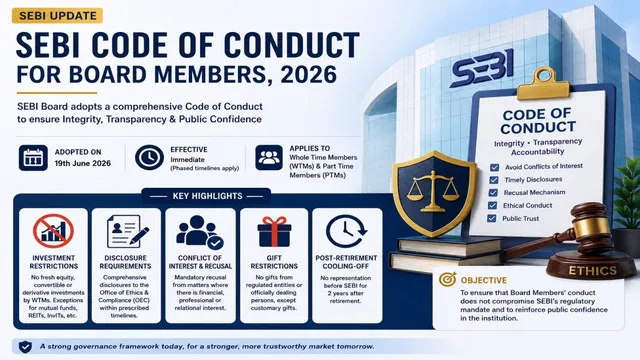
Date of Adoption: 19th June 2026
Effective: Immediate; certain disclosure/liquidation timelines phased in within one month of the Code coming into force
What Is the SEBI Code of Conduct for Board Members?
Regulators the world over face growing scrutiny over how their own decision-makers manage personal financial interests while overseeing the very markets they regulate. SEBI has responded to this expectation by voluntarily adopting a formal Code of Conduct for the Members of its Board — a self-governance framework rather than a market-facing circular.
The Code applies to both categories of Board Members: Whole Time Members (WTMs), which includes the Chairperson, and Part Time Members (PTMs), including ex-officio government or statutory-body representatives. Its stated objective is twofold — to ensure Members' conduct does not compromise the Board's ability to fulfil its regulatory mandate, and to reinforce public confidence that Members discharge their duties fairly and transparently.
In practice, the Code does three things: it bans certain personal investments by Members, sets fixed disclosure timelines to a newly referenced Office of Ethics and Compliance (OEC), and creates a formal recusal mechanism for conflicts of interest — backed by a post-retirement cooling-off period.
Key Definitions
Handling Existing Non-Permitted Investments (WTMs)
A WTM joining the Board with pre-existing non-permitted investments must choose one of four options: liquidate the holding; freeze it until tenure ends; disclose a trading plan to the OEC for phased sale under Regulation 5 of the SEBI (Prohibition of Insider Trading) Regulations, 2015; or sell it during tenure without a trading plan but with prior approval.
- If holdings are not liquidated, voting rights on that equity are suspended during tenure, though corporate-action shares/rights entitlements may still be received.
- Deviation from a disclosed trading plan requires prior approval.
- Approval for the Chairperson's transactions comes from the Board (excluding Chairperson); for other WTMs, from the Chairperson.
- Vested stock options must be exercised before joining the Board — they cannot be exercised during tenure.
Disclosure Obligations for WTMs
WTMs must disclose, using prescribed Schedule formats: family and relative details; professional interests over the last three years; immovable property; financial investments and liabilities; non-permitted investments held by family members; and any property rented out.
Immovable property disclosures made by WTMs are additionally made public by the OEC, though full addresses are withheld for privacy.
Disclosure Obligations for PTMs
Ex-officio PTMs representing Government or a statutory body are exempt from immovable property and financial-investment disclosures to SEBI if equivalent disclosures are already filed with their parent organisation, subject to a confirmation being furnished to the Board.
Other PTMs must disclose family details, equity/derivative holdings at joining, transactions each financial year, and professional interests over the last three years and during tenure — following the same joining/annual/change-based deadlines applicable to WTMs.
Investment Caps and Gift Restrictions
Relaxations for Family Members
Insider Status and Recusal Framework
Every WTM is deemed an "insider" under Regulation 2(1)(g) of the SEBI (Prohibition of Insider Trading) Regulations, 2015, and remains bound by those insider-trading provisions throughout tenure.
Beyond that, the Code introduces a structured recusal mechanism. A Member must recuse — meaning no presence in discussion, no access to related information, and no participation in voting — from any matter falling within a "conflicted relationship."
Matters involving an entire class of entities or generic regulation-making are explicitly excluded from the conflicted-relationship scope. Doubts on applicability are referred to the Board (for Chairperson-related conflicts), the Chairperson (for other WTMs), or the Board excluding the concerned PTM.
Managing and Reporting Recusals
- Conflicted relationships must be disclosed at the earliest opportunity, using a digital disclosure-and-recusal system.
- An annual summary of recusals is published in SEBI's Annual Report.
- If a WTM (other than Chairperson) recuses, the matter is handled by another WTM under the alternate-arrangement protocol.
- If the Chairperson recuses on a matter requiring Chairperson approval, the remaining WTMs decide as a committee.
Any person with reasonable grounds and material evidence of a Member's conflicted relationship may approach the OEC. The OEC evaluates the evidence, seeks the Member's comments, and either closes the matter or escalates it to the Chairperson/Board for a determination — following which recusal is directed if a conflict is confirmed.
Post-Retirement Restrictions
Interpretation and Clarifications
Where the application or interpretation of any provision is unclear, the OEC — with the Chairperson's approval — is empowered to issue clarifications.
Key Changes at a Glance
The "Earlier Framework" column below reflects CorpLawUpdates' editorial characterization of prior informal practice, since the Code itself does not describe a preceding framework.
Compliance Checklist
☑ WTMs holding non-permitted investments on joining must select a disposal option — liquidate, freeze, trading plan, or approved sale — within 1 month of the Code taking effect (for sitting WTMs)
☑ File initial disclosures (family, relatives, property, investments, liabilities) with OEC in the Schedule format within 1 month of joining or of the Code coming into force
☑ Track and cap investment in any single regulated pooled vehicle at 25% of total acquisition cost
☑ Do not make any fresh non-permitted investment (equity, convertible instruments, or equity/commodity derivatives) — for yourself or family members — at any point during tenure
☑ Report any gift over Rs. 50,000 received from a personal friend at a social/religious occasion
☑ Disclose any transaction in financial assets exceeding twice the monthly basic pay, within 1 month of month-end
☑ File annual disclosures as on 31 March by 30th April every year
☑ Disclose any change in family members, relatives, or immovable property status to OEC within 1 month of month-end
☑ Do not solicit or accept gifts from anyone with likely official dealings or from subordinate employees, and ensure family members do not either
☑ PTMs (non-ex-officio): file family, equity-holding, transaction, and professional-interest disclosures per the Schedule on joining and annually; ex-officio PTMs: furnish confirmation of equivalent disclosures already filed with their parent Government/Statutory Organization
☑ Identify and proactively flag conflicted-relationship matters to enable timely recusal
☑ Disclose any future-employment negotiation within 1 month of the month it occurs, and observe the 2-year post-exit appearance bar
CorpLawUpdates Analysis
The most consequential element of this Code is not any single restriction but the shift from informal ethical expectation to a codified, Schedule-driven compliance system for the regulator's own decision-makers. By tying disclosure timelines to statutory-style "within one month from the end of the month" formulations — the same drafting convention SEBI uses in market regulations — the Board effectively subjects itself to the discipline it imposes on regulated entities.
The practical compliance challenge will likely centre on the 25% pooled-vehicle investment cap and its interaction with the conflicted-relationship test. Since breaching the cap itself becomes a recusal trigger under clause 9(3)(v), WTMs and the OEC will need real-time tracking of investment values relative to a shifting base (total acquisition cost as on the last financial year-end or joining date) — a data-management exercise rather than a one-time disclosure.
Similarly, the family-member relaxations for discretionary PMS and unlisted-security holdings under clause 7 create room for legitimate family wealth management, but will require the OEC to develop clear verification protocols to prevent the exception from being used to route otherwise-restricted investments.
Looking ahead, publication of annual recusal summaries in SEBI's Annual Report (per the Schedule format) will make Board-level conflict management visible for the first time in a structured way — a transparency measure market participants and governance analysts are likely to track closely in future reporting cycles.
This article is for informational and educational purposes only and does not constitute legal or regulatory advice. Verify with primary regulatory sources before acting.