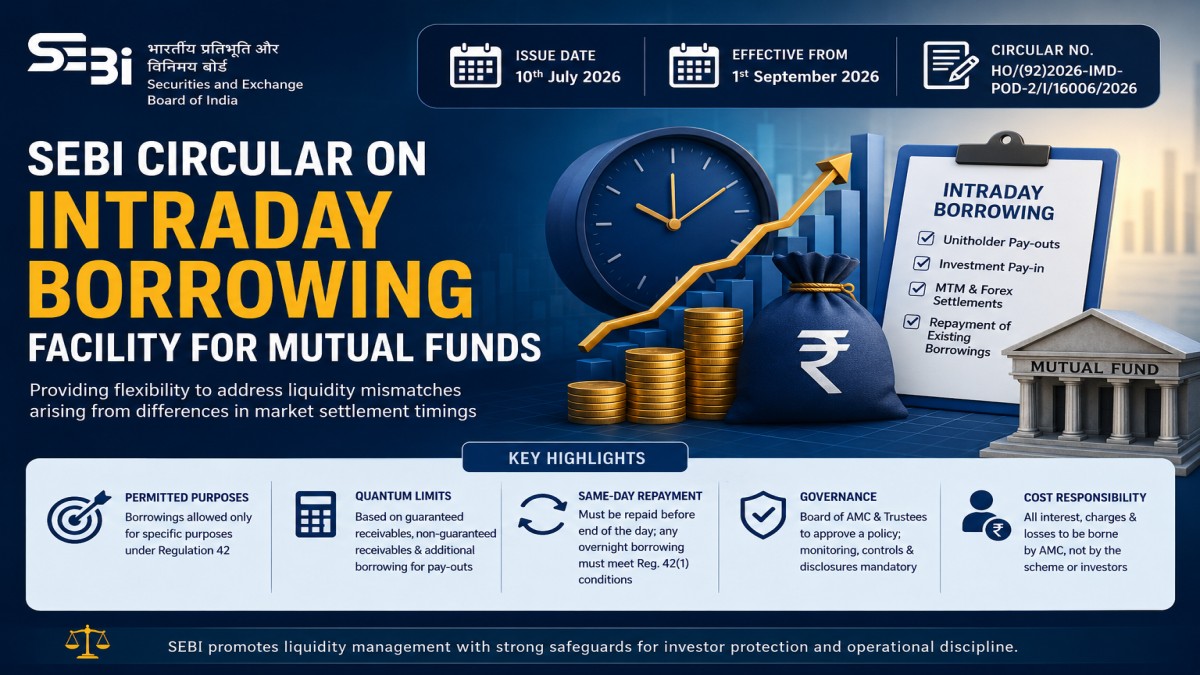
Issuing Authority: SEBI, Investment Management Department | Date of Issue: 10th July 2026 | Comes into Force: 1st September 2026 | Permits intraday borrowing by mutual funds/AMCs
Quick Reference — Circular HO/(92)2026-IMD-POD-2/I/16006/2026
SEBI Circular on Intraday Borrowing — What It Does
The Securities and Exchange Board of India (SEBI) has, through Circular No. HO/(92)2026-IMD-POD-2/I/16006/2026 dated 10th July 2026, set out the conditions under which mutual funds may avail an intraday borrowing facility. The circular is addressed to all Mutual Funds, all Asset Management Companies (AMCs), all Trustee Companies/Boards of Trustees of Mutual Funds, and the Association of Mutual Funds in India (AMFI).
Paragraph 1 records that the facility exists to address liquidity mismatches arising from differences in market settlement timings. SEBI had already amended the SEBI (Mutual Funds) Regulations, 2026 to permit intraday borrowings, via Gazette Notification No. CG-MH-E-07072026-274229 dated 3rd July 2026. This circular operationalises that regulatory amendment by prescribing the specific conditions, purposes, and limits within which the facility may be used.
Importantly, this circular supersedes the existing borrowing guidelines under clause 5.9.1 of the SEBI Master Circular for Mutual Funds dated 20th March 2026 and Circular No. HO/(92)2026-IMD-POD-2/I/7885/2026 dated 25th March 2026. It comes into effect from 1st September 2026.
Permitted Purposes — Addressing Liquidity Mismatch Under Regulation 42
Clause 2.1 sets out the specific purposes for which mutual funds may avail intraday borrowings:
- All unitholder pay-outs such as redemptions, IDCW pay-outs, interest, etc.
- Pay-in with respect to investments made by the scheme.
- MTM obligations and foreign exchange settlements.
- Repayment of existing borrowings.
Intraday borrowing is restricted to the four purposes listed above; SEBI has not left the permitted-use list open-ended.
Quantum Limits on Intraday Borrowing
Clause 2.2 caps how much a scheme may borrow intraday, tying the quantum to receivables expected within the same day:
Guaranteed receivables — inflows from RBI, Clearing Corporations, subscription inflows received in scheme bank accounts, etc. Non-guaranteed receivables sighted during the day — inflows from maturity proceeds and/or secondary market settlement from NCDs, CP, CDs, OTC Swaps, etc., to be received by the scheme by end of the day. Additional borrowing beyond these two categories may be availed by AMCs solely for meeting redemption and other unitholder pay-outs as specified under Regulation 42(1) of SEBI (Mutual Funds) Regulations, 2026.
Repayment Obligation and Overnight Conversion
Clause 2.3 places responsibility squarely on AMCs: intraday borrowings must be repaid by end of the day, and any intraday borrowing that is converted to overnight borrowing must remain within regulatory limits and be used only for purposes permitted under Regulation 42(1) of SEBI (Mutual Funds) Regulations, 2026.
Intraday borrowings must be repaid by end of the day in which they were availed. Overnight conversion is permitted only within existing regulatory limits and permitted purposes.
Governance — Board-Approved Policy and Record-Keeping
Clause 2.4 requires the Boards of AMC and Trustees of a mutual fund to approve a policy governing use of the intraday borrowing facility. This policy must be made available on the AMC's website, and must, among other things, cover approval processes and monitoring mechanisms.
Clause 2.5 requires AMCs to maintain scheme-wise records detailing the underlying liquidity mismatch and the expected source of repayment for each intraday borrowing. Clause 2.6 further requires AMCs to ensure compliance with clauses 6 and 7 of the Fourth Schedule of SEBI (Mutual Funds) Regulations, 2026, and para 17.7 of the Master Circular.
Cost Allocation — Borne by the AMC
Per clause 2.7 of the circular, read with para 11.10 of the Master Circular, the cost of intraday borrowing, if any, shall be borne by the AMC — not the scheme or unitholders. Any loss or cost from an unforeseen event or delay in receiving funds from the receivables described in clauses 2.2.1 and 2.2.2 shall likewise be borne by the AMC.
Effective Date and Statutory Basis
Per clause 3, this circular comes into effect from 1st September 2026. It is issued in exercise of powers under Section 11(1) of the SEBI Act, 1992, read with Regulation 42(2) and Regulation 84 of SEBI (Mutual Funds) Regulations, 2026, to protect investor interests and to promote and regulate the securities market. The circular is signed by Priyanka Mahapatra, General Manager, Investment Management Department, and is available on www.sebi.gov.in under "Legal > Circulars".
Key Change — Old vs New Borrowing Framework for Mutual Funds
Compliance Checklist — Intraday Borrowing Facility
☑ Draft and place before the Boards of AMC and Trustees a formal intraday borrowing policy, covering approval processes and monitoring mechanisms.
☑ Publish the approved policy on the AMC website before the circular's effective date of 1st September 2026.
☑ Build internal controls to ensure intraday borrowings are used only for the four permitted purposes under clause 2.1.
☑ Set up systems to calculate quantum limits based on guaranteed and non-guaranteed receivables per clause 2.2, scheme by scheme.
☑ Establish end-of-day monitoring to ensure intraday borrowings are repaid same-day, and that any overnight conversion stays within Regulation 42(1) limits.
☑ Maintain scheme-wise records of liquidity mismatches and expected repayment sources, as required under clause 2.5.
☑ Review compliance with clauses 6 and 7 of the Fourth Schedule of SEBI (Mutual Funds) Regulations, 2026, and para 17.7 of the Master Circular.
☑ Confirm internal accounting treats intraday borrowing costs and receivable-delay losses as AMC expenses, not scheme expenses.
CorpLawUpdates Analysis
This circular closes the loop on a regulatory change SEBI initiated just a week earlier through the Gazette amendment to the Mutual Funds Regulations. Rather than leaving AMCs to interpret a bare regulatory permission, SEBI has moved quickly to prescribe granular operational conditions — permitted purposes, quantum caps tied to receivable certainty, same-day repayment, and cost allocation — all before the facility even becomes usable. The roughly seven-week gap between issue and effective date suggests SEBI wants AMCs to have their governance apparatus, particularly the board-approved policy, in place before day one.
The most consequential compliance challenge is likely to be the quantum calculation itself. Distinguishing "guaranteed" from "non-guaranteed" receivables sighted during the day, and tracking them scheme-wise in real time, will require AMCs to build or upgrade treasury and liquidity-monitoring systems capable of intraday visibility — a meaningfully higher bar than the periodic reporting typical of annual or monthly compliance regimes.
The explicit cost-allocation rule — that AMCs, not schemes, absorb both the cost of borrowing and any loss from receivable delays — is a deliberate investor-protection design choice. It ensures the facility cannot be used in a way that quietly shifts operational risk onto unitholders, and it gives AMCs a direct financial incentive to manage the facility conservatively rather than routinely.
Practitioners should watch for AMFI or SEBI FAQs clarifying edge cases — particularly around what qualifies as a "non-guaranteed receivable sighted during the day" — and should treat the 1st September 2026 effective date as a hard governance deadline: policies not approved and published by then will leave AMCs unable to use the facility even where operational need arises.
This article is for informational and educational purposes only and does not constitute legal or regulatory advice. Verify with primary regulatory sources before acting.