🟢 Final Circular — Amendment to Existing Master Circular
Issued by: Securities and Exchange Board of India (SEBI)
Date of Circular: July 07, 2026 | Effective From: September 01, 2026
Quick Reference
The Investor Protection Fund (IPF) maintained by each Depository exists to compensate investors in the event of default by a depository participant, and its administration is governed by detailed provisions in SEBI's consolidated Master Circular for Depositories. Under the Master Circular dated December 03, 2024, Paragraph 4.46 laid down comprehensive guidelines covering the contribution to, and utilisation of, the IPF corpus — including how income earned on investments made from the fund should be treated.
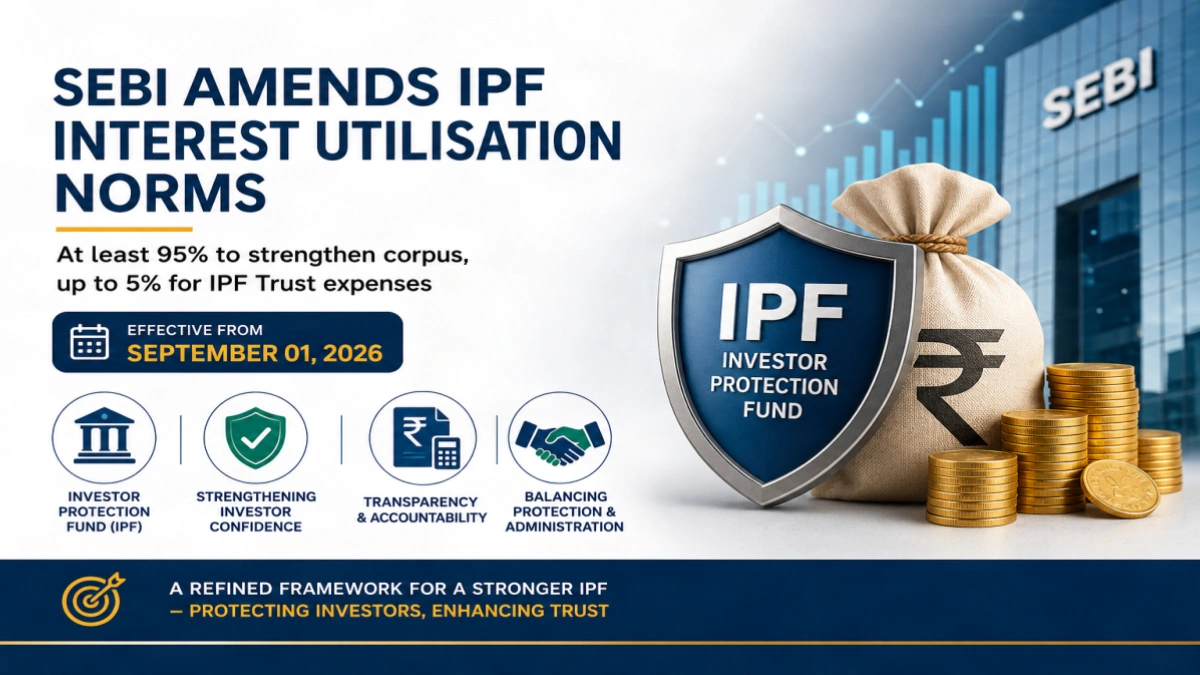
One of those provisions required that 100% of the interest or income earned on IPF investments be credited back to the corpus every year, leaving no room for IPF Trusts to fund their own operational needs — such as employee salaries, statutory dues, or audit costs — from the income the fund itself generates. Following representations from Depositories and a review by SEBI's Secondary Market Advisory Committee (SMAC), SEBI has now relaxed this rule: at least 95% of IPF interest/income must still be ploughed back to corpus, while up to 5% can be used for the IPF Trust's administrative and statutory expenses.
Background: The Earlier 100% Ploughback Rule
Paragraph 4.46.1.1(C)(i)(2) of the December 2024 Master Circular required that all interest or income received from investments made out of the IPF be treated entirely as corpus of the IPF — effectively a full ploughback with no permitted deduction for running costs.
❌ Earlier position: 100% of interest/income from IPF investments had to be ploughed back to corpus — no portion could be used to meet IPF Trust's own administrative or statutory expenses.
Why SEBI Revisited the Rule
SEBI records that it received representations from Depositories on this provision, though the circular does not disclose the specific content of those representations. Taking these representations into account, and with the stated objective of bringing uniformity and consistency to IPF interest/income utilisation norms across depositories and stock exchanges, the proposal was placed before SEBI's Secondary Market Advisory Committee (SMAC). The final decision to amend the norms was based on SMAC's recommendations, comments received during public consultation, and subsequent internal deliberations.
Revised Norms: Contribution to IPF — Clause 4.46.1.1(B)(i)(c)
The contribution clause under Paragraph 4.46.1.1(B), which lists the contributions a Depository must make to its IPF, now specifies:
⚠️ Revised contribution norm: At least 95% of the interest or income received every year from any investments made from the IPF must be contributed by the Depository to the IPF.
Revised Norms: Utilisation of IPF Interest/Income — Clause 4.46.1.1(C)(i), Entry SN 2
The utilisation table under Paragraph 4.46.1.1(C) now sets out a two-part treatment for interest or income received out of investments made from the IPF:
✅ (a) Corpus strengthening: At least 95% of interest/income from IPF received every year must be ploughed back to strengthen the IPF corpus.
✅ (b) Permitted administrative use: A maximum of 5% of interest/income from IPF investments received during the financial year may be utilised toward expenses related to dedicated employees of the IPF Trust and other administrative and statutory expenses — including applicable taxes, audit fees, and the Charity Commissioner's fee.
❌ Overrun rule: If actual administrative/statutory expenses exceed the 5% cap in a financial year, the excess must be borne by the Depository itself — it cannot be charged further to the IPF.
⚠️ Non-utilisation rule: If the 5% allocation is not fully utilised within the same financial year, the unutilised amount must be ploughed back to the IPF.
Applicability and Effective Date
Every Depository is bound by the revised 95%/5% framework from September 01, 2026 — there is no phased rollout or category-wise exemption carved out in the circular.
Directions to Market Infrastructure Institutions
Depositories, as Market Infrastructure Institutions (MIIs), have been directed to:
- Put in place necessary systems and steps to implement the revised norms;
- Make necessary amendments to relevant bye-laws, rules, and regulations wherever applicable; and
- Bring the provisions of the circular to the notice of market participants, including investors, and disseminate the same on their website.
Key Changes: Old vs New
Compliance Checklist for Depositories
- Update the IPF utilisation policy to reflect the 95%/5% split — effective September 01, 2026.
- Amend relevant bye-laws, rules, and regulations to align with the revised Paragraphs 4.46.1.1(B)(i)(c) and (C)(i)(2).
- Set up systems to track interest/income earned on IPF investments on an annual basis.
- Build a process to identify, categorise, and cap IPF Trust administrative/statutory expenses at 5% of yearly interest/income.
- Ensure any expenses exceeding the 5% cap are absorbed by the Depository's own books, not charged to the IPF.
- Ensure any unutilised portion of the 5% allocation is ploughed back to the IPF within the same financial year.
- Maintain audit trail for taxes, audit fees, and Charity Commissioner's fee paid out of the 5% allocation.
- Disseminate the revised norms to market participants and investors via the Depository's website ahead of the effective date.
CorpLawUpdates Analysis
The shift from a rigid 100% ploughback to a 95%/5% split may look like a minor recalibration, but it addresses a practical funding gap that IPF Trusts have quietly dealt with for years. IPF Trusts carry recurring costs — dedicated staff, statutory dues, audit fees, and in several states, a Charity Commissioner's fee since these trusts are typically registered as public charitable trusts — and until now, none of that could be funded from the very income the fund generates. This amendment gives Depositories a defined, capped mechanism to meet those costs without diluting the corpus beyond a small, bounded margin.
The real compliance challenge will lie in the bookkeeping discipline this creates. Depositories must now track interest/income received from IPF investments each financial year, ring-fence up to 5% for eligible administrative use, ensure genuine cost overruns are absorbed by the Depository rather than the fund, and plough back any unused portion — all within the same financial year. This is a more granular accounting exercise than the earlier all-or-nothing rule, and internal audit and compliance teams should build a dedicated annual reconciliation for it.
📌 Key takeaway: This is a bye-law and internal policy amendment exercise, not a wait-and-watch circular — the hard deadline is September 01, 2026.
Worth noting: the circular's own recital refers to bringing "uniformity & consistency in provisions for utilization of interest or income from IPF across depositories and stock exchanges," yet this particular circular is addressed only to Depositories. Practitioners advising stock exchanges should watch for a parallel amendment extending the same 95%/5% framework to exchange-run IPFs, likely along similar timelines.
For CS and compliance professionals servicing Depositories, the immediate action item is straightforward: this is a bye-law and internal policy amendment exercise with a hard September 01, 2026 deadline, not a wait-and-watch circular.
Source: SEBI Circular No. HO/47/14/13(4)2026-MRD-POD3/ I/15577/2026 dated July 07, 2026, "Review of norms for utilization of interest or income from IPF of the Depositories," issued by Hruda Ranjan Sahoo, General Manager, SEBI, under Section 11(1) of the SEBI Act 1992 read with Section 26(3) of the Depositories Act 1996 and Regulation 97 of the SEBI (Depositories and Participants) Regulations, 2018. The circular is available on the SEBI website at www.sebi.gov.in.
This article is for informational and educational purposes only and does not constitute legal or regulatory advice. Verify with primary regulatory sources before acting.


