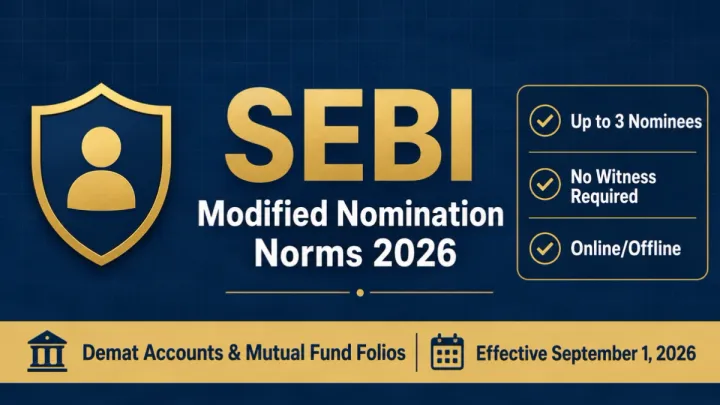
SEBI issued the circular on May 29, 2026 (Circular No. SEBI/HO/OIAE/OIAE_IAD-3/P/CIR/2026/12676) comprehensively overhauling the nomination framework for Demat Accounts and Mutual Fund Folios. The modified nomination norms come into effect from September 1, 2026, while supersession of earlier nomination-related circulars is effective from the date of this circular — i.e., May 29, 2026. The changes make nomination mandatory for new single accounts/folios (with an opt-out option), simplify the process significantly, remove witness requirements for physical nominations, allow up to 3 nominees, and impose new obligations on DPs and MF RTAs to proactively nudge investors without nominations. This is among the most significant investor protection reforms in the securities market in recent years.
💡 Circular at a Glance
🏛️ Section 1 — Background: Why Did SEBI Need to Revamp Nomination Again?
India has a significant and growing problem of unclaimed financial assets. According to data published by the IEPF Authority and SEBI, billions of rupees in unclaimed shares, mutual fund units, and dividends sit idle in the securities market — often because investors passed away without having registered a nominee, leaving their legal heirs scrambling for documentation, probate orders, and court attestations.
SEBI had been steadily tightening nomination norms since 2021 — with the landmark January 10, 2025 circular seeking to completely revamp the framework. However, after that circular was implemented from March 1, 2025, SEBI received representations from AMCs, DPs, and RTAs raising operational challenges — particularly around complex witness requirements, unclear online validation procedures, inconsistent formats across regulated entities, and ambiguity about joint account nomination consent. The May 29, 2026 circular is SEBI's comprehensive response — incorporating public consultation feedback and stakeholder representations to produce a simplified, unified, and workable framework.
📌 What Changed Since January 10, 2025?
The January 10, 2025 circular attempted a comprehensive revamp but created operational confusion — particularly around witness requirements, authentication methods, and mandatory vs optional data capture. The May 29, 2026 circular: (1) removes witness requirement for physical nominations with wet signature; (2) clarifies online validation methods; (3) standardises the nomination form in a single unified Annexure-A; (4) explicitly separates mandatory from optional information; (5) introduces a standardised opt-out declaration form (Annexure-B); and (6) extends applicability to existing accounts mutatis mutandis. Most importantly, it supersedes all 18 previous circulars — creating a single reference document.
📋 Section 2 — Summary of All Key Changes: Before vs After
📌 Section 3 — Detailed Breakdown of Each Provision
Para 4 — Default Choice of Nomination
4.1 — Nomination is now MANDATORY for new single accounts/folios
For every single-held demat account or mutual fund folio opened on or after September 1, 2026, the investor must mandatorily provide a nomination. The only way to skip nomination is to formally opt-out using the prescribed Annexure-B declaration form — silence is no longer treated as opting out.
❌ What Was Possible Before
Investors could simply skip the nomination field during account opening without any formal declaration. Many investors left the field blank, creating millions of accounts with no nomination — a major driver of unclaimed assets.
✅ New Position (from Sep 1, 2026)
Account opening cannot be completed without the investor either (a) providing nomination details per Annexure-A, OR (b) formally opting out using Annexure-B. There is no third option.
4.2 — Nomination Optional for Joint Accounts/Folios
For jointly held demat accounts or mutual fund folios, nomination remains optional — recognising that joint holders typically serve a similar protective function as nominees. However, if a joint account holder wishes to provide nomination, they may do so.
4.3 — Joint Accounts: All Holders Must Consent for Nomination/Change
In joint accounts, the consent of ALL joint-holders is required to add, change, or remove a nominee — regardless of the mode of operation (even if the account is "either or survivor" operated by a single holder). This prevents unilateral nomination changes.
Para 5 — Number of Nominees
Para 6 — Mode of Providing Nomination
Investors have the choice of submitting nomination either online or offline (physical). Regulated entities must make both options available using the standardised Annexure-A format.
🖥️ Online Nomination — 3 Valid Methods
- Digital Signature Certificate (DSC)
- Aadhaar-based e-sign or any other e-sign facility recognised under the Information Technology Act, 2000
- Two Factor Authentication (2FA) — one factor must be OTP sent to the investor's registered mobile number AND email address
📝 Physical / Offline Nomination — Simplified
- Wet signature of the holder — witness NOT required
- If thumb impression is used instead of wet signature: two witnesses required, with name and address captured in the form
- No additional authentication needed for wet signature submissions
⚠️ Key Change — Witness No Longer Required for Standard Physical Nomination
One of the biggest operational pain points under the previous framework was the requirement for a witness signature on physical nomination forms — making it cumbersome for elderly or rural investors. The new circular removes witness requirement entirely for physical nominations signed with wet signature. Witnesses are only needed when the investor uses a thumb impression instead of a signature.
Para 7 — Information to Be Captured in Nomination Form
The circular clearly separates mandatory from optional information — a crucial clarification that removes the overload of information previously required:
📌 Percentage Share — What Happens If Not Specified?
If an investor adds 3 nominees but doesn't specify the percentage share for each, the assets in the account/folio are divided equally among all nominees. For any odd lot that cannot be equally divided, the entire odd lot is transferred to the first nominee mentioned in the form.
Para 8 — Opting Out of Nomination
If an investor genuinely does not wish to nominate anyone, they must formally opt-out using the standardised Annexure-B Declaration Form. The opt-out process has two routes:
What does Annexure-B tell the investor? The opt-out declaration form explicitly informs the investor that: (i) nomination enables faster transmission to legal heirs; (ii) without nomination, legal heirs may need court-issued documents causing delays; and (iii) if no claim is made for a prolonged period after demise, holdings may be treated as unclaimed and transferred to IEPF.
Para 9 — Changes and Cancellation of Nomination
- Investors can provide, change, or cancel nominations any number of times — no limit
- Annexure-A and Annexure-B forms apply equally to subsequent changes/cancellations and to existing investors
- Regulated entities must provide a mandatory acknowledgement to the investor for every instance of nomination or subsequent change
- For joint accounts, all joint-holders' consent is required for any change or cancellation as well
Para 10 — Obligations of Regulated Entities (DPs / MF RTAs)
10.1 — Holding Statements Must Reflect Nomination Status
In every periodic statement of account or holding statement sent to an investor, regulated entities must print either:
- The name(s) of the nominee(s), OR
- A simple Yes / No indicator of whether nomination has been made
The choice of which to print is made by the investor in the nomination form itself — the investor controls what appears on their statement.
10.2 — Proactive Nudging of Investors Without Nomination
For existing and newly opened accounts/folios that do not have a nomination (including opt-outs), DPs and MF RTAs must:
⚠️ Important — Pop-ups ONLY for Those Without Nomination
The bi-annual messages and daily pop-ups must NOT be sent or displayed to investors who have already provided a nomination. This prevents harassment of investors who have already complied and ensures the nudge mechanism is targeted and relevant.
Para 11 — Applicability to Existing Accounts
All the provisions of this circular apply mutatis mutandis to existing accounts and folios as well. This means: existing investors without nomination will be nudged; existing investors can use Annexure-A to add nominees and Annexure-B to formally opt out; and the standardised forms apply to all changes going forward.
Para 15 — 18 Superseded Circulars
This circular supersedes all previous nomination-related circulars with immediate effect from May 29, 2026. A total of 18 circulars — dating back to July 2, 2002 — are superseded. Key ones include:
📅 Section 4 — Key Timelines
👥 Section 5 — Who Is Affected and What Must They Do?
❓ Frequently Asked Questions
📝 Bottom Line
SEBI's May 29, 2026 circular is the most comprehensive and investor-friendly nomination framework ever issued for the Indian securities market. By making nomination mandatory for new single accounts (while preserving the opt-out right), removing the witness requirement for physical nominations, standardising the process across all regulated entities, and introducing proactive nudging obligations on DPs and RTAs, SEBI has addressed the root causes of unclaimed asset accumulation. For investors: act now — add nominees to your demat accounts and mutual fund folios before September 1, 2026 to ensure your family faces minimal hassle in accessing your investments. For regulated entities: system upgrades, bye-law amendments, and deployment of the Annexure-A/B framework must be completed before the September 1, 2026 effective date — the clock is already running.
Source: SEBI Circular No. SEBI/HO/OIAE/OIAE_IAD-3/P/CIR/2026/12676 dated May 29, 2026, issued by S. Manjesh Roy, General Manager, SEBI Investor Awareness Division-3. Available at sebi.gov.in under "Legal → Circulars." This article is for informational purposes only and does not constitute legal or investment advice.