A settlement application before the Securities and Exchange Board of India (SEBI) is not simply a request to pay an amount and close a case. Eligibility, the stage of proceedings, the nature of the alleged default, previous regulatory action and investor-related considerations can all affect the outcome.
SEBI has now notified the Securities and Exchange Board of India (Settlement of Administrative and Civil Proceedings) Regulations, 2026. The regulations establish the framework for settling specified administrative and civil proceedings under securities laws and repeal the 2018 Settlement Proceedings Regulations when the new framework commences, subject to transitional and savings provisions.
For listed companies, securities-market intermediaries, directors, promoters, other persons facing regulatory proceedings and their advisers, the practical questions are straightforward: Can the matter be settled? How is the amount calculated? Which deadlines apply? And what happens to applications already pending under the earlier framework?
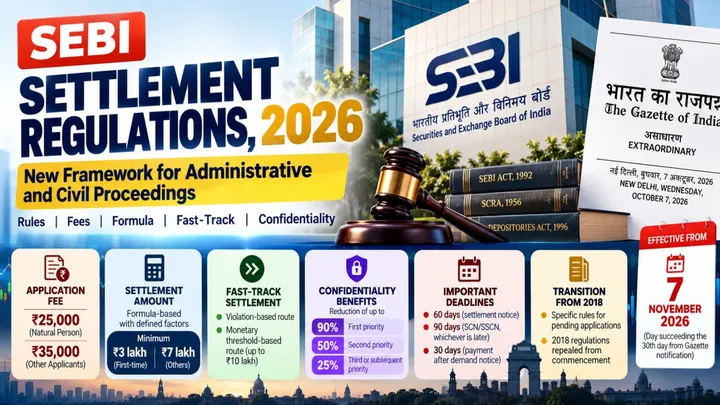
The SEBI (Settlement of Administrative and Civil Proceedings) Regulations, 2026 establish a structured settlement process with non-refundable application fees, a factor-based settlement amount, remedial and regulatory terms, two fast-track settlement routes and a confidentiality mechanism. Based on the Gazette issue dated 7 October 2026, the regulations are scheduled to come into force on 7 November 2026. They also prescribe deadlines and transitional rules for applications under the earlier 2018 framework.
SEBI Settlement Regulations 2026: Key Details at a Glance
These minimum settlement amounts are subject to the detailed provisions of the regulations. The application fee is separate from the settlement amount.
What Does the 2026 Framework Provide?
The 2026 regulations replace the earlier settlement regulations and set out the applicable process in nine chapters, together with schedules covering settlement applications, notices and confidentiality-related information.
Under regulation 2(1)(l), a “specified proceeding” means a proceeding that SEBI may initiate or that has been initiated and is pending before SEBI, or an appeal pending before the Securities Appellate Tribunal or the Supreme Court, concerning violations under sections 11, 11B, 11D, 12(3) or 15-I of the SEBI Act, 1992; section 12A or 23-I of the Securities Contracts (Regulation) Act, 1956; or section 19 or 19H of the Depositories Act, 1996. Whether the framework applies therefore depends on the statutory basis and procedural status of the matter.
When Do the SEBI Settlement Regulations 2026 Come Into Effect?
Regulation 1(2) provides that the regulations shall come into effect on the day succeeding the 30th day from their notification in the Official Gazette.
The date printed on the notification itself is October 6, 2026, while the Gazette issue bears October 7, 2026. Because commencement is tied to Gazette notification, regulated entities should verify the official publication details when calculating transition deadlines.
How Does the Settlement Application Process Work?
Regulation 3 allows an entity, subject to the conditions in the regulations, to apply for settlement of a specified proceeding at any stage of the proceeding. The application must use the prescribed format and include the required undertakings, waivers and settlement-amount computation.
An applicant must make one application covering all specified proceedings relating to the same cause of action. If SEBI returns an application because it is incomplete or does not meet the regulatory requirements, the applicant may submit a complete revised application within 15 days from the date of communication by the Board; otherwise, the application is deemed withdrawn. Where the applicant is not a natural person, the application, undertaking and waiver must be executed by a duly authorised person who is in charge of and responsible for the conduct of the entity’s business.
Submit the prescribed form, undertaking and waivers, settlement computation and application fee.
The committee examines whether settlement is appropriate and considers the proposed settlement terms.
Where required, the proposed terms and Internal Committee recommendation go to the advisory committee.
The Panel considers the recommendations and may accept or reject them, or require reconsideration.
Following acceptance, a demand notice is issued and the applicant must pay the amount and comply with other settlement conditions.
The High Powered Advisory Committee under regulation 23 comprises a judicial member who has served as a Supreme Court or High Court judge and three external experts with expertise in the securities market or connected matters. The regulations also specify the committee's term, quorum and recommendation process.
The process is not automatic. Under regulation 25, the Panel of Whole Time Members may reject an application or recommendation, or return the matter for reconsideration. The regulations also preserve SEBI's authority to issue interim directions where needed to protect investors or maintain market integrity.
Important Settlement Deadlines Under the 2026 Regulations
These periods relate to different procedural situations and are not interchangeable. The 60-day settlement-notice route under regulation 5(1) does not apply where interim directions or prosecution are contemplated, or in cases covered by regulation 27. Regulation 4(2) separately provides that the 90-day limitation in regulation 4(1) does not apply where the specified proceeding is pending before the Securities Appellate Tribunal or the Supreme Court. Under regulation 42, certain timelines may be relaxed where the deadline is not more than 30 days overdue and the delay resulted from factors beyond the applicant’s control; this power does not extend the periods under regulations 4(1) and 5(1). For an eligible extension of the payment deadline beyond the notice of demand, the Panel may increase the settlement amount by 1%, and the extension cannot exceed 30 days.
Which Proceedings May Not Be Settled?
Regulation 6 restricts settlement in specified circumstances. An applicant should check eligibility before preparing the settlement computation or paying the non-refundable application fee.
- Proceedings concerning the same alleged default where a settlement application has already been rejected under the 2026 regulations, subject to specified exceptions.
- Cases where examination, investigation, inspection or audit concerning the relevant cause of action is pending, except for settlement applications involving confidentiality.
- Applicants who are wilful defaulters, fraudulent borrowers or fugitive economic offenders, as covered by the definitions and explanations in the regulations.
Regulation 6 also states that proceedings involving market-wide impact, losses to a large number of investors or an effect on market integrity may not be settled. Regulation 18(2), however, provides for considering settlement where the relevant concerns can be adequately remedied through monetary and remedial or regulatory terms, including a higher settlement amount. The outcome remains subject to the applicable regulatory provisions and decision-making process.
An application may also be rejected where the applicant fails to respond to SEBI, delays or fails to provide requested information, repeatedly fails to attend a required meeting, breaches undertakings or waivers, does not pay within the prescribed period, or fails to comply with the settlement conditions.
How Is the Settlement Amount Calculated?
Regulation 10 prescribes a formula for calculating the settlement amount. The calculation takes into account the statutory base amount and specified factors relating to the stage of proceedings, regulatory history, gravity of the alleged default, aggravating circumstances and mitigating circumstances.
The minimum settlement amount is ₹3 lakh for a first-time applicant and ₹7 lakh for other applicants. A first-time applicant is defined as a person against whom no adverse order has been passed by the adjudicating officer or SEBI and who has not previously obtained a settlement order from SEBI, as on the date of application.
The base amount cannot be lower than the penalty already imposed for the default being settled. Regulation 11 also prescribes how multiple defaults are counted and aggregated, including special treatment for a lead conspirator and for an independent director alleged to have benefited from or actively participated in fraud. Where an order is under challenge before the Tribunal or Supreme Court, the base amount is calculated on the basis of the allegations upheld in the impugned order. If SEBI has appealed to the Supreme Court against relief granted by the Tribunal, 50% of the base amount for each count of default not upheld by the Tribunal must also be considered. Separately, regulation 10(6) requires a 20% additional settlement amount where settlement covers a specified proceeding under section 12(3) of the SEBI Act together with another specified proceeding arising from the same cause of action. This is distinct from the additional amount applicable to refiling after rejection or withdrawal under regulation 7 and the 20% uplift for qualifying transitional applications under regulation 4(4).
Base Amount Multipliers by Applicant Type
Regulation 11 multiplies the minimum statutory penalty by a specified factor according to the applicant's category.
Stage of Proceedings: Why Timing Matters
The stage factor increases as a case progresses through the enforcement process. The applicable value is determined by the stage reached when the settlement application is filed.
The regulatory action factor also takes account of prior warnings and orders. The prescribed values include 0.10 per administrative warning, 0.20 per settlement order and 0.30 per adverse order in the specified proceedings. Values for applicable prior orders are added together, including orders that have been stayed by a tribunal or court.
- Obstructing or prolonging an investigation or proceeding.
- Providing inaccurate or misleading information.
- Misconduct over an extended period of at least 30 days.
- Aggregate monetary loss to clients exceeding ₹5 crore.
- Ignoring prior regulatory guidance or warnings, or evidence of sophisticated or premeditated conduct.
- Minimal participation in the alleged default.
- Exceptional cooperation and early self-identification of misconduct.
- Corrective action designed to prevent recurrence.
- Compensation, restitution or disgorgement of benefits.
- Other listed circumstances, including certain short reporting delays and qualifying independent-director circumstances.
Under regulation 14(1), a gravity factor of 0.25 for reputation risk is added to settlement applications made without admitting a violation of securities laws. Additional prescribed gravity factors may also apply to specified violations. These include failure to make an open offer, certain offer-document violations, violations of regulations 3 and 4 of the SEBI (Prohibition of Insider Trading) Regulations, 2015, and violations under the SEBI (Prohibition of Fraudulent and Unfair Trade Practices Relating to Securities Market) Regulations, 2003.
If the base amount is ₹10 lakh and the combined stage, regulatory action, gravity, aggravating and mitigating factors produce a net factor of 1.5, the formula gives ₹15 lakh before considering any other applicable provision. The illustration assumes the stated values solely to explain the formula; it does not determine the amount payable in any real case.
What Can the Settlement Terms Include?
Under regulation 9, settlement terms may include the calculated settlement amount, disgorgement of wrongful gains or losses averted or caused to investors, and remedial and regulatory terms in proceedings other than those solely for imposition of penalty. Applicable disclosures must also form part of the settlement terms.
The remedial and regulatory terms in regulation 17 may include enhanced compliance procedures, independent review of internal controls, staff training, additional audit and reporting requirements, exit from management, refunds, lock-in of securities and restrictions on acting as a director or officer. Depending on the case, they may also include specified periods of suspension or debarment from the securities market.
Where allegations involve diversion or siphoning of funds, the regulations contain provisions for bringing the money back to the company, together with applicable interest. The conditions will depend on the circumstances and the settlement terms approved in the particular case.
Interest on Amounts Payable
The regulations specify that interest applies to the principal amount payable and that no interest is charged on unpaid interest. Applicability and computation should be checked against the facts of the alleged default and the relevant settlement provisions.
Fast-Track Settlement Under the 2026 Regulations
Chapter VI recognises two forms of fast-track settlement: violation-based fast-track settlement and monetary-threshold-based fast-track settlement. Each has its own conditions and procedure.
Violation-Based
SEBI may issue a fast-track settlement notice before initiating specified proceedings for eligible defaults.
- Delayed disclosures, including returns, reports or documents.
- Certain non-disclosures relating to companies exclusively listed on regional stock exchanges that have exited.
- Disclosures not made in prescribed formats.
- Delayed compliance with legal requirements or SEBI directions.
- Other defaults determined by SEBI.
Monetary-Threshold-Based
Regulation 28 provides for a fast-track route during the Internal Committee's consideration of an application.
Under regulation 28, the Internal Committee calls upon the applicant to submit a revised settlement term. Once received, the application is placed before the Panel of Whole Time Member, and regulations 25 and 34 apply as specified. Regulation 26(3) provides that the High Powered Advisory Committee stages under regulations 23 and 24 do not apply to Chapter VI fast-track settlement.
For a violation-based notice, the entity generally has 30 days from receipt to file the prescribed application, remit the specified settlement amount and comply with, or undertake to comply with, the stated remedial and regulatory terms. A rectification request concerning the calculation may also be made as provided by regulation 27.
SEBI may grant an extension of up to 15 days for the actions specified in regulation 27, for reasons recorded. If the entity does not avail the applicable fast-track route or does not comply with its requirements, the specified proceeding may be initiated or continued, and the entity may be permitted to apply for settlement only at a subsequent stage.
Settlement With Confidentiality: Priority-Based Reductions
Chapter VII (regulations 30–33) allows SEBI to grant confidentiality to a person who provides substantial assistance in an examination, investigation, inspection or audit concerning a securities-law violation, in return for admitting the default for the limited purpose of settling specified proceedings to be initiated. For this chapter, the expression “violation of securities laws” excludes defaults relating to disclosure and reporting requirements. An application may be made only in cases prior to or pending an examination, investigation, inspection or audit. The applicant must cease participating in the violation from the time of disclosure, unless otherwise directed by SEBI; provide complete and truthful information, documents and evidence; cooperate fully, continuously and expeditiously; and not conceal, destroy, manipulate or remove relevant documents.
Confidentiality is not automatic. The Board assesses the application and may reject it if the information, documents or evidence are incomplete or false. The regulations also specify circumstances in which information or identity cannot be treated as confidential, including where disclosure is required by law, agreed to in writing by the applicant or made public by the applicant.
Maximum Reductions Under Regulation 19
These are maximum reductions, not automatic discounts. The applicable reduction depends on the Board's grant of confidentiality and the applicant's priority status.
Under regulation 34, settlement orders involving confidentiality must not directly or indirectly disclose the applicant's identity, although they indicate the securities-law provisions the applicant is alleged to have violated. The confidentiality chapter also protects qualifying information and evidence, subject to the exceptions in the regulations.
What Happens to Settlement Applications Pending Under the 2018 Regulations?
Regulations 44 and 45 address the transition from the Securities and Exchange Board of India (Settlement Proceedings) Regulations, 2018, to the 2026 framework.
Pending applications in which the Panel of Whole Time Members has approved the settlement terms are dealt with according to the terms approved under the 2018 regulations.
The applicant is to receive an option, exercisable within 30 days of receiving the Board's notice, to seek fresh processing under the 2026 regulations or processing based on the settlement amount recommended under the 2018 regulations.
Pending applications where the High Powered Advisory Committee has not yet made a recommendation are to be dealt with under the new regulations through a fresh Internal Committee meeting.
Regulation 4(3) also addresses proceedings pending when the new regulations commence. Where a settlement application for such a proceeding was not previously filed, or was rejected, returned or withdrawn under the 2018 regulations, the application is to be filed within 90 days from commencement. Regulation 4(4) prescribes a settlement amount 20% higher than the amount calculated under regulation 10 for those applications.
From commencement, the 2018 regulations stand repealed. However, previous summary settlement notices and settlement orders are subject to savings provisions. The Internal Committee and High Powered Advisory Committee constituted under the 2018 regulations are deemed to have been constituted under the 2026 regulations, and references to the 2018 regulations in other regulations are treated as references to the new framework.
What Should Companies, Directors and Compliance Teams Do?
The regulations do not create a universal filing obligation for every company. Their practical significance arises where an entity or individual is considering settlement of a specified SEBI administrative or civil proceeding.
- Confirm that the alleged default falls within the specified proceedings covered by the regulations.
- Check the eligibility restrictions, including pending investigations and the applicant's regulatory status.
- Calculate the applicable deadline from the correct triggering event, such as service of the relevant notice.
- Prepare the prescribed application, undertakings, waivers, computation and supporting information.
- Assess the statutory base amount, applicant multiplier, stage factor, regulatory action factor, gravity factor and the applicable aggravating and mitigating factors.
- Consider whether a fast-track route or confidentiality application is legally available and appropriate.
- Review whether disgorgement, interest, investor restitution, financial disclosures or remedial and regulatory terms may apply.
- For pending applications, identify the relevant transitional category and calculate the applicable deadline under the new regulations.
Applicants should also note that withdrawing or having an application rejected does not automatically extinguish the undertakings and waivers specified in the regulations. Refilling after rejection or withdrawal may attract an additional settlement amount of 20%, subject to the conditions and exceptions prescribed in regulations 7 and 4.
CorpLawUpdates Analysis
For applicants, settlement strategy turns on the procedural stage, regulatory history, alleged investor impact and the remedial terms required—not only the amount payable. The factor-based calculation, disgorgement and interest rules, and possible corrective conditions should be assessed together.
For Company Secretaries, legal advisers and compliance teams, the immediate task is to identify the specified proceeding, verify the applicable deadline and transitional category, and review the eligibility and calculation rules against the Gazette before advising the applicant. Neither fast-track settlement nor confidentiality guarantees acceptance by SEBI.
Frequently Asked Questions
1. What are the SEBI Settlement Regulations 2026?
They are the Securities and Exchange Board of India (Settlement of Administrative and Civil Proceedings) Regulations, 2026, notified under reference SEBI/LAD-DOP/2026/318. They set out the procedure and terms for settling specified administrative and civil proceedings under securities laws.
2. When do the 2026 regulations come into effect?
Regulation 1(2) specifies the day succeeding the 30th day from notification in the Official Gazette. Using the Gazette issue date of October 7, 2026, this is calculated as November 7, 2026.
3. What is the application fee under the new regulations?
The non-refundable settlement application fee is ₹25,000 for a natural person and ₹35,000 for other applicants, payable through the specified payment gateway.
4. What is the minimum settlement amount?
The minimum settlement amount is ₹3 lakh for a first-time applicant and ₹7 lakh for other applicants, subject to the detailed calculation and other requirements of the regulations.
5. What is the settlement amount formula?
Regulation 10 provides: Settlement Amount = Base Amount × (Stage of Proceeding + Regulatory Action Factor + Gravity Factor + Aggravating Factors − Mitigating Factors). If the net sum inside the brackets is below one, it is taken as one.
6. What are the two fast-track settlement routes?
Chapter VI provides for violation-based fast-track settlement and monetary-threshold-based fast-track settlement. The latter may apply where the calculated amount is up to ₹10 lakh and no disgorgement or remedial and regulatory term is applicable, subject to the prescribed process.
7. What reductions are available for settlement with confidentiality?
Regulation 19 permits reductions of up to 90% for first priority status, up to 50% for second priority status and up to 25% for third or subsequent priority status. These are maximum possible reductions, not automatic entitlements.
8. Do the 2026 regulations repeal the 2018 settlement regulations?
Yes. Regulation 45 repeals the SEBI (Settlement Proceedings) Regulations, 2018, from commencement of the new regulations. The savings and transitional provisions preserve specified existing orders, notices, committees and treatments of pending applications.
9. Can an application be made while a matter is before the Securities Appellate Tribunal or Supreme Court?
The regulations define specified proceedings to include qualifying appeals pending before the Tribunal or Supreme Court. The ordinary 90-day limitation in regulation 4(1) does not apply to applications made while the specified proceeding is pending before those forums, subject to the other applicable requirements.
Official Regulatory Source
Issuing authority: Securities and Exchange Board of India (SEBI)
Document: Securities and Exchange Board of India (Settlement of Administrative and Civil Proceedings) Regulations, 2026
Notification number: SEBI/LAD-DOP/2026/318
Notification date: October 6, 2026
Gazette issue: Gazette of India, Extraordinary, dated October 7, 2026
Signatory: Amit Pradhan, Executive Director
Primary source: Read the official SEBI notification and regulations.
Disclaimer: This article is for informational and educational purposes only and does not constitute legal or regulatory advice. The regulations contain detailed conditions, exceptions, calculation rules and transitional provisions. Readers should consult the official notification and relevant underlying securities laws before acting.