Powers of Attorney Act, 1882 & Indian Contract Act, 1872
Power of Attorney Format (India) — Free GPA & SPA Generator
Generate court-compliant General Power of Attorney (GPA) and Special Power of Attorney (SPA) deeds in Word (.docx) and PDF. Includes Suraj Lamp (2011) title safeguards, Section 202 irrevocability rules, NRI 3-month stamping protocols, and Maharashtra Article 48 stamp duty guidance.
Free Word & PDF Downloads NRI Section 18 Stamping Guide Built-in AI Custom Clause Drafter
1. POA Type & Revocability Classification
2. Principal (Grantor of Power)
3. Attorney / Agent (Grantee of Power)
4. Specific Powers Conferred
Property Details (For Schedule of Property):
5. Duration of Authority
Maharashtra Stamp Duty Reference (Article 48)
- To Close Relatives (Father, Mother, Spouse, Son, Daughter, Brother, Sister): Flat ₹500 stamp duty without consideration.
- To Non-Relatives / Developer / For Consideration: Same stamp duty as conveyance deed (Article 25) based on market value.
- General Non-Property POA: Flat ₹500 per person authorized.
Need a custom clause? Describe it in plain words
Gemini 2.5Draft bespoke Indian-law compliant clauses & audit legal enforceability
Power of Attorney (POA) Statutory Architecture in India
Legal overview: Powers of Attorney Act, Suraj Lamp Title Transfer Prohibition & NRI Protocol
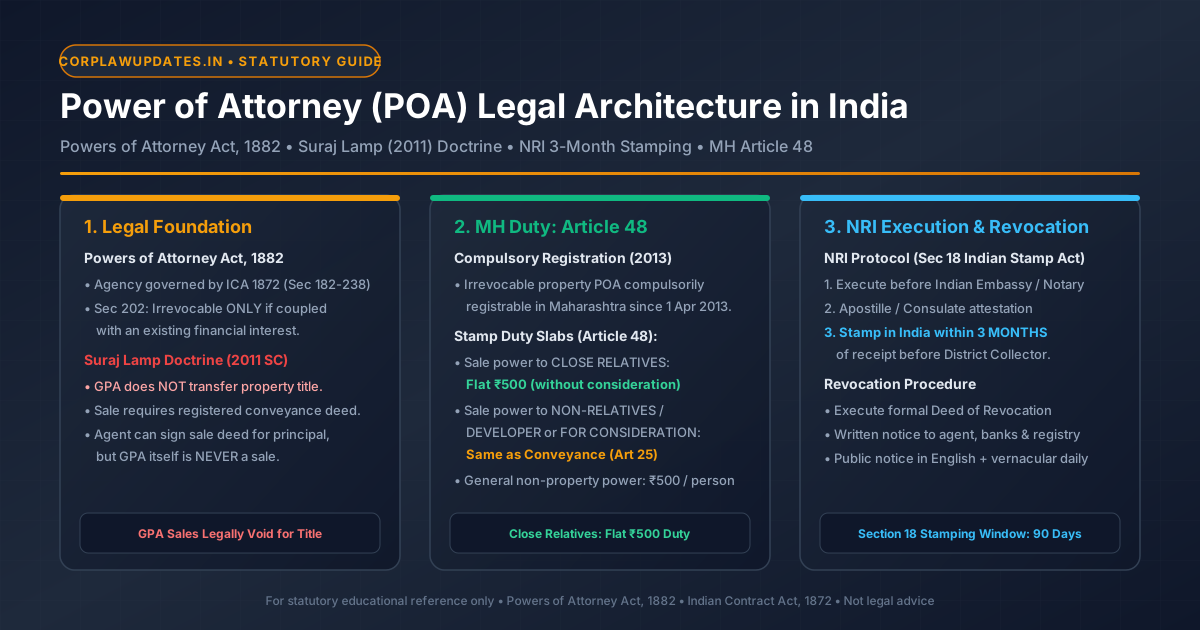
1. Statutory Framework: Powers of Attorney Act & Agency Law
A Power of Attorney is a formal instrument whereby one person (the Principal) delegates legal authority to another person (the Attorney or Agent) to perform acts in the Principal’s name. In India, POA instruments are governed by two foundational statutes:
Powers of Attorney Act, 1882
Section 1A: Defines a power-of-attorney as any instrument empowering a specified person to act for and in the name of the person executing it.
Section 2: Any act executed by the donee in their own name has the same legal efficacy as if executed by the donor in person.
Indian Contract Act, 1872 (Agency)
Sections 182–238: Codifies the law of principal and agent.
Section 184: Any person of the age of majority and sound mind can be an agent.
Section 201: Termination of agency upon revocation, death, or insolvency.
Section 202: Agency coupled with an interest is irrevocable by the principal.
2. General vs Special POA & Irrevocability Rules (Section 202)
General Power of Attorney (GPA)
Confers wide, comprehensive authority over the Principal's affairs—including banking, litigation, property maintenance, tax filings, and document execution. Useful when the principal travels abroad or is elderly, but carries significant risk if granted to untrusted parties.
Special Power of Attorney (SPA)
Restricted strictly to one specified transaction or purpose (e.g. presenting a specific conveyance deed before the Sub-Registrar or defending a specific trial). Once that specific task is accomplished, the SPA is spent and automatically extinguishes.
Warning on "Irrevocable" Powers of Attorney (Section 202 Indian Contract Act):
Many generic online templates label POAs as "Irrevocable." Under Section 202 of the Indian Contract Act, 1872, an agency can be made legally irrevocable only where the agent himself has an interest in the property forming the subject matter of the agency (e.g., when a lender is authorized to sell collateral to recover unpaid debt). A standard POA granted without an underlying financial interest remains revocable at the will of the principal, regardless of how the clause is titled.
3. The Suraj Lamp Doctrine: GPA Does NOT Transfer Property Title
Supreme Court of India Ruling: Suraj Lamp & Industries (2011)
In Suraj Lamp & Industries Pvt. Ltd. v. State of Haryana (2011) 11 SCC 1, a three-judge bench of the Supreme Court categorically settled the law regarding property sales conducted through "SA/GPA/WILL" transfers:
- A Power of Attorney is not an instrument of transfer: A GPA is an instrument of agency. It does not convey, transfer, or create any title or ownership in immovable property.
- Conveyance Deed Mandatory: Immovable property can be transferred only by a registered Deed of Conveyance (Sale Deed) under Section 54 of the Transfer of Property Act, 1882, duly stamped and registered under the Registration Act, 1908.
- Authorized Execution vs Sale: An owner can lawfully execute a registered POA authorizing their agent to sign and execute a deed of conveyance on their behalf, but the POA itself is not a sale.
Purchasing property on GPA and Agreement to Sell without a registered conveyance deed confers no legal title.
4. Registration Rules & Maharashtra Article 48 Stamp Duty
Registration requirements and stamp duty on powers of attorney depend on state legislation:
Maharashtra Compulsory Registration (W.e.f. 1 April 2013):
Under the Registration (Maharashtra Amendment) Act, 2010, Section 17 of the Registration Act was amended to make the registration of an irrevocable Power of Attorney relating to the transfer of immovable property compulsorily registrable in the State of Maharashtra.
| Situation / Powers Granted | Stamp Duty (Article 48, Maharashtra) |
|---|---|
| Authorising sale/transfer of immovable property to close relatives without consideration (father, mother, spouse, son, daughter, brother, sister, grandson, granddaughter) | Flat ₹500 |
| Authorising sale/transfer of immovable property for consideration, or to a non-relative without consideration, or to a promoter/developer | Same duty as Conveyance Deed (Article 25) based on market value |
| Any other case (general non-property administration, banking, litigation) | Flat ₹500 per person authorized |
Note on other states: In Delhi, stamp duty is typically ₹50 (General) or ₹10 (Special). Check your respective state's Stamp Act prior to execution.
5. NRI Protocol: Section 18 of the Indian Stamp Act, 1899
Non-Resident Indians executing a Power of Attorney abroad for use in India must strictly adhere to the three-stage statutory adjudication process under Section 18 of the Indian Stamp Act, 1899:
- Step 1 — Execution Abroad: The NRI principal signs the POA on plain paper before an authorized officer at the Indian Embassy / Consulate, or before a Notary Public in the foreign country (followed by Apostille certification in Hague Convention nations).
- Step 2 — Courier to India: The original attested POA is sent via registered courier to the Attorney in India.
- Step 3 — Stamping within 3 Months: Under Section 18, the document must be presented to the District Collector of Stamps / Registrar for adjudication and payment of stamp duty within three (3) months of its first receipt in India. The Collector endorses the certificate of adjudication on the deed.
6. Revocation Procedure for Powers of Attorney
To legally terminate and cancel an existing revocable Power of Attorney, the Principal must follow these procedural steps:
- Execute a Deed of Revocation: Draft and sign a formal Revocation Deed explicitly identifying the original POA, date of execution, and cancellation of all powers.
- Written Notice to Attorney: Serve the Revocation Deed upon the Attorney via Registered Post with Acknowledgment Due (RPAD) and registered email.
- Notice to Third Parties: Deliver formal written notice of revocation to banks, housing societies, revenue authorities, and the Sub-Registrar where the POA was registered.
- Public Notice: For property-related POAs, publish a revocation notice in one widely circulated English newspaper and one regional vernacular newspaper.
- Register Revocation Deed: If the original POA was registered, the revocation deed must also be registered with the same Sub-Registrar office.
7. Complete 7-Step Execution Checklist
- Choose GPA vs SPA: Select General Power for ongoing management or Special Power for a single designated transaction.
- Enumerate Specific Powers: Clearly specify banking, property, tax, and litigation powers in the generator. Avoid overly vague language.
- Stamp Paper or E-Stamping: Print on non-judicial stamp paper of appropriate state denomination (or e-stamp).
- Signatures: Principal signs at the foot of each page and executes the final signature block; Attorney signs specimen signature block.
- Attestation by 2 Witnesses: Two adult, independent witnesses must sign with full names, addresses, and ID details.
- Notarization / Registration: Attest before a Notary Public. If granting property sale authority or irrevocable power in Maharashtra, register before the Sub-Registrar.
- Distribution & Stamping: Deliver executed originals or certified copies to the agent and concerned banking/revenue institutions.
Frequently Asked Questions (Power of Attorney)
Can a property be sold on GPA in India?
No. The Supreme Court in Suraj Lamp & Industries (2011) categorically ruled that a Power of Attorney is not an instrument of transfer and does not convey title. Property can only be legally transferred via a registered Deed of Conveyance (Sale Deed). A GPA can only authorize an agent to sign the conveyance deed on the principal’s behalf.
Is registration of Power of Attorney mandatory?
Under the Indian Registration Act, registration is generally optional for ordinary powers of attorney. However, registration is strictly mandatory when the POA authorizes the sale or conveyance of immovable property, or in states like Maharashtra where irrevocable POAs relating to property are compulsorily registrable under state amendments.
Can a Power of Attorney be irrevocable?
Only if it satisfies Section 202 of the Indian Contract Act, 1872 — where the agency is coupled with an interest (the agent has a financial or proprietary interest in the property). A standard POA without an underlying interest is revocable at will by the principal regardless of what the agreement is titled.
How can an NRI execute a POA for use in India?
An NRI must sign the POA abroad before an Indian Embassy/Consulate official or a Notary Public (with Apostille if in a Hague Convention country), courier the original to India, and have it stamped by the District Collector of Stamps within 3 months of its first receipt in India under Section 18 of the Indian Stamp Act, 1899.
What is the stamp duty on a POA in Maharashtra?
Under Article 48 of the Maharashtra Stamp Act: ₹500 if empowering close relatives to sell property without consideration; full conveyance duty (Article 25) if empowering non-relatives or for consideration; and ₹500 per authorized person for general administration, banking, and litigation powers.
What happens to a POA if the principal dies?
Under Section 201 of the Indian Contract Act, 1872, a Power of Attorney automatically terminates upon the death, unsoundness of mind, or insolvency of either the Principal or the Attorney. Any action taken by the attorney after the principal’s death is void ab initio, except where Section 202 (agency coupled with an interest) applies.
Does a POA survive the principal’s death?
No. Under Section 201 of the Indian Contract Act, 1872, agency automatically terminates upon the death, unsoundness of mind, or insolvency of either the Principal or the Attorney. The sole exception is agency coupled with an interest under Section 202 (where the agent has an existing financial interest in the property), which survives until that interest is satisfied.