
Key Change

IBBI REG149 overhauls personal guarantor IRP: new Reg 6A asset statement, revised Reg 11A for Section 28A asset transfers, updated Reg 17B when no repayment plan is filed & Forms A–C moved to circular

IBBI Personal Guarantor IRP Regulations 2019 – Complete Guide [Amended up to 2 June 2026]

CL

Editorial team

CorpLawUpdates.in · Professionals & compliance specialists

Verified for complianceLast verified: 14 June 2026
Legal basis: Insolvency and Bankruptcy Board of India (Insolvency Resolution Process for Personal Guarantors to Corporate Debtors) Regulations, 2019 – as amended by Notification No. IBBI/2026‑27/GN/REG149 dated 01 June 2026 (w.e.f. 02 June 2026); read with earlier amendments REG107 (31 Jan 2024), REG125 (19 May 2025), REG131 (20 Nov 2025) and IBBI Circular No. IBBI/IIRP/98/2026 prescribing updated Forms A, B and C.
38 min read5,772 wordsIBBI (Insolvency Resolution Process for Personal Guarantors to Corporate Debtors) Regulations, 2019 (Amended upto 02-06-2026)Effective: 2 June 2026Last amended: 1 June 2026High impact13 views

Summary

The IBBI has overhauled the Insolvency Resolution Process for Personal Guarantors Regulations, 2019 through REG149, effective 2 June 2026. New Reg 6A mandates detailed asset disclosure, Reg 11A coordinates asset transfers under Section 28A, Reg 17B is tightened, and Forms A–C move to circular format

Quick AnswerAI

The June 2026 IBBI amendment REG149 updates the 2019 Personal Guarantor IRP Regulations by inserting Regulation 6A (comprehensive asset statement), replacing Regulation 11A to manage asset transfers under new Section 28A, aligning Regulation 17B with the revised Section 106 procedure when no repayment plan is filed, and shifting Forms A–C from the regulations into an IBBI circular format.

Key Takeaways

  • REG149 (01 June 2026, effective 02 June 2026) is the latest amendment to the IBBI IRP Regulations for Personal Guarantors, which now span 5 chapters and 23 regulations.
  • New Regulation 6A introduces a mandatory, granular statement of assets for personal guarantors, covering physical assets, financial assets, digital/crypto holdings, overseas interests, ESOPs and beneficial interests, with supporting evidence.
  • A substituted Regulation 11A coordinates asset transfers between the personal‑guarantor IRP and the corporate debtor’s CIRP under new Section 28A of the IBC, requiring creditor approval and proper disclosure when guarantor assets are moved into the corporate insolvency estate.
  • Regulation 17B is aligned with the updated Section 106 framework: where no repayment plan is submitted, the resolution professional must seek creditor approval and approach the Adjudicating Authority for time‑bound directions instead of leaving the process in limbo.
  • References to Forms A, B and C in Regulations 4(2), 7(1) and 16(2) are replaced by “forms as specified by circular”; the actual formats now sit in IBBI Circular No. IBBI/IIRP/98/2026, decoupling them from the regulations for easier future updates.
  • Together with earlier changes in 2024–25 (Reg 17A, Reg 17B, Reg 23), the June 2026 amendment responds to low recovery and high closure rates in personal‑guarantor cases by tightening disclosure, improving process coordination with corporate insolvency and creating clearer consequences when repayment plans are not filed.
IBBI Insolvency Resolution Process for Personal Guarantors to Corporate Debtors Regulations 2019 – Amended June 2, 2026

The Insolvency and Bankruptcy Board of India (IBBI) has notified significant amendments to the IBBI (Insolvency Resolution Process for Personal Guarantors to Corporate Debtors) Regulations, 2019 vide Notification No. IBBI/2026-27/GN/REG149 dated 01 June 2026, effective 02 June 2026. These are among the most substantive changes to the personal guarantor insolvency framework since the regulations came into force on December 01, 2019. The amendment introduces a landmark mandatory asset disclosure framework (new Regulation 6A), mandates coordination between resolution professionals of personal guarantors and corporate debtors (new Regulation 11A), streamlines the repayment plan meeting process (new Regulation 17A), tightens the non-submission of repayment plan procedure (amended Regulation 17B), replaces form-based references with circular-based formats, and removes the three prescribed forms from the regulation itself. This guide covers every chapter, every regulation, every amendment — with current vs proposed comparisons, practical impact, and FAQs.

⚡ Notification at a Glance

IBBI/2026-27/
GN/REG149
Notification Number
June 01, 2026
(w.e.f. 02-06-2026)
Notified / Effective
5 Chapters
23 Regulations
Total Scope
Key Regs
Reworked
New Reg 6A inserted; Reg 11A & 17B aligned with Section 28A / Section 106
3 Forms
Removed
Forms A, B & C → Circular
Dec 01, 2019
Original Regulations
🔴 Why These Amendments Matter — The Personal Guarantor Crisis in Numbers

As of mid-2025, 664 cases had been admitted for insolvency resolution of personal guarantors — yet 143 had been closed on account of non-submission or rejection of repayment plans. This exposed a critical procedural gap: what happens when no repayment plan is prepared after admission? The June 2026 amendments directly address this gap while simultaneously introducing sweeping transparency requirements (mandatory asset disclosure including crypto, ESOPs, overseas investments) and inter-process coordination mechanisms with corporate debtor insolvency proceedings.

👤 Who Do These Regulations Apply To?

The IBBI (Insolvency Resolution Process for Personal Guarantors to Corporate Debtors) Regulations, 2019 apply only where:

  • the debtor is an individual personal guarantor to a corporate debtor (company or LLP), and
  • the guarantee in favour of a creditor has been invoked and remains unpaid in full or in part, and
  • an application under Sections 94 or 95 of the Insolvency and Bankruptcy Code, 2016 is filed before the NCLT as the adjudicating authority.

They do not govern fresh‑start processes or ordinary individual/partnership insolvencies before the Debt Recovery Tribunal; those remain under the general Part III framework and separate rules.

📜 Section 1 — Amendment History: How the Regulations Have Evolved

NotificationDateKey Changes
IBBI/2019-20/GN/REG050December 01, 2019Original regulations — 5 Chapters, Regulations 1–22, Forms A/B/C
IBBI/2023-24/GN/REG107January 31, 2024Amended Reg 4(1): Removed bar on IP who acted as RP/liquidator in corporate debtor. Inserted Reg 11A (first version) re meeting-related disclosures. Inserted Reg 17A for repayment plan consideration at meeting
IBBI/2025-26/GN/REG125May 19, 2025Inserted Reg 17B: Resolution professional to file application with AA on non-submission of repayment plan (with creditor approval)
IBBI/2025-26/GN/REG131November 20, 2025Inserted Reg 23: Mandatory filing of Forms with timelines; late filing fee ₹500/form/month of delay; AFA consequences for non-compliance
IBBI/2026-27/GN/REG149 👈 CURRENTJune 01, 2026
(w.e.f. 02-06-2026)
Inserts Regulation 6A requiring a full statement of assets (including digital, overseas and beneficial interests); substitutes Regulation 11A to coordinate asset transfers with the corporate debtor’s CIRP under new Section 28A; aligns Regulation 17B with the updated Section 106 framework on non‑submission of repayment plans; replaces references to Forms A, B and C in Regulations 4(2), 7(1) and 16(2) with “forms specified by circular”; omits the definition of “form” in Regulation 3(e) and shifts the formats for consent, claims and proxies to IBBI Circular No. IBBI/IIRP/98/2026.

📘 CHAPTER I — PRELIMINARY (Regulations 1–3)

Regulation 1 — Short Title & Commencement

These regulations are called the IBBI (Insolvency Resolution Process for Personal Guarantors to Corporate Debtors) Regulations, 2019. They came into force on December 01, 2019 — the same date on which Part III of the IBC (governing insolvency of individuals and partnerships) was brought into force for personal guarantors to corporate debtors. Unchanged by the June 2026 amendment.

Regulation 2 — Application

These regulations apply exclusively to the insolvency resolution process for personal guarantors to corporate debtors — i.e., individuals who have given personal guarantees on behalf of companies undergoing or susceptible to insolvency. They do not apply to fresh-start processes or bankruptcy of other individuals. Unchanged by the June 2026 amendment.

Regulation 3 — Definitions 🔴 AMENDED

KEY DEFINITIONS — JUNE 2026 CHANGE: Clause (e) Omitted
ClauseTermStatusMeaning
(a)AssociateUnchangedSame meaning as in Section 79(2) of the IBC in relation to a debtor
(b)CodeUnchangedInsolvency and Bankruptcy Code, 2016 (31 of 2016)
(c)Corporate debtorUnchangedCorporate person for whom the guarantor has given a personal guarantee
(d)Electronic meansUnchangedAuthorised and secured computer programme capable of sending communication at the last email address and keeping record
(e)Form⛔ OMITTEDPreviously defined as "a form appended to these regulations". Removed because Forms A, B, C are now notified by IBBI through circular (IBBI/IIRP/98/2026 dated June 02, 2026)
(f)ParticipantUnchangedPerson entitled to attend a meeting of creditors — includes creditor, guarantor, resolution professional, and any person authorised by creditors
(g)Resolution processUnchangedInsolvency resolution process of a guarantor
(h)Resolution process commencement dateUnchangedDate of admission of an application under Section 100 of the IBC
(i)Resolution process costsUnchangedRP fees + RP expenses (incl. professional fees) + finances raised + other costs — to the extent approved or ratified by creditors
(j)–(k)Section; Other expressionsUnchangedSection = Section of IBC; undefined terms to take meaning from IBC and the 2019 Rules

📗 CHAPTER II — GENERAL (Regulations 4–6A)

Regulation 4 — Eligibility of Resolution Professional 🔴 AMENDED

An insolvency professional (IP) is eligible as resolution professional (RP) only if three conditions are met:

a
Independence: The IP, his insolvency professional entity, and all partners/directors of that entity must be independent of the guarantor — meaning they are not an associate of the guarantor AND are not a related party of the corporate debtor (Section 5(24) of IBC).
b
No Disciplinary Proceeding: The IP must not be subject to any ongoing disciplinary proceeding or restraint order of IBBI or of the insolvency professional agency of which he is a professional member.
c
No Party Representation: The IP entity, or any other partner/director of that entity, must not represent any party in the resolution process.
❌ Before (REG107 / Jan 2024 onward)
Regulation 4(2): RP must provide written consent in "Form A" to the Adjudicating Authority before appointment.
✅ After (REG149 / June 02, 2026)
Regulation 4(2): RP must provide written consent in "such form as notified by the Board through circular" — Form A now notified via Circular IBBI/IIRP/98/2026 dated June 02, 2026, not appended to the regulation.
📌 Note on Jan 2024 Amendment: Bar on Prior RP/Liquidator Role Removed

The January 2024 amendment (REG107) removed the earlier restriction that prevented an IP who had acted as interim resolution professional, resolution professional, or liquidator in respect of the corporate debtor from being appointed as RP for the personal guarantor. This change — already in the consolidated regulations — recognises that such an IP may in fact be best positioned to handle the guarantor's resolution given their knowledge of the corporate debtor's affairs.

Regulation 5 — Preservation of Records

The resolution professional must preserve both a physical and electronic copy of all records relating to the guarantor's resolution process, in accordance with the record retention schedule as communicated by IBBI in consultation with insolvency professional agencies. This is a continuing obligation throughout the process and beyond. Unchanged by the June 2026 amendment.

Regulation 6 — Debt Counselling

Debt counselling may be provided to a guarantor by such person as may be recognised by IBBI or the Central Government. This is an enabling provision — it allows debt counselling but does not make it mandatory or define a standard format. Unchanged by the June 2026 amendment.

🆕 Regulation 6A — Statement of Assets NEW — Inserted w.e.f. June 02, 2026

This is the most significant insertion in the June 2026 amendment. Regulation 6A requires that along with an application for initiating insolvency resolution process (whether under Section 94 by the guarantor, or Section 95 by a creditor), a complete and true statement of ALL assets with supporting evidence must be filed with the Adjudicating Authority. The statement is exhaustive — covering 12 categories of assets.

REGULATION 6A(1) — 12 CATEGORIES OF MANDATORY ASSET DISCLOSURE
(a) CASH & BANK DEPOSITS
Cash in hand; savings/current account balances; fixed deposits; recurring deposits; post office savings instruments; digital wallet balances
(b) BUSINESS INTERESTS & COMMERCIAL ASSETS
Sole/joint ownership in proprietorships, partnerships, LLPs, or companies — including inventory, plant & machinery, tools, professional equipment, and goodwill
(c) INVESTMENTS (DOMESTIC & OVERSEAS)
Shares, debentures, bonds, mutual funds, government securities, and other financial instruments — including foreign bank accounts, overseas securities, and overseas immovable properties
(d) IMMOVABLE PROPERTY
All rights, title, or interest — residential, commercial, industrial property, agricultural land, leasehold or freehold interests
(e) RETIREMENT & PROVIDENT FUND ASSETS
PF, pension funds, gratuity, superannuation funds, and any other retirement benefit scheme balances or entitlements
(f) DIGITAL ASSETS 🆕
Cryptocurrencies, virtual digital assets (VDAs), non-fungible tokens (NFTs), digital tokens, domain names, and other digital properties with commercial value — first time expressly required!
(g) IP & INTANGIBLE ASSETS
Patents, trademarks, copyrights, licences, franchises, brand value, goodwill, royalty rights, and all other intangible assets
(h) VALUABLE MOVABLE ASSETS
Jewellery, precious metals & stones, works of art, antiques, collectibles, high-value watches, and high-value electronic or personal assets
(i) AGRICULTURAL ASSETS & LIVESTOCK
Agricultural produce, livestock, and related agricultural equipment
(j) RECEIVABLES & ADVANCES
Trade receivables, loans given, tax refunds due, security deposits, salary arrears, and any other sums receivable
(k) CLAIMS & CONTINGENT ASSETS
Litigation/arbitration claims, insurance claims, expected inheritances, and beneficial interests under trusts or similar arrangements
(l) ESOPs & BENEFICIAL OWNERSHIP 🆕
ESOPs (vested and unvested), securities/assets held through nominees, and any beneficial interest in any entity, trust, or arrangement
REGULATION 6A(2) — MANDATORY INCLUSIONS IN STATEMENT OF ASSETS

The statement must mandatorily include assets across five dimensions of ownership — no asset can be excluded on the basis of formal legal title:

a
Direct or indirect ownership — whether in the individual's name or otherwise
b
Individual or joint ownership with any other person
c
Fiduciary capacity — as trustee, guardian, executor, or partner
d
Beneficial ownership structures — through nominees, trusts, partnerships, companies, HUFs, or any other arrangement conferring beneficial interest or control
e
Control, influence, or economic benefit — any asset over which the individual exercises control or derives economic benefit, irrespective of legal title
Proviso (Section 95 applications by creditors): Where a creditor files the application (not the guarantor), the creditor need only file information relating to the individual's assets to the extent available with the creditor — creditors are not expected to have complete knowledge of the guarantor's asset base.

📙 CHAPTER III — REGISTRATION OF CLAIMS (Regulations 7–10)

Regulation 7 — Submission and Verification of Claim 🔴 AMENDED

❌ Before (Reg 7(1))
Creditors must submit claims in "Form B" to the RP by the last date in the public notice under Section 102(1)
✅ After (June 02, 2026)
Creditors must submit claims in "such form as notified by the Board through circular" — Form B now notified via Circular IBBI/IIRP/98/2026

Key substantive rules under Regulation 7 (unchanged):

  • Creditor bears costs of submitting the claim
  • Claims may be proved via information utility records or documentary evidence
  • RP can call for additional evidence or clarifications
  • RP must verify each claim and prepare list of creditors within 30 days from public notice
  • Where claim amount is uncertain — RP makes best estimate based on available information
  • Estimates may be modified as additional information comes in — up until approval of the repayment plan
  • Claims in foreign currency must be valued in Indian rupees at the RBI official exchange rate on the resolution process commencement date

Regulation 8 — Transfer of Debt Due to Creditors

If a creditor assigns or transfers their debt during the resolution process, both the assigning creditor and the assignee/transferee must provide the RP with the terms of the assignment and the identity and details of the new creditor. The RP must then notify all creditors and the Adjudicating Authority of the change in the creditors list within two days. This ensures real-time maintenance of the creditor register. Unchanged.

Regulation 9 — List of Creditors

The list of creditors under Section 104(1) must contain: names, amount claimed, amount admitted, and security interest (if any) for each creditor. The RP must: (a) make it available for inspection by claim-submitters; (b) serve a copy on the guarantor; (c) make it available on the guarantor's website if any; (d) present it at the meeting of creditors; and (e) file a certified copy with the AA along with the repayment plan. Unchanged.

Regulation 10 — Statement of Affairs

The RP must prepare a comprehensive statement of affairs for the purposes of Section 107(3)(b), covering for the preceding 3 financial years and the current financial year: assets & liabilities, excluded assets & excluded debts, income statements, income-tax returns, creditor-wise amounts (secured/unsecured), debts owed to associates, guarantees given, and financial statements for any business owned. Unchanged.

📕 CHAPTER IV — MEETINGS OF CREDITORS & VOTING (Regulations 11–16)

Regulation 11 — Meeting of Creditors 🔴 AMENDED

KEY RULES FOR MEETINGS — WHAT CHANGED IN JUNE 2026
1
Eligible participants
Only creditors included in the list of creditors may participate. Voting share proportional to debt owed.
2
First Meeting (AMENDED in June 2026)
The RP must convene the first meeting in accordance with sub-section (3A) of section 106 AND sub-section (1) of section 107. The reference to Section 106(3A) was inserted by the June 2026 amendment — aligning the timing of the first meeting with the new sub-section that was added to the IBC for post-admission coordination. Notice period: not less than 48 hours.
3
Requisition meeting threshold
RP must convene a meeting if creditors holding 33% of voting share request it.
4
Decision threshold
Decisions require approval of more than 50% of voting share of creditors who voted (not total voting share).

🆕 Regulation 11A — Facilitation of Transfer of Assets REPLACED w.e.f. June 02, 2026

The earlier version of Regulation 11A (inserted in January 2024) dealt with meeting-related disclosures of the repayment plan. The June 2026 amendment replaced it entirely with a new, more significant provision governing cross-process asset transfer coordination — one of the most practically important changes in this amendment.

NEW REGULATION 11A — THREE SUB-REGULATIONS
Sub-regulation (1) — Coordination with Corporate Debtor RP
Where a personal guarantor is undergoing an insolvency resolution process, the RP of the personal guarantor must coordinate with the RP of the corporate debtor regarding transfer of assets in the CIRP of the corporate debtor — specifically for the purposes of Section 28A of the IBC (which governs disposal of assets by the corporate debtor's CoC/RP that may affect the personal guarantor's estate).
Sub-regulation (2) — Creditor Approval Required
The RP of the personal guarantor must obtain approval from the meeting of creditors of the personal guarantor before any assets of the personal guarantor are transferred in the corporate insolvency resolution process of the corporate debtor. This ensures that the guarantor's creditors have a say in how assets flowing through the corporate process affect the guarantor's estate.
Sub-regulation (3) — Disclosure in Reports
Once creditors grant approval for the asset transfer, the RP must ensure that the proposed transfer is appropriately disclosed in the report under Section 106 (RP's report at the first meeting) and Section 112 (report to AA under fresh start process). This creates a transparent audit trail linking the CIRP and the personal guarantor's IRP.
⚠️ Why Regulation 11A Matters: Closing the Coordination Gap

In practice, a promoter who is a personal guarantor may have assets that overlap with (or are affected by) the corporate debtor's resolution plan. Without a coordination mechanism, the RP handling the CIRP and the RP handling the personal guarantor's IRP might take conflicting positions on the same assets. Regulation 11A creates a formal bridge — requiring the guarantor's creditors to consent to any such cross-process transfer, and requiring the RP to disclose it in statutory reports.

Regulation 12 — Contents of Meeting Notice

Meeting notices must inform participants of venue, time, date, and options — (i) to attend in person, via video conferencing, or by proxy; and (ii) for creditors to vote in person, by proxy, by electronic means, or electronic proxy. The notice must carry an agenda including list of matters for discussion, issues for voting, and relevant documents. For video conferencing or e-voting, login credentials, password generation details, and contact details of the facilitator must be included. Unchanged by June 2026 amendment.

Regulation 13 — Quorum

  • Quorum: Creditors representing at least 33% of voting share — present in person, by proxy, or via video conferencing
  • Creditors may modify this percentage for future meetings at any meeting
  • If quorum not achieved: meeting auto-adjourned to same time and place the next day — with no quorum requirement on the adjourned day (unless creditors had decided otherwise)

Regulation 14 — Conduct of Meeting

  • RP presides over the meeting
  • Roll call at commencement — each participant states name, capacity, creditor represented (if any), and confirmation of receipt of agenda
  • RP confirms quorum after roll call and ensures it is maintained throughout
  • Only participants and RP-authorised persons may attend — no uninvited observers

Regulation 15 — Voting by Creditors

The voting process has a two-stage structure to ensure maximum creditor participation:

1
In-meeting vote: RP takes vote after discussion on each item listed for voting; minutes prepared showing names of creditors who voted for, against, or abstained
2
Post-meeting electronic vote: Within 48 hours of conclusion, RP circulates minutes and opens electronic voting for creditors who were absent or didn't vote — kept open for at least 24 hours
3
Final record: Within 24 hours of voting conclusion, RP records and circulates consolidated decision (combining in-meeting + electronic votes)

Regulation 16 — Voting by Proxy 🔴 AMENDED

❌ Before
Reg 16(2): Creditor must deliver "Form C" (proxy form) to the RP at least 24 hours before the meeting
✅ After (June 02, 2026)
Reg 16(2): Creditor must deliver "such form as notified by the Board through circular" — Form C now notified via Circular IBBI/IIRP/98/2026

The proxy must not be an associate of the guarantor, and may vote by electronic means. These substantive rules are unchanged.

📒 CHAPTER V — REPAYMENT PLAN (Regulations 17–23)

Regulation 17 — Contents of Repayment Plan

MANDATORY vs OPTIONAL CONTENTS OF REPAYMENT PLAN
MUST INCLUDE — Regulation 17(1)
  • Term and implementation schedule; amounts and dates of repayment
  • Source of funds for resolution process costs (paid in priority over creditors)
  • Minimum budget for guarantor's & dependents' reasonable expenses (at least 10% of realisable income for debt repayment)
  • Financing required for implementation
  • If the guarantor has a business: how it will be conducted during the plan; RP's role
  • Manner of dealing with funds pending repayment to creditors
  • Functions of the RP (supervision and implementation)
  • Variation of onerous contract terms
  • Details of excluded assets and excluded debts
  • Terms and conditions for discharge of the guarantor
MAY INCLUDE — Regulation 17(2)
  • Transfer or sale of all/part of guarantor's assets and mode of sale
  • Administration or disposal of guarantor's funds
  • Satisfaction or modification of security interests
  • Reduction in amount payable to creditors
  • Curing or waiving of breach of debt
  • Modification of repayment terms
  • Portion of income of guarantor for debt repayment and method of calculation
  • Manner of dealing with un-repaid funds at end of the plan period
  • Any other matters required by creditors

🆕 Regulation 17A — Meeting of Creditors for Repayment Plan Originally Jan 2024; Retained in June 2026

The RP must place the repayment plan (as mentioned under Section 105 of the IBC) before a meeting of creditors for its consideration. Proviso (crucial): Where no repayment plan has been received within the period stipulated under Section 106, the RP must notify this fact in a meeting of creditors — so creditors are actively informed of the non-submission, triggering the Regulation 17B pathway.

📝 Regulation 17B — Non-Submission of Repayment Plan AMENDED — Reference Updated June 2026

❌ Before (May 2025 version)
Where no repayment plan is prepared, RP shall file application with AA "intimating the non-submission of a repayment plan and seek appropriate directions"
✅ After (June 02, 2026)
RP shall file application with AA "in accordance with sub-section (1A) of section 106" — aligns Reg 17B with the specific sub-section of the IBC inserted to address this scenario; the RP needs creditor approval before filing
📌 Context: The Non-Submission Problem — 143 out of 664 Cases

IBBI data showed that of 664 admitted personal guarantor IRP cases, 143 had been closed due to non-submission or rejection of repayment plans — creating a vacuum where no resolution or bankruptcy order was being passed. Regulation 17B + amended Section 106(1A) of the IBC now create a formal pathway: if no repayment plan is submitted, the RP (with creditor approval) files a specific application under Section 106(1A) for the AA to pass appropriate orders — which may include converting the proceeding to a bankruptcy order.

Regulation 18 — Purchase of Assets by Certain Persons

The following persons are barred from purchasing or acquiring any interest in the guarantor's property (directly or indirectly) without Adjudicating Authority permission: the RP or any partner/director of his IPE; any professional appointed by the RP for the process; any creditor; any company where the guarantor or a creditor is a promoter or director; and any associate of the guarantor, creditor, or RP. Any purchase made in contravention may be set aside by the AA. Unchanged.

Regulation 19 — Filing with the Adjudicating Authority

  • RP must file the creditor-approved repayment plan with the AA along with the report under Section 106 or 112 (as applicable) — within 120 days from the resolution process commencement date
  • RP must provide copies of all filed documents to the guarantor and creditors within 3 days of filing with the AA

Regulation 20 — Breach of Repayment Plan by the Guarantor

1
If RP identifies failure — issue notice within 3 days requiring the guarantor to either address the failure or provide explanation within 15 days
2
If guarantor addresses failure or provides satisfactory explanation — RP reports the failure to creditors within 7 days
3
If failure not addressed and it will affect plan implementation — RP may apply to the AA under Section 116(2) for directions

Regulation 21 — Application for Discharge Order

For the purposes of a discharge order, the RP files an application along with copies of the notice and report under Section 117 to the AA under Section 119. The AA may then pass the discharge order on consideration of these materials. Unchanged.

Regulation 22 — Non-Cooperation by Guarantor

If the guarantor fails to cooperate at any time during the resolution process period or during repayment plan implementation, the RP prepares a statement to this effect and files it with the AA for appropriate directions. Unchanged.

Regulation 23 — Filing of Forms Inserted Nov 2025; Forms Moved to Circular by June 2026

Regulation 23 was inserted in November 2025 and creates a statutory framework for mandatory form filing — with penalties for delay or inaccuracy:

  • RP must file Forms with enclosures as notified by IBBI through circular, within stipulated timelines
  • IBBI provides Forms on its electronic platform; may modify them from time to time
  • RP must ensure Forms and enclosures are accurate and complete
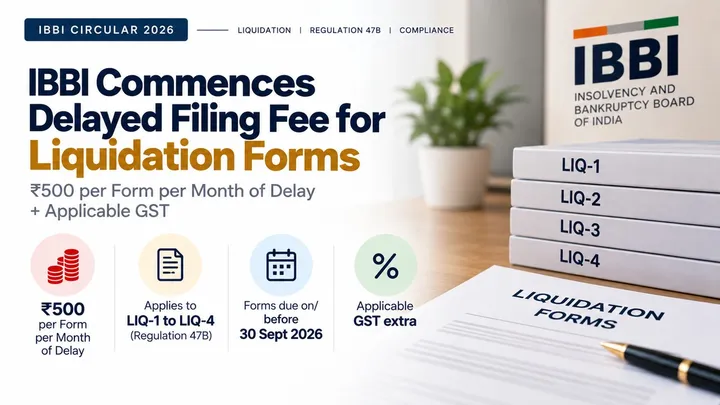
  • Late filing fee: ₹500 per Form per calendar month of delay
  • Consequences of non-compliance: IBBI may take any action including refusal to issue or renew Authorisation for Assignment (AFA) — the RP's licence to take up cases

📋 Section 7 — Forms A, B & C — From Regulations to Circular

One of the most practically significant structural changes in the June 2026 amendment is the removal of Forms A, B, and C from the body of the regulation and their relocation to a separate IBBI Circular (IBBI/IIRP/98/2026 dated June 02, 2026). This gives IBBI the flexibility to update the forms without amending the regulations each time. Here is what each form covers:

FormPurposeFiled ByFiled WithRegulation
Form AWritten consent to act as Resolution ProfessionalInsolvency ProfessionalAdjudicating AuthorityRegulation 4(2)
Form BSubmission of claims with supporting proofCreditorResolution ProfessionalRegulation 7(1)
Form CProxy appointment — to attend and vote at creditor meetingsCreditorResolution Professional (24 hrs before meeting)Regulation 16(2)

📊 Section 8 — Complete Before vs After: All June 2026 Changes

RegulationBefore (Pre June 2026)After (w.e.f. June 02, 2026)Type
Reg. 2(e)
"Form" definition
"form" means a form appended to these regulationsOMITTED — definition no longer needed as forms now issued via circularOmission
Reg. 4(2)
RP consent form
Written consent in "Form A"Written consent in "such form as notified by the Board through circular"Substitution
NEW Reg. 6A
Statement of assets
Did not existComprehensive 12-category asset statement mandatory with application under Sections 94 and 95 — including digital assets, ESOPs, overseas investments, beneficial ownership structuresInsertion
Reg. 7(1)
Claim form
Submit claim in "Form B"Submit claim in "such form as notified by the Board through circular"Substitution
Reg. 11(3)
First meeting
Convene first meeting in accordance with "sub-section (1) of section 107"Convene in accordance with "sub-section (3A) of section 106 AND sub-section (1) of section 107"Insertion
NEW Reg. 11A
Asset transfer coordination
Earlier Reg 11A (Jan 2024) dealt with disclosure in the repayment plan reportNew framework: RP must coordinate with CIRP RP on asset transfers (Section 28A); obtain creditor approval; disclose in Section 106/112 reportsReplaced
Reg. 16(2)
Proxy form
Deliver "Form C" to RP at least 24 hours before meetingDeliver "such form as notified by the Board through circular"Substitution
Reg. 17B
Non-submission of plan
"…intimating the non-submission of a repayment plan and seek appropriate directions""…in accordance with sub-section (1A) of section 106" — specific statutory reference insertedSubstitution
Forms A, B, C
(appended to Regulations)
Forms were appended to the regulations as physical schedulesREMOVED from the regulations; now notified via IBBI Circular No. IBBI/IIRP/98/2026 dated June 02, 2026Omission

❓ Section 9 — Frequently Asked Questions

Q1. Who exactly is a "personal guarantor to a corporate debtor" and when do these regulations apply??
A personal guarantor is an individual (typically a promoter or director) who has given a personal guarantee for the debts of a corporate person (company or LLP). Under Section 60(2) of the IBC, the insolvency resolution process of a personal guarantor to a corporate debtor must be filed before the same NCLT/DRT that is handling the corporate debtor's insolvency. These regulations govern that process — from the filing of the application to the approval of a repayment plan or passage of a bankruptcy order — applicable since December 01, 2019.
Q2. Is the new Regulation 6A statement of assets required immediately for all pending applications??
Regulation 6A applies to applications filed on or after June 02, 2026, since it is effective from that date. For applications already admitted (i.e., where the resolution process has commenced), the statement would not technically be required under Regulation 6A — but the RP's obligation to prepare a statement of affairs under Regulation 10 continues, and the AA may require disclosure of current assets in the course of the proceedings. Practically, the RP and guarantor should ensure that asset disclosure is comprehensive regardless of admission date, given IBBI's heightened focus on transparency.
Q3. What are "digital assets" under Regulation 6A and why are they included??
Clause (f) of Regulation 6A(1) defines digital assets to include cryptocurrencies, virtual digital assets (VDAs — as defined under the Finance Act, 2022), non-fungible tokens (NFTs), digital tokens, and domain names or other digital properties having commercial value. They are included because regulators recognised that promoters often hold significant value in digital assets that are difficult to trace and easy to conceal. By expressly requiring disclosure with supporting evidence, IBBI ensures that creditors' recoveries are not diminished by concealed crypto or NFT holdings. This is a landmark first — no prior IBBI regulation had expressly mandated digital asset disclosure.
Q4. What happens if the guarantor does not disclose all assets under Regulation 6A??
The statement of assets must be "complete and true with supporting evidence" — so non-disclosure or mis-disclosure is a serious matter. Under the IBC, a guarantor who provides false information in insolvency proceedings may be prosecuted for fraud under Section 70 (false representations) or Section 76 (concealment of property) of the IBC, which carry penalties including imprisonment. Additionally, the AA can take adverse inferences against the guarantor, and the RP has an independent obligation to investigate the guarantor's affairs. The 5 dimensions of mandatory inclusion under Regulation 6A(2) — particularly the "irrespective of legal title" requirement — are specifically designed to prevent formal non-disclosure through nominee holdings or trust structures.
Q5. How does new Regulation 11A interact with the CIRP of the corporate debtor??
Regulation 11A is triggered specifically when the personal guarantor's IRP is concurrent with the CIRP of the corporate debtor. Section 28A of the IBC governs transfer of assets from the corporate debtor's estate — which in some cases may include assets originally belonging to (or encumbered by) the personal guarantor. Under new Regulation 11A: (1) the guarantor's RP must actively coordinate with the corporate RP on such transfers; (2) the guarantor's creditors must approve the transfer; (3) the RP must disclose the proposed transfer in their Section 106/112 report. This prevents a situation where assets of the guarantor are effectively dealt with in the CIRP without the knowledge or consent of the guarantor's own creditors.
Q6. What is the consequence if no repayment plan is submitted by the guarantor under Regulations 17A and 17B??
Under Regulation 17A, the RP must first notify the creditors in a meeting of creditors that no repayment plan has been received within the Section 106 period. After obtaining creditor approval, the RP then files an application under Section 106(1A) of the IBC with the Adjudicating Authority (per updated Regulation 17B). The AA can then pass appropriate orders — which may include passing a bankruptcy order under Section 106(6) / Part III of the IBC. This closes the legal vacuum that existed in 143 cases where the process had been admitted but no repayment plan was ever submitted, leaving cases in limbo.
Q7. What is the "10% of realisable income" rule in the repayment plan??
Regulation 17(1)(c) requires the repayment plan to provide a minimum living budget for the guarantor and dependent family members. Crucially, it mandates that at least 10% of the guarantor's realisable income shall be utilised for repayment of debts. This ensures a minimum creditor recovery standard even for personal guarantors with modest incomes, while protecting the guarantor's basic living expenses. The repayment plan also specifies which funds are set aside, how they are invested pending repayment, and what happens to residual funds at the end of the plan period.
Q8. What is the Authorisation for Assignment (AFA) and why is it relevant to Regulation 23??
An Authorisation for Assignment (AFA) is the annual authorisation that IBBI grants to registered insolvency professionals to be eligible for assignment as IP in new insolvency/liquidation cases. Without a valid AFA, an IP cannot take up new cases. Under Regulation 23(5), IBBI may refuse to issue or renew an IP's AFA as a consequence of: (a) failure to file Forms with required information; (b) inaccurate or incomplete Forms; or (c) delayed filing. This makes the Form-filing obligation under Regulation 23 directly tied to the IP's ability to practice — a powerful compliance incentive.

✅ Section 10 — Compliance Action Checklist

  • For Personal Guarantors filing applications from June 02, 2026: Prepare a comprehensive Regulation 6A statement of assets covering all 12 categories and 5 dimensions of ownership — with supporting evidence (bank statements, share certificates, crypto wallet screenshots, property documents, income-tax returns)
  • Digital asset disclosure: Declare all cryptocurrencies, NFTs, VDAs, and domain names with current market value as of the application date — obtain valuation evidence from licensed exchanges where possible
  • ESOP and beneficial ownership: Disclose all ESOPs (vested and unvested), nominee holdings, HUF assets, and trust interests — even if legal title does not rest with the guarantor
  • Creditor applications (Section 95): File asset information to the extent available — no obligation to file complete guarantor asset details, but include all information in creditor's possession
  • Resolution Professionals — update consent forms: Form A for written consent is no longer appended to the regulations — use the IBBI Circular (IBBI/IIRP/98/2026 dated June 02, 2026) format
  • Creditors — update claim forms: Form B is now issued via circular — ensure claims are filed in the updated circular format
  • Concurrent CIRP situations (Reg. 11A): If the personal guarantor's IRP runs concurrently with the corporate debtor's CIRP, the RP must actively coordinate on asset transfers under Section 28A — obtain creditor meeting approval before any cross-process transfer and disclose in Section 106/112 reports
  • Repayment plan process: If no repayment plan is received in the Section 106 period, notify creditors in a meeting (Reg. 17A proviso) and then file application under Section 106(1A) with creditor approval (Reg. 17B) — do not leave the case in limbo
  • Form filing timelines (Reg. 23): File all IBBI-specified Forms within stipulated timelines — late filing attracts ₹500/form/calendar month of delay and may result in AFA non-renewal
  • Proxy appointments: Use the Form C issued under Circular IBBI/IIRP/98/2026 — deliver to RP at least 24 hours before the meeting; old forms appended to the regulations are no longer valid
Sources: IBBI (Insolvency Resolution Process for Personal Guarantors to Corporate Debtors) Regulations, 2019 [Amended upto June 02, 2026] | Notification No. IBBI/2026-27/GN/REG149 dated June 01, 2026 | IBBI Circular No. IBBI/IIRP/98/2026 dated June 02, 2026 (Forms A, B, C) | Notification No. IBBI/2025-26/GN/REG131 dated November 20, 2025 (Regulation 23) | Notification No. IBBI/2025-26/GN/REG125 dated May 19, 2025 (Regulation 17B) | Notification No. IBBI/2023-24/GN/REG107 dated January 31, 2024 | Insolvency and Bankruptcy Code, 2016 | ibbi.gov.in | CorpLawUpdates.in

This article is for informational and educational purposes only and does not constitute legal advice. For specific insolvency matters, consult a registered insolvency professional or legal counsel.
Related Updates