✅ FINAL AMENDMENT DIRECTIONS — RESERVE BANK OF INDIA
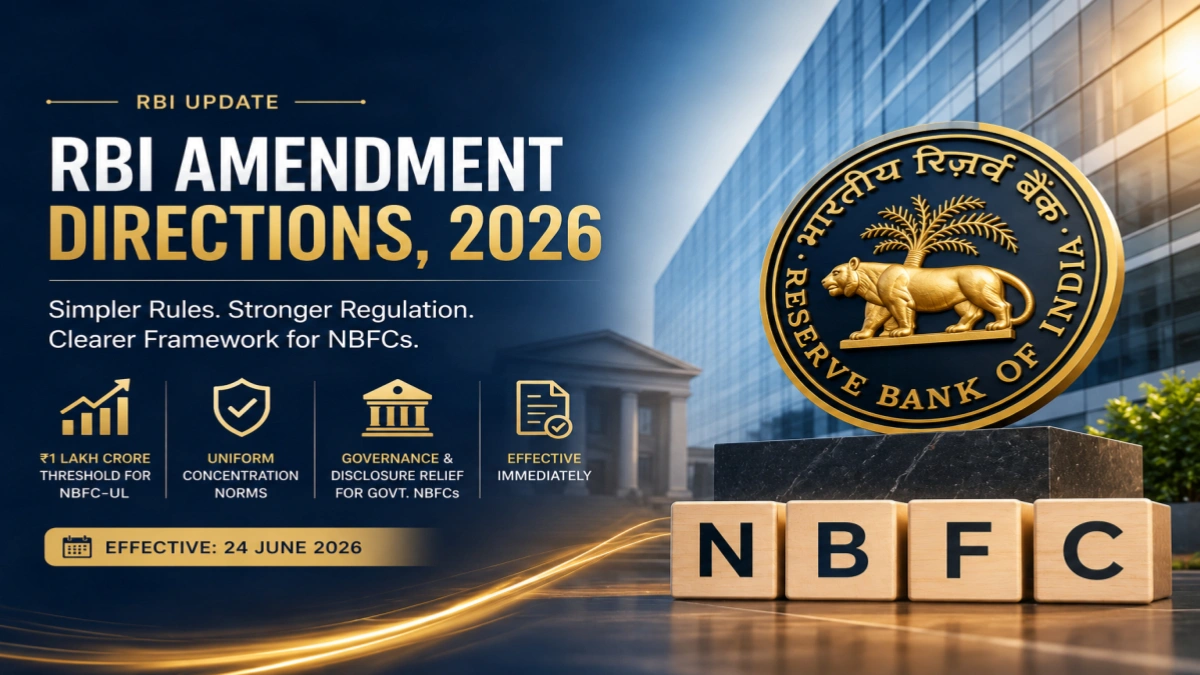
Four simultaneous Amendment Directions issued by RBI on June 24, 2026, effective immediately. These are final directions — the consultation phase (April–May 2026) is closed. All changes are operative from the date of issuance.
📋 Quick Reference
Why RBI Overhauled NBFC Upper Layer Identification — and What Triggered the Government NBFC Changes
The Reserve Bank of India's Scale Based Regulatory (SBR) Framework for NBFCs, introduced in 2021 and consolidated into comprehensive Directions issued on November 28, 2025, created a four-layer classification system — Base Layer, Middle Layer, Upper Layer, and Top Layer — with progressively stringent regulatory requirements. The identification of NBFCs warranting placement in the Upper Layer (NBFC-UL) was previously governed by a scoring-based parametric methodology that considered multiple quantitative and qualitative parameters to rank NBFCs by their systemic importance. While conceptually sound, this approach was perceived by industry stakeholders as opaque, complex, and difficult to predict — making compliance planning and strategic balance-sheet management challenging for large NBFCs.
A parallel gap existed in the framework's treatment of Government-owned NBFCs. These entities — which include large public sector infrastructure lenders, housing finance companies, and development finance institutions — had historically operated outside the SBR Upper Layer either because they did not meet the scoring threshold or because their inclusion was not explicitly provided for. Additionally, Government NBFCs had been receiving individual exemptions from credit/investment concentration norms on a case-by-case basis, a practice that created regulatory asymmetry compared to their private-sector counterparts — one RBI had already proposed correcting via a draft Circular on 'Credit/Investment Concentration Norms – Government owned NBFCs' issued through a Press Release dated January 15, 2024, the feedback on which is now incorporated in these final directions.
On April 10, 2026, RBI issued draft Amendment Directions proposing a fundamental overhaul — replacing the parametric methodology with a clean, absolute asset-size threshold, explicitly bringing eligible Government NBFCs into the Upper Layer, and withdrawing concentration norm exemptions. After receiving stakeholder feedback through May 4, 2026, RBI has now finalised and issued four Amendment Directions on June 24, 2026, implementing these changes with immediate effect. These four directions collectively amend the Registration and SBR Framework, the Concentration Risk Management, the Governance, and the Financial Statements Directions for NBFCs.
Notably, these four directions consolidate the outcome of two separate consultation tracks. The April 2026 draft directions addressed NBFC-UL identification and Government NBFC inclusion. A separate and earlier draft Circular on 'Credit/Investment Concentration Norms – Government owned NBFCs', issued via Press Release dated January 15, 2024, had proposed withdrawing the case-by-case concentration norm exemptions for Government NBFCs. Both sets of stakeholder feedback have now been incorporated into the final directions issued on June 24, 2026.
Direction 1: NBFC-UL Identification — New ₹1,00,000 Crore Asset Threshold (RBI/2026-27/163)
This is the most structurally significant of the four directions. It amends the RBI (Non-Banking Financial Companies – Registration, Exemptions and Framework for Scale Based Regulation) Second Amendment Directions, 2026, which itself amends the parent Directions of November 28, 2025.
Substitution of Paragraph 24 — The New NBFC-UL Definition
⚠️ Core Change — Old Parametric Scoring Replaced
The Upper Layer shall now consist of NBFCs having an asset size of ₹1,00,000 crore and above as per the latest audited balance sheet for the financial year. This replaces the earlier multi-parameter scoring methodology entirely. The criterion is absolute, binary, and objective — if your audited balance sheet shows assets at or above this threshold, you are in the Upper Layer. There is no discretionary scoring, no weighting of qualitative factors, and no intermediary ranking list.
This also abolishes the old framework's "top ten by asset size" automatic inclusion rule — the first prong of the previous dual methodology. Under the new framework, no NBFC is automatically included or excluded based on relative peer ranking. The ₹1,00,000 crore threshold is the single and sole criterion, applied in absolute terms against each NBFC's own audited balance sheet.
✅ What This Means for NBFCs
The Upper Layer continues to be identified annually by RBI. The new criterion makes it transparently predictable — any NBFC that knows its own audited balance sheet total can now self-assess its Upper Layer eligibility without waiting for RBI's parametric scoring outcome. The threshold will be reviewed every three years (new paragraph 31), providing a scheduled mechanism for recalibration as the sector grows.
Deletion of Earlier Methodology — Paragraphs 25, 26, and 30
Paragraphs 25 and 26 of the parent Directions, which set out the parametric methodology and scoring matrix for NBFC-UL identification, are deleted in their entirety. Paragraph 30, which contained supplementary provisions linked to the scoring process, is also deleted. The heading of sub-section A.8.1 is retitled to "Criteria for identification of NBFCs in the Upper Layer," and sub-section A.8.2.3 is retitled to "Review of criteria for identification of NBFC-UL" — both reflecting the shift from a methodology-description heading to a criteria-based heading.
One further textual amendment under Direction 1: in paragraph 28 of the parent Directions, the word "parametric" is substituted with "prescribed" — a consequential clean-up that removes the last reference to the old parametric methodology from the operative provisions of Chapter II.
Amendment to Paragraph 12 — Upper Layer Definition Updated
Paragraph 12 of the parent Directions, which defines the Upper Layer, is substituted to reflect that the Upper Layer comprises NBFCs specifically identified annually by RBI as warranting enhanced regulatory requirements based on the criteria in paragraph 24. The reference is now to the new asset-size criteria, not the earlier scoring framework. Sub-paragraph (4) of paragraph 15 is also deleted — this sub-paragraph had contained a proviso linked to the old identification methodology.
New Sub-Section B5 — Guidelines for NBFC Group Entities of Scheduled Commercial Banks
💡 Important New Provision — Bank Group NBFCs
A new sub-section B5 and paragraph 36A are inserted after paragraph 36. NBFCs that are group entities of Scheduled Commercial Banks must comply with the applicable provisions of the RBI (Commercial Banks – Undertaking of financial services) Directions, 2025 (as updated from time to time) wherever the same business or activity is being undertaken by both the NBFC and its parent bank. This provision applies to such NBFCs regardless of their layer-wise classification under the SBR framework. The layer classification itself remains unchanged — for example, an IDF-NBFC that is a group entity of a Scheduled Commercial Bank must comply with NBFC-UL regulations (other than mandatory listing) even if it continues to sit in the Middle Layer under SBR.
Direction 2: Concentration Risk Management — Government NBFC Exemptions Withdrawn (RBI/2026-27/164)
This direction amends the RBI (Non-Banking Financial Companies – Concentration Risk Management) Directions, 2025. It addresses the twin issues of Government NBFC concentration norms and State Government guarantee treatment for all NBFC-UL entities.
Withdrawal of Concentration Norm Exemptions for Government NBFCs
❌ Exemptions Withdrawn — Effective June 24, 2026
A proviso has been inserted after sub-paragraph (1) of paragraph 3 of Chapter I (Preliminary) of the Concentration Risk Management Directions. Government-owned NBFCs will now be governed by the concentration norms and prudential limits applicable to the layer in which they are classified under SBR. All prior exemptions from concentration norms granted to Government NBFCs — whether general or case-by-case — stand withdrawn with immediate effect. Paragraph 19 of Chapter III (Middle Layer guidelines), which contained a specific carve-out for Government NBFCs in the Middle Layer, is deleted.
Transitional Arrangement for Existing Breaches
⚠️ Run-Off Permitted for Existing Limit Breaches
Recognising that some Government NBFCs may already be in breach of concentration limits (including where existing sanctioned limits have been drawn down), RBI has provided a transitional mechanism. Any such breach as on June 24, 2026 may be allowed to run off till maturity. However, no further exposure may be taken on such obligors once the breach exists. The only exception is for Government NBFCs in the Middle Layer or Upper Layer: they may take additional exposures beyond prudential limits, provided those additional exposures are fully covered by eligible credit risk transfer instruments resulting in zero net incremental exposure.
State Government Guarantees as Credit Risk Transfer Instruments — New Note after Paragraph 29(1)
✅ State Govt Guarantees — All NBFC-UL Entities
A new note has been inserted after paragraph 29(1) in Chapter IV (Guidelines for NBFC-UL). The key provisions are: (a) Exposures offset by State Government guarantees shall be reclassified and recognised as an exposure to the guaranteeing State Government rather than to the original counterparty. (b) Such reclassified exposures are exempt from the prudential exposure limit applicable to NBFC-UL. (c) However, since the credit risk transfer instrument is a State Government guarantee, a risk weight of 20 per cent shall apply to such offset exposures. This provision is available to all NBFC-UL entities — not just Government NBFCs.
IFC Exposure Limit — Amended Paragraph 35 and Table in Paragraph 39
Paragraph 35 of Chapter IV, which governs exposure limits for Infrastructure Finance Companies (IFCs) in the Upper Layer, has been amended. The table under paragraph 39 now sets the group of connected counterparties limit for NBFC (IFC) at 45 per cent of Tier 1 capital. Additionally, the first proviso to paragraph 35 has been amended to allow an IFC to exceed even that group exposure limit by a further 20 per cent of its Tier 1 capital where the exposure is to a group of connected counterparties. These changes recognise that IFCs, by the nature of their lending to large infrastructure projects, often face concentrated exposures to connected counterparty groups.
Direction 3: Governance — Listing Requirement Exemption for Fully Government-Owned NBFC-UL (RBI/2026-27/165)
This is the shortest of the four directions but contains a practically significant carve-out. The RBI (Non-Banking Financial Companies – Governance) Amendment Directions, 2026 amend the parent Governance Directions of November 28, 2025.
✅ Government-Owned NBFC-UL — Listing Exemption
A new proviso has been inserted after paragraph 43 of the Governance Directions: the provisions of paragraph 43 — which require NBFC-UL entities to mandatorily list their equity shares on recognised stock exchanges — shall not apply to NBFC-UL entities that are fully owned and controlled by the Government. This is a calibrated relief. The listing requirement under SBR was designed to impose market discipline on systemically important NBFCs through public disclosures and shareholder scrutiny. For Government entities where full ownership and control already rests with the sovereign, RBI has taken the view that this market-discipline rationale does not apply with the same force.
This exemption is strictly limited to the listing obligation under paragraph 43 of the Governance Directions. Every other Upper Layer governance requirement — enhanced board composition, independent director thresholds, mandatory committees, and all disclosures beyond those addressed in Direction 4 — continues to apply in full to fully Government-owned NBFC-UL entities.
Direction 4: Financial Statements — Disclosure Exemption for Fully Government-Owned NBFC-UL (RBI/2026-27/166)
This direction amends the RBI (Non-Banking Financial Companies – Financial Statements: Presentation and Disclosures) Directions, 2025. Its content mirrors the Governance direction in structure.
✅ Government-Owned NBFC-UL — Financial Disclosure Exemption
A proviso has been inserted after paragraph 23 of the Financial Statements Directions: the provisions of paragraph 23 — which set out enhanced financial statement presentation and disclosure requirements specific to NBFC-UL entities — shall not apply to NBFC-UL entities that are fully owned and controlled by the Government. These entities will continue to follow the disclosure framework applicable to their classification (Middle Layer or Upper Layer) under other provisions, but the specific Upper-Layer-triggered enhanced disclosures under paragraph 23 will not apply to them.
Key Changes — Before vs After Comparison
Compliance Checklist for NBFC Compliance Officers and Professionals
CorpLawUpdates Analysis
The shift from parametric scoring to an absolute asset-size threshold of ₹1,00,000 crore for NBFC-UL identification is the most consequential regulatory simplification in the SBR framework since its introduction. The old methodology, while technically sophisticated, created an information asymmetry where large NBFCs could not predict with certainty whether they would be placed in the Upper Layer — since the scoring depended partly on qualitative factors and the relative position of other NBFCs in the scoring pool. The new criterion eliminates this ambiguity entirely. Any NBFC can now determine its Upper Layer exposure by reviewing its own balance sheet total. The three-year review cycle for the threshold is a sensible mechanism that allows the criterion to keep pace with nominal GDP growth and sector expansion, without creating annual uncertainty for large NBFCs about their regulatory layer.
The inclusion of Government NBFCs in the NBFC-UL framework — and the simultaneous withdrawal of concentration norm exemptions — represents a long-overdue levelling of the regulatory playing field. Large public sector NBFCs, several of which comfortably exceed ₹1 lakh crore in assets (PFC, REC, NaBFID, HUDCO, IREDA and similar entities), have historically benefited from both implicit sovereign backstop assumptions and explicit regulatory carve-outs. The run-off provision for existing breaches is pragmatic and provides a reasonable transition period, but the message is clear: Government ownership is no longer a justification for regulatory arbitrage in concentration norms. The practical compliance challenge for many of these entities will be significant — they have built large, concentrated sectoral books in power, infrastructure, and housing finance precisely because they did not face meaningful concentration limits. Mapping these exposures against the now-applicable prudential limits and establishing credible run-off plans will require immediate board-level attention.
The State Government guarantee treatment in the Concentration Risk Directions deserves careful attention from all NBFC-UL entities, not just Government NBFCs. The provision that exposures backed by State Government guarantees be reclassified as sovereign exposure and exempted from prudential limits is an operationally useful tool — particularly for IFCs lending to state-owned utilities and infrastructure projects where State guarantee coverage is common. However, the imposition of a 20% risk weight on such offset exposures means that the capital relief is not free. NBFCs will need to carefully model whether the prudential limit headroom gained by deploying State guarantees is worth the capital cost compared to other credit risk transfer instruments. The IFC-specific liberalisation of group exposure limits to 45% is aligned with the nature of infrastructure lending, where multiple project entities within the same group frequently borrow from the same lender for different projects.
The Government-owned NBFC-UL exemptions from mandatory listing (Governance Directions) and enhanced financial disclosures (Financial Statements Directions) reflect a nuanced policy judgment that market-discipline mechanisms designed for listed private-sector entities may be inappropriate for sovereign-controlled institutions. This is a defensible position, but practitioners should note that these exemptions are conditioned on the entity being fully owned and controlled by the Government — partial government ownership (such as a listed NBFC where the government holds a majority but not 100% stake) will not qualify. Compliance teams at entities near this threshold should obtain clarity from RBI on the definition of "fully owned and controlled" if any doubt exists. The one open question practitioners should flag immediately is the definition of "fully owned and controlled by the Government" — entities where the sovereign holds a majority but not 100% stake should not assume the listing or disclosure exemptions apply without formal RBI guidance. The directions use this phrase without defining it, and compliance teams at borderline entities need clarity before relying on it in any board filing or regulatory submission.
📄 Source Documents
1. Press Release 2026-2027/530, dated June 24, 2026 — Reserve Bank of India (signed: Brij Raj, Chief General Manager)
2. RBI/2026-27/163 | DOR.FIN.REC.No.137/03.10.001/2026-27 — RBI (NBFC – Registration, Exemptions and Framework for Scale Based Regulation) Second Amendment Directions, 2026
3. RBI/2026-27/164 | DOR.FIN.REC.No.138/03.10.001/2026-27 — RBI (NBFC – Concentration Risk Management) Third Amendment Directions, 2026
4. RBI/2026-27/165 | DOR.FIN.REC.No.139/03.10.001/2026-27 — RBI (NBFC – Governance) Amendment Directions, 2026
5. RBI/2026-27/166 | DOR.FIN.REC.No.140/03.10.001/2026-27 — RBI (NBFC – Financial Statements: Presentation and Disclosures) Second Amendment Directions, 2026
All signed by: J P Sharma, Chief General Manager-in-Charge, Department of Regulation, Reserve Bank of India, Central Office, Mumbai.
This article is for informational and educational purposes only and does not constitute legal or regulatory advice. Readers should verify all information with primary regulatory sources (rbi.org.in) before acting on the basis of this article.