Press Release
2026-2027/502
Date Issued
June 19, 2026
Scheme Origin
December 1969
Tier Structure
3-Tier (Block → District → State)
CD Ratio Benchmark
60% (Rural & Semi-Urban)
⚡ REGULATORY UPDATE — EFFECTIVE IMMEDIATELY
The Reserve Bank of India has issued the final revised Circular on the Lead Bank Scheme (LBS) on June 19, 2026, superseding all earlier instructions on the subject. The circular mandates exclusive Lead District Manager appointments per district, formalises three-tier credit planning, prescribes uniform meeting timelines, and constitutes dedicated SLBC sub-committees on Agriculture, MSMEs, Financial Inclusion and Digital Payments.
The Reserve Bank of India, through Press Release 2026-2027/502 dated June 19, 2026, signed by Brij Raj, Chief General Manager, issued the final revised Circular on the Lead Bank Scheme (LBS). This follows the draft Circular published on February 13, 2026, on which public feedback was solicited until March 6, 2026. The feedback received has been examined and necessary modifications incorporated in the final guidelines. A statement on key items of feedback and action taken is provided in the Annex to the circular.
The revised Circular comprehensively replaces all earlier instructions governing the Lead Bank Scheme, which has been in existence since December 1969. The Scheme designates one commercial bank as the Lead Bank for each district, responsible for coordinating credit institutions and government agencies to improve credit flow to priority sectors and deepen financial inclusion. The final circular strengthens institutional architecture at all three tiers — block, district, and state — and introduces stricter accountability mechanisms, uniform timelines, and formalised credit planning processes.
Background: Why the Lead Bank Scheme Needed an Overhaul
📜 HISTORICAL BACKGROUND
The Lead Bank Scheme traces its origins to two landmark committee reports of 1969. The
Gadgil Study Group (1969) recommended an "Area Approach" to banking, identifying the need for a coordinating bank in each district to address weak rural banking presence and inadequate rural credit. The
Nariman Committee (1969) — headed by F.K.F. Nariman — endorsed this recommendation and proposed that each public sector bank should adopt specific districts as Lead Banks, with the district as the fundamental unit of banking and credit planning. Based on these recommendations, the Lead Bank Scheme was officially launched in
December 1969. A subsequent review by the
Usha Thorat Committee (2009) supported the continuation of the scheme, recognising its importance in expanding
priority sector lending coverage. The present 2026 revision represents the most comprehensive overhaul of the scheme since its introduction.
🔴 PROBLEM 1
Unclear Role Delineation
The DCC and DLRC lacked clearly defined mandates, leading to overlap and inconsistency in district-level coordination outcomes.
🔴 PROBLEM 2
Weak LDM Offices
Lead District Manager offices lacked dedicated staff, infrastructure, vehicles, and budgets, hampering on-ground implementation capacity.
🔴 PROBLEM 3
Non-Uniform Meeting Timelines
No standardised timelines existed for BLBC, DCC, DLRC, and SLBC meetings, agenda circulation, minutes recording, or action tracking.
🔴 PROBLEM 4
Fragmented Credit Planning
The role of Block Level Bankers' Committees in credit plan preparation was not formalised, weakening the bottom-up approach to district credit plans.
🔴 PROBLEM 5
No Structured SLBC Sub-Committees
State Level Bankers' Committees lacked dedicated sub-committees for Agriculture, MSMEs, Financial Inclusion, and Digital Payments.
🔴 PROBLEM 6
Outdated Instructions
Existing LBS instructions had accumulated over decades without comprehensive review, creating inconsistency and gaps in the regulatory framework.
📋 REGULATORY FOUNDATION
PRESS RELEASE
2026-2027/502 dated June 19, 2026
DRAFT CIRCULAR
Issued February 13, 2026; Public feedback till March 6, 2026
ANNOUNCED BY
RBI Governor Sanjay Malhotra in Statement on Developmental and Regulatory Policies, February 6, 2026
ALIGNMENT
National Strategy for Financial Inclusion 2025–30
SCOPE
Supersedes ALL earlier LBS instructions; applies to all Scheduled Commercial Banks designated as Lead Banks
SIGNATORIES INVOLVED
Brij Raj, Chief General Manager, RBI
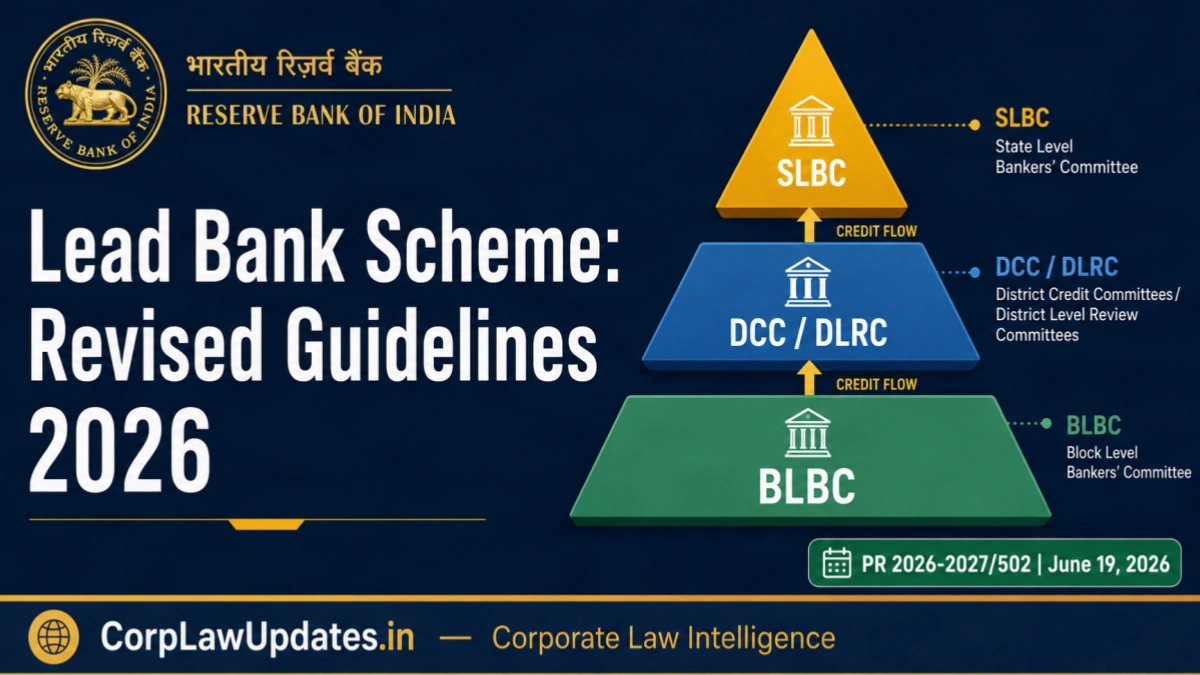
Revised Three-Tier Structure of the Lead Bank Scheme
THE THREE-TIER ARCHITECTURE
TIER 3 — STATE LEVEL
State Level Bankers' Committee (SLBC)
Apex inter-institutional forum. Co-chaired by Chairman/MD/ED of SLBC Convenor Bank and Chief Secretary/Additional Chief Secretary/Principal Secretary of Finance of the State. Focuses on policy, strategic issues, priority sector lending, and financial inclusion. Must constitute four dedicated sub-committees: SC-Agriculture & Allied Activities, SC-MSME & Other Priority Sector, SC-Financial Inclusion & Financial Literacy, and SC-Digital Payments. Meetings are conducted every quarter. The Chief Minister/Minister of Finance/Industries/Agriculture shall be invited to address SLBC meetings; the Chief Minister is specifically requested to attend at least one SLBC meeting per year.
↓
TIER 2 — DISTRICT LEVEL
District Consultative Committee (DCC)
District-level coordination and implementation forum. Responsible for execution of credit plans, monitoring financial inclusion, and coordinating with government departments.
District Level Review Committee (DLRC)
Reviews credit flow at district level. Provides platform for Members of Parliament, MLAs and other public representatives to give feedback on banking services and credit delivery.
↓
TIER 1 — BLOCK LEVEL (BASE)
Block Level Bankers' Committee (BLBC)
Foundation of the credit planning process. To be constituted in every block of a district. Prepares and reviews block credit plans. Block credit plans feed into District Credit Plans, which in turn feed into State-level Credit Plans — completing the bottom-up credit planning architecture.
Key Changes in the Final Circular
🏦
Lead District Manager (LDM) — Exclusive Appointment Mandate
Every Lead Bank must appoint a
Lead District Manager exclusively for each district under its
charge. Banks must assign only one district to one LDM. Responsibility for multiple districts is permitted only in exceptional circumstances. RBI has directed Lead Banks to strengthen LDM offices with
dedicated staff, IT infrastructure, vehicles, and separate budgets. An RBI officer will be designated as Lead District Officer for each district to represent the central bank at district level.
📋
Block Level Bankers' Committee — Formalised Role in Credit Planning
The BLBC is now formally designated as the foundation of the credit-planning process. Each BLBC will prepare and review block credit plans. These plans will feed upward into District Credit Plans, which will in turn feed into State-level Credit Plans — implementing a structured bottom-up credit planning approach across the country.
⏰
Uniform Timelines for All Committee Meetings
RBI has prescribed uniform timelines for meetings of BLBCs, DCCs, DLRCs, and SLBCs. The circular introduces stricter timelines for (a) circulating agenda papers, (b) recording minutes, and (c) tracking action taken on decisions. Lead District Managers and SLBC convenors must establish robust monitoring systems to ensure decisions are implemented within defined timelines. Virtual participation in meetings is permitted where physical attendance is difficult.
🔍
Clearer DCC vs. DLRC Role Distinction
The circular draws a clear distinction between the two district-level committees. The DCC functions as the district-level coordination and implementation forum. The DLRC focuses on reviewing credit flow and provides a platform for Members of Parliament, MLAs, and other public representatives to provide feedback on banking services and credit delivery.
🏛️
SLBC — Four Dedicated Sub-Committees Mandated
SLBCs must now focus on policy and strategic issues relating to priority sector lending and financial inclusion. Four dedicated sub-committees are now mandatory: SC-Agriculture & Allied Activities (chaired by SLBC/UTLBC core member bank with highest agriculture lending share or Agriculture Commissioner), SC-MSME & Other Priority Sector, SC-Financial Inclusion & Financial Literacy, and SC-Digital Payments (chaired by SLBC Convenor or Zonal head of a major bank). Standardisation of information on SLBC websites is also directed. Notably, the Chief Minister/Minister of Finance/Industries/Agriculture shall be invited to address SLBC meetings, and the Chief Minister is specifically requested to attend at least one SLBC meeting per year — reinforcing state government engagement at the apex banking coordination forum.
Credit-Deposit Ratio Benchmark & NABARD's Role
CD Ratio Benchmark — 60%
Banks must monitor the Credit-Deposit (CD) ratio with a benchmark of 60% across rural and semi-urban branches at the all-India level. Lead Districts with low CD ratios are to be addressed through special sub-committees and monitorable action plans.
NABARD — District Development Manager
NABARD will continue to appoint a District Development Manager (DDM) in each district to act as a liaison between NABARD and district-level banking and financial institutions, and to prepare Potential Linked Credit Plans (PLP).
Infrastructure Bottleneck Reporting
SLBC convenor banks are directed to flag infrastructure and administrative bottlenecks — including digital connectivity gaps, power supply issues, law and order concerns, and security challenges — that may hinder financial inclusion efforts.
Before vs. After: Key Changes at a Glance
Impact Analysis: Who Is Affected and How
Must appoint exclusive LDMs per district. Required to provide LDM offices with dedicated staff, vehicles, IT infrastructure, and separate budgets. Must monitor CD ratio and prepare block/district credit plans through BLBC mechanism. Non-compliance with uniform timelines for meetings and action tracking will be monitored by RBI.
Must constitute four mandatory sub-committees (Agriculture, MSME, Financial Inclusion, Digital Payments). Must focus SLBC on policy and strategic issues. Must standardise information on SLBC websites. Must flag infrastructure and administrative bottlenecks to RBI. Required to establish robust monitoring systems for decision tracking.
Continues to appoint District Development Managers in each district. DDMs act as liaison between NABARD and district-level banking institutions, and prepare Potential Linked Credit Plans. NABARD's role in block-level credit planning through DDMs is now more formally integrated into the three-tier architecture.
Chief Secretary/Additional Chief Secretary/Principal Secretary of Finance will co-chair SLBCs. Relevant state department heads are mandatory SLBC members. The Chief Minister/Minister of Finance/Industries/Agriculture shall be invited to address SLBC meetings, with the Chief Minister requested to attend at least one meeting per year. DLRC now provides a clearer platform for elected representatives (MPs, MLAs) to give feedback on credit delivery and banking services.
PRIORITY SECTOR / RURAL BORROWERS
Formalised BLBC-driven bottom-up credit planning is expected to improve credit flow to agriculture, MSMEs, and underserved rural areas. The 60% CD ratio benchmark for rural/semi-urban branches incentivises increased lending. Bottleneck reporting mechanism aims to address infrastructure barriers to financial inclusion.
RBI will designate Lead District Officers for each district to represent the central bank at district level. RBI's Regional Directors are mandatory SLBC members. The central bank will now have enhanced oversight through uniform timelines, standardised meeting reporting, and structured monitoring of CD ratios and credit planning outcomes.
Compliance Action Points
📌 FOR LEAD BANKS
Review existing LDM appointments — ensure one exclusive LDM per district; no LDM handling multiple districts except in exceptional cases approved internally
Audit LDM office infrastructure — identify gaps in staffing, IT, vehicles, and budget allocation; allocate dedicated budgets for each LDM office
Operationalise BLBC in every block — ensure BLBCs are active, prepare block credit plans, and integrate these into district credit plans
Adopt uniform timelines prescribed by RBI for BLBC, DCC, and DLRC meetings — update internal SOPs for agenda circulation, minutes recording, and action tracking
Monitor CD ratio — track CD ratio at rural and semi-urban branches with the 60% benchmark; prepare action plans for districts falling below the threshold
📌 FOR SLBC CONVENOR BANKS
Constitute four dedicated sub-committees: Agriculture & Allied Activities, MSME & Other Priority Sector, Financial Inclusion & Financial Literacy, and Digital Payments
Re-orient SLBC agenda to focus on policy and strategic issues relating to priority sector lending and financial inclusion
Standardise SLBC website — ensure standardised information on banking data, credit plans, and meeting outcomes is publicly available
Establish bottleneck reporting mechanism — identify and flag digital connectivity, power supply, law & order, and security issues to RBI
Set up monitoring systems to ensure decisions taken at SLBC meetings are tracked and implemented within prescribed timelines
Coordinate with state government to ensure the Chief Minister and/or Minister of Finance/Industries/Agriculture is invited to address SLBC meetings — Chief Minister's attendance at least once per year is mandated
📌 FOR COMPLIANCE & REGULATORY AFFAIRS TEAMS
Replace all earlier LBS-related internal policy documents with revised circular framework — this circular supersedes ALL prior instructions
Update DCC/DLRC participation and agenda templates to reflect clearly delineated roles prescribed in the revised circular
Prepare board/management briefing on revised LBS framework — especially on LDM resourcing, BLBC formalisation, and SLBC sub-committee constitution requirements
📎 SOURCE & REFERENCES
Primary Source: RBI Press Release 2026-2027/502, dated June 19, 2026 — "RBI issues Circular on Lead Bank Scheme", signed by Brij Raj, Chief General Manager
Circular Link: RBI Notification ID 13521
Draft Circular: Issued February 13, 2026; Feedback period closed March 6, 2026
Policy Alignment: National Strategy for Financial Inclusion 2025–30; RBI Statement on Developmental and Regulatory Policies, February 6, 2026
Scheme Origin: Lead Bank Scheme introduced by RBI in December 1969, on the recommendations of the Gadgil Study Group and Nariman Committee (1969); reviewed by the Usha Thorat Committee (2009)
Disclaimer: This article is prepared for informational purposes only and does not constitute legal advice. Readers should refer to the original RBI circular and consult qualified professionals before acting on this information. CorpLawUpdates.in is not responsible for any action taken in reliance on this content.