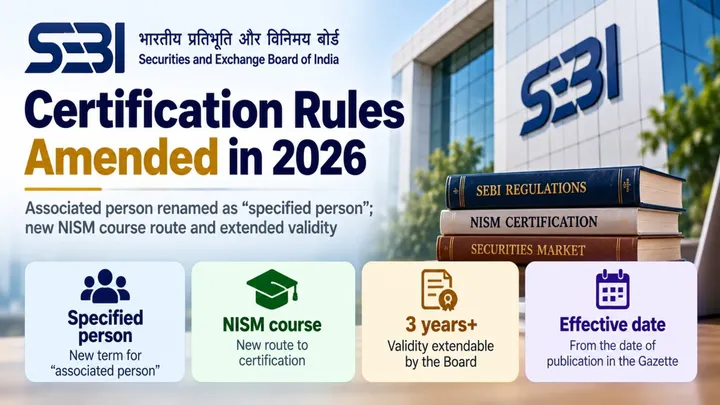
SEBI has renamed "associated persons" as "specified persons", inserted a new definition of the term that expressly includes employees of foreign portfolio investors and foreign venture capital investors working in India, and added a new way to meet the certification requirement: passing a course or programme specified by NISM in consultation with SEBI. It has also allowed the Board to specify an extended period in place of the three-year validity of a certificate. The regulations came into force on the date of their publication in the Gazette; the Gazette issue is dated 8 October 2026.
Quick Answer
The Securities and Exchange Board of India (Certification of Associated Persons in the Securities Markets) (Amendment) Regulations, 2026 replace the term "associated person" with "specified person" throughout SEBI's 2007 certification regulations, including their title but except in the proviso to regulation 3(1). A specified person is defined as a principal or employee of an intermediary, or an agent, distributor or other natural person engaged in the securities market business, and includes an employee of a foreign portfolio investor or foreign venture capital investor working in India. A new route to certification, passing a course or programme specified by NISM in consultation with the Board, is added in regulation 4(1)(d), and the three-year certificate period can be replaced by an extended period specified by the Board. The regulations came into force on the date of their publication in the Official Gazette; the Gazette issue is dated 8 October 2026.
What Changed?
Who Is a "Specified Person"?
The new regulation 2(1)(m) defines a specified person as:
- a principal or employee of an intermediary;
- an agent or distributor;
- any other natural person engaged in the securities market business; and
- an employee of a foreign portfolio investor or a foreign venture capital investor working in India.
The amendment text does not reproduce the clause (c) that it omits. It is likely the old definition of "associated person", but the source does not say so, so check it against the consolidated 2007 regulations.
The New NISM Course Route
Regulation 4(1) lists the ways a person can satisfy the certification requirement. The text of clauses (a) to (c) is not reproduced in the amendment. The amendment adds clause (d): "by passing a course or programme as may be specified by NISM in consultation with the Board from time to time."
In regulation 4(3), the amendment substitutes the words "as may be specified by the Board under sub regulation (1) of regulation 3" with words referring, as the case may be, to the date of appearing for examination, the date of obtaining CPE (continuing professional education) or the date of enrolment in a course or programme specified by NISM in consultation with the Board. It also adds "or clause (d)" after "clause (b)". The base text of regulation 4(3) is not reproduced, so the amendment does not show what that date governs. Regulations 4(2) and 4(4) were also amended to refer to clause (d).
Validity of the Certificate
In regulation 5(1), the amendment inserts the words "or for such other extended period as may be specified by the Board" after "for a period of three years" and before "from the date of the grant". The English text does not reproduce the rest of regulation 5(1), but the words around the insertion show that a certificate otherwise runs for three years from the date of the grant. In regulation 5(2), the amendment inserts "Unless otherwise provided by the Board," before the words "Upon expiry" and the same extension wording after "for a period of three years" and before "at a time,". The Hindi text of the notification also refers to the heading of regulation 5 and describes the period as running from the date of grant or the date the validity is extended; the English text mentions neither, and this article follows the English text.
The amendment does not itself extend any validity period. It lets SEBI do so later by specification.
Consequential Changes in Other Regulations
Who Is Affected?
Key Dates
17 October 2007: Original regulations published in the Gazette.
2025: Last amended before this by the (Amendment) Regulations, 2025 vide No. SEBI/LAD-NRO/GN/2025/251. The English text of the Gazette note gives only the year; the Hindi text gives the date as 15 July 2025.
7 October 2026: Date of the notification.
8 October 2026: Gazette issue date. The regulations apply from the date of publication.
The PDF carries a digital signature dated 9 October 2026, but the Gazette issue itself is dated 8 October 2026. We read the date of publication as 8 October; confirm it against the official Gazette entry before quoting it in a formal document.
What Should Intermediaries Do Now?
These are practical suggestions, not requirements stated in the amendment.
- Update internal policies, forms and training records that use the words "associated person".
- Check who counts as a specified person, including agents, distributors and FPI or FVCI staff in India.
- Watch for NISM and SEBI specifications of courses or programmes under regulation 4(1)(d).
- Watch for any Board notice extending the three-year validity period.
- Compare the changes with the consolidated 2007 regulations once SEBI updates them.
Frequently Asked Questions
What do the SEBI certification amendment regulations of 2026 change?
They rename "associated person" as "specified person" (except in the proviso to regulation 3(1)), omit clause (c) of regulation 2(1) and insert a new definition of "specified person" as clause (m), add a NISM course or programme route to certification in regulation 4(1)(d), allow the Board to specify an extended period in place of the three-year certificate validity, update the Companies Act reference to the 2013 Act, and make consequential changes in the Debenture Trustees Regulations, 1993 and the Self Regulatory Organizations Regulations, 2004.
Who is a specified person under the new definition?
A principal or employee of an intermediary, an agent or distributor, or another natural person engaged in the securities market business, including an employee of a foreign portfolio investor or foreign venture capital investor working in India.
When do the regulations come into force?
On the date of their publication in the Official Gazette. The Gazette issue is dated 8 October 2026.
Is there a new way to get certified?
Yes. Regulation 4(1)(d) allows certification by passing a course or programme specified by NISM in consultation with SEBI. No course has been specified in the amendment.
Does the certificate still last three years?
Yes, unless the Board specifies a longer period. The amendment lets SEBI set an extended period but does not set one.
Why is the Companies Act, 1956 replaced with the Companies Act, 2013?
The amendment makes this change in regulation 2(2) without stating a reason. It updates the reference to the current Act.
Which other regulations are changed?
The SEBI (Debenture Trustees) Regulations, 1993 (regulation 17A(4)) and the SEBI (Self Regulatory Organizations) Regulations, 2004 (regulations 2(1)(ea) and 2(1)(ha)), through the Schedule inserted by new regulation 12. In each, "Associated Persons" is replaced with "Specified Persons".
Do existing certificates remain valid?
The amendment does not say anything on this. It contains no transition or saving provision in the text we reviewed.
CorpLawUpdates Analysis
This is mainly a structural amendment. The name change and the wider definition affect how the rules read, but the most useful part is the enabling power: NISM, with SEBI, can now specify courses and programmes, and the Board can extend certificate validity. Neither power has been used in this notification, so the practical effect depends on what SEBI and NISM announce next. The express mention of FPI and FVCI employees working in India is a point to check for firms with India-based staff. These are editorial views, not SEBI statements.
Document: Securities and Exchange Board of India (Certification of Associated Persons in the Securities Markets) (Amendment) Regulations, 2026.
Issuing authority: Securities and Exchange Board of India.
Reference: F.No. SEBI/LAD-DOP/2026/319, 7 October 2026; Gazette of India, Extraordinary, Part III, Section 4, No. 605, 8 October 2026.
Signatory: Amit Pradhan, Executive Director.
Powers: Section 30 read with Sections 11, 12 and 19 of the Securities and Exchange Board of India Act, 1992.
Amends: Securities and Exchange Board of India (Certification of Associated Persons in the Securities Markets) Regulations, 2007, published in the Gazette of India on 17 October 2007 vide F. No. 11/LC/GN/2007/4567(b) and last amended by the (Amendment) Regulations, 2025 vide No. SEBI/LAD-NRO/GN/2025/251; and, through the Schedule, the SEBI (Debenture Trustees) Regulations, 1993 and the SEBI (Self Regulatory Organizations) Regulations, 2004.
Primary source: F.No. SEBI/LAD-DOP/2026/319 as published in the Gazette of India, Extraordinary, Part III, Section 4, No. 605, dated 8 October 2026
This article is for informational and educational purposes only and does not constitute legal or regulatory advice. Readers should verify the applicable primary regulatory source before taking action.