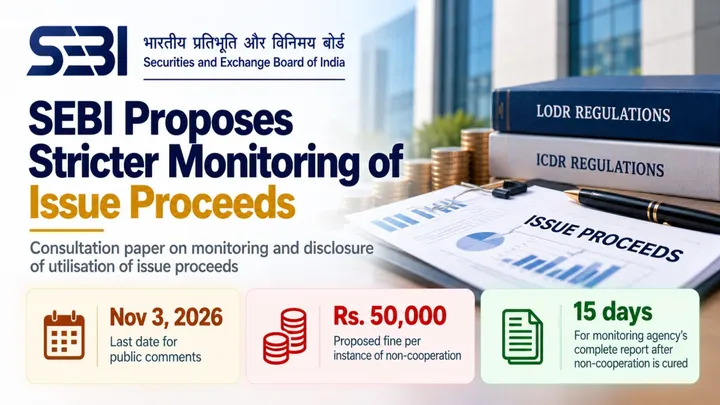
A listed company that does not cooperate with its monitoring agency (MA) could be reported to the stock exchange and fined Rs. 50,000 per instance, under a Working Group recommendation on which SEBI is now seeking public comments. SEBI's consultation paper of October 13, 2026 covers the review of the framework for monitoring and disclosure of utilization of issue proceeds. It also summarizes a stock exchange SOP under which continued non-cooperation or non-payment of the fine can escalate to notices to promoters and, ultimately, freezing of their demat accounts. Comments are open until November 3, 2026.
Quick Answer: What Is SEBI Proposing on Monitoring and Disclosure of Issue Proceeds?
On October 13, 2026, SEBI released a consultation paper seeking public comments on Chapter I of the first report of the Working Group for review of the SEBI (Listing Obligations and Disclosure Requirements) Regulations, 2015, which covers monitoring and disclosure of utilization of issue proceeds. The Working Group recommends that monitoring agencies (MAs) submit reports directly to stock exchanges, that exchanges levy a fine of Rs. 50,000 per instance of non-cooperation by a listed entity reported by an MA, that an MA be mandatory for all issuances irrespective of issue size (excluding the size of the offer for sale), and that a new Regulation 32A be inserted in LODR. SEBI's own additional proposals in Table 1 of the paper cover four of the Working Group's recommendations, including a bar on changing MAs while non-cooperation is unrectified. Comments are due by November 3, 2026.
Quick Reference
What Is This Consultation Paper About?
The LODR Regulations were published in the Gazette of India on September 2, 2015 to consolidate the various listing agreements into one framework. The paper notes that periodic amendments since then may have led to interpretation issues. SEBI therefore constituted a Working Group, chaired by Shri V S Sundaresan, to streamline the regulations, simplify structure and language, and remove ambiguity and redundancy.
The Working Group's first report has three chapters:
- Chapter I: monitoring and disclosure of utilization of issue proceeds (the subject of this paper);
- Chapter II: penal provisions and stock exchange actions for non-compliance by listed companies, including the stock exchange SOP;
- Chapter III: clarifications on Related Party Transaction provisions under LODR.
The report was placed before SEBI's Advisory Committee on Listing Obligations and Disclosures (ACLOD) and discussed internally. The paper presents the Working Group's Chapter I recommendations and SEBI's additional proposals arising from that discussion. Chapters II and III are outside this paper.
What Does the Working Group Recommend?
The paper states that the Working Group's Chapter I recommendations include the thirteen items below. It gives the full report's location on the SEBI website (sebi.gov.in, October 2026 common documents, file "working_group_report_lodr_p.pdf"). The items, as summarized in the paper, are:
- Empower the monitoring agency to directly submit its report to stock exchanges within prescribed timelines.
- In case of non-cooperation by the listed entity during monitoring, the direct report is to be based on best available information and accompanied by a "Statement of non-cooperation".
- Stock exchanges to levy a fine on the listed entity for non-cooperation reported by the monitoring agency.
- On termination of the agreement before 100% utilization of issue proceeds, the listed entity and the existing monitoring agency must ensure timely submission of the MA report during the transition period.
- Harmonize the ICDR and LODR provisions on monitoring and disclosure of utilization of issue proceeds, with consequential amendments.
- Mandatory appointment of a monitoring agency for all issuances irrespective of issue size (excluding the size of the offer for sale).
- Clarification on monitoring of gross issue proceeds.
- Modifications to the existing format of the monitoring agency report.
- Deletion of sub-regulation (5) of Regulation 262 of the ICDR Regulations and modification of Regulation 262(6).
- Alignment of terminology under Regulation 32 of LODR, with consequential amendments.
- Regulation 32 of LODR to deal with the "Statement of utilization including variation(s)", if any, and to apply to listed entities exempt from appointing a monitoring agency under the ICDR Regulations.
- Insertion of a separate Regulation 32A in LODR dealing with monitoring agency report aspects.
- Transitory provisions for implementing the amended ICDR and LODR provisions.
The paper itself does not describe the detail behind items 7 to 13, such as the revised report format or the content of Regulation 32A. Those sit in the Working Group report, and practitioners should read it directly.
What Additional Proposals Has SEBI Made?
SEBI's additional proposals are set out in Table 1 of the paper against four recommendations of the Working Group report, which the paper numbers as Recommendations 1 to 4. That numbering follows the Working Group report and differs from the 13-item summary list above.
Direct reporting and non-cooperation (Working Group Recommendation 1)
- Fee disputes are not non-cooperation. Non-payment of fee to the monitoring agency shall not be considered a ground for reporting non-cooperation. The Working Group's Para 1.2(ii) had listed non-payment of fee alongside other examples, namely not providing information, delay in sharing information and information without supporting documents.
- Fee-protection through contract. Monitoring agencies may deal with fee risk through suitable clauses in the agreement with the listed entity, including payment of the entire fee for the monitoring period in advance, if considered appropriate.
- Refund on early termination. If the MA has received the entire fee in advance and the agreement is terminated before 100% utilization of issue proceeds, the MA may be required to refund the proportionate amount for the remaining monitoring period. SEBI says this will discourage non-payment of fees.
- Best-available-information report. As recommended, the MA may submit its report on best available information. In case of non-cooperation, the report must carry a statement of non-cooperation.
- Cure mechanism. SEBI notes that the lack of a complete report for a reporting quarter may still leave an information gap for investors and may carry into later MA reports. It therefore proposes that if a listed entity rectifies non-cooperation for a reporting period for which the MA filed a direct report, the MA must, within 15 days of receiving complete information from the listed entity, submit a subsequent complete report to the stock exchanges. That report must explicitly state that the listed entity has rectified its non-cooperation status for the period.
- Exchange display. Based on ACLOD feedback, stock exchanges are to prominently display the MA report and, where applicable, the statement of non-cooperation on their websites for immediate investor attention.
Fines and the stock exchange SOP (Recommendation 2)
The Working Group recommends a fine of Rs. 50,000 per instance reported by the MA in a quarter, with later action following the SOP in Section VII-A of the Master Circular. SEBI's paper summarizes the exchange-submitted SOP process:
Termination of the MA agreement (Recommendation 3)
SEBI proposes to accept the Working Group's recommendation. It adds that where an MA has reported non-cooperation for one or more reporting quarters, the listed entity shall neither terminate its agreement with the existing MA nor appoint a new one until it rectifies the non-cooperation status and enables the existing MA to submit a complete report for that quarter.
ICDR and LODR harmonization (Recommendation 4)
The Working Group proposes deleting the MA report timelines from the ICDR Regulations and bringing them under LODR. SEBI proposes to accept this and, to avoid inconsistency, to omit the words "on a quarterly basis" from the MA provisions in addition to the amendments suggested in Annexure II of the report. The affected ICDR provisions are:
- Regulation 41(2): IPO on Main Board
- Regulation 82(2): Rights Issue
- Regulation 137(2): Further Public Offer
- Regulation 162A(2): Preferential Issue
- Regulation 173A(2): Qualified Institutional Placement
- Regulation 262(2): IPO by SMEs
When a company raises money from the market, a monitoring agency (MA) is appointed to check how the money is being used and to report on it. Under the recommendations, the MA could send its report directly to the stock exchange, even if the company has not supplied all the information, with a statement of non-cooperation. The exchange would then fine the company Rs. 50,000 per reported instance, and continued default could escalate to the company's promoters.
Under the SEBI (ICDR) Regulations, 2018 as in force today, an issuer must appoint a SEBI-registered credit rating agency as monitoring agency only where the issue size exceeds Rs. 100 crore (excluding the offer-for-sale portion). This covers IPOs, further public offers, rights issues, preferential issues and QIPs — preferential issues and QIPs were brought in by the November 2022 amendment. For SME IPOs the threshold is a fresh issue size above Rs. 50 crore (lowered from Rs. 100 crore in March 2025). The monitoring agency reports quarterly to the issuer until 100% of the proceeds are utilized, and the issuer files the report with the stock exchange within 45 days of each quarter-end. Issues by banks, public financial institutions and insurance companies are exempt. The Working Group now recommends making appointment mandatory for all issuances irrespective of size.
What Would Change If the Proposals Are Adopted?
Caution: the "mandatory for all issuances" point and the new Regulation 32A are Working Group recommendations listed in the paper. Table 1 does not contain a separate SEBI proposal on either, and the paper does not say what the current exemption thresholds are.
Who Would Be Affected?
Directly: listed entities that have raised funds through issuances governed by the ICDR Regulations (the paper cites IPOs on the Main Board and by SMEs, rights issues, further public offers, preferential issues and QIPs), and monitoring agencies appointed for those issues.
Also affected: promoters, who would face notice and a possible freeze of their demat accounts under the SOP escalation; stock exchanges, which would levy fines, display MA reports and statements of non-cooperation, and intimate depositories; and depositories.
Entities exempt from appointing an MA: the Working Group recommends (item 11 in the list above) that Regulation 32 of LODR deal with the "Statement of utilization including variation(s)" and apply to listed entities that are exempt from appointing an MA under the relevant ICDR provisions. The paper does not list who is exempt.
When Does It Apply?
What Should Practitioners Watch?
Because this is a draft, there is no compliance checklist. The following steps do not assume the proposals will be finalized as written.
Frequently Asked Questions
What did SEBI propose in its October 13, 2026 consultation paper?
In its consultation paper of October 13, 2026, SEBI sought public comments on Chapter I of the first report of the Working Group for review of the SEBI (Listing Obligations and Disclosure Requirements) Regulations, 2015, covering monitoring and disclosure of utilization of issue proceeds. Key recommendations include direct reporting by monitoring agencies to stock exchanges, a fine of Rs. 50,000 per instance of reported non-cooperation and a new LODR Regulation 32A.
Is this proposal already in force?
No. The October 13, 2026 SEBI paper is a consultation paper seeking public comments, and none of its proposals takes effect unless and until SEBI adopts them. The paper recommends amendments to the LODR and ICDR Regulations and does not state when, or in what form, they would be adopted.
What is the last date to submit comments?
November 3, 2026. Comments with rationale go through SEBI's public comment link, or by email to [email protected] if the web form has technical issues.
What is the proposed fine for non-cooperation with a monitoring agency?
Rs. 50,000 per instance of non-cooperation by a listed entity reported by the monitoring agency in a reporting quarter or half year, as applicable, levied by stock exchanges.
Can a monitoring agency report non-cooperation if its fee is unpaid?
Under SEBI's proposal, no. Non-payment of fee is not to be treated as a ground for reporting non-cooperation. Monitoring agencies may instead use contractual clauses such as advance payment of the entire monitoring-period fee.
What happens if a listed entity fixes its non-cooperation later?
The monitoring agency must submit a subsequent complete report to the stock exchanges within 15 days of receiving complete information from the listed entity. The report must state that the entity has rectified its non-cooperation status for that period.
Can a listed entity change its monitoring agency after non-cooperation is reported?
Not under the proposal. Where an MA has reported non-cooperation for one or more quarters, the entity may neither terminate the agreement nor appoint a new MA until it rectifies non-cooperation and enables the existing MA to submit a complete report for that quarter.
What is the escalation path if a listed entity does not cure non-cooperation or pay the fine?
Under the stock exchange SOP summarized in the paper, exchanges review compliance and issue notices to non-compliant listed entities within 30 days of the due date for the monitoring agency report. If the MA has not filed a subsequent complete report stating that non-cooperation was rectified, and/or the entity has not paid the fine within 15 days of that notice, exchanges issue notice(s) to the promoters. If, 10 days after the promoters' notice, non-cooperation is still not rectified and/or the fine remains unpaid, exchanges shall intimate depositories to initiate freezing of the promoters' demat accounts as per the SOP framework.
Will every issuer need a monitoring agency?
The Working Group recommends mandatory appointment for all issuances irrespective of issue size, excluding the size of the offer for sale. The paper also refers to entities exempt from appointing an MA under existing ICDR provisions and does not say how this interacts with the recommendation, so the final text needs watching.
CorpLawUpdates Analysis
In our view, for listed companies the issue is information discipline. The Working Group's examples of non-cooperation include not providing information to the MA, delay in sharing it and information without supporting documents. If the proposals are adopted, an MA report carrying a statement of non-cooperation would be displayed prominently on the stock exchanges' websites, so delay in responding to the MA could become visible to investors.
In our view, the bar on changing agencies is the sharper proposal, because it stops an issuer from ending an MA relationship while non-cooperation is unrectified. On fees, the paper cuts both ways. Unpaid fees can no longer be reported as non-cooperation, which leaves that risk with monitoring agencies, who may respond by asking for the fee in advance. The proportionate-refund proposal then adds a cost for an MA that has taken the whole fee in advance and is terminated early. Two open points are worth raising in comments: how the mandatory-appointment recommendation interacts with the exemptions the paper references, and how the Working Group's separate review of penal provisions (Chapter II) will align with the fine recommended here.
Source Note
Document: Consultation Paper: Recommendations of the Working Group for review of SEBI (Listing Obligations and Disclosure Requirements) Regulations, 2015: Review of framework for monitoring and disclosure of utilization of issue proceeds
Issuing authority: Securities and Exchange Board of India
Reference number: Not stated in the document
Date: October 13, 2026
Signatory: Not stated in the document
Primary source: SEBI Consultation Paper dated October 13, 2026 (published on www.sebi.gov.in). Comments can be submitted through the SEBI public comment form.
This article is for informational and educational purposes only and does not constitute legal or regulatory advice. Readers should verify the applicable primary regulatory source before taking action.