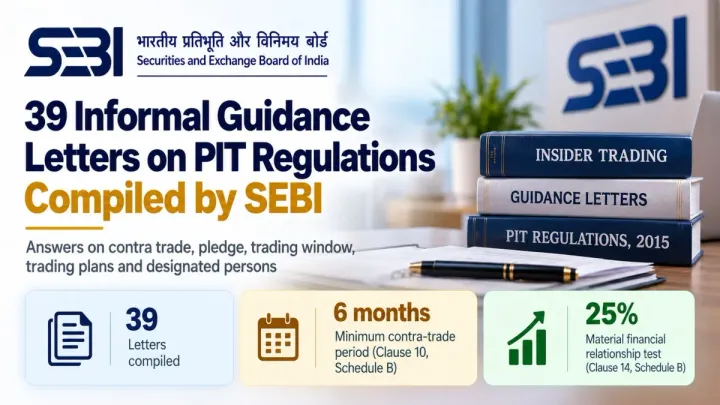
A promoter wants to gift shares to a daughter. A director wants to release a pledge and sell the shares to repay an ESOP loan. A company wants to know whether its pending QIP is UPSI. Over eleven years, SEBI has answered questions like these in 39 informal guidance letters on the SEBI (Prohibition of Insider Trading) Regulations, 2015, and the September 2026 compilation now puts them all in one document.
This article reorganises those letters by issue instead of by date, so a compliance officer can find what SEBI has said on contra trade, pledge, trading window closure, trading plans and designated persons without reading 73 pages.
SEBI's September 2026 compilation consolidates 39 informal guidance letters issued under the PIT Regulations, 2015 between October 2015 and September 2026. Contra trade is the largest single group; other recurring topics include trading window closure, identification of designated persons and their immediate relatives, trading plans under Regulation 5, and pledge. The compilation creates no new obligation. It lists, for each letter, the date of the applicant's letter, a gist of the query, the regulations involved, SEBI's response, and a weblink to the original guidance.
Quick Reference
How Should Practitioners Treat Informal Guidance?
Treat each letter as SEBI's view on the facts the applicant submitted, and not as a general rule. The compilation labels every response as "based on the submissions made by the applicant in the instant case". The Scheme itself describes informal guidance as an interpretation of a provision in the context of a proposed transaction or a specific factual situation.
That has two practical consequences. First, a letter that favours a structure is no guarantee for a similar structure with different facts. Second, SEBI has declined to answer where facts were incomplete, hypothetical or unclear about the legal provision involved (see the section on unanswered queries below).
Informal guidance is SEBI telling one applicant how it reads a rule on that applicant's facts. It is a strong signal of SEBI's thinking, but the safe approach is to compare your facts against the letter's facts before relying on it.
What Has SEBI Said About Contra Trade Restrictions?
Contra trade is the question asked about most often in the compilation. Clause 10 of Schedule B requires a listed company's code of conduct to specify a period, not less than six months, within which a designated person cannot execute a contra trade. SEBI's letters have clarified who is caught, which transactions count as the first leg and when relaxation is possible. (Numbers like #13 are the compilation's entry numbers for each letter.)
Family-trust transfer (Nimish Patel, #22). An inter se transfer between a promoter and a family trust — where the promoter is both settlor and sole beneficiary — was tested against the clause (i) defence in the proviso to Regulation 4(1), which turns on both sides being insiders with the same information and each making a conscious and informed decision.
Practical interpretation: In the KDDL letter, SEBI also relied on its published FAQs, which say that restrictions apply date-wise and that an acquisition through a rights issue or FPO followed by a sale before six months is a contra trade. A compliance officer building a contra-trade check should therefore track the date and nature of every acquisition and disposal by each designated person, including immediate relatives, and not only open-market trades.
A designated person is allotted shares in a rights issue in March and wants to sell some in July. Following the KDDL and Jaro reasoning, the sale is within six months of an acquisition and would attract the company's contra-trade restriction, unless the compliance officer is empowered to grant, and records reasons for, a relaxation that does not violate the Regulations.
How Are Pledges Treated Under the PIT Regulations?
The Welspun Corp letter (#37) takes pledge and revocation of pledge to be "dealing" in securities, and therefore a "trade" under Regulation 2(1)(l), even though they are strictly not buying, selling or subscribing. The earlier Binani (#1) and Geetanjali (#3) letters examined creation and invocation of pledge under Regulation 4(1) — they did not themselves frame the Regulation 2(1)(l) "trade" point.
CorpLawUpdates analysis: The Welspun and Avenue Supermarts letters together matter most for listed companies with ESOP-funded pledges. The compliance officer's pre-clearance record is doing real work in both: it is where bona fides are assessed. Codes of conduct that already list pledge purposes as bona fide, which SEBI said is permissible, should still be checked so they do not contradict the PIT Regulations.
When Can Insiders Trade During Trading Window Closure?
Trading window restrictions do not apply to transactions in clauses (i) to (iv) and (vi) of the proviso to Regulation 4(1), nor to a bona fide pledge, but only subject to pre-clearance by the compliance officer and compliance with the respective SEBI regulations (Clause 4(3)(a) of Schedule B). Several letters apply Clause 4(3)(a) to promoter-to-promoter transfers.
- Off-market inter se transfer between insiders (KCP, #25; Empire Industries, #35). Exempt from trading window restrictions if the conditions in clause (i) of the proviso are met and the compliance officer pre-clears. In KCP, the compliance officer could seek declarations, including confirmation of compliance with the Insolvency and Bankruptcy Code, 2016, as the seller acted through a liquidator.
- Block deal inter se transfer (Raghav Commercial, #24). A transfer through the block deal window between individual and non-individual promoters, without breaching Regulation 3 and with both sides making a conscious and informed trade decision, falls within Regulation 4(1)(ii) and does not attract trading window restrictions, subject to pre-clearance.
- On-market inter se purchase (Star Cement, #13). A promoter buying on the market after selling within six months may not qualify for the clause (i) defence that would be available to an off-market inter se transfer.
- Promoters who are named but inactive (Apollo Tricoat Tubes, #18). The person was named as a promoter and happened to hold more than 10% of the voting rights — that holding level was a fact of the case, not a designation threshold. As a promoter, he was a designated person, and a trade during trading window closure would violate Clause 4 of Schedule B.
What Do the Letters Say About Trading Plans Under Regulation 5?
Regulation 5 gives insiders who may be perpetually in possession of UPSI an option to trade through an approved trading plan. SEBI's letters stress that it is an option, that the plan must be specific and that once approved it must be followed.
- Plan must be followed. Once approved, the insider has to comply with the trading plan (Indo Thai Securities, #5). A promoter who is also an insider may formulate a plan (Indo Thai).
- No maximum-price condition. Regulation 5(2)(v) requires either the value of trades or the number of securities. A condition of "maximum value per share" alongside a share count may defeat the bar on deviating from the plan in Regulation 5(4) and may signal future pricing (Tide Water Oil, #7).
- Compliance officer's role. The compliance officer reviews the plan for potential violation, may seek express undertakings and approves and monitors implementation under Regulation 5(3) (Hawkins Cookers, #14). Without an approved plan, designated persons remain subject to the code of conduct.
- Plan as a defence, not an exemption. Trading under an approved plan can prove innocence under the proviso to Regulation 4(1) (Shreevatsaa, #17; Deepak Nitrite, #28).
- Redundant queries. Where the underlying purchase is not a regulatory requirement, a Regulation 5 query was treated as redundant (R S Software, #20).
What Counts as UPSI, and Who Is an Insider?
A pending QIP, its pricing and its probable impact on share capital are UPSI, because a change in capital structure is UPSI per se under Regulation 2(1)(n). SEBI said so in the Deepak Nitrite letter (#28), which also held that the Chairman and Managing Director and the Executive Director and CEO are connected persons and therefore insiders. Members of the promoter group may be insiders depending on the facts.
Other letters widen the net in different ways:
- Securities lending (HDFC Securities, #15). Lending and borrowing under the SLB mechanism is a "trade" under Regulation 2(1)(l), so doing it while in possession of UPSI can amount to insider trading, subject to the insider proving innocence.
- Discretionary PMS (HDFC Bank, #6). Even if the employee has no control over investment decisions, trades of an insider in possession of UPSI are assumed to be motivated by that knowledge — and the letter confirms that a closed trading window answer applies to such discretionary-PMS trades as well.
- AIF units (Yes Bank, #27; SBI Funds Management, #16). Units of an AIF are "securities" under the SCRA, and the PIT definition excludes only mutual fund units. Designated persons and immediate relatives may invest in AIFs subject to compliance with the PIT and AIF Regulations, and the code of conduct applies where the AIF scheme invests in listed or proposed-to-be-listed securities.
- Mutual fund exclusion (Prabhudas Lilladher, #11). The exclusion from the definition of securities is for mutual fund units only.
- Statutory-obligation defence (Glenmark, #31; Anjani Portland, #32). In Glenmark, the proviso to Regulation 4(1) did not cover a promoter's sale to meet minimum public shareholding. In Anjani Portland, it did not cover a promoter's sale under a condition of the Master Circular on Schemes of Arrangement. In each case the sale was not a new statutory or regulatory obligation on the promoter — the defence does not stretch to cover compliance steps the promoter volunteered into.
Who Is a Designated Person, and What About Relatives?
Designated persons are specified by the board of directors or analogous authority, in consultation with the compliance officer, based on role, function and access to UPSI in addition to seniority and professional designation (Regulation 9(4)). The letters add the following points.
What Do the Letters Say About the Compliance Officer and Pre-Clearance?
- Who can be compliance officer. A senior officer who reports to the board of directors or the head of the organisation. Appointing anyone else is not in accordance with the Regulations. If more than one person is appointed, they are jointly and severally responsible (Mindtree, #2).
- Who needs pre-clearance. Only designated persons, above the value thresholds set by the board. A promoter designated as a designated person must therefore obtain pre-clearance (Kirloskar Chillers, #10).
- Accountability. The compliance officer may approve or reject pre-clearance after assessment under the PIT Regulations and the code of conduct, and acts under the supervision of the board or audit committee, to which questions about the officer's actions may be referred (Kirloskar Chillers, #10).
- Intermediaries' restricted lists. The compliance officer maintains the restricted list on a confidential basis and uses it to approve or reject pre-clearance. Sharing it with designated persons would undermine confidentiality. Trades in securities outside the restricted list are still subject to pre-clearance above the threshold (KP Capital Advisors, #23).
- Merchant bankers (ISK Advisors, #36). A merchant banker that managed an issue stays a connected person for six months after its association, so Regulation 26 of the Merchant Bankers Regulations, read with the PIT definition of connected person, barred it from acquiring the shares of that company (RPSL) — while acquisitions in other companies were not barred. A wholly owned subsidiary is deemed a connected person unless the contrary is established. The letter also discusses reporting under Regulation 27 of the Merchant Bankers Regulations.
Disclosures: Is Form C Needed for Bonus Shares, Gifts or Off-Market Transfers?
In its 2017 letter to Kotak Mahindra Bank (#12), SEBI said disclosure is required beyond the threshold irrespective of the mode of acquisition or disposal. Where the person has no role in the transaction and the information is already public, as with bonus shares or shares received under a scheme of amalgamation or demerger, a separate disclosure may not be necessary. For off-market transactions and gifts, disclosure must be made. The value to report is the prevailing market value on the day of acquisition or disposal.
The Kotak Mahindra Bank letter dates from 2017, and the Regulations have since been amended (the NOCIL letter refers to the 2024 amendments). The compilation does not say whether the later amendments change this disclosure position — check the current text of Chapter III and the Form C requirements before applying it.
When Does SEBI Decline to Answer?
Several letters show applications that were fully or partly unanswered. The reasons recur: the request was ambiguous or hypothetical (Indo Thai), the requester had no direct or proximate interest (Indo Thai), the factual situation was incomplete or general (R S Software, KDDL, Century Plyboards), or the legal provision was not cited (KDDL). The compilation also notes that guidance sought by Symphony Limited in 2016 was not provided because the query did not mention a specific PIT provision. Binani's query was answered, but SEBI declined to issue a no-action letter because bona fide intent was not demonstrated on the facts presented.
Practical interpretation: An application is more likely to get a substantive answer if it states the full transaction (number of shares, dates, parties), cites the provisions involved and avoids assumptions.
Which Are the Most Recent Letters?
Practical Takeaways for Compliance Officers
The compilation is guidance and not a live compliance deadline, so a formal checklist does not fit. These are the points the letters keep returning to:
- Confirm that your code of conduct sets a contra-trade period of not less than six months and states whether the compliance officer can grant a relaxation, with reasons recorded in writing.
- Track acquisitions through rights issues, OFS, warrant conversions and gifts as potential first legs, together with immediate relatives' trades.
- Record the bona fide purpose and pre-clearance reasoning for every pledge, revocation and invocation.
- For inter se transfers (including promoter-to-family-trust transfers), document that both sides are insiders with the same information, that Regulation 3 is not breached and that each made a conscious and informed decision.
- Review who is designated, based on role and access to UPSI and not seniority, and include promoters.
- Keep restricted lists confidential and pre-clear above-threshold trades in all securities for intermediaries' designated persons.
- Before relying on any letter, open the original on SEBI's website and compare its facts with yours.
CorpLawUpdates Analysis
Read together, the letters show a consistent SEBI logic. It looks at the substance of a transaction (who holds the information, whether beneficial ownership changes, whether the transaction is voluntary) and then points back to the compliance officer and the company's code of conduct as the decision point. Pre-clearance and conditional relaxation sit with the compliance officer; the defences under the proviso to Regulation 4(1) must be established by the insider.
For compliance teams, the immediate issue is documentation. Where SEBI says the compliance officer "may take a suitable view", the quality of the written reasoning is what protects the company later.
The Welspun and Avenue Supermarts letters on pledge are the most operationally useful recent additions. The Jaro letter is a reminder that contra-trade restrictions follow a promoter who sells in an OFS, even when the planned acquisition is a secondary-market purchase.
Frequently Asked Questions
It is a September 2026 SEBI document that consolidates 39 informal guidance letters issued under the PIT Regulations, 2015 between October 2015 and September 2026. For each letter it gives the date of the applicant's letter, the gist of the query, SEBI's interpretation, the regulations involved and a weblink.
No. Each letter answers one applicant on the facts that applicant submitted — SEBI labels every response "based on the submissions made by the applicant in the instant case". The compilation itself does not claim general binding force, and SEBI's own preface says the original letter prevails over the compilation if the two differ. Companies should treat the letters as indicative of SEBI's view and compare facts before relying on them.
No. Star Cement (#13) and Raghav Commercial (#24) support individual application. Rama Mines (#29) applied the restriction jointly to two corporate promoters controlled by the same shareholders, on its own facts. Century Plyboards (#34) considered the designated person and his immediate relatives collectively.
No. SEBI said in Mindtree and KPIT that exercise of ESOPs is not "trading" except for Chapter III disclosures, so exercise and the sale of the resulting shares do not attract contra-trade restrictions on that basis.
Yes, in the Jaro letter SEBI said a disposal through OFS followed by an acquisition within six months of the initial transaction would be a contra trade. The compliance officer may grant relaxation if empowered by the board, for reasons recorded in writing and without violating the Regulations.
Clause 4(3)(a) of Schedule B exempts a pledge for a bona fide purpose such as raising funds from trading window restrictions, subject to pre-clearance by the compliance officer. In Avenue Supermarts, SEBI said the compliance officer decides case by case what is bona fide under the company's code of conduct.
Yes. In the Yes Bank letter SEBI said AIF units are "securities" under the SCRA and the PIT definition excludes only mutual fund units. Designated persons and immediate relatives may invest in AIFs subject to the PIT and AIF Regulations.
On Deepak Nitrite's facts, yes. SEBI said a pending QIP, its pricing and its probable impact on share capital are UPSI, because a change in capital structure is UPSI per se under Regulation 2(1)(n). The same letter held the Chairman and Managing Director and the Executive Director and CEO to be connected persons, and therefore insiders.
The SEBI (Informal Guidance) Scheme 2025 replaced the SEBI (Informal Guidance) Scheme, 2003 with effect from 1 December 2025. The preface states that guidance may be sought and given as no-action letters or interpretive letters.
Issuing authority: Securities and Exchange Board of India
Date: September 2026 (73 pages)
Reference number / signatory: Not stated in the source
Primary source link: SEBI, "Compilation of Informal Guidance – SEBI (Prohibition of Insider Trading) Regulations, 2015 (Period October 2015 – September 2026)", September 2026, 73 pages. The original letters are linked in the compilation under each entry.
Coverage note: Some entries in the compilation are abridged and show omitted paragraphs (for example Indo Thai, Shreevatsaa, R S Software, KP Capital and Yes Bank). Where a conclusion in this article depends on an abridged entry, it reflects only the text shown in the compilation. Dates shown for a few entries in the compilation's contents list and body differ, so this article relies on upload dates and avoids letter dates where they conflict.
This article is for informational and educational purposes only and does not constitute legal or regulatory advice. Readers should verify the applicable primary regulatory source before taking action.