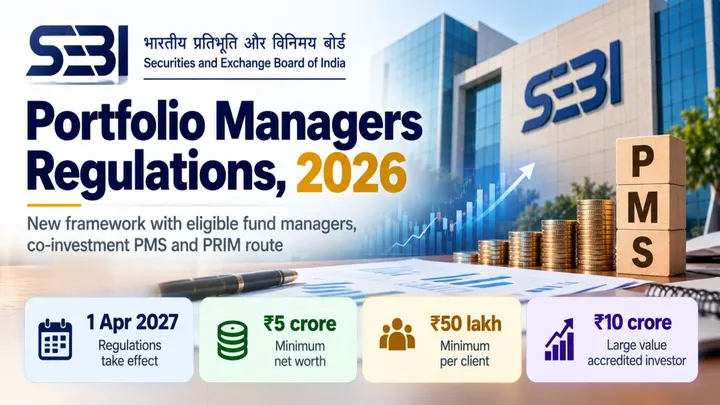
SEBI has notified the Securities and Exchange Board of India (Portfolio Managers) Regulations, 2026, which repeal the 2020 Regulations from 1 April 2027. They set out registration (including ₹5 crore net worth), client agreements, disclosure documents, custody and audit requirements for portfolio managers, and contain dedicated chapters for eligible fund managers, co-investment portfolio managers and a Portfolio Management Service Route for Investment in Mutual Fund units (PRIM). The notification does not say which provisions are new compared with the 2020 Regulations.
Quick Answer
The Securities and Exchange Board of India (Portfolio Managers) Regulations, 2026 (F.No. SEBI/LAD-DOP/2026/322) come into effect on 1 April 2027 and repeal the 2020 Regulations from that date. A portfolio manager must be a body corporate maintaining at least ₹5 crore net worth, with 10% of it in unencumbered liquid assets, and must have a principal officer, a compliance officer and one additional employee. It cannot accept less than ₹50 lakh per client, but this does not apply to accredited investors, subject to disclosures. Chapters III (eligible fund managers), IV (co-investment portfolio managers) and VI (PRIM) change these requirements; PRIM, for example, requires ₹2 crore net worth and a ₹25 lakh minimum client investment. Existing portfolio managers have 12 months from commencement under regulation 4(a)(iv)(d), a clause placed in the net worth row, and 36 months to commence business under regulation 6(8). Regulations 16(5) and 17(1)(l) give 12 and 36 months for client investments made before the 2020 Regulations were notified to meet the ₹50 lakh minimum and certain prudential rules respectively.
What Changed?
This is a complete re-issue, not a short amendment. The regulations contain 46 regulations in ten chapters and three schedules. The source does not set out a clause-by-clause comparison with the 2020 Regulations, so this article describes what the 2026 text provides and flags earlier positions only where the text itself refers to them.
Registration and Eligibility
An applicant must be a body corporate. SEBI considers infrastructure (office space, equipment, dealing room and manpower), key personnel, net worth, fit and proper status under Schedule II of the SEBI (Intermediaries) Regulations, 2008, and investor interest. The dealing room requirement does not apply to portfolio managers the Board specifies.
The compliance officer cannot be the principal officer or the employee appointed under regulation 4(b)(ii) (reg 27(3)), and must satisfy eligibility criteria the Board specifies. Co-investment portfolio managers can assign the compliance role to the principal officer.
Transition: What Existing Portfolio Managers Must Do and When
The regulations apply from 1 April 2027. For portfolio managers already operating, several requirements come with a grace period counted from commencement.
Commencing business and savings. A registered portfolio manager must commence its business activities within three years from the date of registration, which means fulfilling conditions the Board specifies (reg 6(7)); existing portfolio managers have 36 months from commencement of these regulations (reg 6(8)). On repeal of the 2020 Regulations, anything done or action taken under them, including registrations granted, fees collected, and any inquiry, investigation or show-cause notice, is deemed to have been done or taken under the corresponding provisions of the 2026 Regulations. Pending applications are deemed made under them, accrued rights, obligations, liabilities and penalties are unaffected, and references to the 2020 Regulations in other regulations, guidelines or circulars are read as references to the corresponding provisions (reg 46(2), (3)).
Client Rules: Contracts, Disclosures and Fees
- Written agreement first. A written investment agreement with contents listed in the Third Schedule is needed before taking up an assignment. The content requirement does not apply to large value accredited investors (reg 15(1)).
- Related-party and associate investments need prior client consent in the manner the Board specifies; unrated securities of related parties or associates are barred (regs 15(1)(c), 17(1)(i)).
- Disclosure Document in digital format with a certificate, provided before the agreement; a free physical copy on request (reg 15(2)).
- Contents include fees, risks, related-party transactions, conflicts of interest, diversification policy, three years of audited financials and three years of Time Weighted Rate of Return performance for discretionary portfolio managers.
- Certification and filing. An independent chartered accountant certifies it at registration and annually within six months of year end; material changes are filed with the Board and notified to clients within fifteen calendar days.
- Fees may be fixed, return-based or a combination, with no guaranteed returns and no up-front fees (reg 15(3)).
- Reports to clients at least every three months, covering portfolio value, transactions, expenses, risks, defaults and distributor commission (reg 24).
Investing and Operating Rules
The Special Categories
Who Is Affected?
Key Dates
7 October 2026: Notification date.
8 October 2026: Gazette issue (Extraordinary No. 604).
1 April 2027: Regulations take effect; 2020 Regulations repealed.
Twelve months from commencement: Net worth and legacy client minimum investment.
Thirty-six months from commencement: Business commencement and prudential limit requirements for earlier investments.
Compliance Checklist for Portfolio Managers
Practical steps drawn from the text, not requirements stated as a checklist by SEBI.
- Confirm a body corporate structure and ₹5 crore net worth, with 10% in unencumbered liquid assets.
- Check that the principal officer, compliance officer and one more employee meet the qualification, experience and NISM rules, and that the compliance officer is a separate person.
- Map every client to the ₹50 lakh minimum, or document accredited investor status.
- Update the Disclosure Document, CA certification and filing calendar (annual, within six months of year end; addendum within fifteen days).
- Review fee terms for up-front fees, guaranteed return language and disclosure of the fee range.
- Check mutual fund holdings for direct plans and related-party or associate exposure for consent and rating rules.
- Review client agreements against the Third Schedule, and the code of conduct in the Second Schedule.
- Set up alert systems for prudential limits and diary the 12-month and 36-month transition dates.
- Decide whether Chapter III, Chapter IV or PRIM applies. Chapter III requires a declaration (new applicants) or prior intimation and declarations (existing portfolio managers); Chapters IV and VI refer to conditions the Board may specify, so watch for further Board communication.
Consequences and supervision. A portfolio manager that contravenes the Act, the rules or regulations, or circulars and guidelines issued under them, is liable to action under securities laws or any other law in force (reg 42). The Board may appoint an inspecting authority, after reasonable notice or without notice for reasons recorded in writing, may appoint an auditor to inspect or investigate, and may recover inspection expenses from the portfolio manager (regs 35 to 41). Clarifications and guidelines the Board issues in notes or circulars are binding on portfolio managers (reg 45). The regulations do not state penalty amounts.
Open Questions in the Text
- Scope of the 12-month clause. Regulation 4(a)(iv)(d) sits in the net worth row after the liquid-asset clause. It does not say whether the twelve months covers the whole ₹5 crore requirement or only the 10% liquid asset deployment.
- Earlier positions. Regulation 16(5) and 17(1)(l) refer to investments made before the 2020 Regulations were notified, but the 2026 text does not restate the 2020 rules. Compare against the 2020 text before advising on legacy clients.
- Board specifications. Many limits (unlisted securities, derivatives, foreign securities, prudential limits, credit rating basis, related-party consent) depend on circulars to be specified later.
- Compliance officer for co-investment portfolio managers. Regulation 12(6) lets a co-investment portfolio manager assign the compliance officer role to the principal officer for the purposes of regulation 27(1), but regulation 13(h) lists regulation 27(1), (2) and (3) among the provisions that do not apply to co-investment portfolio managers, and regulation 4(a)(iii), which lists a compliance officer among key personnel, is not disapplied. The text does not reconcile these.
Frequently Asked Questions
When do the SEBI Portfolio Managers Regulations, 2026 come into effect?
On 1 April 2027. The 2020 Regulations are repealed from that date.
What is the minimum net worth for a portfolio manager?
At least ₹5 crore, maintained at all times, separate from capital adequacy requirements for other activities, with at least 10% of it in unencumbered liquid assets.
What is the minimum investment per client?
A portfolio manager cannot accept funds or securities, or both together, worth less than ₹50 lakh per client (reg 16(3)). This does not apply to an accredited investor, subject to appropriate disclosures in the Disclosure Document and the agreed terms (reg 16(4)). The minimum is also disapplied for co-investment portfolio managers (reg 13) and for eligible fund managers (reg 9), and PRIM has its own ₹25 lakh minimum. Regulation 16(5) gives twelve months from commencement for client investments made before the notification of the 2020 Regulations to comply.
What is a large value accredited investor?
An accredited investor who has entered into an agreement with the portfolio manager for a minimum investment of ₹10 crore.
What is PRIM?
The Portfolio Management Service Route for Investment in Mutual Fund units. It allows investment only in direct plans of Indian mutual funds, index funds, ETFs and specialised investment funds, with a ₹2 crore net worth and a ₹25 lakh minimum client investment.
What is a co-investment portfolio manager?
A manager of a Category I or II AIF who serves only that AIF's investors and invests only in unlisted investee companies where the AIF invests.
Can a portfolio manager charge up-front fees?
No. Fees may be fixed, return-based or a combination, but no up-front fees and no guaranteed returns.
How long does an existing portfolio manager have to start business under the new rules?
Thirty-six months from the commencement of the regulations, to fulfil the conditions the Board specifies.
How often must clients receive reports?
As agreed in the contract, but at intervals not exceeding three months, and whenever the client requires.
What are the registration fees?
₹1 lakh application fee, ₹10 lakh registration fee and ₹5 lakh renewal fee every three years.
CorpLawUpdates Analysis
The regulations are a full re-issue. Because the notification does not compare itself with the 2020 text, a line-by-line comparison against the repealed Regulations is a sensible first step for existing portfolio managers. The dedicated chapters create separate lanes for eligible fund managers (tied to the Income-tax Act, 2025), AIF co-investment and mutual fund-only PMS, each with its own exclusions. For existing portfolio managers, the practical work is likely to sit in working out how the 12-month clause in regulation 4(a)(iv)(d) applies to their net worth position, and in checking legacy investments against regulations 16(5) and 17(1)(l), whose wording refers to the notification of the 2020 Regulations. The large number of items left to Board specification means circulars will determine much of the practical burden. These are editorial views, not SEBI statements.
Document: Securities and Exchange Board of India (Portfolio Managers) Regulations, 2026.
Issuing authority: Securities and Exchange Board of India.
Reference: F.No. SEBI/LAD-DOP/2026/322, 7 October 2026; Gazette of India, Extraordinary, Part III, Section 4, No. 604, 8 October 2026.
Signatory: Amit Pradhan, Executive Director.
Powers: Section 30(1) read with Section 11(1), Section 11(2)(b) and Section 12(1) of the Securities and Exchange Board of India Act, 1992.
Repeals: Securities and Exchange Board of India (Portfolio Managers) Regulations, 2020, from 1 April 2027 (reg 46).
Primary source: F.No. SEBI/LAD-DOP/2026/322 on sebi.gov.in (Gazette of India, Extraordinary, Part III, Section 4, No. 604, dated 8 October 2026)
This article is for informational and educational purposes only and does not constitute legal or regulatory advice. Readers should verify the applicable primary regulatory source before taking action.