Listed companies that raise small-ticket debt through private placement currently carry a fixed compliance cost regardless of how small the issue is: appointing a merchant banker with the same obligations as a full public issue. SEBI has now proposed removing that requirement for a defined category of low-risk issuers.
Quick Answer
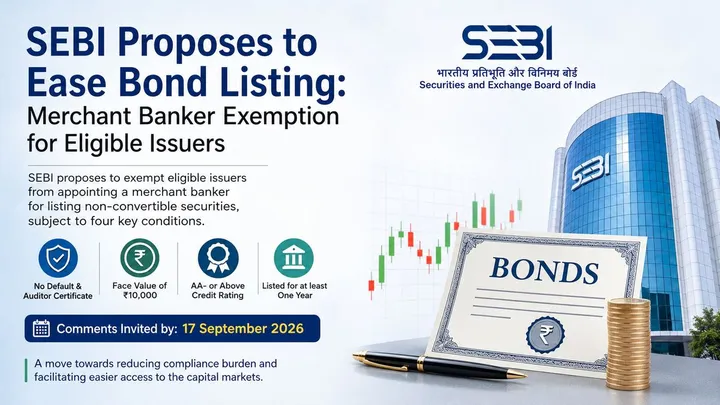
SEBI has proposed exempting certain listed issuers from the requirement to appoint a merchant banker for privately placed "Small-value debt" — debt securities or non-convertible redeemable preference shares issued at a face value of Rs. 10,000 — through a consultation paper dated August 27, 2026. The exemption would apply only where the issuer meets four cumulative conditions: registration with a specified financial sector regulator, at least one year of stock exchange listing with a clean compliance record, no default in the preceding three financial years and the current year (backed by an auditor's certificate), and a credit rating of AA- or above on a senior, secured instrument. Public comments are invited until September 17, 2026. The proposal is not yet in effect.
Quick Reference
What Is SEBI Proposing?
Under Clause 1.3 of Chapter V of the SEBI Master Circular for issue and listing of Non-Convertible Securities, Securitised Debt Instruments, Security Receipts, Municipal Debt Securities and Commercial Paper dated October 15, 2025 ("NCS Master Circular"), an issuer may issue a debt security or non-convertible redeemable preference share on a private placement basis at a face value of Rs. 10,000 — referred to as "Small-value debt". Two conditions currently attach to this: the instrument must be interest/dividend-bearing with a fixed maturity and no structured obligations, and the issuer must appoint at least one merchant banker whose role, responsibilities and obligations mirror those in a public issue of the same instrument.
The consultation paper proposes adding a proviso to this clause: the requirement to appoint a merchant banker would not apply where the issuer satisfies four cumulative conditions set out in the draft circular at Annexure A. The interest/dividend-bearing structure requirement is unaffected and would continue to apply regardless of whether the merchant banker exemption is used.
Why This Matters
SEBI's stated rationale is that the mandatory merchant banker requirement creates a disproportionate cost burden relative to the size of Small-value debt offerings, that the debt segment has a limited pool of active merchant bankers, and that the appointment process causes delays in a market where price discovery is highly time-sensitive and prevailing yields shift quickly. Collectively, this raises the effective cost of capital and discourages issuers from tapping the Small-value debt route frequently.
SEBI also notes that listed issuers already operate under the SEBI (Listing Obligations and Disclosure Requirements) Regulations, 2015 ("LODR Regulations"), which impose governance, continuous disclosure and regulatory scrutiny obligations enforced by SEBI and the Stock Exchanges. A significant proportion of listed debt issuers are also RBI-registered or RBI-regulated NBFCs subject to separate prudential norms on capital adequacy, asset classification and debt issuance. SEBI's view is that this layered oversight can substitute for merchant banker involvement in qualifying cases.
Who Would Be Affected If the Proposal Is Adopted?
Directly affected: Listed issuers proposing to raise Small-value debt through private placement who are registered/regulated by SEBI, RBI, IRDAI or PFRDA, and who separately meet the listing-tenure, non-default and rating/security conditions. The consultation paper indicates a large share of this population consists of RBI-registered/regulated NBFCs.
Indirectly affected: Merchant bankers active in the small-ticket private placement debt segment; Recognised Stock Exchanges, which would need to verify eligibility at the in-principle approval stage and may need to amend bye-laws and systems; Registered Depositories, which are also addressed in the draft circular.
Not covered by the exemption: Issuers not registered/regulated by SEBI, RBI, IRDAI or PFRDA — including many listed non-financial companies; issuers listed for less than one year; issuers with a default in the specified lookback period; and Small-value debt that is unsecured, subordinated, or rated below AA-. These categories would continue to require mandatory merchant banker appointment.
The Four Conditions for Exemption
1. Regulatory Registration
The issuer must be registered/regulated by a financial sector regulator in India — specifically, SEBI, RBI, IRDAI or PFRDA, as named in the draft circular.
2. Listing Tenure and Clean Compliance Record
The issuer must be listed in any segment on any recognised Stock Exchange(s) for at least one year. At the time of granting in-principle approval, the Stock Exchange(s) must confirm there are no pending fines or penalties levied by SEBI or the Stock Exchanges for non-compliance with the LODR Regulations.
3. Non-Default Track Record, Auditor-Certified
The issuer must not have defaulted in the last three financial years and the current financial year in respect of: repayment of deposits or interest thereon; redemption of non-convertible preference shares or debt securities and interest thereon; declaration and payment of dividend to shareholders; and repayment of any term loan or interest thereon. The issuer must submit an auditor's certificate to this effect to the Stock Exchange.
4. Senior, Secured Status and AA- Rating
The debt security must be unsubordinated/senior and "secured" by a first or pari passu charge on identifiable assets of the issuer, and must be rated at least AA- or above on the date of private placement.
Current Position vs Proposed Position
Is This Already in Force?
No. This is a consultation paper, and the exemption is not currently available. The draft circular text at Annexure A states that, once notified, the provisions "shall be applicable with immediate effect" — meaning no separate transition period is currently contemplated. However, the source document does not confirm a date for the final circular, and the conditions could change after the comment process.
Practical Implications
- Preparedness: Issuers that may qualify can begin assembling supporting records now — rating status, default history across the specified categories, listing tenure and LODR compliance status — so they can act quickly if the exemption is notified.
- Merchant banker mandates: Firms active in the small-ticket private placement segment may see reduced mandate volumes from issuers that qualify for the exemption, though issuers outside the four conditions would continue to require appointment.
- Stock Exchange processes: Exchanges will need a verification mechanism for the "no pending fines" check and the auditor's certificate at the in-principle approval stage, along with any bye-law changes directed in the final circular. The draft also directs exchanges to report implementation status to SEBI and to monitor ongoing issuer compliance with the exemption conditions.
- Rating dependency: The AA- threshold makes the credit rating a gatekeeping factor for cost savings, not just a pricing input — this may increase the practical importance of rating timelines in deal execution.
What Should Practitioners Watch?
- The public comment deadline: September 17, 2026.
- Whether the final list of "financial sector regulators" (SEBI, RBI, IRDAI, PFRDA) is expanded or narrowed after comments.
- Whether SEBI clarifies the lookback period or materiality threshold for "pending fines or penalties" under Condition 2, which the draft does not specify.
- Any Stock Exchange circulars or bye-law amendments issued if and when the final circular is notified, per paragraph 6 of the draft.
- Whether existing rated, secured Small-value debt programmes would meet all four conditions — a useful internal exercise ahead of any final notification, without assuming the proposal will be adopted unchanged.
How to Submit Comments
SEBI has invited public feedback on the draft circular at Annexure A. Comments/suggestions must be submitted by September 17, 2026, through the online web-based form at SEBI's public comments portal.
For technical issues in submitting comments through the web-based form, market participants may contact:
- Mr. Rohit Dubey, General Manager ([email protected])
- Ms. Nishtha Tewari, Assistant General Manager ([email protected])
Emails should use the subject line: "Consultation paper on Exemption from the requirement of mandatory merchant banker appointment for Small-value debt through private placement by certain listed issuers."
Frequently Asked Questions
What is "Small-value debt" under SEBI's rules?
It refers to a debt security or non-convertible redeemable preference share issued on a private placement basis at a face value of Rs. 10,000, as defined in Clause 1.3, Chapter V of the SEBI NCS Master Circular dated October 15, 2025.
What does the current rule require for Small-value debt private placements?
The issuer must appoint at least one merchant banker, with the same role, responsibilities and obligations as apply to a public issue of the same instrument.
What has SEBI proposed to change?
SEBI's consultation paper proposes exempting eligible issuers from this merchant banker requirement, subject to four cumulative conditions covering regulatory registration, listing tenure and compliance record, non-default history, and credit rating/security status.
Which regulators count as a "financial sector regulator" for this exemption?
The draft circular names SEBI, RBI, IRDAI and PFRDA.
Does a recently listed company qualify for the exemption?
Not under the draft as proposed. The issuer must have been listed on a recognised Stock Exchange for at least one year.
What if the issuer has defaulted in the past?
Any default in the preceding three financial years or the current financial year — across deposits, listed debt/NCPS, dividends, or term loans — would disqualify the issuer from the exemption under Condition 3.
What credit rating is required for the exemption to apply?
The debt security must be rated AA- or above on the date of private placement, and must be senior/unsubordinated and secured by a first or pari passu charge on identifiable assets.
Is this exemption already in effect?
No. It is a proposal open for public comment until September 17, 2026, and is not yet part of any notified SEBI circular.
What happens to issuers who don't meet all four conditions?
They would remain subject to the existing requirement to appoint a merchant banker for Small-value debt private placements.
CorpLawUpdates Analysis
For compliance teams, the immediate point to note is how narrowly the first condition is drawn. Restricting eligibility to issuers regulated by SEBI, RBI, IRDAI or PFRDA leaves a meaningful population of listed NCD issuers — particularly non-financial corporates — outside this specific relief, even if they are otherwise well-governed and frequently rated. The relief is therefore best understood as targeted at financial-sector issuers, especially NBFCs, rather than as a general reduction in private placement compliance costs across the listed debt market.
The draft also leaves some implementation questions open. Condition 2 requires Stock Exchanges to confirm there are "no pending fines or penalties" for LODR non-compliance, but does not specify a lookback period or a materiality threshold — this is an area where exchange-level guidance, or comments from market participants, may add clarity before finalization. Similarly, because the exemption applies only to AA- and above rated, secured, senior instruments, it does not address the cost burden for lower-rated or unsecured Small-value debt — arguably the segment where the disproportionate cost of merchant banker appointment is felt most acutely relative to issue size.
Source Note
Document: Consultation Paper — "Exemption from the requirement of mandatory merchant banker appointment for Small-value debt through private placement by certain listed issuers"
Issuing Authority: Securities and Exchange Board of India (SEBI)
Draft Circular Reference: SEBI/HO/DDHS/DDHS-PoD-1/P/CIR/2025/XXX (Annexure A) — reference number and date shown as placeholders in the draft
Date Issued: August 27, 2026
Signatory: Not designated in the draft circular (shown as placeholder)
Statutory Authority: The draft circular states it would be issued under Section 11(1) of the Securities and Exchange Board of India Act, 1992, read with Regulation 55(1) of the SEBI (Issue and Listing of Non-Convertible Securities) Regulations, 2021.
Primary Source: www.sebi.gov.in [INTERNAL LINK: SEBI Legal → Circulars]
This article is for informational and educational purposes only and does not constitute legal or regulatory advice. Readers should verify the applicable primary regulatory source before taking action.