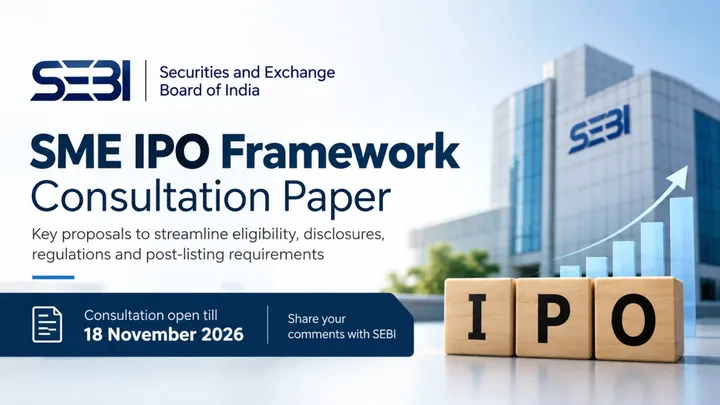
SEBI’s consultation paper dated 14 October 2026 proposes to replace the paid-up-capital test for SME IPOs with market-capitalisation bands of ₹1,000 crore and ₹4,000 crore, raise the profit test to an average operating profit of ₹3 crore a year, cut the minimum application to ₹1 lakh, raise minimum allottees from 200 to 500, and drop compulsory market making. The proposals are not yet final. Comments are open until 4 November 2026.
The Five Numbers That Matter
What Changed? Old Rule vs Proposed Rule
Read this table first. It covers every headline parameter in under a minute.
Table 1. Source: SEBI consultation paper dated 14 October 2026, as summarised by CorpLawUpdates. Verify clause wording before relying on any figure.
Why Is SEBI Reviewing the SME Framework Now?
SEBI’s review covers four areas: eligibility, the issue and allotment framework, trading and market making, and lock-in and migration. The paper follows a Working Group review, discussions in the Primary Market Advisory Committee (PMAC) and SEBI’s own further deliberation.
The numbers explain the urgency. As of 31 July 2026, 1,496 entities had listed on the SME Platform since inception, including those that later moved up. Of these, 365 companies had migrated to the Main Board. SME IPOs had raised ₹40,222 crore, and the market capitalisation of SME Platform entities, migrated ones included, stood at ₹4,70,984 crore.
Figures as of 31 July 2026, as reported in the consultation paper.
SEBI’s reasoning is that a framework built for small issuers should stay proportionate as the segment grows. That is the logic behind both the larger market-cap bands and the stricter profit and allottee tests.
Who Is Affected If the Proposals Are Adopted?
Not affected yet: everyone, in a legal sense. Until final amendments are notified, the current ICDR rules govern.
Key Dates and Timeline
The paper does not give a final effective date. Where it uses 31 December 2026 in examples, that date is illustrative only and is not an announced notification date.
Provision-by-Provision Analysis
The major proposals in the paper, organised by topic, with the principal thresholds, practical implications and drafting points highlighted.
1How Would SME IPO Eligibility Change From Paid-Up Capital to Market Capitalisation?
SEBI proposes to replace the Regulation 229 test, which looks at post-issue paid-up capital, with a post-issue market-capitalisation framework. The paper’s reasoning is that nominal share capital may not show an issuer’s true size, valuation or growth potential.
An issuer in the ₹1,000 crore to ₹4,000 crore band that opts for the SME Platform and has not already adopted Ind AS must provide restated consolidated Ind AS financial statements for the last three financial years and the stub period, if any.
Eligibility is re-checked at the final stage
Under the proposed revised framework, SEBI would reassess eligibility when the Red Herring Prospectus (for a book-built issue) or Prospectus (for a fixed-price issue) is filed. At that stage, an issuer whose estimated post-issue market capitalisation is ₹1,000 crore or below would be required to use the SME framework; an SME issuer whose estimate exceeds ₹4,000 crore would be required to re-file under the Main Board framework. An SME issuer with an estimated post-issue market capitalisation above ₹1,000 crore and up to ₹4,000 crore could continue under the SME framework, subject to the proposed conditions. These provisions would be subject to the transition rules: a Main Board DRHP filed before notification of the revised framework would continue under the existing Main Board framework.
2What Is the New Track-Record Rule for Converted or Reorganised Businesses?
The issuer must also file at least one annual audited financial statement, or part thereof, prepared after the conversion or reorganisation with the Registrar of Companies under the Companies Act, 2013, before filing the Draft Offer Document.
The rule extends to a qualifying business reorganisation where the issuer earns more than 50% of its revenue, as disclosed for the latest financial year in the Draft Offer Document, from businesses previously carried on by a proprietorship, partnership firm or LLP. “Business reorganisation” is proposed to include acquisition, transfer, vesting, succession, a scheme of arrangement or another arrangement under which the business is carried on by the issuer.
In these cases the predecessor business’s operating track record could count toward Chapter IX eligibility. Practitioners will need to track the effective date, the four-quarter period, ROC filings and the revenue test.
3What Is the New ₹3 Crore Average Operating Profit Test?
The test looks at the three years as a block instead of asking which individual years crossed a line. SEBI says the goal is a meaningful and sustained level of operating profitability for SME Platform issuers.
The alternative route: Regulation 229(7)
A later internal deliberation proposes a new Regulation 229(7). An issuer that does not meet the profit test could still list on the SME Platform if it satisfies Regulations 229(3), 229(4) and 229(5) and meets all of these conditions:
- The issue is made through book building.
- At least 75% of the net offer is allotted to Qualified Institutional Buyers (QIBs).
- If the 75% QIB allocation is not achieved, the entire subscription money must be refunded.
- The portion compulsorily allotted to QIBs is not underwritten.
The route is meant for established businesses that have not yet reached the profit threshold. It is not a general waiver: business-track-record, continuity and other conditions still apply.
4Will the ₹10 Crore Limit on General Corporate Purpose Go?
SEBI’s stated rationale is to give larger SME issuers more flexibility while keeping a proportional safeguard.
5What Are the Proposed Offer for Sale (OFS) Rules in SME IPOs?
SEBI proposes a dedicated Regulation 230A for the OFS part of an SME IPO. Fully paid-up equity shares offered for sale would ordinarily need to have been held by the seller for at least one year before the Draft Offer Document is filed.
The draft lists exceptions, including certain government-related sellers, certain court-, Tribunal- or Central Government-approved schemes, and eligible bonus shares, subject to the conditions in the proposed text.
The reason for the last row is plain. SEBI does not want an institution-led alternative route to become mainly a secondary-sale exit.
6How Would SME Lock-In Periods Change?
The paper proposes revising Regulations 238 and 239 to simplify lock-in and align selected periods with the Main Board.
Table 2. Consult the full draft text for covered categories and exceptions.
Depositories could also record securities as “non-transferable” for the lock-in period, on the issuer’s instructions, where the securities cannot otherwise be locked in through the depository system.
7What Is the Proposed ₹1 Lakh Minimum Application and Allocation Structure?
SEBI proposes a minimum application value of ₹1 lakh, comprising four lots with a minimum value of ₹25,000 per lot. The minimum application value is calculated by reference to the issue price of the specified securities, not the amount payable with the application. The proposed text separately provides for payment of at least 25% of the issue price per specified security on application; for an offer for sale, the full issue price would be payable on application. Subsequent applications would be made in multiples of the applicable lot size.
Normal book-built route: who gets what
Reallocation provisions apply. NII portion keeps the one-third/two-thirds split: one-third for applications above ₹2 lakh and up to ₹10 lakh, two-thirds for applications above ₹10 lakh.
Regulation 229(7) route: a different split
Read the two allocation structures separately. They should not be merged into a single rule.
8Why Does SEBI Want 500 Minimum Allottees Instead of 200?
SEBI proposes to raise the minimum number of allottees in an SME IPO from 200 to 500. Each RII would receive at least the minimum lot, subject to availability of shares in the RII category. Remaining shares would be allotted proportionately, without each allotment needing to be a multiple of the minimum lot.
The paper also proposes omitting Part A2 of Schedule XIV, which illustrates the NII allotment procedure. SEBI says these changes support wider shareholding distribution and a simpler framework.
9What Is the One-Share Trading Lot, and Why Drop Compulsory Market Making?
SEBI proposes to reduce the secondary-market trading lot for SME-listed securities to one share. The current price-band-based lot comes from SEBI Circular No. CIR/MRD/DSA/06/2012 dated 21 February 2012.
Regulation 261 now requires compulsory market making for at least three years from listing or migration from the Main Board, with a market-maker inventory of at least 5% of securities proposed to be listed. SEBI proposes to omit the compulsory framework, including the mandatory inventory and related arrangements.
Source: consultation paper data.
SEBI relies on these figures to ask whether a compulsory arrangement is proportionate for every SME security.
10How Would Underwriting and Minimum Subscription Change?
Regulation 260 now requires 100% underwriting of an SME IPO and requires lead managers to underwrite at least 15% of the issue size on their own account. SEBI proposes to remove these SME-specific requirements and align with the Main Board approach, where the unsubscribed portion must be fully underwritten where applicable.
- Proposed Regulation 265A would require minimum subscription of at least 90% of the offer through the offer document, except in the case of an offer for sale of specified securities. This would remain subject to the minimum number of specified securities prescribed under the Securities Contracts (Regulation) Rules, 1957.
- If the minimum subscription is not received, all application monies would have to be refunded forthwith and no later than four days from closure of the issue.
- The separate provision in Regulation 264(5), requiring confirmation from the Registrar to the Issue that at least 90% of the offer has been subscribed before closure is announced, is proposed to be omitted.
- Under the proposed Regulation 229(7) route, the portion required to be allotted to Qualified Institutional Buyers (QIBs) would not be underwritten.
Source: consultation paper data.
These figures form part of SEBI’s reasoning on fund-raising costs.
11How Would Migration to the Main Board Work?
SEBI proposes to revise Regulations 276 and 277 so that market capitalisation drives migration thresholds for issuers listed on the SME Platform after notification. The framework also removes migration from the Main Board to the SME Platform.
The draft would also restrict further issues of capital until migration is complete, unless the issuer undertakes to comply with the applicable Main Board requirements under the SEBI (Listing Obligations and Disclosure Requirements) Regulations, 2015.
Other Proposed Main Board Alignments
Section 5.8 of the consultation paper proposes additional changes to align selected SME IPO requirements with the Main Board framework. These are proposals for consultation, not requirements currently in force.
- Minimum promoters’ contribution: Align Regulation 236 with the Main Board framework, including recognition of SR equity shares. For a partly paid-up IPO where minimum promoters’ contribution exceeds ₹100 crore, the proposed text would require promoters to bring in at least ₹100 crore before the issue opens and bring in the balance in proportion to calls before the relevant calls are made.
- Securities eligible for minimum promoters’ contribution: Align Regulation 237(1)(c) with the Main Board framework, including the proposed treatment of specified securities allotted below the issue price to certain investors and entities during the preceding year.
- Lead manager responsibilities and due diligence: Introduce proposed Main Board-aligned responsibilities and disclosure requirements for lead managers.
- Offer documents: Align provisions on filing and updating offer documents and introduce specified certificates at the draft offer-document stage.
- Pricing: Align price-band and differential-pricing provisions with the Main Board framework, including the proposed removal of SME-specific uniform-minimum-application-lot wording.
- Issue-related advertisements: Refer to the Red Herring Prospectus for book-built issues and the Prospectus for fixed-price issues under the proposed requirement.
- Post-issue responsibilities: Extend lead-manager responsibility through allotment, refund and dematerialisation, and receipt of listing or trading permission, as applicable.
- Technical cross-reference: Correct the reference in Regulation 279(7) from “Chapter VII” to “Chapter V”.
Source: SEBI consultation paper dated 14 October 2026, section 5.8. The proposed wording and scope remain subject to SEBI’s final amendments.
What Are the Proposed Transition Rules?
Transition clauses are tied to the date the revised framework is notified in the Official Gazette.
The trading-lot and market-making changes would apply to all SME-listed securities from the date of a separate circular rescinding the existing trading-lot circular. Until that circular is issued, current market-making arrangements would continue.
- The revised framework would become mandatory for draft offer documents filed on or after the expiry of three months from its notification in the Official Gazette. During the three-month transition period, the issuer could elect the existing or revised framework, subject to the proposed conditions, and would need to state its choice in the draft offer document.
- A Main Board DRHP filed before notification would continue under the existing Main Board framework. For an SME DRHP filed before notification where the RHP or Prospectus has not yet been filed, an issuer may elect the existing or revised framework subject to the proposed conditions. An issuer choosing the revised framework would need to issue an addendum to the DRHP and make the consequential changes.
What Has Not Changed?
- The consultation paper itself does not amend the ICDR Regulations, 2018. Existing rules govern until final amendments take effect.
- The 15% GCP limit stays, though the ₹10 crore ceiling is proposed to go.
- The normal-route allocation limits (35% RII, 15% NII, up to 50% QIB) remain part of the draft.
- The OFS framework keeps a one-year holding period, subject to exemptions.
- Existing lock-in obligations of already-listed SME issuers would not be wiped out retrospectively.
- The paper sets no new penalty schedule. No consequence should be assumed where the paper is silent.
What Should Practitioners Watch?
Because this is a consultation paper, there is no compliance checklist yet. These are preparatory steps that do not assume the proposals will be adopted as drafted.
Drafting Points SEBI May Need to Clarify
The suggested draft text leaves three points that readers should watch. These are observations from the paper, not settled interpretations.
- Market capitalisation vs “post-issue capital calculated at the offer price”: the final eligibility rule should fix the terminology and the calculation.
- Exactly ₹4,000 crore: “above ₹4,000 crore” in the narrative against “₹4,000 crore or more” in the draft Regulation 277.
- Operating-profit measure: EBIT in one place, EBITDA in another. The proposed computation should be explicit.
SEBI invites comments with supporting rationale until 4 November 2026. The paper specifies online submission through SEBI’s public-comment form. For technical issues with the form, write to [email protected].
If you must email because of a technical issue, the paper specifies this subject line: Consultation Paper on Recommendations pursuant to Review of provisions of SEBI (Issue of Capital and Disclosure Requirements) Regulations, 2018 related to Initial Public Offer by Small and Medium Enterprises
Frequently Asked Questions
CorpLawUpdates Analysis
This is a recalibration of the whole SME IPO framework, not a single threshold tweak. Market-cap eligibility, a bigger optional band with Ind AS reporting, a higher profit bar and a QIB-led alternative route could change how companies structure an IPO.
The proposals pull in two directions. Higher profit and allottee requirements tighten entry, while lower underwriting, market-making and lock-in burdens cut cost and friction. For compliance teams, the immediate issue is that these effects interact, so each proposal should be modelled together, not alone.
Until SEBI settles the open drafting points, especially the operating-profit measure and the ₹4,000 crore trigger, advisers should model the criteria without treating them as binding.
- Document: Consultation Paper on Recommendations pursuant to Review of provisions of SEBI (Issue of Capital and Disclosure Requirements) Regulations, 2018 related to Initial Public Offer by Small and Medium Enterprises
- Issuing authority: Securities and Exchange Board of India (SEBI)
- Date: 14 October 2026
- Reference number and signatory: not stated in the material reviewed
- Primary source: SEBI consultation paper dated 14 October 2026 · SEBI Working Group report on SME provisions
This article is for informational and educational purposes only and does not constitute legal or regulatory advice. Readers should verify the applicable primary regulatory source before taking action.