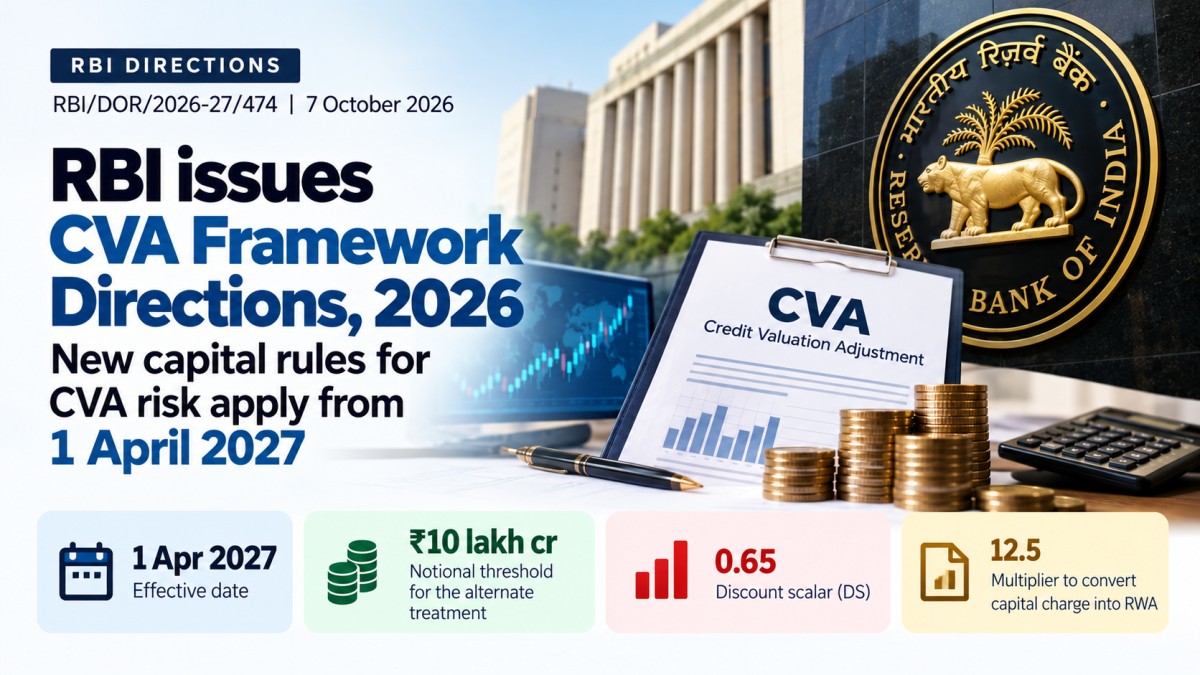
From 1 April 2027, commercial banks must hold capital against CVA risk, the risk of losses on derivatives as counterparty credit spreads and other market risk factors move. The RBI's Credit Valuation Adjustment (CVA) Framework Directions, 2026 set out how that capital is calculated. A bank whose aggregate notional of non-centrally cleared derivatives is ₹10 lakh crore or less on a consolidated group-wide basis at the reporting date may choose a simpler alternate treatment, unless the supervisory authority does not permit it.
Quick Answer
On 7 October 2026 the RBI issued the Reserve Bank of India (Commercial Banks – Credit Valuation Adjustment Framework) Directions, 2026 (RBI/DOR/2026-27/474, DOR.MRG.REC.No.246/00-00-001/2026-27). They come into effect on 1 April 2027 and apply to commercial banks, which must calculate CVA risk capital under the Basic Approach (BA-CVA) in a reduced or full version. A bank whose aggregate notional amount of non-centrally cleared derivatives, on a consolidated group-wide basis, is ₹10 lakh crore or less as at the reporting date may instead set CVA capital at 100% of its counterparty credit risk capital, with no recognition of CVA hedges. The supervisory authority may not permit this option if CVA risk from the bank's derivative positions materially contributes to its overall risk, and a bank that exceeds the threshold at a reporting date must apply BA-CVA from that date. Risk-weighted assets are the capital charge multiplied by 12.5.
What Is CVA Risk and Why Does It Need Capital?
Credit Valuation Adjustment is an adjustment to the risk-free price of a derivative, or securities financing transaction, to reflect a potential default by the counterparty. CVA risk is the risk of losses from changes in CVA values as counterparty credit spreads and market risk factors move. The Directions apply regulatory CVA, which can differ from accounting CVA because it excludes the effect of the bank's own default and applies certain constraints.
What Changed Under the Final CVA Framework Directions?
The RBI press release (2026-2027/1271) says the 7 August 2026 draft proposed four main revisions. Feedback was open until 28 August 2026, and modifications were incorporated in the final text. The feedback statement annexed to the press release was not part of the material reviewed here, so differences between the draft and final Directions are not identified.
The Directions also repeal para 85(3) of the Capital Adequacy Directions, 2025 on 1 April 2027.
Which Banks and Transactions Are Covered?
The Directions apply to commercial banks, defined as banking companies (other than Small Finance Banks, Payments Banks and Local Area Banks), corresponding new banks and the State Bank of India. Banks calculate CVA capital on a standalone basis for all covered transactions in both the banking book and trading book, including eligible CVA hedges.
- Derivatives, other than those listed as excluded
- The bank's global portfolio, including overseas branches
- Exposures to clients as a clearing member, treated as bilateral
- Derivatives transacted directly with a QCCP
- Trades later novated to a QCCP
- Transactions meeting the conditions in para 85(6)(i)(f) and (g) of the Capital Adequacy Directions, 2025 and paras 16(6) to 16(8) of the SA-CCR Amendment Directions
- Securities financing transactions (SFTs)
Trades booked at different branches with the same counterparty can form one netting set for CVA only if the netting agreement independently meets the recognition requirements, including legal enforceability in every relevant jurisdiction. A clearing member may use an MPOR of at least five business days for client exposures when computing exposure at default under SA-CCR.
Which CVA Approach Must a Bank Use?
Open to banks with aggregate notional of non-centrally cleared derivatives of ₹10 lakh crore or less (group-wide, at the reporting date). CVA capital equals 100% of CCR capital. No CVA hedge recognition. Applies to the entire portfolio.
For banks that do not hedge CVA risk. Capital = 0.65 × K_reduced. Hedges are not recognised.
For banks that hedge CVA risk. Capital = 0.65 × K_full, which blends K_reduced and K_hedged.
BA-CVA is the default. A bank may choose the full or reduced version at its discretion, but a bank using the full version must also compute the reduced version, which limits hedging recognition. The supervisory authority may refuse the alternate treatment if it finds that CVA risk from the bank's derivatives materially contributes to its overall risk. A bank that exceeds ₹10 lakh crore at a reporting date must apply BA-CVA from that date.
How Is CVA Capital Calculated Under the Reduced BA-CVA?
DS
aggregates systematic and idiosyncratic risk
- Stand-alone CVA per counterparty (SCVA): (1 / 1.4) × risk weight × sum over netting sets of effective maturity × EAD × discount factor.
- EAD is calculated as under SA-CCR in the Amendment Directions, 2026.
- Discount factor: (1 − e^(−0.05 × M)) / (0.05 × M), using 5% as the discount rate.
- Correlation: ρ is the supervisory correlation parameter of 50%, which can be read as the correlation between a counterparty's credit spread and a single systematic credit spread factor. ρ² of 25% represents the correlation between the credit spreads of any two counterparties (para 14(iii)).
- K_reduced: the square root of (ρ × sum of SCVA)² plus (1 − ρ²) × sum of SCVA squared.
Supervisory risk weights (Table 1)
- High yield (HY): any rating below BBB / Baa. The "+" or "−" notation is ignored and the main category risk weight applies.
- Multiple ratings: use the worst rating; with three or more ratings of differing risk weights, take the two lowest risk weights and apply the higher.
- No rating: use the NR risk weight, which is the same as HY in Table 1.
- Rating source: ratings of Eligible Credit Rating Agencies per the Capital Charge for Credit Risk – Standardised Approach Directions, 2026, using the issuer rating.
- Sector mapping: a bank needs an internal policy approved by the appropriate authority; counterparties not fitting any sector go to "Other sectors".
How Is Effective Maturity Determined?
- Instruments with a determined cash flow schedule: effective maturity is the cash-flow-weighted time to payment (the sum of each period's time multiplied by its cash flow, divided by total cash flows). A bank that cannot calculate this uses a more conservative measure, such as the maximum remaining time the counterparty may take to fully discharge its obligations, which is normally the nominal maturity (para 17(2)).
- Floor: one year for the effective maturity of each netting set, subject to the exemption below. A transaction originally longer than one year stays subject to the floor even when its residual maturity falls below one year (para 17(1)).
- No recognised netting: each transaction is its own netting set (para 17(3)).
- Netting sets: the notional-weighted average of transaction maturities, using the contractual trade notional (not SA-CCR adjusted or effective notional). The average is calculated first and the applicable floor is applied afterwards. Where one netting agreement contains both transactions that meet the exemption conditions and transactions that do not, the two groups are averaged and floored separately (para 17(4) and its Explanations).
- Exemption from the one-year floor: fully or nearly fully collateralised OTC derivatives with original maturity under one year, where variation margin covers the current mark-to-market exposure, the documentation requires daily re-margining and daily revaluation, and it provides for prompt liquidation or set-off of collateral on default or failure to re-margin. Without netting, the floor is one day. With a recognised netting agreement, the floor is the minimum holding period for the transaction type in Table 29 under para 163(8) of the Capital Adequacy Directions, 2025 (the highest of them where several types are present). These conditions do not by themselves make transactions a netting set (para 17(5)).
How Does the Full BA-CVA Recognise CVA Hedges?
Full BA-CVA computes K_full = 0.25 × K_reduced + 0.75 × K_hedged, where 0.25 is the supervisory β that limits how far hedging can cut capital. K_hedged separately aggregates the systematic part, the idiosyncratic part and a hedge-misalignment term for indirect hedges, so K_hedged cannot reach zero when indirect hedges are used.
RBI Illustrative Examples: How Much Capital Results?
Annex 1 works two examples, with EAD assumed from SA-CCR and all values in ₹ crore. Counterparty 1 is a bank (5% risk weight, 3-year maturity, EAD 1,000) and counterparty 2 is an industrial corporate (3% risk weight, 2-year maturity, EAD 600), both investment grade.
These are the RBI's illustrative figures from Annex 1, not data about any bank. RWA would be the capital charge multiplied by 12.5.
What Disclosures Must Banks Make?
These form part of Pillar 3 disclosures (para 27; templates and frequency in Annex 2). Table CVAA is mandatory for every bank subject to CVA capital requirements, including a bank using the alternate treatment. Template CVA1 is mandatory for a bank whose CVA RWA is measured under the reduced BA-CVA, with a narrative on the types of hedges it uses even though the reduced version does not recognise them. Template CVA2 is mandatory for a bank using the full BA-CVA. Total RWA in each template equals the capital charge multiplied by 12.5.
Compliance Checklist for Banks Before 1 April 2027
The Directions state no separate penalty. They are issued under Section 35A of the Banking Regulation Act, 1949.
Open Questions to Watch
- Supervisory discretion. The proviso to para 8 lets the supervisor deny the alternate treatment if CVA risk is material, but gives no quantitative test.
- Cross-references. Ratings mapping depends on the Credit Risk Standardised Approach Directions, 2026, and EAD on the SA-CCR Amendment Directions, 2026, so changes there flow into CVA.
- Feedback statement. The annex to the press release explains how draft comments were handled and may clarify intent.
Frequently Asked Questions
What is the RBI CVA Framework?
It is the RBI's Credit Valuation Adjustment Framework Directions, 2026, setting capital requirements for CVA risk on derivatives for commercial banks from 1 April 2027.
When do the CVA Framework Directions come into effect?
They come into effect from 1 April 2027. Para 85(3) of the Capital Adequacy Directions, 2025 stands repealed from that date.
Which banks can use the alternate treatment?
Banks whose aggregate notional amount of non-centrally cleared derivatives, on a consolidated group-wide basis, is ₹10 lakh crore or less at the reporting date. The supervisor may refuse it if CVA risk is material.
What is the CVA capital charge under the alternate treatment?
It is 100% of the bank's counterparty credit risk capital requirement computed under the SA-CCR Amendment Directions, 2026, with no recognition of CVA hedges.
How are risk-weighted assets for CVA risk calculated?
By multiplying the CVA capital charge by 12.5.
What is the difference between reduced and full BA-CVA?
The reduced version recognises no hedges and suits banks that do not hedge CVA risk. The full version recognises eligible single-name and index CDS hedges, but still floors capital through a 0.25 weight on the reduced result.
Are securities financing transactions included in the CVA charge?
No. SFT trades are excluded from the CVA capital charge, as are derivatives with QCCPs.
What disclosures are required?
Table CVAA annually, and Template CVA1 or CVA2 semiannually, as part of Pillar 3.
CorpLawUpdates Analysis
For banks, the immediate issue is data and systems: CVA now depends on SA-CCR EAD, sector and rating mapping, effective maturity and, for hedgers, a full hedge eligibility process. Banks near the ₹10 lakh crore threshold must also monitor it every reporting date, because crossing it moves them to BA-CVA. Smaller derivatives books are the likely users of the alternate treatment, while large dealers should expect the more detailed approach. Because the CVA and SA-CCR Directions share an effective date and cross-refer, banks may find it easier to implement them together. These are editorial views, not RBI statements.
Documents: (1) Reserve Bank of India (Commercial Banks – Credit Valuation Adjustment Framework) Directions, 2026; (2) Press Release: RBI issues Directions on 'Credit Valuation Adjustment (CVA) Framework'.
Issuing authority: Reserve Bank of India.
Reference: RBI/DOR/2026-27/474, DOR.MRG.REC.No.246/00-00-001/2026-27, 7 October 2026; Press Release 2026-2027/1271.
Signatories: Sunil T S Nair, Chief General Manager (Directions); Brij Raj, Chief General Manager (press release).
Powers: Section 35A, Banking Regulation Act, 1949.
Draft: issued 7 August 2026; feedback invited until 28 August 2026.
Repeals: Para 85(3) of the Reserve Bank of India (Commercial Banks – Prudential Norms on Capital Adequacy) Directions, 2025, with effect from 1 April 2027 (para 29).
Primary source: RBI/DOR/2026-27/474 and Press Release 2026-2027/1271, dated 7 October 2026 (www.rbi.org.in)
This article is for informational and educational purposes only and does not constitute legal or regulatory advice. Readers should verify the applicable primary regulatory source before taking action.