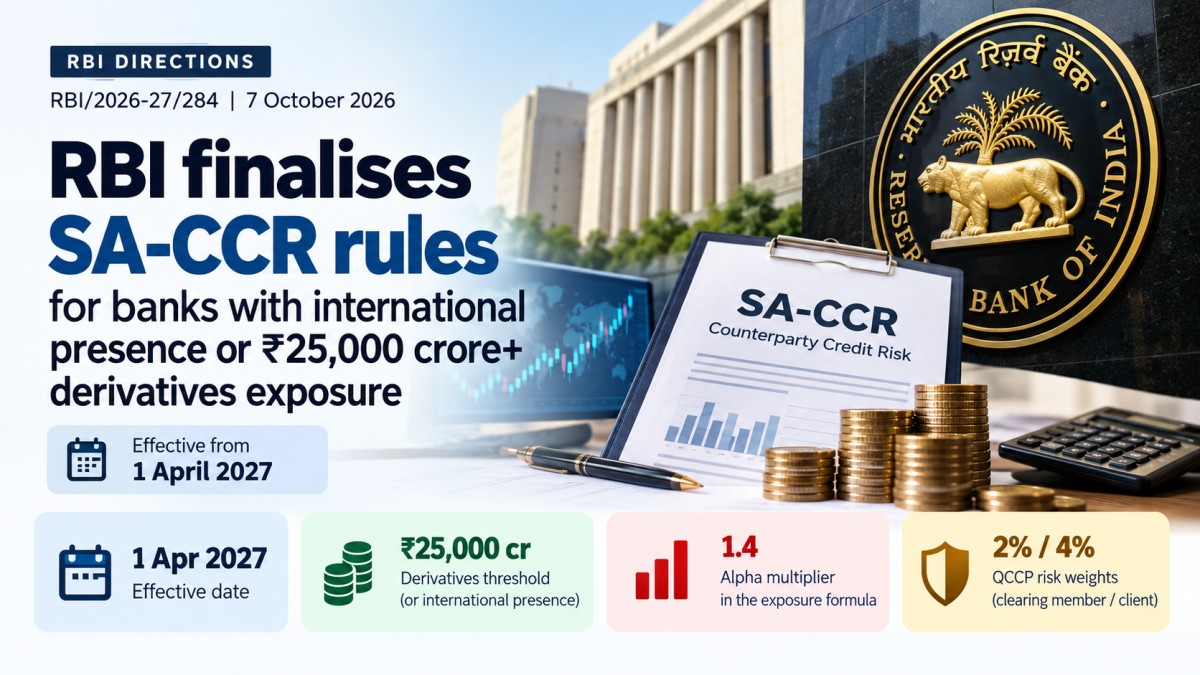
Commercial banks with an international presence or a large derivatives book will have to recalculate how much capital they hold against derivative and clearing exposures. From 1 April 2027, the RBI's final SA-CCR (Standardised Approach for Counterparty Credit Risk) rules apply to commercial banks with an international presence or book value of derivatives outstanding of ₹25,000 crore and above, on a consolidated group-wide basis. Other commercial banks may choose SA-CCR or the Current Exposure Method. The RBI released the Amendment Directions on 7 October 2026 after examining feedback on its draft of 10 June 2026.
Quick Answer
On 7 October 2026 the RBI issued the Reserve Bank of India (Commercial Banks – Forthcoming Instructions) Amendment Directions, 2026 (RBI/2026-27/284, DOR.MRG.REC.240/00-00-001/2026-27), amending Chapters II and III of the Reserve Bank of India (Commercial Banks – Forthcoming Instructions) Directions, 2025 dated 28 November 2025, which set the capital rules for counterparty credit risk (CCR). The amended rules cover the scope of CCR, SA-CCR methodology, central counterparty (CCP) exposures and CCR disclosure templates. They come into effect on 1 April 2027 and apply to commercial banks with an international presence or book value of derivatives outstanding of ₹25,000 crore and above as on the reporting date, on a consolidated group-wide basis. All other commercial banks may choose to adopt either the Current Exposure Method (CEM) or SA-CCR.
What Is SA-CCR and Why Has the RBI Amended the Rules?
Counterparty credit risk is the risk that the other party to a transaction defaults before final settlement of its cash flows, causing a loss if the transactions have a positive value at that time. SA-CCR is the standardised method banks use to measure that exposure for derivatives and long-settlement transactions. The RBI says it reviewed the 2025 instructions to align more closely with international standards.
What Changed Under the Final SA-CCR Amendment Directions?
The press release (2026-2027/1272) lists six areas the June 2026 draft proposed to revise. The RBI says feedback was examined and modifications were incorporated in the final text, with a feedback statement in an Annex to the press release. That Annex was not part of the material reviewed here, so differences between the draft and final text are not identified.
Which Banks Must Follow the SA-CCR Directions?
Para 10(2) adds that, for applicable banks, exposure computation for all regulatory purposes must use SA-CCR instead of CEM and be applied consistently. The Directions address commercial banks only.
How Is Counterparty Credit Exposure Calculated Under SA-CCR?
For each margined and unmargined netting set, exposure at default equals alpha multiplied by the sum of Replacement Cost and Potential Future Exposure, with alpha fixed at 1.4. Risk-weighted assets equal the applicable risk weight multiplied by the exposure amount.
The SA-CCR formula applies to OTC derivatives, exchange-traded derivatives and long-settlement transactions. Securities financing transactions (SFTs) follow paragraphs 157 to 165 of the Commercial Banks – Prudential Norms on Capital Adequacy Directions, 2025, and exposures cleared through a CCP follow paragraphs 15 to 20 of the Directions (para 6C). For an OTC derivative counterparty, the total exposure amount is reduced by any credit valuation adjustment already recognised as an incurred write-down, but not below zero (para 8).
alpha
Replacement Cost
Potential Future Exposure
Replacement Cost (RC)
- Unmargined netting sets: RC is the greater of zero and the market value (V) less haircut net collateral (C).
- Margined netting sets: RC uses V, C, the threshold (TH), the minimum transfer amount (MTA) and the net independent collateral amount (NICA), floored at zero.
- Cap: exposure for a margined netting set cannot exceed the same netting set calculated unmargined.
- One-way margin: a netting set where only the bank posts variation margin is treated as unmargined.
- Collateral: excess collateral or out-of-the-money trades cannot reduce RC below zero, but can reduce PFE.
Potential Future Exposure (PFE)
PFE equals a multiplier times an aggregate add-on. The multiplier is capped at 1 and its formula uses a 5% floor parameter. It equals 1 where the netting set is under-collateralised and falls below 1 where it is over-collateralised or the trades are out of the money (para 12(1) to 12(4)). The aggregate add-on is the sum of add-ons across five asset classes (interest rate, foreign exchange, credit, equity and commodity), with no diversification benefit across asset classes.
Equity and commodity derivatives: The Directions state that a bank is not permitted to engage in transactions in equity or commodity derivatives. The equity and commodity add-on rules therefore apply only to counterparty credit risk exposures that arise when a bank acts as a clearing member of an exchange in those derivatives segments, subject to applicable RBI guidelines (paras 12(25) and 12(28)).
Basis transaction hedging sets use a supervisory factor multiplied by 0.5, and volatility transaction sets use a factor multiplied by 5. Selected parameters from Table 2:
Foreign exchange and credit index parameters are in Table 2 of the Directions and are not reproduced here. Banks should rely on the source table.
What Are the Margin Period of Risk (MPOR) Floors?
Banks estimate the MPOR for each netting set and use the higher of that estimate and the applicable floor (para 12(36)). The 20-business-day floor applies to netting sets that are not with a central counterparty and where the number of transactions exceeded 5,000 at any time during the previous quarter, and to netting sets containing illiquid collateral or an OTC derivative that cannot be easily replaced, judged in the context of stressed market conditions (para 12(37)). If a bank has had more than two margin call disputes on a netting set over the previous two quarters that lasted longer than the applicable floor, it must use double the applicable floor for that netting set for the subsequent two quarters. For non-centrally cleared derivatives, only variation margin call disputes count.
What Are the Netting Rules?
A bank may net only where it has a netting contract creating a single legal obligation, written and reasoned legal reviews in the relevant jurisdictions, and procedures to review legal changes. The Directions say banks may continue relying on existing legal opinions while they remain valid. Cross-product netting between derivatives and SFTs is not recognised, and cross-product netting across hedging sets is prohibited for the PFE add-on. If RBI is not satisfied on enforceability, netting benefit is not available.
How Are Exposures to Central Counterparties (CCPs) Treated?
- QCCP RWA equals trade exposure RWA plus default fund capital multiplied by 12.5.
- Cap at non-QCCP treatment: if the RWA for exposures to a QCCP would be higher than the RWA calculated as if the CCP were a non-qualifying CCP, the bank uses the non-QCCP calculation (para 15(5)).
- QCCP status lost: a bank may keep QCCP treatment for up to three months unless RBI requires otherwise.
- MPOR for QCCP: 10 business days for OTC derivatives; the 20-day floor for more than 5,000 trades does not apply if the netting set has no illiquid collateral, exotic transactions or disputes.
- Clearing member to client: capitalise as bilateral trades; client initial margin may be recognised as credit risk mitigation.
- Settlement-risk-only products: 0% risk weight on prepaid default fund contributions covering such products, under an internal policy approved by the appropriate authority (para 15(4)).
- Monitoring: report all CCP exposures, including default fund contributions, to senior management and the appropriate Board committee at least quarterly.
What Are the Rules on Option Premium Deferment and Exemptions?
- A bank may, at its discretion, defer premium on permissible options (generic or structured) sold to users. It must first satisfy itself that the user can adhere to the deferment schedule, in accordance with a Board or Risk Management Committee of the Board approved policy; the deferment must not extend beyond the contract's maturity; and the premium must be received uniformly over the contract's maturity, at least once a quarter. Options and option structures remain governed by the suitability and appropriateness instructions in the Reserve Bank of India (Market-makers in OTC Derivatives) Directions, 2021.
- The facility is not available to an intermediary bank without its own option book that offers the product on a fully covered basis.
- Deferred premium is included in Replacement Cost.
- Sold options outside netting and margin agreements may be excluded if the entire premium is received; otherwise exposure is capped at the unpaid amount.
- CDS protection purchased against a banking-book exposure may be excluded where capital substitution applies.
What Disclosures Must Banks Make?
Para 21 requires banks to disclose all banking-book and trading-book exposures subject to a counterparty credit risk charge, including charges on CCP exposures, as part of Pillar 3, using the templates and frequencies in Annex III. Each Annex III template states its scope of application as "All banks", while para 3(iii) limits the Directions to banks with an international presence or derivatives of ₹25,000 crore and above, with other banks free to choose CEM or SA-CCR. The Directions do not say how these two points apply together to banks using CEM, so confirm the position before preparing the disclosures. Annex II separately contains illustrative SA-CCR calculations for sample portfolios, which the Directions say are not a validation suite.
Compliance Checklist for Banks Before 1 April 2027
The Directions state no separate penalty. They are issued under Section 35A of the Banking Regulation Act, 1949.
Frequently Asked Questions
What is the RBI SA-CCR amendment of October 2026?
It is the RBI's final Amendment Directions of 7 October 2026 on the Standardised Approach for Counterparty Credit Risk, amending capital rules for CCR, CCP exposures and disclosures in the 2025 Forthcoming Instructions Directions for commercial banks.
When do the SA-CCR amendment directions take effect?
They take effect from 1 April 2027.
Which banks must use SA-CCR?
Commercial banks with an international presence or derivatives outstanding at book value of ₹25,000 crore and above on the reporting date, on a consolidated group-wide basis. Other commercial banks may choose CEM or SA-CCR.
What is the SA-CCR exposure formula?
Exposure equals 1.4 multiplied by the sum of Replacement Cost and Potential Future Exposure, calculated separately for each margined and unmargined netting set.
What risk weight applies to a bank's trade exposure to a QCCP?
A 2% risk weight applies to a clearing member bank's trade exposure to a qualifying central counterparty (QCCP). A client bank's exposure to its clearing member or a higher-level client is also treated as a trade exposure to the CCP, at 2%, if all the conditions in para 16(7) are met. If all of them except the protection against the joint default of the clearing member and its other clients (para 16(7)(b)(iii)) are met and the CCP is a QCCP, a 4% risk weight applies. If the conditions are not met, the exposure is capitalised as a bilateral transaction.
What is the minimum margin period of risk for non-cleared daily-margined derivatives?
The floor is ten business days for non-centrally-cleared derivatives under daily margin agreements. It rises to 20 business days for netting sets not with a central counterparty that had more than 5,000 transactions at any time in the previous quarter, and for netting sets containing illiquid collateral or an OTC derivative that cannot be easily replaced.
Can banks defer option premium?
Yes, on permissible options sold to users, if the bank follows a Board or committee-approved policy, defers it no later than contract maturity and receives premium at least quarterly. The deferred amount is included in Replacement Cost.
What new disclosures are required?
Banks must disclose Table CCRA annually and Templates CCR1 to CCR5 semi-annually under Pillar 3.
CorpLawUpdates Analysis
For risk and finance teams, the immediate issue is lead time: SA-CCR needs trade-level data, collateral and margin terms, legal netting evidence and CCP data, and 1 April 2027 leaves about six months from the issue date. Banks with large derivatives books, clearing-member business or multi-agreement netting sets are likely to face the most work, while banks below the threshold can weigh CEM against SA-CCR. Because the feedback statement was not reviewed here, treat any comparison with the June 2026 draft as unverified. These are editorial views, not RBI statements.
Documents: (1) Reserve Bank of India (Commercial Banks – Forthcoming Instructions) Amendment Directions, 2026; (2) Press Release: RBI issues Amendment Directions on 'Standardised Approach for Counterparty Credit Risk (SA-CCR)'.
Issuing authority: Reserve Bank of India.
Reference: RBI/2026-27/284, DOR.MRG.REC.240/00-00-001/2026-27, 7 October 2026; Press Release 2026-2027/1272.
Signatories: Sunil T S Nair, Chief General Manager (Directions); Brij Raj, Chief General Manager (press release).
Powers: Section 35A, Banking Regulation Act, 1949.
Draft: issued 10 June 2026; feedback invited until 1 July 2026.
Amends: Chapters II and III of the Reserve Bank of India (Commercial Banks – Forthcoming Instructions) Directions, 2025 dated 28 November 2025. Paragraphs 7 to 21 are substituted by paragraphs 6A to 21, the existing Annex is renamed Annex 1, and Annex 2 and Annex 3 are inserted.
Primary source: RBI/2026-27/284 and Press Release 2026-2027/1272, dated 7 October 2026 (www.rbi.org.in)
This article is for informational and educational purposes only and does not constitute legal or regulatory advice. Readers should verify the applicable primary regulatory source before taking action.