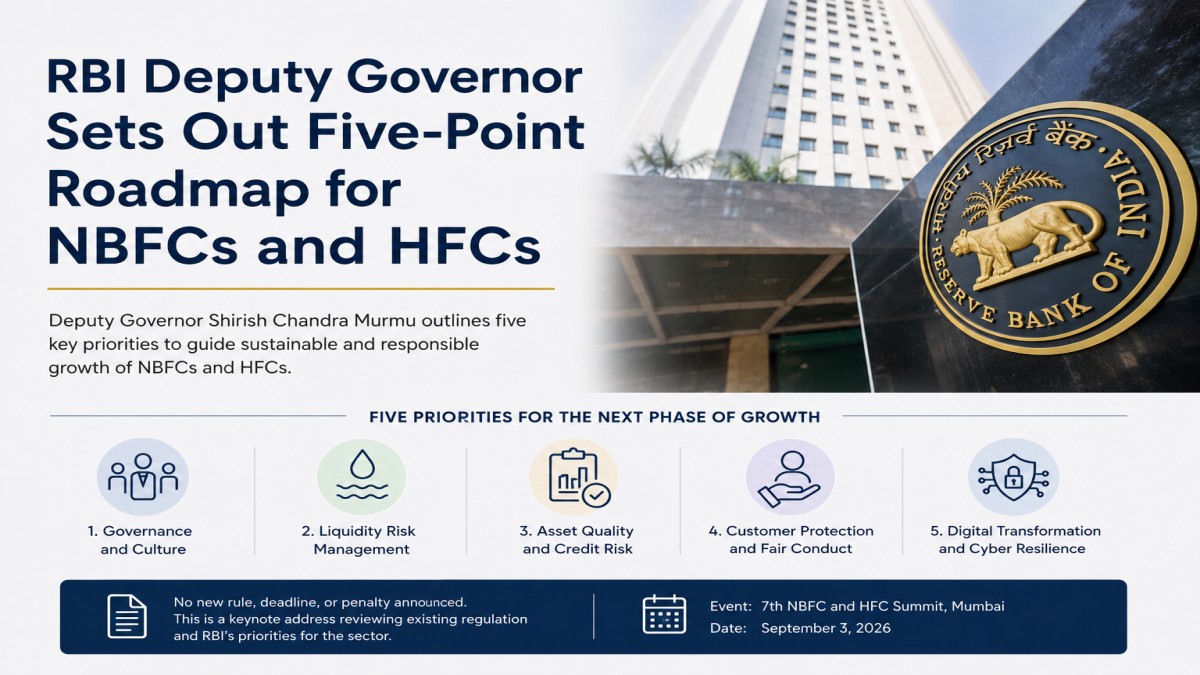
RBI Deputy Governor Sets Out Five-Point Roadmap for NBFCs and HFCs
NBFCs and HFCs preparing for their next phase of growth now have a clearer sense of where RBI's supervisory attention will fall. Speaking at the 7th NBFC and HFC Summit in Mumbai on September 3, 2026, Deputy Governor Shri Shirish Chandra Murmu set out five areas — governance, liquidity, asset quality, customer conduct, and cyber resilience — that will shape supervisory expectations for the sector in the years ahead.
The address, titled "NBFCs, HFCs and the New Phase of Growth," does not introduce a new rule. Instead, it reviews a decade of regulatory reform and signals where boards and compliance functions at non-bank lenders should focus as the sector scales.
Quick Answer
RBI Deputy Governor Shirish Chandra Murmu, in a keynote at the 7th NBFC and HFC Summit on September 3, 2026, identified five priorities for NBFCs and HFCs: governance and culture, liquidity risk management, asset quality and credit risk, customer protection and fair conduct, and digital transformation with cyber resilience. He also reviewed reforms introduced since 2019, including Scale Based Regulation, the Liquidity Risk Management framework, and the November 2025 consolidation of entity-wise NBFC regulations. No new compliance obligation, threshold, or deadline was announced.
Quick Reference
Why This Matters
NBFCs and HFCs now account for a meaningfully larger share of India's credit system than they did a year ago. Shri Murmu noted that NBFC credit is about 16.7 per cent of nominal GDP, up from 15.9 per cent a year earlier, and equals about 27 per cent of the credit extended by Scheduled Commercial Banks, up from 26 per cent. As the sector's footprint grows, RBI's supervisory expectations grow with it — and this address is the clearest recent signal of where that attention will concentrate.
Who Is Affected?
The Regulatory Journey: Reforms RBI Reviewed
Before turning to priorities, Shri Murmu walked through the reforms RBI has introduced for NBFCs over the past five to six years. Taken together, they explain the regulatory foundation the sector now operates on.
Shri Murmu also listed specific growth-support measures RBI has introduced, without giving exact dates for each:
- Lower risk weights for infrastructure lending by NBFCs
- More flexibility for boards on related-party lending
- Inclusion of quarterly profit for computing net owned funds and capital
- Removal of prior approval for branch expansion by larger NBFCs — those with more than 1,000 branches
- Exemption of small NBFCs without public funds or customer interface, and with assets below ₹1,000 crore, from registration requirements
Regulatory Philosophy: Building the Foundation First
To explain RBI's approach, Shri Murmu used an analogy about a landmark skyscraper in the Middle East that began construction in January 2004 and reached its 100th floor in 36 months, eventually standing 2,717 feet tall as the world's tallest building — a project that, notably, spent 14 months on the foundation alone before any floor was built. (CorpLawUpdates note: this description corresponds to a well-known Gulf skyscraper, though the speech does not name it.) The point Shri Murmu drew from it: RBI's reforms — liquidity rules, scale-based layers, governance requirements — exist to build a foundation strong enough for the sector's continued growth, even when the pace of growth is fast.
RBI's Five Priorities for the Next Phase of Growth
The core of the address is a five-point list of areas Shri Murmu said matter most for the sector's sustainable growth going forward.
1. Governance and Culture
Boards and senior management are expected to build a culture of sustained compliance and ethics across the organisation, with that discipline scaling alongside the entity's growth.
2. Liquidity Management
Entities must diversify funding sources rather than relying on concentrated, short-term wholesale funding — a vulnerability past liquidity events exposed. RBI also wants securitisation to evolve from a liquidity tool into a genuine risk-transfer mechanism, backed by proper skin-in-the-game and transparency requirements, alongside continued work toward a deeper corporate bond market.
3. Asset Quality and Credit Risk
As credit growth accelerates, RBI expects rigorous stress testing, early-warning systems, and dynamic provisioning, along with greater use of AI and machine learning to detect early signs of borrower stress. Shri Murmu was explicit that growth must never come at the cost of underwriting standards.
4. Customer Protection and Fair Conduct
Conduct regulation, grievance redressal, and responsible lending remain top priorities, with particular attention to vulnerable customers. The address specifically referenced RBI's recent guidelines on the conduct of recovery agents as an example of this focus.
5. Digital Transformation and Cyber Resilience
Continued technology adoption — from blockchain in supply chain finance to AI in fraud detection — must be matched by stronger cyber security investment to protect customer data. Digitalisation should not exclude vulnerable segments or introduce new risks.
Digital Infrastructure and Innovation Themes
Shri Murmu pointed to India's digital public infrastructure — PMJDY, UPI, Aadhaar, the Account Aggregator framework, and the more recently launched Unified Lending Interface (ULI) — as tools NBFCs can use to lower the cost of credit and speed up disbursal. He described cash-flow based lending, using data points such as a food service provider's order values or footfall, as an emerging alternative to conventional balance-sheet lending. On regulatory approach, he noted RBI has chosen not to build a separate framework for digital finance, instead applying "substance over form" to adapt existing rules to digital contexts.
What Should Practitioners Watch?
Because this is a keynote address rather than a notified regulation, there is no compliance deadline or filing obligation to track. Practitioners advising NBFCs and HFCs should instead treat it as a supervisory signal:
- Boards should expect continued supervisory attention on liquidity concentration and funding diversification, not just at examination time but as an ongoing governance expectation.
- Risk and compliance functions should anticipate closer scrutiny of stress-testing and early-warning systems, particularly where AI/ML tools are used for borrower monitoring.
- Entities using recovery agents should review conduct practices against RBI's recent recovery-agent guidelines, referenced but not detailed in this address.
- NBFCs relying on the small-entity registration exemption should independently verify the applicable RBI circular for exact eligibility conditions, since the speech does not restate them in full.
- Cyber-security investment and data-protection practices are likely to remain a recurring supervisory theme rather than a one-time compliance item.
CorpLawUpdates Analysis
For compliance teams, the practical value of this address lies less in any single new requirement and more in its signalling function. RBI has, over successive years, moved from reactive crisis-response regulation — the 2019 Liquidity Risk Management framework followed liquidity stress in the sector — toward proportionate, scale-based, and increasingly consolidated regulation, culminating in the November 2025 exercise to bring entity-wise rules into one place. Reading this speech alongside that trajectory suggests RBI's supervisory focus for NBFCs and HFCs is shifting from foundational rule-building toward embedding governance, liquidity discipline, and cyber resilience as ongoing institutional practice rather than one-off compliance exercises. Where implementation difficulty is likely to arise is in mid-sized NBFCs that must now match large-NBFC-level governance and stress-testing sophistication without the same scale of resources — a tension the address does not resolve but does implicitly acknowledge by calling for governance "to scale" alongside growth.
Frequently Asked Questions
Is this a new RBI regulation for NBFCs?
No. It is a keynote address delivered by Deputy Governor Shirish Chandra Murmu at the 7th NBFC and HFC Summit on September 3, 2026. It introduces no new rule, threshold, or deadline.
What are RBI's five priorities for NBFCs and HFCs?
Governance and culture, liquidity management, asset quality and credit risk, customer protection and fair conduct, and digital transformation with cyber resilience.
What is the current size of NBFC credit relative to the economy?
NBFC credit is about 16.7 per cent of nominal GDP, up from 15.9 per cent a year earlier, and about 27 per cent of Scheduled Commercial Bank credit, up from 26 per cent.
When was Scale Based Regulation introduced for NBFCs?
RBI introduced Scale Based Regulation in October 2021 and consolidated the framework further in October 2023.
Which small NBFCs are exempt from registration?
NBFCs without public funds or customer interface, and with assets below ₹1,000 crore, are exempt from registration requirements, per the recent measure referenced in the address.
What did RBI do in November 2025 for NBFC regulation?
RBI completed an exercise to bring all entity-wise NBFC and HFC regulations into a single consolidated framework, aimed at reducing compliance costs.
Does the address change digital lending or fintech partnership rules?
No. It references the 2024 Digital Lending guidelines and RBI's "substance over form" approach but does not modify existing digital lending rules.
Is there a compliance deadline arising from this speech?
No. As a keynote address, it creates no filing obligation or compliance deadline for NBFCs or HFCs.
Source Note
Document: Keynote Address, "NBFCs, HFCs and the New Phase of Growth"
Issuing authority: Reserve Bank of India
Delivered by: Shri Shirish Chandra Murmu, Deputy Governor (contributions by Shri Mohammed Majidullah, General Manager)
Occasion: 7th NBFC and HFC Summit, Mumbai
Date: September 3, 2026
This article is for informational and educational purposes only and does not constitute legal or regulatory advice. Readers should verify the applicable primary regulatory source before taking action.


