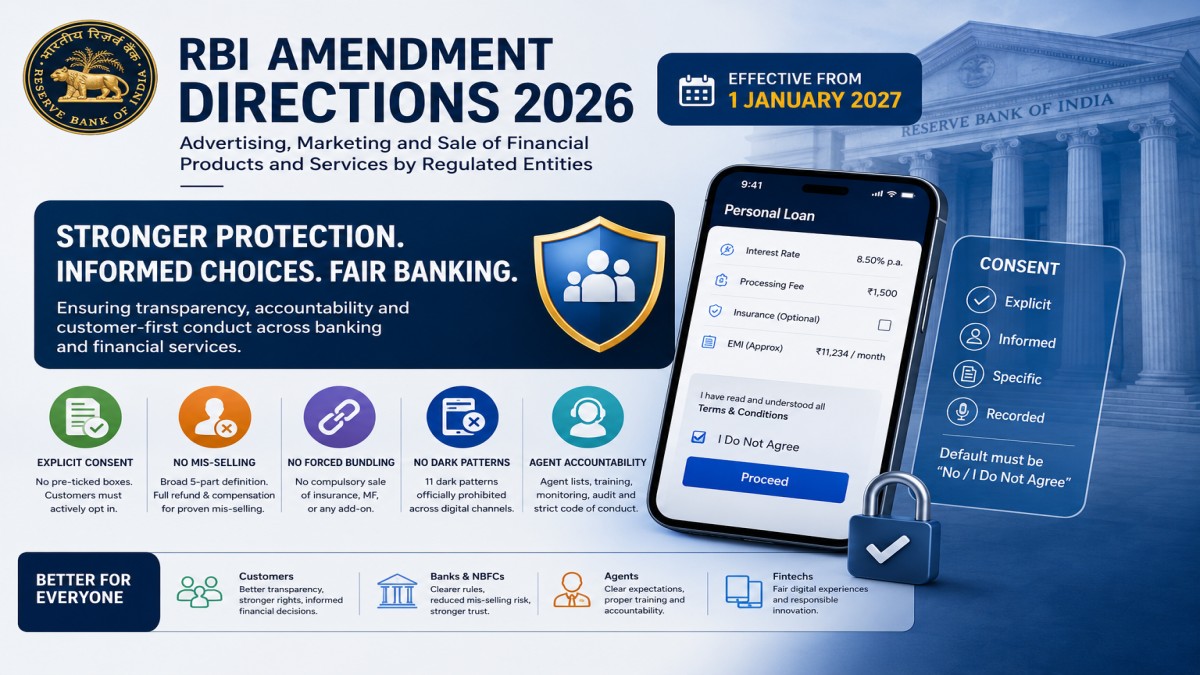
The Reserve Bank of India on June 15, 2026 issued comprehensive Amendment Directions on Advertising, Marketing and Sale of Financial Products and Services by Regulated Entities, with effect from January 1, 2027. Issued under Press Release 2026-2027/460, these directions significantly strengthen the regulatory framework governing how banks, NBFCs, Housing Finance Companies, and other regulated entities (REs) advertise, market and sell financial products and services — whether their own or third-party — to customers.
The directions had a long gestation: first announced in the Statement on Developmental and Regulatory Policies dated February 6, 2026, draft directions were published on February 11, 2026 for stakeholder consultation. Feedback was examined, modifications incorporated, and the final directions issued on June 15, 2026. A companion set of directions simultaneously amends the Undertaking of Financial Services framework governing agency business and referral services. Together, they cover 17 separate notifications spanning every category of RE — from Commercial Banks to Rural Co-operatives to NBFCs and Housing Finance Companies.
⚡ Key Facts at a Glance
Press Release
2026-27/460
RBI Press Release No.
Jun 15, 2026
Date of Issue
Jan 1, 2027
Effective From
17 Directions
Across All RE Categories
11 Dark Patterns
Explicitly Prohibited (Annex IIA)
Sec 35A
Banking Regulation Act — Legal Basis
🏦 Which Regulated Entities Are Covered?
RBI has issued parallel, entity-specific amendment directions across multiple regulated entity categories. Broadly, one set amends the Responsible Business Conduct (RBC) Directions governing advertising, marketing and sale conduct, while the other amends the Undertaking of Financial Services Directions governing agency business and referral-service arrangements. Both sets take effect from January 1, 2027.
🧭 Why RBI Issued Two Parallel Amendment Sets
The June 15, 2026 package is easier to understand if read as a two-layer compliance framework. One set of amendments updates the Responsible Business Conduct (RBC) directions, which govern how regulated entities advertise, market, recommend, sell and service financial products for customers. The second set updates the Undertaking of Financial Services directions, which govern the conditions under which certain regulated entities may undertake agency business, referral arrangements or related financial service activities.
- RBC amendments: customer protection rules — disclosures, dark patterns, mis-selling, bundling, suitability, conduct of DSA/DMA channels, post-sale checks, complaint handling and compensation architecture.
- Undertaking of Financial Services amendments: structural permission framework — what kinds of agency / referral / financial service arrangements are permitted, and on what conditions.
- Read together: the first set tells REs how they must behave while selling; the second tells many REs what kinds of business arrangements they may undertake while doing so.
📖 Section 1 — New Definitions Inserted into Paragraph 4
The Amendment Directions insert six new definitions into the principal Responsible Business Conduct Directions. These definitions are the building blocks for the entire new framework — every operative provision in Sections F.1 through F.7 relies on these terms being precisely defined.
NEW DEFINITIONS — PARAGRAPH 4 AMENDMENTS
4(6A)
Compulsory Bundling
The practice by a bank of making the availment of one product or service by a customer conditional upon the availment of another product or service — whether that other product is the bank's own or third-party — offered by the bank. This definition is the legal anchor for the anti-bundling obligation in Para 85V.
4(10.1A)
Dark Pattern
Any practice or deceptive design pattern using user interface or user experience interactions on any platform that is designed to mislead or trick users into doing something they originally did not intend or want to do, by subverting or impairing consumer autonomy, decision-making or choice, amounting to misleading advertisement, unfair trade practice, or violation of consumer rights. This definition aligns with CCPA's framework under the Guidelines for Prevention and Regulation of Dark Patterns, 2023.
4(10B) 4(10C)
DSA / DMA and DSA / DMA Sub-Agent
DSA / DMA [Para 4(10B)]: Any entity or individual (other than the bank's own employee) engaged by a bank — irrespective of the contractual designation or nomenclature used (including Business Correspondent, Loan Service Provider, etc.) — to sell, market, promote, or influence customers for purchase of the bank's own or third-party product/service.
DSA / DMA Sub-Agent [Para 4(10C)]: An individual engaged by a DSA/DMA who is involved in selling/marketing activities on behalf of a bank at the point of customer interface.
Explanation: Where an individual is directly engaged by a bank under an outsourcing arrangement for selling/marketing activities, the instructions applicable to both DSA/DMA and DSA/DMA sub-agent shall apply to such an individual.
4(13A)
Explicit Consent
A specific, informed and unambiguous indication of an individual's choice, given through a duly recorded or documented statement or clear affirmative action, which indicates agreement to a specific action by or arrangement with a bank. The "explicit" qualifier means passive consent (pre-ticked boxes, silence, or inactivity) is not sufficient — the customer must actively and knowingly agree.
4(20A)
Mis-Selling — Five Limbs
Sale of a financial product or service (own or third-party) constitutes mis-selling in any of these five cases:
(i) Sale of a product that is neither suitable nor appropriate for the customer's profile at the time of sale, notwithstanding her/his explicit consent — consent does not cure unsuitability.
(ii) Sale without providing correct or complete information, or by giving misleading information.
(iii) Sale without the customer's explicit consent.
(iv) Compulsory bundling of another product/service with the sale of the requested product/service.
(v) Sale involving any other element defined as mis-selling by the relevant financial sector regulator.
4(26A)
Third-Party Product or Service (TPPS)
A product or service offered by a bank to its customers on behalf of a third-party provider after entering into an agency business or referral services arrangement with that provider, as permitted under the Undertaking of Financial Services Directions, 2025. This definition covers insurance, mutual funds, pension products, and any other third-party product distributed through a bank's network.
📋 Section 2 — F.1: Comprehensive Policy Requirement (Paragraphs 85A & 85B)
Every regulated entity must now put in place a board-level policy covering advertising, marketing, and sale of both own and third-party financial products. This policy is the foundation — all operational requirements in F.2 through F.7 flow from it.
PARA 85A & 85B — POLICY OBLIGATIONS
85A
General Advertising & Sale Policy (All Banks)
A bank must put in place a comprehensive policy covering, at minimum: criteria for determining customer suitability and appropriateness; a feedback mechanism; and customer compensation procedures in cases of mis-selling. The policy must cover both the bank's own and third-party products and services.
85B
Additional Policy Elements for Banks Using DSAs / DMAs
Banks using DSAs/DMAs must additionally include in their policy: eligibility criteria for DSAs/DMAs; due diligence requirements (pre and post-engagement); training obligations for sub-agents; permissible functions/activities; performance evaluation standards; inspection/audit requirements; control mechanisms for statutory compliance; and procedures and penal actions for non-compliant DSAs/DMAs.
🤝 Section 3 — F.2: Engagement of DSAs / DMAs (Paragraphs 85C–85F)
This is one of the most operationally intensive sections — directly regulating the conduct, identification, and accountability of Direct Selling Agents (DSAs) and Direct Marketing Agents (DMAs) who form the front line of financial product distribution in India.
PARAS 85C–85F — DSA / DMA ENGAGEMENT RULES
85C
Public List of Empanelled DSAs / DMAs — Website Disclosure
A bank must maintain and display an up-to-date list of all DSAs/DMAs engaged with it on its website for public reference. The list must include: name; type (corporate or individual); address; period of engagement; and products/services they deal with. The list must be updated within 7 calendar days of any modification.
85D
Mandatory Qualifications / Certifications
A bank must ensure that its employees and DSA/DMA sub-agents involved in the sale of own or third-party financial products/services possess any requisite qualification or certification prescribed by the relevant financial sector regulator (SEBI, IRDAI, PFRDA, etc.) for the specific product being sold.
85E
Physical Identification — DSA/DMA Sub-Agents Must Be Distinguishable from Bank Employees
Any DSA/DMA sub-agent or TPPS Provider representative present within a bank's premises must be clearly distinguishable from the bank's own employees — including through clear "on person" identification (such as different ID cards, badges, or uniforms). This prevents customers from being misled about who they are dealing with.
85F
Code of Conduct — Mandatory for All Sales Personnel
A bank must put in place a Code of Conduct for all sale and marketing activities, applicable to its own employees, DSAs/DMAs and their sub-agents, and TPPS Provider representatives deployed in bank premises. Key requirements:
▸ DSAs/DMAs must provide an undertaking to abide by the Code (before any sale activities begin)
▸ The bank's own employees and TPPS representatives must similarly undertake compliance
▸ The agreement with each DSA/DMA must specify penal/disciplinary actions for Code violations
▸ The Code of Conduct must be displayed on the bank's website for public reference
✅ Section 4 — F.3: Consent Aspects (Paragraphs 85G–85I)
The consent framework is perhaps the most significant structural shift in these directions. It moves away from implied consent and passive acceptance toward a rigorous, documented, explicit-consent architecture.
PARAS 85G–85I — EXPLICIT CONSENT FRAMEWORK
85G
How Explicit Consent Must Be Obtained
Products/services may only be offered to a customer with their
explicit consent. Acceptable consent modes:
📝 Signed declaration (physical or electronic)
📱 OTP-based approval
🎙️ Digitally recorded confirmation
📋 Clearly demarcated section of the product agreement
For forms with multiple products: each product must be
clearly enumerated and the customer must have the option to choose only the desired product(s). Consent records must be stored for
1 year after cessation of the contractual agreement.
85H
Mandatory Pre-Consent Disclosures — Key Features Must Be Prominent
When obtaining consent, the bank must prominently disclose key features in a manner that draws the customer's attention, including:
▸ Fees, charges, and interest rates
▸ Risks involved
▸ Financial commitment required from the customer
▸ Lock-in conditions
▸ Exit terms including penalties
Where RBI or another regulator has prescribed a specific format (such as Key Facts Statement / KFS, or Most Important Terms and Conditions / MITC), the bank must use that prescribed format.
85I
UI Design Mandate:
Default Must Be "No / I Do Not Agree"
The user interface process flow for obtaining consent must be designed so that consent cannot be granted without the user going through the applicable terms and conditions. Critically, the default choice must be "No" / "I do not agree" — the customer must actively opt in, not opt out. This directly bans pre-ticked consent boxes and default-yes interfaces.
📢 Section 5 — F.4: Advertisement & Marketing (Paragraphs 85J–85O)
F.4.1 — Promotional Materials / Communications (Paras 85J–85M)
PROMOTIONAL MATERIALS RULES
85J
No advertising TPPS as the bank's own product. When giving details of any TPPS Provider to a customer, the bank must clarify its own role (agent/referrer) in providing that product/service. Cross-selling must be transparent.
85K
All advertising / promotional materials (physical or digital) must be clear and factual. They must disclose the interest rate and other fees/charges associated with the product/service being promoted. Terms and conditions must be prominently disclosed at all points of sale and digital channels (website, mobile app, etc.).
85L
Promotional communications / alerts about promotional offers may be sent to a customer only if she/he has given explicit consent to receive them. No unsolicited promotional push notifications or marketing communications.
85M
Unsubscribing from any service or promotional communication must be easy and simple. A subscription trap — where opting out is deliberately made complex — is expressly prohibited by this provision (and reinforced by the Dark Pattern definition).
F.4.2 — Conduct of Bank Employees, DSAs/DMAs and Sub-Agents (Paras 85N–85O)
PARA 85N — 10-POINT CODE OF CONDUCT FOR SALES PERSONNEL
Banks must ensure that all employees, DSAs/DMAs, sub-agents, and TPPS representatives deployed for sale/marketing in bank premises comply with all of the following ten obligations:
1
Make upfront disclosure of fees, charges, and interest rates while marketing/selling any product or service.
2
Communicate full terms and conditions to the customer if they plan to buy, and make all other relevant information available.
3
Send any communication to the customer only in the mode and format approved by the bank.
4
Make telephonic contacts and visits only between 09:00 and 19:00 hours, unless the customer has expressly requested otherwise.
5
Provide customer care and grievance redressal contact details if requested by the customer.
6
Respect customer privacy — discuss matters only with the customer unless she/he has explicitly consented to sharing with a third party.
7
Provide the "Do Not Disturb" customer list to the bank for promotional communication opt-outs.
8
Do not visit a customer at residence/business/office without explicit consent.
9
Do not mislead or coerce the customer in the purchase of any product/service.
10
Do not make any false or unauthorised commitment on behalf of the bank.
Para 85O — No False Representation as Bank Employee
A bank must ensure that DSAs/DMAs and their sub-agents do not mislead the customer about their business or organisation name. DSA/DMA sub-agents and TPPS Provider representatives deployed in bank premises must not falsely represent themselves as the bank's employees.
💼 Section 6 — F.5: Sale of Financial Products / Services (Paragraphs 85P–85X)
F.5.1 — Suitability and Appropriateness (Para 85P)
Before any financial product/service (other than those the bank has determined as suitable for all customers per its policy) is sold to an individual customer, the bank must conduct a suitability and appropriateness assessment. This analysis must weigh:
Product factors: Features, risk-return attributes, time horizon, complexity, fee structure
vs.
Customer factors: Age, income, level of financial literacy, risk tolerance
Where any financial sector regulator (SEBI, IRDAI, PFRDA) has prescribed a specific suitability assessment methodology for a product regulated by it, the bank must adhere to that prescribed methodology.
F.5.2 — Application Forms and Documentation (Paras 85Q–85T)
APPLICATION FORM & DOCUMENT REQUIREMENTS
85Q
Product-Specific Application Forms. Physical forms: one specific form per product/service, prominently indicating nature (loan, deposit, insurance,
mutual fund, pension, hybrid product, etc.) and features. Digital forms with multiple products: a
dedicated section/module per product, with prominent disclosure of nature and features, and explicit consent obtained for each product separately.
85R
Regional Language Availability. All documents related to the bank's own product sales (including T&Cs) must be available in the language of the region or a language understood by the customer. For TPPS, the bank must ensure adherence to instructions from the relevant regulator on this subject.
85S
Application Acknowledgement. After receiving an application, the bank must send an acknowledgement via message, email, or other secure medium confirming receipt of the specific application. The acknowledgement must include a contact number for further queries.
85T
Post-Sale Document Delivery. On completion of a sale, a copy of the signed T&Cs / agreement must be provided to the customer (physically or digitally), in a secure manner to maintain confidentiality of customer information.
F.5.3 — Measures for Prevention of Mis-Selling (Paras 85U–85X)
MIS-SELLING PREVENTION RULES — PARAS 85U–85X
85U
No incentive structures that promote mis-selling. A bank's policies and practices must not create incentives for mis-selling of own or third-party products. Bank employees must not directly or indirectly receive incentives from any TPPS Provider for the sale or marketing of TPPS — eliminating a major conflict of interest in bancassurance, bank-MF distribution, and similar channels.
85V
Compulsory bundling of TPPS with own products is prohibited. Exception: if purchase of a TPPS is a risk mitigant for a bank's own product (e.g., insurance for a home loan), the customer must be given the option to purchase that TPPS from any TPPS Provider — not locked to the bank's empanelled provider. Voluntary package offers (with explicit consent) and complimentary services (no additional cost) do not constitute compulsory bundling.
85W
No loan proceeds may fund the purchase of any product without explicit consent. A bank may not use any sanctioned loan amount to fund a customer's purchase of any product (own or third-party) without explicit consent. This addresses the practice of auto-debiting loan proceeds for insurance or investment products at disbursement.
85X
Dark Pattern prohibition — mandatory user testing and internal audit. Banks and their DSAs/DMAs must ensure their user interfaces do not deploy any dark pattern. All digital UIs must be subject to user testing and periodic internal audit for identification of unfair features including dark patterns. Banks must also adhere to the CCPA's Guidelines for Prevention and Regulation of Dark Patterns, 2023, as amended.
🔁 Section 7 — F.6: Feedback and Compensation to Customers (Paragraphs 85Y & 85Z)
Para 85Y — Post-Sale Feedback Mechanism (30 Days)
A bank must establish a mechanism to seek customer feedback within 30 days of the sale of any financial product/service. The mechanism must verify that customers have understood both the features and the risks of what they purchased. It may include random-sample call-backs or surveys conducted by a department/vertical not associated with product sales (ensuring independence). A half-yearly report on feedback findings must be prepared and used for reviewing existing policies and product features.
Para 85Z — Mis-Selling Complaint & Full Compensation
Customers may lodge a mis-selling complaint within: (a) the timeline prescribed by the relevant regulator, or (b) 30 days of receiving the signed copy of T&Cs/agreement (where no regulator timeline is specified). Where mis-selling is established, the bank must: (i) refund the entire amount paid for the financial product/service; (ii) intimate the customer of cancellation (where applicable); and (iii) compensate the customer for any loss arising from mis-selling, as per its approved policy.
🔗 Section 8 — F.7: Adherence to Other Regulations (Paragraph 85ZA)
PARA 85ZA — CROSS-REGULATORY COMPLIANCE OBLIGATIONS
(1)
DoT and TRAI regulations on commercial communication: Including the Telecom Commercial Communications Customer Preference Regulations (TCCCPR), 2018, as amended from time to time. Banks must comply with "Do Not Call" registries and commercial communication restrictions under these telecom regulations.
(2)
SEBI, IRDAI, and PFRDA regulations on products/services falling under their respective domains. A bank selling mutual funds must comply with SEBI's suitability norms; selling insurance requires IRDAI compliance; distributing pension products requires adherence to PFRDA guidelines.
(3)
Other relevant RBI guidelines on undertaking agency business, outsourcing of financial services, mobilisation of deposits through agents, etc., as applicable.
🕵️ Section 9 — Annex IIA: 11 Dark Patterns Prohibited in Banking
The most vivid and practically impactful part of these directions is Annex IIA — the illustrative list of 11 dark patterns specifically relevant to banks. Each is defined precisely, with banking-specific illustrations so there is no room for ambiguity about what is prohibited.
① False Urgency
Falsely stating or implying urgency or scarcity to push an immediate purchase. Examples: fake countdown timers, "offer ends soon" messages, pre-approved loans with falsely imminent interest rate hike warnings.
② Basket Sneaking
Adding products/services, charity payments, or insurance to a checkout without customer consent. Example: defaulting loan protection insurance or online fraud protection to "selected" during a loan application.
③ Confirm Shaming
Using guilt, fear, ridicule, or shame to prevent a customer from opting out. Example: "No, I don't want extra security for my account" as the decline button text when opting out of a service.
④ Forced Action
Forcing a user to buy/subscribe to an unrelated service or share personal data to access what they originally wanted. Example: pop-ups that redirect to loan section even when user clicks the close/exit button.
⑤ Subscription Trap
Making cancellation of a paid subscription impossible, hidden, ambiguous, or requiring pre-loaded payment authorisation for a "free" trial. Example: credit card or insurance sign-up is easy; cancellation buried behind multiple confirmation steps.
⑥ Interface Interference
Manipulating UI to highlight preferred options and obscure others. Examples: bank-preferred option in bright colour; default consent as "Yes"; account-closure option buried deep in navigation.
⑦ Bait and Switch
Advertising one outcome and delivering another. Examples: lower interest rate advertised, higher rate charged at application; savings account rate without minimum balance disclosure; lifetime-free credit card with undisclosed transaction minimum.
⑧ Drip Pricing
Concealing price elements, revealing them post-confirmation, advertising as "free" without disclosing in-app purchase requirements, or blocking use of paid services unless extra purchases are made. Example: not disclosing processing fees upfront.
⑨ Disguised Advertisement
Masking ads as news, user content, or urgent account alerts. Examples: push notifications disguised as "Important: Your account might benefit from this" but actually promoting a new product.
⑩ Nagging
Repeated, persistent interruptions to push a transaction after the customer has already declined. Examples: repeatedly asking to enable non-essential cookies; mandatory dialogue boxes requiring selection before leaving an app.
⑪ Trick Wording
Deliberately confusing language, double negatives, or ambiguous choices to misdirect the customer. Example: "Uncheck this box if you do not want to receive offers" — double negative designed to confuse.
🏢 Section 10 — Companion Directions: Agency Business & Referral Services
Alongside the Responsible Business Conduct Amendment Directions, RBI simultaneously issued a second batch of directions amending the Undertaking of Financial Services Directions, 2025. These cover the regulatory framework governing agency business arrangements and referral services offered by REs — the legal backbone through which TPPS distribution is structured. The feedback received on the draft directions has been incorporated into these final directions, which also take effect from January 1, 2027.
📊 Section 11 — Impact Analysis: Who Is Affected and How
🏦 Banks & NBFCs
Must revamp all digital UIs for dark pattern compliance; update consent flows to default-no; publish DSA/DMA lists; create or overhaul sales policies by January 1, 2027. Major operational and technology work required.
🤝 DSAs / DMAs
Subject to Code of Conduct requirements, cannot falsely represent as bank employees, must hold relevant certifications, and face formal accountability through bank agreements including penal clauses. Business correspondent organisations face the highest scrutiny.
👤 Bank Customers
Strongest consumer protection framework since the Banking Ombudsman Scheme. Right to suitability assessment; full refund + compensation for mis-selling; default-no consent; product documents in regional language; easy unsubscription; and a 30-day feedback check-in.
🏢 TPPS Providers (Insurers, AMCs, etc.)
Cannot offer direct/indirect incentives to bank employees for their products' sale. Banks must not advertise TPPS as their own products. Clearer separation between the bank's role and the TPPS Provider's role must be communicated to customers.
UX/UI teams must audit every user flow for dark patterns. Default-yes consent boxes, forced pop-up redirects, pre-selected add-on products, and manipulative "decline" button text are all now explicitly prohibited under named categories.
⚖️ Legal & Compliance Teams
New definitions of mis-selling (5 limbs), dark patterns (11 types), explicit consent, and compulsory bundling must be embedded in legal review processes. Mis-selling liability now extends to unsuitable sales even with customer consent.
✅ Section 12 — Compliance Action Checklist (For Banks & NBFCs)
-
✅
Board-approved Advertising & Sale Policy (Para 85A/85B): Draft or update a comprehensive policy covering suitability criteria, feedback mechanisms, customer compensation for mis-selling, and DSA/DMA governance — by December 31, 2026
-
✅
DSA/DMA Public List on Website (Para 85C): Build and publish the full DSA/DMA list with name, type, address, engagement period, and products dealt with — and implement a 7-calendar-day update process
-
✅
Code of Conduct (Para 85F): Publish Code of Conduct on website; obtain signed undertakings from all DSAs/DMAs; ensure agreement with each DSA/DMA specifies penal provisions for Code violations
-
✅
Consent Infrastructure Overhaul (Paras 85G–85I): Audit all consent flows — physical and digital — to ensure explicit consent mechanisms; default-no UI design; enumeration of individual products in multi-product forms; and 1-year consent record retention
-
✅
Dark Pattern UI Audit (Para 85X): Commission an internal or external audit of all digital interfaces (website, mobile app, internet banking) against the 11 prohibited dark pattern categories in Annex IIA; remediate all identified issues before January 1, 2027
-
✅
Sales Staff & DSA/DMA Conduct Training (Para 85N): Train all employees, DSA/DMA sub-agents, and TPPS representatives on the 10-point conduct code, calling-hours restrictions (09:00–19:00), and identification requirements
-
✅
Incentive Structure Review (Para 85U): Audit all commission and incentive structures for bank employees involved in TPPS sales — eliminate any direct or indirect compensation from TPPS Providers to bank employees
-
✅
Bundling Policy Review (Para 85V): Identify all product bundles and verify: voluntary bundles have explicit consent; mandatory risk-mitigant products (e.g., home loan insurance) give customer free choice of provider; complimentary services are genuinely at no cost
-
✅
Post-Sale Feedback Mechanism (Para 85Y): Establish a 30-day post-sale feedback process (call-backs or surveys) run by a department independent of sales; set up a half-yearly feedback report to senior management/board
-
✅
Mis-Selling Complaint & Compensation Mechanism (Para 85Z): Update grievance redressal procedures to handle mis-selling complaints within the 30-day window; implement a full-refund + loss-compensation policy; train customer care teams on the new mis-selling definition (all 5 limbs)
Sources: RBI Press Release 2026-2027/460 dated June 15, 2026 | RBI/2026-27/115 DOR.MCS.REC.No.94/01-01-032/2026-27 | Reserve Bank of India (Commercial Banks – Responsible Business Conduct) Second Amendment Directions, 2026 (Notification Id: 13485) | Reserve Bank of India (Commercial Banks – Undertaking of Financial Services) Third Amendment Directions, 2026 (Notification Id: 13495) and corresponding directions for all other RE categories (Ids: 13486–13501) | Statement on Developmental and Regulatory Policies dated February 6, 2026 | Banking Regulation Act, 1949 — Section 35A | CCPA Guidelines for Prevention and Regulation of Dark Patterns, 2023 | TCCCPR, 2018 |
rbi.org.in
Scope Note
These amendments do not operate as a standalone code for every possible customer-facing interaction by all financial-sector participants. They amend specific RBI directions applicable to specified categories of regulated entities. For compliance purposes, each institution should read the relevant entity-specific amendment notification together with its principal directions, outsourcing / digital lending / fair practices requirements, sectoral conduct rules, and applicable consumer-protection or telecom-consent frameworks.
This article is for informational and educational purposes only and does not constitute legal or compliance advice. Verify all requirements with the official RBI notifications before relying on this content for compliance purposes. The directions quoted above apply to Commercial Banks; parallel directions with equivalent provisions have been issued for all other regulated entity categories.


