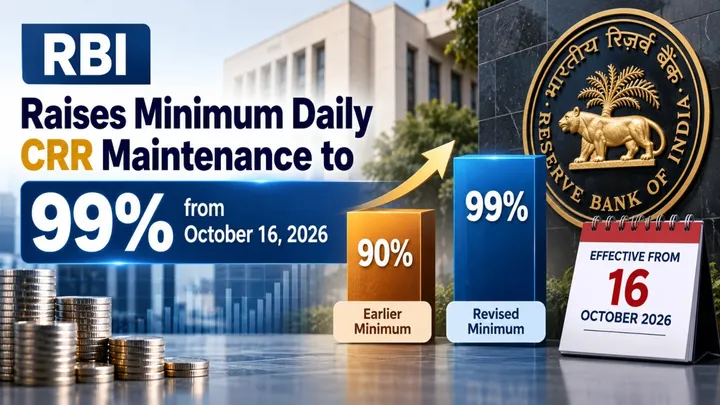
Scheduled banks will have significantly less flexibility in managing their daily cash reserve balances from October 16, 2026. The Reserve Bank of India (RBI) has raised the minimum daily Cash Reserve Ratio (CRR) maintenance requirement from 90% to 99% of the required CRR, leaving a much narrower margin for daily fluctuations in reserve balances.
The change has been announced under Section 42(1) of the Reserve Bank of India Act, 1934. Importantly, the circular concerns the minimum daily maintenance threshold; it should not be interpreted as requiring banks to maintain CRR equal to 99% of their deposits.
Under RBI circular RBI/2026-27/290 dated October 9, 2026, every scheduled bank must maintain at least 99% of the required CRR on each day from the fortnight beginning October 16, 2026, compared with the earlier minimum of 90%. The circular does not amend the existing condition that the average of CRR maintained daily over the reporting fortnight must not be less than the CRR prescribed by RBI.
RBI's New Daily CRR Requirement: Key Details
How the Daily Minimum Changes
Illustration: minimum daily balance as a percentage of the required CRR amount.
These bars represent the daily minimum as a percentage of the amount of CRR required—not the percentage of a bank's deposits that must be maintained as CRR.
What Has RBI Changed?
The circular revises the minimum percentage of the required CRR that a scheduled bank must maintain on every day of a reporting fortnight.
The practical difference is the reduction in daily flexibility. Previously, the minimum permitted balance could fall to 90% of the required CRR. Under the revised requirement, it cannot fall below 99% of that amount.
Banks must keep their CRR balances much closer to the required amount every day. They previously had room for a daily shortfall of up to 10% of the required CRR; under the new minimum, the permissible daily shortfall is limited to 1%, subject to the continuing fortnightly average requirement.
Understanding the Difference Between Daily CRR and Fortnightly CRR
The circular deals with two related but distinct conditions: the minimum balance that must be maintained on each day and the average CRR balance that must be maintained over the reporting fortnight.
The bank's CRR balance must not fall below 99% of the required CRR on any day during the reporting fortnight.
The average of the daily CRR balances must still be not less than the CRR prescribed by RBI.
Meeting one condition does not remove the need to comply with the other. A bank must monitor its daily reserve position while also ensuring that its average balance over the entire reporting fortnight meets the prescribed requirement.
Illustrative Example
The following figures are hypothetical and explain only the daily minimum calculation.
Assume that the CRR amount required for a particular day is ₹100 crore.
This example does not mean that every bank has a CRR requirement of ₹100 crore. The actual amount depends on the applicable CRR requirement for that bank. The fortnightly average condition continues to apply in addition to the daily minimum.
Which Banks Are Affected by the Revised Requirement?
The circular is addressed to all scheduled banks. These banks should prepare to apply the revised daily minimum from the reporting fortnight beginning October 16, 2026.
Scheduled banks must align daily CRR monitoring and liquidity management with the revised threshold. The circular does not create a separate direct compliance obligation for ordinary depositors or non-bank businesses in the text supplied.
The circular does not separately expand the requirement to other categories of financial institutions. Any question concerning their obligations should be assessed under the instructions specifically applicable to those entities.
RBI's circular of October 9, 2026 contains no exemption for particular scheduled banks and no transition arrangement. The revised 99% minimum applies to all scheduled banks from the fortnight beginning October 16, 2026.
Why Does the Change Matter for Banks?
RBI states that the decision follows a review of current liquidity conditions. Its circular does not provide a detailed forecast of the impact on individual banks or the wider credit market.
From an operational perspective, increasing the daily minimum from 90% to 99% reduces the margin available for managing short-term fluctuations in CRR balances. Banks will need to pay closer attention to the timing of cash flows and their reserve positions throughout the reporting fortnight.
The direct compliance effect is clear: the minimum balance allowed on an individual day is higher. The effect on a particular bank's liquidity planning will depend on its reserve position, cash-flow patterns and existing treasury arrangements.
The 99% figure is the minimum daily maintenance percentage of the required CRR. It is not a declaration that banks must maintain CRR equal to 99% of their net demand and time liabilities. The circular also does not, by itself, announce a change to the prescribed CRR rate.
What Should Banks Do Before October 16, 2026?
The following steps are practical implementation suggestions based on the revised requirement. They are not additional directions expressly prescribed by the circular.
Treasury and liquidity management teams should align daily monitoring thresholds with the 99% minimum.
Assess expected inflows, outflows and daily reserve positions throughout the reporting fortnight.
Check that treasury dashboards, internal alerts and relevant controls reflect the new threshold.
Continue monitoring the average daily CRR to ensure it is not below the rate prescribed by RBI.
Confirm any separate reporting, record-keeping or enforcement requirements under the bank's applicable CRR framework. This circular does not itself prescribe a new reporting form.
The operative wording is the reporting fortnight beginning October 16, 2026, rather than the circular's issue date of October 9, 2026.
Frequently Asked Questions
1. What is the new minimum daily CRR maintenance requirement?
RBI has increased the minimum daily CRR maintenance requirement for scheduled banks from 90% to 99% of the required CRR, effective from the reporting fortnight beginning October 16, 2026.
2. When does the revised CRR maintenance requirement take effect?
RBI's revised 99% minimum daily CRR maintenance requirement takes effect from the fortnight beginning October 16, 2026. The RBI circular announcing it, RBI/2026-27/290, is dated October 9, 2026.
3. Does the new 99% requirement mean that banks must keep 99% of their deposits with RBI?
No. The 99% figure refers to the required CRR amount, not 99% of a bank's deposits. The circular revises the minimum daily maintenance percentage applicable to the prescribed CRR requirement.
4. Must banks still meet the prescribed CRR on a fortnightly average basis?
Yes. RBI's circular of October 9, 2026 changes only the daily minimum. It does not amend the existing condition that the average of CRR maintained daily must not be less than the CRR prescribed by RBI.
5. Which entities are covered by the circular?
The circular is addressed to all scheduled banks. It does not separately extend the stated requirement to non-bank entities in its text.
6. What was the earlier minimum daily CRR requirement?
The earlier minimum was 90% of the required CRR on all days during the reporting fortnight. The revised minimum is 99%.
7. Does the circular prescribe a new CRR reporting form or penalty?
The circular supplied for this update does not specify a new reporting form or a separate penalty. Banks should consult the other applicable CRR instructions for existing reporting and enforcement requirements.
8. Why has RBI increased the daily minimum?
RBI states that it made the decision after reviewing current liquidity conditions. The circular does not provide a detailed explanation of the expected effect on individual banks or lending activity.
CorpLawUpdates Analysis
This section is editorial analysis, not part of the RBI circular.
The key development is the reduction in the daily operating margin available to scheduled banks under the CRR maintenance framework. A minimum of 99% leaves much less room for daily reserve shortfalls than the earlier 90% threshold.
For treasury and compliance teams, the immediate priority is to ensure that daily balances meet the revised threshold while the average over the reporting fortnight continues to satisfy RBI's prescribed CRR. Internal monitoring processes should be aligned before the new reporting fortnight begins.
RBI's circular should be read narrowly. It changes only the minimum daily maintenance requirement and states the fortnight from which the change applies. The existing fortnightly average condition is not amended. Questions concerning other reporting obligations, penalties or related regulatory provisions should be answered from the relevant underlying instructions, rather than inferred from this circular alone.
Regulatory Source
Issuing authority: Reserve Bank of India (RBI)
Document: Section 42(1) of the Reserve Bank of India Act, 1934 — Change in Daily Minimum Cash Reserve Maintenance Requirement
Circular reference: RBI/2026-27/290
Department reference: DoR.RET.REC.247/12.01.001/2026-27
Date: October 9, 2026
Signatory: Manoranjan Padhy, Chief General Manager
Primary source: RBI circular supplied for this article. Add the direct RBI publication URL to this source note when the official web link is available.
Disclaimer: This article is for informational and educational purposes only and does not constitute legal or regulatory advice. Readers should verify the applicable primary regulatory source and any subsequent amendments before taking action.