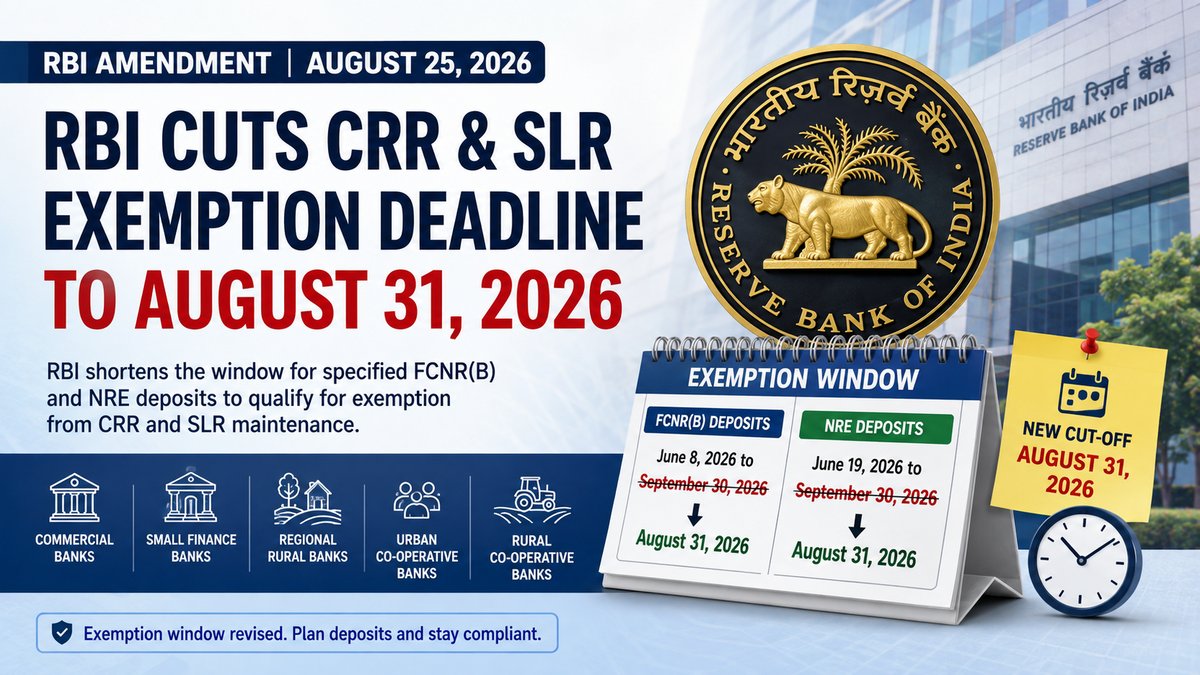
The Reserve Bank of India has shortened the eligibility window for specified FCNR(B) and NRE deposits that receive exemption from CRR and SLR maintenance. The earlier September 30, 2026 cut-off has been advanced to August 31, 2026.
RBI Revises CRR and SLR Exemption Window: September 30 Cut-off Moved to August 31, 2026
RBI has amended its CRR and SLR Directions for commercial banks, small finance banks, regional rural banks, urban co-operative banks and rural co-operative banks. The change is narrow but operationally important: the final date for mobilisation of specified deposits eligible for the CRR and SLR exemptions has been brought forward by one month.
The amendment was issued on August 25, 2026 and comes into force with immediate effect. The underlying framework continues to provide the specified exemptions, but the qualifying mobilisation window now closes on August 31, 2026.
Quick Answer
RBI has replaced the date September 30, 2026 with August 31, 2026 for specified fresh FCNR(B) and NRE deposits that qualify for exemption from CRR and SLR maintenance. The amendment applies across the five bank categories covered by the respective Fourth Amendment Directions and takes effect immediately.
What Changed Under RBI's August 25, 2026 Amendments?
The substantive change is the same across the five amendment directions: the end date of the relevant deposit mobilisation window has been moved from September 30, 2026 to August 31, 2026.
Which Deposits Are Covered by the Exemption?
The source documents identify two categories of deposits for the exemption window.
FCNR(B) Deposits
Fresh FCNR(B) deposits with a minimum tenor of three years and a maximum tenor of five years are within the stated exemption framework.
NRE Term Deposits
Fresh Non-Resident (External) Rupee (NRE) term deposits with a tenor of three years or more are within the stated exemption framework.
The source expressly includes deposits that are renewed upon maturity within the description of the relevant deposits mobilised by the banks.
What Are the Revised Eligibility Periods?
The revised end date is August 31, 2026 for both categories, while the starting dates remain unchanged.
In practical terms, deposits mobilised after August 31, 2026 are outside the specific mobilisation period described in these amendment documents. The documents do not state a new extension beyond August 31, 2026.
Who Is Affected by the RBI Amendment?
The amendment directions individually cover five categories of banks:
- Commercial Banks
- Small Finance Banks
- Regional Rural Banks
- Urban Co-operative Banks
- Rural Co-operative Banks
The underlying Directions differ by bank category, but the amendment documents make the same core date change for the specified exemption.
Why Does the August 31 Deadline Matter?
The immediate practical effect is a shorter window for deposit mobilisation within the exemption framework. A bank planning to rely on the specified CRR and SLR exemption needs to identify qualifying deposits against the revised August 31 deadline rather than the previously stated September 30 date.
For treasury, deposit mobilisation and regulatory compliance teams, the change therefore affects the timing analysis around qualifying FCNR(B) and NRE deposits.
What This Means for Compliance Teams
- Review deposit mobilisation plans that were prepared using September 30, 2026 as the cut-off.
- Reassess whether qualifying FCNR(B) and NRE deposits fall within the revised dates.
- Coordinate treasury and regulatory reporting teams so the revised date is reflected in internal controls and monitoring.
- Retain supporting deposit records necessary to establish the relevant mobilisation date and applicable tenor.
What Is the Regulatory Basis for the Amendment?
The directions state that RBI issued the amendments under its statutory powers, including Section 35A of the Banking Regulation Act, 1949. The documents also refer to Section 42 of the Reserve Bank of India Act, 1934 and the relevant provisions of the Banking Regulation Act relating to CRR and SLR, as applicable to the respective bank category.
The source documents state that RBI was satisfied that issuing the amendments was necessary and expedient in the public interest.
Old Position vs New Position
When Does the Amendment Take Effect?
The Fourth Amendment Directions are dated August 25, 2026, and each document states that the provisions come into force with immediate effect. Accordingly, the revised August 31, 2026 cut-off should be treated as the operative date from the date of issuance.
Compliance Checklist for Banks
- Confirm whether the institution is covered by one of the five Fourth Amendment Directions.
- Identify fresh FCNR(B) deposits within the specified three-to-five-year tenor range.
- Identify fresh NRE term deposits with a tenor of three years or more.
- Check the mobilisation date against the revised August 31, 2026 cut-off.
- Account for the source's inclusion of deposits renewed upon maturity where applicable.
- Update internal compliance calendars, treasury controls and monitoring reports that still refer to September 30, 2026.
- Preserve the supporting records used to determine whether the deposit falls within the relevant exemption window.
The checklist above is limited to actions reasonably arising from the source documents. The amendment itself does not prescribe additional forms, penalties or separate reporting procedures in the text provided.
Frequently Asked Questions
What date has RBI changed for the CRR and SLR exemption?
RBI has changed the cut-off date from September 30, 2026 to August 31, 2026 for the specified deposit exemptions.
Which deposits are covered by the exemption window?
The source refers to fresh FCNR(B) deposits with a tenor of three to five years and fresh NRE term deposits with a tenor of three years or more.
What is the revised FCNR(B) mobilisation period?
The revised FCNR(B) period is June 8, 2026 to August 31, 2026.
What is the revised NRE deposit mobilisation period?
The revised NRE period is June 19, 2026 to August 31, 2026.
Does the amendment apply immediately?
Yes. The Fourth Amendment Directions state that their provisions come into force with immediate effect from August 25, 2026.
Which banks are covered?
The five source documents separately cover commercial banks, small finance banks, regional rural banks, urban co-operative banks and rural co-operative banks.
Does the source include deposits renewed upon maturity?
Yes. The source wording expressly includes deposits that are renewed upon maturity within the described mobilisation category.
Has RBI changed the underlying CRR or SLR exemption itself?
The amendment documents provided here change the qualifying mobilisation dates. They do not state a change to the specified deposit tenors themselves.
CorpLawUpdates Analysis
The important point is not a new CRR or SLR ratio. The amendment instead changes the time window in which specified deposits can qualify for the existing exemption. That distinction matters because a bank may still meet every deposit-related condition but fall outside the exemption framework if the relevant mobilisation date is outside the revised period.
The change is particularly relevant for internal planning because the previous framework permitted mobilisation through September 30, 2026. RBI has now brought that date forward to August 31, 2026 while retaining the original starting dates of June 8, 2026 for FCNR(B) deposits and June 19, 2026 for NRE term deposits.
For compliance purposes, the safest operational approach is therefore to update internal systems and monitoring immediately rather than allowing documents, dashboards or treasury instructions to continue using the earlier September 30 date.
Regulatory Source Note
Issuing authority: Reserve Bank of India, Department of Regulation, Central Office.
Date: August 25, 2026.
Primary RBI documents:
- Commercial Banks: RBI/2026-27/238; DOR.RET.REC.205/12.01.001/2026-27 — Reserve Bank of India (Commercial Banks – Cash Reserve Ratio and Statutory Liquidity Ratio) Fourth Amendment Directions, 2026.
- Small Finance Banks: RBI/2026-27/239; DOR.RET.REC.206/12.01.001/2026-27 — Reserve Bank of India (Small Finance Banks – Cash Reserve Ratio and Statutory Liquidity Ratio) Fourth Amendment Directions, 2026.
- Regional Rural Banks: RBI/2026-27/240; DOR.RET.REC.207/12.01.001/2026-27 — Reserve Bank of India (Regional Rural Banks – Cash Reserve Ratio and Statutory Liquidity Ratio) Fourth Amendment Directions, 2026.
- Urban Co-operative Banks: RBI/2026-27/241; DOR.RET.REC.208/12.01.001/2026-27 — Reserve Bank of India (Urban Co-operative Banks – Cash Reserve Ratio and Statutory Liquidity Ratio) Fourth Amendment Directions, 2026.
- Rural Co-operative Banks: RBI/2026-27/242; DOR.RET.REC.209/12.01.001/2026-27 — Reserve Bank of India (Rural Co-operative Banks – Cash Reserve Ratio and Statutory Liquidity Ratio) Fourth Amendment Directions, 2026.
Signatory: Manoranjan Padhy, Chief General Manager.
Underlying framework: Respective RBI Cash Reserve Ratio and Statutory Liquidity Ratio Directions, 2025, updated as on June 19, 2026.
Primary-source basis: The five RBI Fourth Amendment Directions dated August 25, 2026 amend the relevant mobilisation periods by replacing the September 30, 2026 end date with August 31, 2026 and state that the amendments come into force with immediate effect.
Disclaimer: This article is for informational and educational purposes only and does not constitute legal or regulatory advice. Readers should verify the applicable primary regulatory source before taking action.